TL;DR
- Below roughly 150 people, device logistics usually lands on HR or Operations by default, because there is nobody else. The vendors selling to you assume an IT counterpart who does not exist.
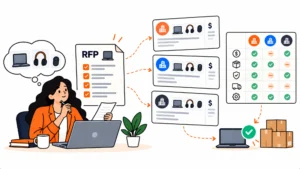
- The job splits into five things: buying, configuring, shipping, tracking and getting it back. Most vendors are strong at two or three and quiet about the rest.
- Configuration is the gap that catches people out. A vendor can ship a sealed laptop to Lisbon and still leave you with nobody to enrol it, set it up or support it.
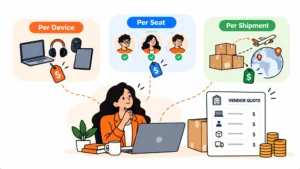
- Nobody in this category publishes a price. We checked six vendors' own pages on 14 October 2026 and not one shows a figure, so comparison means writing a specification and asking.
- Buying a platform before you have an asset register is backwards. The register is the thing that survives a vendor change.
- The honest test is what happens on a bad day, not a good one: a broken laptop in a country the vendor covers on paper.
The Laptop That Sat in A Warehouse for Three Weeks
A 70-person company hired a designer in Portugal. HR ordered a laptop through the equipment platform they had signed up to a month earlier, picked the spec from a dropdown, entered the home address and marked the start date.
The machine arrived on time. It was sealed, unconfigured and useless. Nobody had told the platform which device management system to enrol it into, because the company did not have one. The designer spent her first week on a personal laptop, which meant her work sat outside every control the company had, and on day eight somebody in the leadership team asked an uncomfortable question about where the client files were.
The platform had done exactly what it said it would. It procured and it shipped. The company had assumed that buying a device logistics product meant buying device setup, and nobody had said otherwise because nobody had asked.
Best tools for Device Management
So the failure was not the vendor. It was a specification written by somebody who had never been told that procurement, configuration and support are three separate purchases, and that platforms in this category rarely sell all three.
The Five Jobs, and Which Ones Vendors Actually Do
Device logistics sounds like one thing. It is five, and a vendor can be excellent at some and absent from others without ever saying so.
Buying. Sourcing the machine, in the right country, at a price you did not negotiate yourself. Every platform does this.
Configuring. Enrolling the device into a management system, applying settings, installing software, encrypting the disk. This requires you to have a management system. Most platforms will enrol into yours and almost none will give you one.
Shipping. Getting it to a home address across a border, with the customs paperwork handled and the duty either prepaid or billed clearly. This is genuinely hard and it is where the specialists earn their keep.
Tracking. Knowing which serial number sits with which person, where, since when, and under what arrangement. Some platforms hold this well. Some hold only what they shipped, which means the twenty machines you bought before signing are invisible.
Recovering. Getting the device back when somebody leaves, including the courier, the packaging, the chasing and the condition check. This is the job most often quietly excluded.
| Job | Who usually does it | Where it fails without IT |
|---|---|---|
| Buying | Every platform | Spec chosen by somebody guessing |
| Configuring | You, or nobody | Device arrives sealed and unusable |
| Shipping | Specialists, well | Duty billed later as a surprise |
| Tracking | Varies sharply | Only covers what the vendor shipped |
| Recovering | Often excluded | Nobody owns the chase |
Read the second column before the price. A platform that covers three of five is not cheaper than one that covers five; it is a different purchase.
What HR Actually Needs to Know Before a Demo
Do I need a device management system first?
Almost certainly yes, and it is a separate product from the logistics platform. Without one, a shipped laptop is a sealed box: nothing is enrolled, nothing is encrypted by policy, and nothing can be wiped remotely if it goes missing. Apple's own platform now carries management at no cost for Apple fleets, which has moved the point at which a small team must pay for anything, so check what you already have before buying.
Who sets up the machine on day one?
Somebody has to, and if the answer is the new starter following a document, say that out loud and write the document. The failure mode is assuming the platform does it because the demo showed a laptop arriving. Ask the question in those words: when the box is opened, who performs the setup, and what happens if it does not work.
What happens when a laptop breaks in month four?
This is the question that separates vendors, and it is rarely in the demo. Is there a replacement held locally or does one ship from a hub four days away? Is the warranty claim yours to make or theirs? Does the broken one get collected, and by whom? A company with no IT team cannot absorb a week of somebody not working.
Will the platform hold records for devices it did not sell?
Usually only partly, and this matters more than it sounds. The machines you bought before signing are often the oldest and nearest to replacement, so excluding them from the register means the refresh planning is built on the newer half of your fleet.
What does it cost, really?
Nobody will tell you from a web page. We read the pricing page of every vendor named in this article on 14 October 2026 and not one publishes a figure. That is not evasiveness unique to this category, but it does mean comparison requires a written specification sent to several vendors, which is a piece of work most teams underestimate.
Three Shapes of Supplier, Honestly
A logistics platform
Buys, ships and tracks. Integrates with a management system you already run. Usually covers retrieval as a priced add-on.
When this is right. You have a management system, people in several countries, and enough hiring that the manual version has become somebody's part-time job.
When it fails. When you do not have a management system. The platform will ship you a sealed box and the demo will not have mentioned that this is a problem, because every other customer in the room had an IT team.
A reseller with a service wrapper
A hardware reseller that will also configure, image and dispatch. Often regional, often very good inside its region.
When this is right. Most of your people are in one or two countries and you want somebody who will answer a phone and physically touch the machines.
When it fails. The moment you hire outside the region. A reseller strong in Germany is a courier arrangement in Brazil, and the price reflects the former.
Bundling it with your employment provider
If you employ people through an EOR, several of them will now sell you the device alongside the employment arrangement. One contract, one invoice.
When this is right. The device population matches the EOR population exactly and the countries are ones they genuinely cover.
When it fails. When the two populations diverge, which they always do. Your directly employed staff in your home country are not covered by the EOR, so you end up with two arrangements and the bundle saved you nothing. Replacement coverage is also typically thinner than a specialist's.
Five Questions That Decide Which Shape You Need
Where are your people, by count rather than by impression? Write the list. Teams routinely describe themselves as global on the strength of three people outside the home country, and three people is a courier problem rather than a platform problem.
Do you have a management system, and does somebody administer it? Owning a licence is not the same as having somebody who applies policy and responds when enrolment fails. If no name goes against that, you are buying setup as well as logistics and the specification has to say so.
How many devices did you buy before this conversation? That number decides whether a platform that only tracks its own shipments is acceptable. At thirty existing machines it is a nuisance. At a hundred and twenty it leaves you running two registers.
What is your actual replacement expectation? Next day in your home country and a week elsewhere is a defensible policy. Next day everywhere is not purchasable at a small scale, and a vendor who implies otherwise is describing a hub network you are not paying for.
Who owns this when it goes wrong? Not which function. Which person. Device logistics without a named owner reverts to whoever is most conscientious, which is how it ended up with HR in the first place.
The Options
RemoAsset, named below, is owned by the same people who publish HROpsLab. Its limitations are stated as plainly as everybody else's, and on this particular question they matter.
RemoAsset
A device lifecycle platform covering procurement, deployment, tracking and retrieval for distributed teams. It enrols devices into a management system before dispatch and holds the serial, the assignment and the location in one register.
Its cons are relevant here and are stated plainly: it publishes no price and requires a demo, which means it cannot be compared from a web page any more than its competitors can. It is markedly weaker for hardware it did not supply, so a fleet you bought elsewhere is only partly visible. And it is not a device management system, so it does not remove the need for one. For a company with no IT team, that last point is the one to sit with: RemoAsset will enrol into your management system and it will not be your management system.
Workwize
A hardware lifecycle platform with its own warehouse network, covering procurement, deployment, storage and retrieval. Note that its domain is now goworkwize.com; the older workwize.com address no longer resolves, verified 14 October 2026.
Honest assessment: the warehouse footprint is the real product, and it shows in storage and redeployment, which are the jobs most platforms treat as an afterthought. It publishes no price. It is built for teams who already run device management, so the configuration gap in this article applies to it as much as to anybody.
Firstbase
A subscription-shaped model: equipment provided as an ongoing service rather than a purchase, with retrieval and replacement folded in.
Honest assessment: the subscription framing genuinely suits a company with no IT team, because more of the lifecycle sits with the vendor by default. The tradeoff is that you are renting, so there is no residual value at the end and the arithmetic over four years looks different from buying. No published price.
GroWrk
Procurement, deployment and retrieval across a wide country list, sold as a tailored arrangement rather than a product with tiers.
Honest assessment: its own pricing page is titled as an invitation to a conversation, which is honest about what it is. The consultative model suits an unusual country mix and costs you time in evaluation. Nothing is published.
allwhere
Equipment procurement and management with a consultative sales model and a managed-service character.
Honest assessment: for a team with nobody to own this internally, a managed service is a reasonable answer and the model is built around that. The same property makes it slower to start and harder to compare, because each arrangement is scoped individually. No published figures.
Deel IT
Device procurement and management attached to an employment platform, so the hardware arrives through the same provider that handles the employment arrangement.
Honest assessment: the bundle is genuinely convenient when the device population and the employed population are the same. They diverge the moment you have directly employed staff, and the device half is a younger product than the employment half. No published price.
The Comparison
| Platform | Ships and tracks | Enrols into your MDM | Is an MDM | Pricing |
|---|---|---|---|---|
| RemoAsset | Yes | Yes | No | Quote-based, demo required |
| Workwize | Yes, own warehouses | Yes | No | Quote-based |
| Firstbase | Yes, subscription shape | Yes | No | Quote-based |
| GroWrk | Yes | Yes | No | Quote-based, tailored |
| allwhere | Yes, managed service | Yes | No | Quote-based |
| Deel IT | Yes, with employment | Yes | No | Quote-based |
The third column is the one that matters for a company with no IT team, and every entry in it reads the same. None of these is a device management system. That is the gap you have to fill separately, and it is the single most common surprise in this category.
The Decision Table
| Situation | Scale | Setup | Primary Pain | Recommended Starting Point |
|---|---|---|---|---|
| Everyone in one country, no IT | Under 50 | Reseller with a service wrapper | Nobody to configure a machine | Local reseller who images before dispatch |
| Three people abroad, rest at home | Under 80 | Courier plus a register | Buying a platform for three people | Spreadsheet and a named owner, not a platform |
| Hiring across four countries | 50 to 200 | Logistics platform plus an MDM | Sealed laptops nobody can set up | Buy the MDM first, then the platform |
| Fleet bought before signing | Any | Platform that imports existing assets | Two registers running in parallel | Confirm import in writing before signing |
| All staff employed via an EOR | Under 150 | Bundle with the employment provider | Two vendors for one population | Bundle, and re-check when you hire directly |
| Mixed EOR and direct employment | 80 plus | Specialist covering both populations | Bundle covers only half the people | Specialist, not the employment bundle |
| Replacement speed is the worry | Any | Vendor with regional stock | A week without a working laptop | Ask where stock physically sits, by country |
| No named owner internally | Any | Managed service | Reverts to whoever is conscientious | Name somebody before buying anything |
The Customs Question Nobody Explains Until the Invoice
Shipping a laptop across a border is the part of this that looks simple and generates the most unexpected cost. It is worth understanding in outline, because the way a vendor handles it changes the number on your invoice by a meaningful margin.
A machine crossing a border attracts duty and import tax, and somebody has to be the importer of record. That is a role with obligations, and which party takes it is a commercial decision rather than a technical one. Vendors handle it in three broadly different ways and they are not equivalent.
Delivered duty paid. The vendor handles the paperwork, pays the charges and bills you a single figure that includes them. This is the version you want and it is usually the most expensive line on the quote, because the vendor is pricing in risk as well as cost.
Delivered duty unpaid. The machine ships, the courier presents a bill at the door, and the new starter is asked for money on their first morning. This happens more often than anybody admits and it is a genuinely bad first day. If a quote is notably cheaper than the others, this is the first thing to check.
You as importer of record. Some arrangements leave the obligation with you, which is fine if somebody understands what that means and badly wrong if nobody does. At a company with no IT team there is frequently also nobody with trade compliance experience, and that combination is where the real exposure sits.
Ask one question in those words: for a laptop shipped to each of my top five countries, who is the importer of record, and is duty included in the figure you have quoted me? A vendor who answers precisely has done this before. A vendor who answers generally has not, or is hoping you will not ask again.
The second thing worth knowing is that the cheapest route is frequently not shipping at all. Buying locally in a country where you have several people, through a vendor with stock there, avoids the entire question. That is why country coverage and local stock matter more than the length of a vendor's country list.
The First Ninety Days, in Order
Everything above describes what to buy. This is the sequence, because doing these in the wrong order is what produces the sealed-laptop problem.
Weeks one and two: the register. Build the spreadsheet described below, covering every machine you can account for. Expect gaps. The gaps tell you how bad the current situation is and give you a number to quote internally when asking for budget.
Weeks two and three: the management system. Decide what you are enrolling devices into, buy it if you need to, and name the person who administers it. This comes before the logistics decision because every logistics vendor will ask what you enrol into, and the answer "nothing yet" materially changes what they can sell you.
Week four: the specification. One page, as described later. Send it to four vendors, not one, and not seven. Four gives you a spread without consuming a month of calls.
Weeks five to eight: evaluation. Demos, then the awkward questions. Insist on talking to somebody technical rather than only to sales, and ask every vendor the same bad-day question about a broken laptop in a specific country.
Weeks nine to twelve: a pilot, not a rollout. Run one real hire through the whole chain in a country that is not your easiest. Order, ship, configure, confirm the person can work on day one, then deliberately raise a support issue and watch what happens. A pilot that only tests the happy path tells you nothing you did not already see in the demo.
Then sign, or do not. A vendor who will not support a single-hire pilot is telling you something about how they will behave when you have a problem at scale.
Thinking About Cost When Nobody Publishes One
The absence of published pricing makes a cost comparison harder, not impossible. What it requires is deciding your own unit before you ask, so that four different answers can be converted into one shape.
The unit that works for most companies at this size is cost per person per year, fully loaded. That means the hardware, amortised across however long you keep it, plus the logistics, plus the configuration, plus the retrieval, divided by the number of people covered. It is a blunt number and it is comparable, which is what you need.
Four things get left out of vendor quotes with some regularity, and each one belongs in your own version of the arithmetic.
Retrieval. Frequently priced separately or excluded. If your annual leaver rate is meaningful, this is not a rounding error.
Shipping to a second address. People move. A quote built on one shipment per person per lifecycle understates reality by whatever your relocation rate is.
Storage between holders. A machine returned in March and reissued in June sits somewhere for three months. Somebody charges for that, or it sits in a cupboard in your office and the cost is hidden rather than absent.
The hours you still spend. The jobs the vendor does not cover do not disappear. Put a figure on them, even a rough one, because that number is what justifies paying more for a vendor who covers more.
Run the arithmetic once with your own assumptions before any vendor conversation, and write down what you expect the answer to be. A quote that comes in far below your expectation is usually excluding something rather than being generous, and having a prior makes that visible immediately.
Build the Register Before You Buy the Platform
The most common sequencing mistake in this category is buying a platform in order to get a register. It works, and it quietly ties the most durable thing you own to a vendor you may leave.
A register is a list of every device, its serial number, who holds it, where, since when, what it cost, and what arrangement it sits under. That list is yours. It survives a vendor change, it is what an auditor asks for, and it is what tells you how much of your fleet is about to need replacing.
Start it in a spreadsheet, today, before any vendor conversation. Seven columns, one row per machine, including the ones somebody bought on a company card two years ago. It will be incomplete and that is fine; the gaps are themselves a finding, because a device you cannot account for is a device that will not come back.
Then require the platform to import it. Ask in writing whether the platform will hold records for devices it did not supply, and what fields survive the import. Several will say yes and mean partly, which you want to discover now rather than in month three.
And keep exporting it. Monthly, to a file you control. A register that exists only inside a vendor's product is a register you rent. This costs five minutes and it is the difference between switching vendors and starting again.
What the Specification Needs to Say
Because nobody publishes a price, the quality of your quotes depends entirely on the quality of your ask. Four vendors given a vague brief will return four incomparable numbers, and the cheapest will usually be the one that excluded the most.
Write one page. It needs the headcount by country, including the countries with one person. It needs the device standard, stated as a spec rather than a model, because models go out of stock. It needs the expected annual volume of new starters and leavers, which is what actually drives the cost. It needs your replacement expectation by country, stated as a working-day target you would accept rather than one you would like.
And it needs the five jobs named explicitly, with a column for each vendor to mark included, extra or not offered. That single table does more than any amount of demo attendance, because it forces the quiet exclusions into the open where they can be priced.
Send the same page to everybody. Resist the urge to tailor it per vendor, which feels helpful and destroys comparability.
One addition that is worth the extra paragraph: describe your three worst weeks rather than your average one. The month you onboarded nine people, the week three laptops failed, the quarter you opened a country nobody planned for. Vendors price and design around the average, and the average is not what breaks. A quote built against a realistic bad month is both more expensive and more honest, and the gap between the two numbers tells you how much of the risk the vendor was quietly leaving with you.
And state plainly what you do not have. A specification that says there is no IT function and no management system currently in place will get you a worse price and a much better fit, because the vendors who cannot serve that will say so early rather than at implementation.
Offboarding Is Where the Arrangement Is Actually Tested
Procurement gets the attention because it is the part with a deadline attached. Recovery is where companies with no IT team lose the most money, and it is the job most often excluded from the quote.
The mechanics are unglamorous and they decide everything. Somebody has to notice a leaver, trigger a collection, get packaging to a person who no longer works for you, arrange a courier to a home address, chase when it does not happen, and check the condition of what comes back. Every one of those steps fails differently.
The trigger is the weakest link. At a company with no IT function, nothing automatically connects a resignation to a device collection. The leaver process lives in an HR system that does not know what hardware exists. So the collection starts when somebody remembers, which is usually after the last working day, which is precisely when the person stops answering email.
Packaging decides the return rate. A former employee asked to find a box and arrange a courier themselves mostly does not. Vendors who send a prepaid, pre-labelled container to the door get materially better returns than those who send instructions, and the difference is larger than any other single factor.
Condition disputes need a record. A machine that arrives with a cracked screen becomes an argument you cannot win without a dispatch condition note and a photograph. Ask whether the vendor records condition at both ends, because the ones who do not will quietly bill you for damage you cannot contest.
And some devices are not worth recovering. A four-year-old laptop with somebody in another country frequently costs more to collect than it is worth. Decide that in advance with a written rule based on age and location, because the alternative is three months of chasing followed by the same conclusion.
So when you compare vendors, weight recovery more heavily than the demo does. A platform that ships beautifully and recovers badly costs you a device every time somebody leaves, and at a company of seventy people with normal attrition that is a real annual number.
What Getting This Wrong Costs
The visible cost is a subscription that does less than you thought, and that is the smallest part.
The real cost is time from people who have other jobs. A company with no IT function pays for device logistics in HR hours and founder hours, and those hours do not appear on any invoice. A platform that covers three of the five jobs leaves the other two exactly where they were, so the team that expected to get a day a week back gets perhaps half of it and concludes the product was oversold. It was not. The specification was.
Then there is the compliance exposure that nobody counts. Work sitting on a personal laptop because the company one arrived unconfigured is a real risk, and it does not show up until somebody asks where the files are. The designer in the opening of this article worked for eight days outside every control the company had, and the only reason anybody found out was that a leadership question happened to land in the right week.
Ask it this way before you sign. If the box arrives sealed on a Monday and the new starter cannot log in, who fixes it by Tuesday, and is their name in the contract?
Four Things to Get in Writing
Demos are verbal and contracts are not. These four turn up as disputes often enough that they belong in the document rather than in somebody's notes.
What the replacement commitment actually is, per country. Not a global service level. A working-day target for each of your top five countries, with a stated remedy if it is missed. A vendor who will commit in writing for Germany and not for Brazil has told you something precise and useful about where their stock sits.
Whether duty is included, per country. Covered above, and it belongs in the contract rather than the quote. A quote is a snapshot and a contract is what you can hold somebody to when a courier asks your new designer for money at the door.
What happens to your data and your register if you leave. Ask for an export format and a deletion commitment. The register is yours and the answer should be immediate; a vendor who has to check is a vendor who has not been asked before, which is itself informative.
Who the named contact is, and what happens out of hours. At a company with no IT team, the vendor is your IT team. A ticket queue with a next-business-day response is a different product from a named person who answers, and the two are frequently sold with the same words.
None of this requires a lawyer. It requires asking four questions and insisting the answers appear in the document rather than in an email that gets lost when the account manager changes.
When You're Ready to Outgrow the First Arrangement
The signal is not headcount. It is the number of exceptions.
When the standard spec no longer covers what people need, when three countries have their own workaround, when somebody is maintaining a second spreadsheet because the platform does not hold the older machines, you have outgrown the first arrangement regardless of how many people you employ.
Two things to put in place at that point, and neither is a new vendor. Name an owner with actual time, because every failure in this article traces back to device logistics being somebody's fourth priority. And get the management system right before extending the logistics contract, because the configuration gap compounds: every month you ship unconfigured machines is a month of devices you cannot see, cannot patch and cannot wipe.
The vendor conversation gets much easier after both. You will know what you are asking for, you will have a register to hand them, and you will be able to tell the difference between a platform that does five jobs and one that does three well.
Frequently Asked Questions
Who should own device logistics at a company with no IT team?
One named person, with time allocated, and in practice it is usually somebody in Operations or People rather than a function. What matters far more than which department holds it is that an individual is accountable, because device logistics without an owner reverts to whoever is most conscientious and then fails quietly when that person is busy or leaves.
Do equipment platforms set up the laptop before it ships?
They will enrol a device into a management system you already run, and almost none will provide that management system. This is the single most common surprise for a company with no IT function: the machine arrives sealed and correct, and there is nobody to perform the setup, so ask in plain words who performs configuration and what happens if it fails.
Do I need an MDM before buying an equipment platform?
In almost every case yes, and it is a separate purchase from the logistics platform. Without one there is no policy-enforced encryption, no remote wipe and no way to confirm what is installed, and Apple's own platform now includes management at no cost for Apple fleets, so check what you already have access to before assuming this is an extra line of spend.
Why does nobody publish equipment platform pricing?
Every vendor named in this article was checked against its own pricing page on 14 October 2026 and none shows a figure, because arrangements are scoped per customer on country mix, volume and which of the five jobs are included. The practical consequence is that comparison requires a written specification sent to several vendors rather than a web search, and the quality of your quotes depends on the quality of that one page.
Will a platform track devices it did not sell me?
Some will, some will do it partly, and the difference matters because the machines you already own are usually the oldest and closest to replacement. Ask specifically which fields survive an import of existing assets and get the answer in writing, because a platform that holds only its own shipments leaves you running two registers and planning refresh from the newer half of your fleet.
Is bundling devices with an EOR a good idea?
It works well while the device population and the employed population are identical, and it stops working the moment you employ anybody directly, because your home-country staff fall outside the arrangement. Replacement coverage in a bundle is also typically thinner than a specialist's, so it suits companies whose entire workforce sits with one employment provider and suits almost nobody else.
What should I build before I talk to any vendor?
An asset register in a spreadsheet: every device, its serial, who holds it, where, since when, what it cost and under what arrangement. It will be incomplete and the gaps are themselves useful, and it is the one asset in this whole area that survives changing vendors, which is exactly why it should not live only inside a product you rent.
How do I get quotes I can actually compare?
Write one page covering headcount by country, the device standard as a spec rather than a model, expected joiners and leavers per year, and your replacement expectation stated as a working-day target. Then list the five jobs with a column for each vendor to mark included, extra or not offered, and send the identical page to everybody rather than tailoring it, because tailoring feels helpful and destroys comparability.
HROpsLab takes no vendor money and publishes no paid placements.