
TL;DR
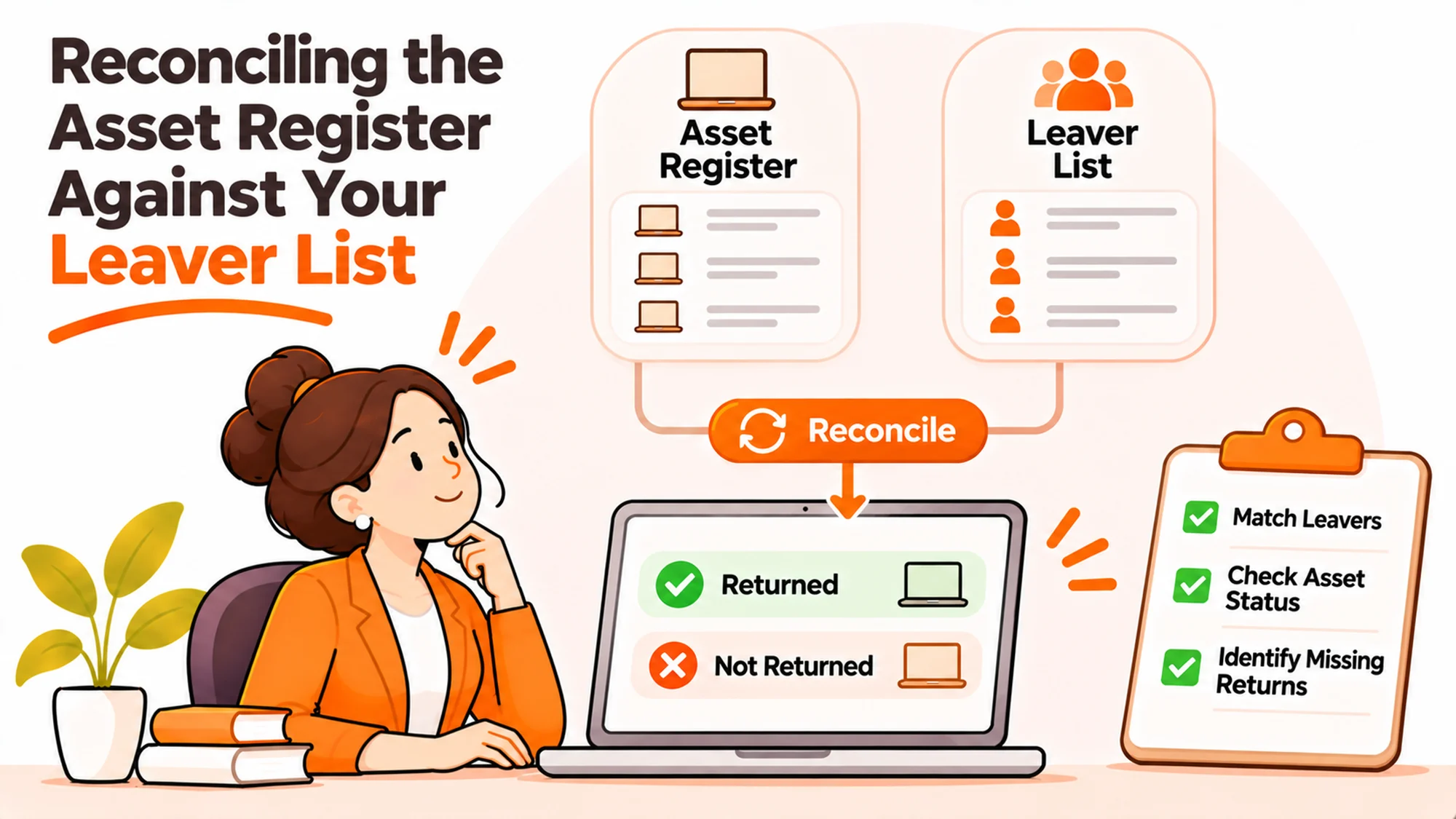
Equipment reconciliation is usually imagined as a big annual count. The version that actually prevents loss is far smaller: a monthly join between everybody who left and everything still assigned to them.
- Monthly beats annual for this specific check.
- Join leavers to assigned devices, nothing else.
- Recovery odds fall sharply with time.
- Contractors are the cohort most often absent.
- Close every row, including the write-offs.
- Five minutes a month, not a project.
The small version is the one that works
Ask most teams about reconciling equipment and they describe an annual exercise: a full count, everybody asked, a project with a owner and a deadline.
That exercise has value and it is not what prevents loss. By the time an annual count runs, a device that went missing in February has been gone for most of a year, and the person who had it stopped answering their email in March.
Best tools for HR Operations
The check that actually prevents loss is far smaller. Once a month, take everybody who left and everything still assigned to them, and look at the rows where both are true.
Why this one and not others
Because departures are where almost all equipment loss originates. People do lose devices while still employed, and that surfaces on its own soon enough: a support ticket, a replacement request, a conversation with their manager. A departure surfaces absolutely nothing unless somebody deliberately goes and looks for it, which is the entire reason this check has to be scheduled rather than left to anybody noticing.
How to run it
Two lists and a join, and it genuinely takes minutes once the lists exist.
- Everybody whose last working day fell in the period, from the HRIS. Include contractors if they appear there, and note it if they do not.
- Everything still assigned to a person, from the asset register, with no status filter.
- Join on the person identifier. Any row that matches is a device assigned to somebody who has gone.
- Work the rows. Each is either in transit, already back and not recorded, or genuinely outstanding.
That second category is worth noting, because it is usually larger than people expect. Devices that arrived and were never checked in look identical to devices that never came back, and the difference is somebody walking to a cupboard.
It is also the cheapest category to eliminate. If whoever receives returned machines records the arrival as it happens rather than in a weekly batch, this group disappears entirely and your monthly list becomes a list of genuine problems rather than a mix of problems and paperwork.
joining an asset register to your HRIS covers building the join properly. Without it this becomes two exports and a spreadsheet each month, which works and which people stop doing after about four months.
Why the interval matters so much
The argument for monthly rather than quarterly, and it is about people rather than data.
The chance of recovering a device falls sharply with elapsed time, for reasons that are entirely human. Shortly after leaving, somebody still has your email in their inbox, still feels some connection, and still has the laptop somewhere obvious. Months later they have changed address, deleted the thread, and genuinely cannot remember what they had.
| Time since departure | What you are asking | Typical outcome |
|---|---|---|
| Before last day | A normal task | Usually done |
| First few weeks | A small favour | Often done |
| Several months | A large favour | Frequently not |
| A year | An archaeology exercise | Rarely |
A monthly cadence keeps you in the second row. An annual count puts you in the fourth, which is why annual counts find problems rather than preventing them.
The cohort the join usually misses
Everything above assumes the leaver list contains everybody who left. For most organisations it does not.
Contractors are frequently absent from the HRIS because they are not on payroll. Their engagement ends when the work ends, often with no recorded date, so they never appear in any month’s leaver list and the device assigned to them is never surfaced.
This is usually the single largest hole in an otherwise functioning process, and it is invisible precisely because the process works correctly on everybody it can see.
The fix does not require putting contractors in your HRIS. It requires an end date for each engagement somewhere your join can read, and somebody who owns that engagement confirming it has finished. A quarterly review of open engagements catches the ones that simply stopped without anybody saying so.
The data obligation is identical regardless of employment status. NIST Special Publication 800-88 on media sanitization applies to a contractor’s machine exactly as it does to an employee’s, and the NIST Cybersecurity Framework does not distinguish either.
Close every row, including the ones you lose
The discipline that stops the list growing forever, and the one teams most often lack.
Every row in the join has to reach a resolved state. Recovered and recorded, confirmed as in transit, bought by the former employee, or written off with a reason.
That last option is the one nobody wants to use, so rows sit open indefinitely. A list of two hundred unresolved devices stretching back three years is not a record of anything; it is a monument to decisions nobody made.
Give somebody the authority to write a device off at a defined age, and require a reason rather than a tick. A documented write-off is a defensible position and an open row is not, which matters if anybody ever asks what happened to a specific machine. what to do about unreturned equipment goes further into this and the equipment evidence an audit actually asks for covers what the evidence should look like.
What a reason should say
What was tried, when, and why it stopped. Three lines are enough. The test is whether somebody reading it in two years understands that a decision was made, rather than wondering whether anybody ever noticed the device was gone in the first place.
Two checks worth adding once this works
Only after the leaver join is running reliably, because adding more before that just means nothing gets done.
Role changes. People moving between roles may need different equipment and may be holding something they no longer need. Almost no process looks at this, and it is where second devices quietly accumulate.
Long absences. Somebody on extended leave still holds a machine, which is usually fine and occasionally matters, particularly where the absence turns into a departure. Knowing is better than discovering.
Both are smaller and less urgent than the leaver join. Both are also where the unglamorous accumulation happens: the monitors, the second laptops, the docks nobody tracked. designing an equipment approval workflow is relevant since a decent approval process reduces how much of this appears in the first place.
When not to bother
Two cases, and a caution.
Almost no turnover. If three people left last year, the join is a conversation rather than a process. Do it when somebody leaves and skip the cadence.
No register worth joining to. If the asset register is substantially wrong, this check produces rows that are mostly noise and people stop trusting it within two months. Fix the register first, even roughly.
The caution: this is a detection control, not a prevention one. It tells you a device is outstanding. It does not get it back, and the getting back is a logistics job involving packaging, a courier and somebody being at home. a laptop retrieval service for remote employees is that half, and a team that runs a perfect monthly reconciliation and has no way to actually collect anything has built a very precise list of things it is losing.
The prevention control is arranging collection before the last working day, which removes most rows from this join before they appear. Reconciliation is what catches whatever that misses, and it should be a short list rather than the main event.
What the list length tells you
The number of rows this join produces each month is a measure of your offboarding process rather than of your reconciliation. A long list is not evidence that reconciliation is working hard; it is evidence that collection is not being arranged early enough.
So watch the trend rather than the absolute figure. A list that shortens over several months means the prevention side is improving. A list that stays the same length while you diligently work it every month means you have built a very effective way of discovering the same failure repeatedly.
That distinction is worth making explicitly to whoever asks for the reporting, because the instinct is to celebrate a reconciliation that closes many rows. Closing rows is cleanup. Having fewer rows to close is the actual outcome.
Detection tells you what is missing. Collection is a separate job. See a laptop retrieval service for remote employees or a managed laptop lifecycle service.
Frequently asked questions
What does equipment reconciliation actually involve?
Joining everybody who left in the period to everything still assigned to them in the asset register, and working the rows where both are true. It is two lists and a join rather than the full annual count most people imagine.
How often should we run it?
Monthly. The chance of recovering a device falls sharply with elapsed time for entirely human reasons, so a monthly cadence keeps you asking a recent colleague a small favour rather than asking a stranger to go through their cupboards.
Why not just do an annual count?
An annual count finds problems rather than preventing them. A device that went missing in February has been gone most of a year by the time the count runs, and the person who had it stopped reading your emails months earlier.
What usually gets missed?
Contractors, because they are often not in the HRIS and so never appear on any leaver list. The process works correctly on everybody it can see, which is exactly why the gap is invisible until somebody audits open engagements.
What do we do with rows we cannot resolve?
Write them off at a defined age, with a reason recorded saying what was tried and why it stopped. A documented write-off is a defensible position; an open row three years old is a decision nobody made.
What should we add once this is working?
Role changes and long absences, in that order. Both are smaller than the leaver join and both are where second laptops, monitors and docks quietly accumulate without anybody recording them.
Is reconciliation enough on its own?
No. It is a detection control that tells you a device is outstanding and does nothing to retrieve it. The prevention control is arranging collection before somebody’s last working day, which removes most rows before they ever appear in the join.