By [Author Name] · [Date] · [X] min read · [Table of Contents]
TL;DR
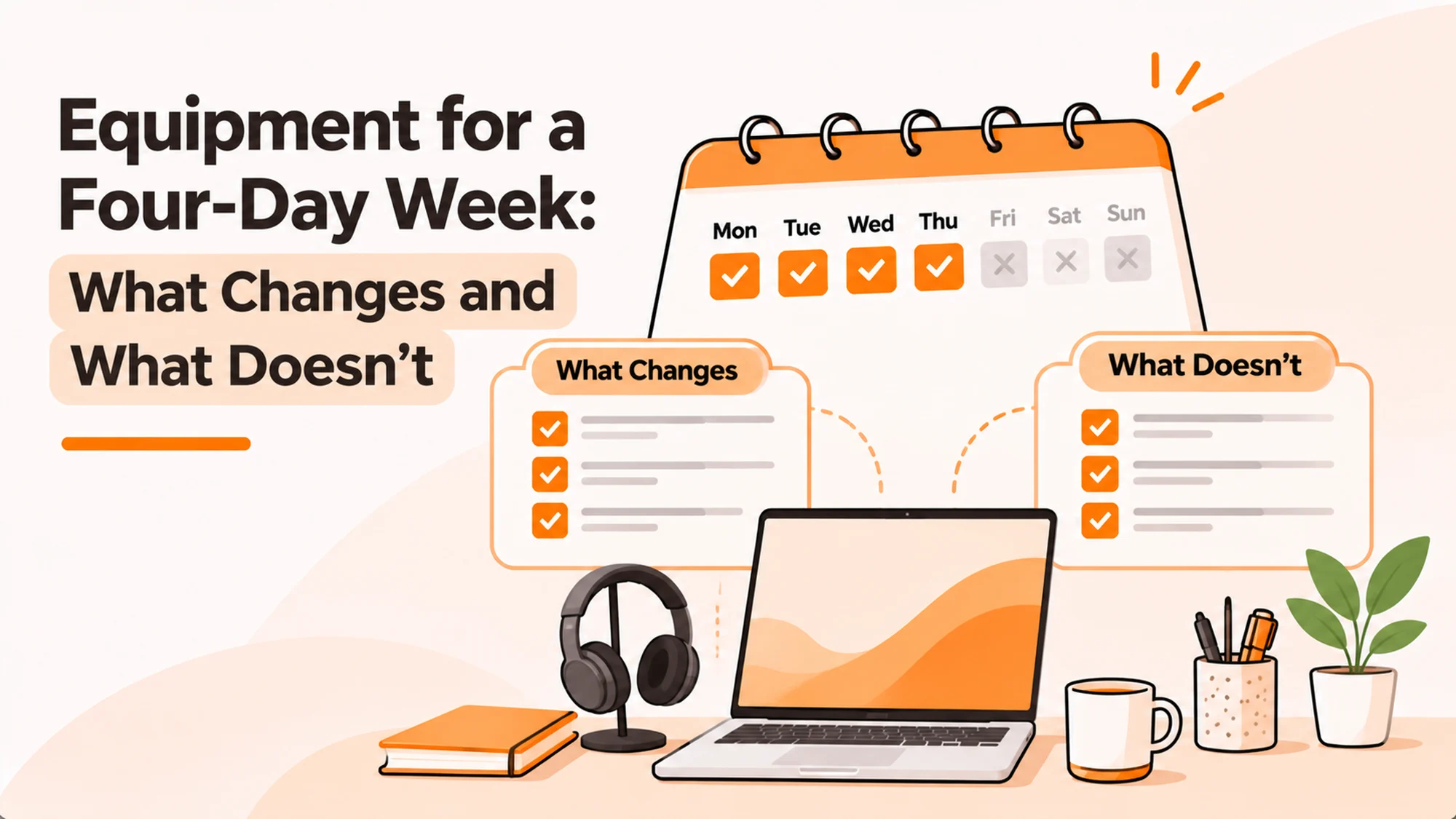
- Equipment for a four-day week is the question of what hardware policy changes when people work fewer days for the same pay.
- For most companies the honest answer is nothing changes, and saying so explicitly is the whole job.
- It does three things: it stops the pattern becoming a pretext to cut kit, it settles shared-device questions, and it protects the fifth day.
- Three patterns exist: everyone off the same day, staggered days, and compressed hours.
- Choose based on whether your people overlap, not on how many days they work.
- Done right, nobody mentions equipment at all, which is the measure of success.
A company announces a four-day week starting in April. Six weeks out, somebody in finance asks whether people working 80 per cent of the hours should have 100 per cent of the equipment budget. It's a reasonable-sounding question, nobody has an answer, and the person who answers it first sets policy for 240 people by accident.
These aren't edge cases. A company that moved to Fridays off discovers three teams are staggered instead, so there is no single quiet day. Another compressed into four longer days and found the laptops were fine while the chairs weren't. A third cut the equipment allowance proportionally and then spent the next two years answering a version of the same question about why it had done so.
Best tools for HR Operations
The real issue isn't how many days people work. It's that a change to the working pattern invites a review of everything attached to the working pattern, and equipment gets pulled into a conversation it doesn't belong in.
When You Don't Actually Need to Change Anything
Stage one: nothing changes and that's correct. Same people, same work, same tools, fewer days. The laptop doesn't care which days it runs, and the honest version of this policy is one sentence confirming that equipment allocation is unaffected.
Stage two: friction appears. Somebody asks the budget question, or a manager proposes sharing machines between people who are never in on the same day. Both are reasonable questions with the same answer, and both need answering once rather than per case.
Stage three: it becomes a liability. Equipment gets cut proportionally, people notice the inconsistency, and the four-day week itself starts being discussed as a cost-saving exercise rather than a working pattern change. That's a reputational problem the hardware saving will never cover.
Stage four: the edge case. Staggered patterns across multiple countries, where coverage matters and the quiet day differs by market. That's where equipment genuinely does need a thought, mostly about support rather than about the devices themselves.
What HR Teams Actually Need from an Equipment Position
> "Does the allowance change?" > No. Say so in writing before anybody asks. > The question arrives from finance within weeks of any announcement, and the absence of a stated answer is what makes it a debate.
> "Can people share machines if they never overlap?" > Almost never worth it, even when the pattern technically allows. > Accountability disappears, the register can't represent it, and the overlap you were promised doesn't hold.
> "What about the fifth day?" > Decide whether anybody is expected to be reachable, and equip accordingly. > This is the question that actually has an equipment consequence, and it's usually the one nobody raises.
> "Do part-time people change?" > No, and watch that the four-day week doesn't quietly redefine them. > A company where full-time means four days has to re-examine what it calls its genuinely part-time staff.
> "Does support coverage change?" > Yes, and this is the real operational question. > If everybody is off on Friday including IT, a device failing on Thursday evening has four days to wait.
There's a sixth question that only surfaces after launch. What happens to somebody who works their fifth day voluntarily, at home, on company kit? That's a working-time question rather than an equipment one, and it needs an answer from somebody qualified, but the equipment policy shouldn't accidentally imply permission by staying silent.
The Three Patterns and What Each One Costs
Everybody off the same day. What it is: the whole company takes the same day, usually Friday. When it's right: single-market companies with no customer coverage requirement, where the simplicity is worth more than the flexibility. When it fails: on support and on failure. Nobody is available on the quiet day, so a device problem on Thursday afternoon becomes a four-day outage for that person, and the spare pool suddenly matters much more than it did.
Staggered days. What it is: teams or individuals take different days, so the company is always covered. When it's right: wherever coverage matters, which is most companies with customers or with a support function. When it fails: for anybody hoping to share equipment, because the whole point of staggering is that people are working on different days and therefore each need their own machine on their own days.
Compressed hours. What it is: the same total hours in four longer days. When it's right: when the work genuinely has to total the same hours, which makes it a different policy from a true four-day week. When it fails: on ergonomics rather than on hardware. Ten-hour days make the chair, the monitor height and the input devices matter considerably more than they did at eight.
I'd keep equipment identical across all three and spend the attention on support coverage instead.
| Pattern | Equipment changes? | Sharing possible? | Support risk | What to watch |
|---|---|---|---|---|
| Same day off | No | No | High on the quiet day | Spare pool depth |
| Staggered | No | No, by definition | Low | Nothing much |
| Compressed hours | No for IT | No | Medium | Chairs and monitors |
How to Choose What to Say: Five Questions
Is anybody proposing a cut? Find out early, because this is the question that does damage. A proportional reduction in equipment for a pattern change that keeps pay whole reads as inconsistent to everybody who notices, and somebody always notices.
Do people overlap? Under staggered patterns they do, constantly. Under a single quiet day they don't on that day and do on every other one, which is still four days of overlap and still means a machine each.
Who covers the quiet day? If the answer is nobody, your device failure response time just became four days for anybody unlucky on a Thursday. That's the one genuine operational change the pattern produces, and it is the question most companies never get round to answering.
Are hours compressed or reduced? It changes the ergonomics conversation entirely. Longer days put real strain on a setup that was adequate at eight hours, and the complaints arrive about three months in.
Does this redefine part-time? If full-time is now four days, somebody contracted for three is in a different relative position than they were. Worth checking what that means for anything expressed as a proportion of full-time hours, because rather more things are expressed that way than anybody remembers.
Six Platforms Worth Knowing
RemoAsset Best for: keeping equipment arrangements unchanged while everything else about the working week changes. Why companies choose it: procurement and retrieval across 80+ countries with each device tracked through issue and return, which matters here mainly because a pattern change is a good moment to find out your register was already inaccurate. Pricing is published, from $1,499 a year on the Subscription tier for companies with 50 to 5,000+ employees, including a 60 per cent reduction on retrieval charges. It's our own product, so weigh that accordingly. Where it struggles: no network discovery, so it won't surface machines bought outside the process, and a four-day week doesn't change that. No software licence management, which is relevant because per-seat licensing doesn't fall when days do. And only the Subscription tier publishes a figure, with pay-as-you-go quoted.
Workwize Best for: holding a deeper spare pool, which matters more when nobody works Fridays. Why companies choose it: its own warehouses, so buffer stock has somewhere to live. Where it struggles: no published rate card. The figures on its pricing page are savings claims rather than prices. The live domain is goworkwize.com.
Firstbase Best for: equipping quickly when a pattern change coincides with growth. Why companies choose it: strong supply side and a clean subscription shape. Where it struggles: publishes nothing on price, and retrieval is the weaker half.
GroWrk Best for: companies whose pattern differs by country. Why companies choose it: flexible arrangement rather than a fixed package. Where it struggles: no rate card, and its pricing page runs a competitor cost estimator whose outputs are its own estimates.
allwhere Best for: handing logistics over so internal attention goes to the pattern change itself. Why companies choose it: managed service, minimal lift. Where it struggles: publishes nothing, so comparison needs a conversation.
Deel IT Best for: companies already running employment through Deel. Why companies choose it: hardware and employment together, with MDM and support included. Where it struggles: publishes no price, and its own page states both 130+ and 150+ countries without explaining the difference.
The Decision Table: What Actually Needs Deciding
| Situation | Scale | Setup | Primary Pain | Recommended Starting Point |
|---|---|---|---|---|
| Pattern change, no other change | Any | Single market | Budget question | One sentence: nothing changes |
| Finance proposing a cut | Any | Any | Perceived inconsistency | Hold the line, state the reasoning |
| Everybody off the same day | Any | Any | Four-day failure window | Deepen the spare pool |
| Staggered across countries | Any | Multi-market | Coverage confusion | Map the quiet day per market |
| Compressed hours | Any | Any | Ergonomics at ten hours | Review chairs and monitors |
| Register already inaccurate | Any | Weak records | Surfaces during the change | Fix the register, not the policy |
Most companies need only the first row and spend their time on the second.
Say Nothing Changes, In Writing, Before Anybody Asks
This is the entire recommendation and it takes one sentence, so it's worth being specific about why it needs writing down at all.
A working pattern change opens every adjacent policy for discussion. All of them. That's not cynicism, it's just what happens when a company announces something significant: people reasonably wonder what else is affected, and anything without a stated answer becomes an open question. Equipment is the most visible of those because it sits on a desk.
So publish the position alongside the announcement rather than waiting for the question. Something like this. Equipment allocation, specification and refresh cycles are unchanged by the move to a four-day week, and nobody's entitlement moves with the pattern. One line, in the same communication, and the conversation never starts.
Waiting costs more than you'd expect. By the time finance has raised it in a meeting, HR has an argument on its hands rather than a statement to make, and the person arguing for a cut has usually done some arithmetic that looks compelling in isolation.
And be ready with the reasoning rather than just the position. The reason equipment doesn't scale with days worked is that a laptop is not consumed by use, it's allocated to a person, and that person still needs it on every day they work. A monitor doesn't become 80 per cent of a monitor. That framing settles it quickly with most people.
The same logic covers software, which is the larger cost in many companies and which nobody thinks to mention. Per-seat licensing bills by seat rather than by day, so a four-day week doesn't reduce it either, and that's worth stating in the same breath before somebody discovers it separately.
Why Sharing Doesn't Work Even When the Pattern Allows It
Somebody will propose it. On a staggered pattern, where person A works Monday to Thursday and person B works Tuesday to Friday, the overlap is three days and the idea doesn't even get off the ground. But on a pattern where two part-time people genuinely never coincide, it looks efficient.
It isn't, for the same reasons it isn't in any other context.
The first is accountability. A device with two users has no owner, so nobody is responsible for reporting a fault, confirming it at audit, or arranging its return. Support requests about shared machines take longer to resolve because the diagnostic information is split between two people who each saw half the problem.
The second is the register. Most asset systems hold one holder per device, so a shared machine gets entered under one name and that record is partially false from the first day. At the next reconciliation it fails, and at the next departure the recovery process chases the wrong person.
The third is that the non-overlap never holds. Somebody swaps a day, covers for a colleague, or comes in for a meeting on their day off, and now two people need the same laptop. It'll happen within the first two months.
So the position is simple. One person, one machine, regardless of how many days a week they work it. The saving from sharing is one laptop, and the cost is permanent ambiguity about who holds it, which surfaces at every audit and every departure.
The Fifth Day Is the Real Equipment Question
Everything above is about not changing things. This is the part that genuinely needs a decision, and it's the one most companies skip.
A four-day week means a fifth day where people are not working. What it doesn't automatically mean is that nobody will touch anything. Some people will check email. Some will be asked to cover an incident. Some will do a little work because they want to, which is a working-time question rather than an equipment one but which has an equipment consequence either way.
Decide what you intend and say it. If the fifth day is genuinely off, consider whether access should be restricted rather than merely discouraged, because a policy nobody enforces teaches people the policy isn't real. If some roles are expected to be reachable, say which roles, and make sure those people have what they need rather than assuming their normal setup covers it.
There's an equipment consequence that follows from the second case. A real one. Somebody expected to respond on their day off needs to be able to do so from wherever they are, which may mean a phone, a mobile connection, or simply a clear instruction that they are not expected to open a laptop. Getting that wrong means somebody drives home to deal with something that could have waited.
And watch for the drift. Companies that start with a firm fifth day often find that after a year it has become a soft one, with a handful of people routinely working it. That's worth noticing because it changes both the working-time position and, eventually, what equipment and access those people need.
Support Coverage on the Quiet Day
Here's the operational change that actually costs something, and it's about people rather than hardware.
If the whole company is off on Friday, a laptop failing on Thursday afternoon leaves somebody without a working machine until Monday. For an individual that's annoying. For a company where several devices fail each month, it's a predictable recurring outage that nobody planned for, and it lands hardest on the people whose work is most time-sensitive.
Two things fix it and both are cheap. The first is a deeper spare pool, because the window you need to cover is now four days rather than one and the arithmetic changes accordingly. If your previous pool was sized for a one-day replacement window, it's now undersized by a factor you can calculate.
The second is deciding who, if anyone, is reachable. That might be a rota where one IT person covers the quiet day on a light-touch basis, or it might be an explicit statement that nothing gets fixed until Monday and here is the spare you can collect. Either is defensible; the absence of a decision is not.
Staggered patterns largely avoid this, which is a genuine argument for them that rarely features in the discussion. If somebody from IT is always working, the four-day window never opens.
What Changes for Compressed Hours
Worth separating, because compressed hours is a different policy from a four-day week and the equipment consequences are the opposite way round.
Under compressed hours, people work the same total hours in fewer, longer days. The laptop is unaffected. What changes is everything the person's body interacts with for ten hours instead of eight: the chair, the monitor height, the keyboard, the desk.
A setup that was adequate at eight hours a day frequently isn't at ten. The complaints arrive around month three, they arrive as individual requests rather than as a pattern, and they get handled one at a time by whoever is asked, which is how you end up with twelve different chairs and no policy.
So if you're compressing rather than reducing, review the home setup standard before launch rather than after. It's one conversation and it's considerably cheaper than twelve separate ones.
Anything raised on health or accessibility grounds should go to whoever handles that rather than through an equipment exception route, and that distinction should be stated plainly so people know where to take it.
Where Jurisdiction Comes In
Two things here are not equipment questions and shouldn't be settled as though they were.
Whether and how working hours can be changed, what a four-day week means for contracts, pay, holiday entitlement and anything calculated as a proportion of working time, all differ by jurisdiction and by the specific arrangement. That needs local advice in every market rather than one policy applied everywhere, and a company running the pattern in several countries should expect several answers.
The second is anything about work performed on the fifth day. Anything at all. Whether somebody choosing to work is working, what that means for their hours, and what obligations follow are questions for advice rather than for an equipment standard. What the equipment policy can usefully do is avoid implying permission by accident.
Everything else on this page is portable. The statement that equipment is unchanged, the one-person-one-machine rule, the spare pool arithmetic, the compressed-hours ergonomics review. None of that needs legal advice, and all of it is what determines whether equipment features in the conversation about your working pattern at all.
How Deep the Spare Pool Actually Needs to Be
The advice above says deepen the pool and the arithmetic changes. Here's the arithmetic, because it's the one number in this whole exercise worth calculating properly.
Start with how many device failures you actually get. Not an estimate: count the replacement requests from the last twelve months and divide by twelve. For most companies it lands somewhere between one per fifty people per month and one per hundred and fifty, depending on how old the estate is and how much the machines travel. A company of two hundred with a three-year-old fleet might see two or three a month.
Then the window. Previously, a machine failing on Tuesday was replaced from the pool and the pool was topped up within your normal procurement time. With a single quiet day, a failure on Thursday afternoon has to be covered until Monday, which means the pool has to absorb four days of demand rather than one. If your procurement time was already a week, the window is now a week plus four days.
Multiply those together and you get a pool size. Three failures a month, a window extended by four days, in a thirty-day month, means you need roughly half an extra machine of standing capacity. That rounds to one, and one more laptop is the entire cost of fixing the four-day failure window.
| Failures a month | Old window | New window | Extra standing capacity |
|---|---|---|---|
| 1 | 7 days | 11 days | Under half a machine |
| 3 | 7 days | 11 days | About one machine |
| 6 | 7 days | 11 days | About two machines |
| 3 | 14 days | 18 days | About one machine |
The rows that matter are the middle two. I've watched a company of 190 people run this calculation and conclude it needed 23 spares, because somebody had estimated the failure rate instead of counting it. The real figure was three a month and the honest answer was one extra laptop.
Which is the useful conclusion: this is cheap. The reason it's worth calculating rather than asserting is that a vague instruction to deepen the pool produces either nothing or an over-order, and an actual number produces one laptop.
Two refinements if your situation is less simple. If your people are spread across markets and the pool is held centrally, add shipping time to the window, which may push the number to two or three. And if a particular team's work genuinely stops without a machine, consider holding their spare locally rather than centrally, because the pool only helps if it can reach the person inside the window.
One thing the arithmetic doesn't capture. The pool has to be stocked with machines people can actually use. A spare pool of four-year-old devices is a pool of things that will fail during the loan period, which produces a second incident inside the first. Keep the spares on the same refresh cycle as the fleet.
What the Equipment Paragraph Actually Says
The recommendation is one paragraph published with the announcement. Worth being specific about what goes in it, because the version people write when improvising tends to be either too short to answer anything or long enough to invite debate.
Four sentences cover it. Equipment allocation, specification and refresh cycles are unchanged by the move to a four-day week. One person, one machine, regardless of how many days a week they work. Device support on the quiet day works as follows, with the specific arrangement stated. And if you need something, here's who to ask, which saves a hundred people each guessing at who might be responsible.
That's it, and each sentence is doing a job. The first closes the budget question before it opens. The second closes the sharing question, which otherwise arrives from a manager who has done some reasonable-looking arithmetic. The third is the only genuinely new information, and it's the thing people will actually want to know when their laptop dies. The fourth prevents a hundred individual emails to whoever people guess is responsible.
What to leave out is the reasoning, at least in the announcement itself. The argument about a laptop being allocated rather than consumed is a good one and it belongs in your pocket for when finance raises it, not in a company-wide message where it reads as pre-emptive defensiveness about a decision nobody has questioned yet.
Where to put it matters as much as what it says. In the same document as the pattern announcement, not in a follow-up, because a follow-up arrives after the questions have already been asked and answered informally by somebody else.
And say the same thing to managers separately, because they're the ones who'll be asked first. A short note to people managers a day before the announcement, covering the same four points plus the instruction to send equipment questions to one place, prevents most of the inconsistency that otherwise appears in the first fortnight.
The Second Year, When the Pattern Settles
Everything above is about launch. What happens twelve to eighteen months later is a different set of questions and almost nobody plans for them.
The first is that the fifth day usually softens. Companies that start with a firm boundary often find a handful of people routinely working it, sometimes because their role has external dependencies, sometimes by preference. That changes the equipment position slightly: those people are effectively working five days and may need the support arrangements you designed around four.
The second is that hiring happens. People who joined after the announcement never experienced the transition, so the reasoning behind the equipment position is invisible to them, and the position itself is just a line in a document. That's usually fine and occasionally produces a request based on an assumption from a previous employer. Keeping the four sentences somewhere findable handles it.
The third is that the quiet-day support arrangement gets tested properly. Eventually. In the first few months there may be no failures on a Thursday afternoon, so the arrangement is theoretical. Around month eight it happens for real, and whatever you designed either works or is revealed as something nobody actually set up. Worth a deliberate check at six months rather than discovering it during the incident.
The fourth, if you compressed hours rather than reducing them, is the ergonomics complaints arriving as individual requests. They start around month three and continue, and because each one arrives separately they get handled separately, which is how a company ends up with twelve different chairs. A review of the home setup standard at six months catches the pattern. One meeting.
The fifth is the one worth watching most closely. People quietly reverting. A four-day week that becomes a four-and-a-half-day week in practice has an equipment consequence only at the margins, but it's a signal about the policy generally, and the equipment data is sometimes where it shows first. If device activity on the quiet day is rising year on year, that's information about something larger than hardware.
The One Measurement Worth Taking
Nothing above requires data, which is unusual for a policy page, and there is one number worth collecting anyway because it answers a question that will otherwise be argued from opinion.
Count device activity on the quiet day, monthly, as a proportion of a normal working day. Not per person and not by name: one aggregate figure.
In the first few months it should be close to nothing, which confirms the pattern is real and gives you a baseline. What matters is the trend. A figure that sits at a few per cent for a year and then climbs to fifteen is telling you something the engagement survey will not: that the fifth day is becoming a working day for a growing number of people.
That is useful to whoever owns the policy, and it is an equipment question only at the edges. If a meaningful group is working the quiet day, the support arrangement built around nobody working it is wrong, and the people doing it may need things the design assumed they would not.
Two cautions about how to collect it. Keep it aggregate, because per-person activity monitoring on somebody's day off is a different thing entirely and will be read that way. And share it with whoever owns the working pattern rather than treating it as an equipment metric, because the decision it informs is theirs.
What not to measure is anything per individual, anything that identifies who worked when, or anything that could be used to assess somebody. The number is about whether the policy is holding, not about whether people are complying with it, and those two framings produce very different reactions when people find out the figure exists.
If your systems cannot produce an aggregate figure without producing a per-person one, skip the measurement. It is a nice-to-have and it is not worth building a monitoring capability for.
One related figure is worth a glance if you have it already. Support ticket volume by day. A four-day week should show four days of tickets and a flat fifth, and if the fifth day carries a tenth of normal volume twelve months in, that is the same signal arriving through a channel you were already measuring. It costs nothing to look at, it involves no new collection, and it is the sort of thing that answers an argument about whether the pattern is working better than any amount of discussion.
The Cost of Getting This Wrong
The financial cost of handling this badly is close to zero, which is exactly what makes it easy to get wrong. Nobody is watching a line item.
What's expensive is the signal. A four-day week is usually introduced as something a company is doing for its people, and cutting equipment alongside it reframes the whole thing as a cost exercise. I've watched a company spend eighteen months answering a version of the same question because it reduced the home-office allowance by a fifth at the same time as announcing the pattern, and the saving was about 40 a head.
The second cost is the four-day failure window. That is real and recurring. A device dying on Thursday with nobody available until Monday happens several times a year in any company of size, and each instance is a person unable to work for most of a week. That cost is invisible because it never appears as a line item anywhere.
Third is the sharing proposal, if it gets adopted. The saving is one laptop and the cost is a register that can't represent reality, support that takes longer, and an accountability gap that surfaces at the worst moment.
So the question worth asking isn't what equipment should change. It's whether anybody has said out loud that nothing does.
When You're Ready to Move Beyond Answering It Case by Case
You'll know when the same question has been asked by three different people in two weeks, which is roughly what happens after any pattern announcement without a stated equipment position.
What replaces it is a paragraph. Equipment allocation and specification are unchanged. One person, one machine, regardless of days worked. Here's who covers the quiet day. Here's the spare pool arrangement. Four sentences, in the same document as the pattern announcement, published at the same moment rather than in a follow-up nobody reads.
RemoAsset is our own product, so weigh this accordingly. The part that's relevant is narrow: a working pattern change is a natural moment to discover your asset register was already wrong, and getting devices to and from people across 80+ countries with the record kept straight is what it does. It has no network discovery, so the machines nobody recorded stay invisible, and no software licence management.
If you're announcing a four-day week in the next quarter, the equipment paragraph costs you ten minutes and prevents the whole conversation.
Frequently Asked Questions
Does equipment allocation change under a four-day week?
No, and saying so in writing before anybody asks is the whole recommendation. A laptop is allocated to a person rather than consumed by use, and that person still needs it on every day they work. A monitor doesn't become four-fifths of a monitor. The same logic covers per-seat software, which bills by seat rather than by day and therefore doesn't fall either.
Should the home office allowance be reduced proportionally?
No. Reducing it reframes a pattern change that keeps pay whole as a cost-saving exercise, which is a reputational cost that dwarfs the saving. The figures involved are usually tens of pounds per person, and the conversation it starts can run for a year or more. If finance raises it, the reasoning above tends to settle it quickly.
Can people share a laptop if they never work the same days?
Almost never worth it. A device with two users has no clear owner, most asset registers hold only one holder so the record is partially false from day one, and the non-overlap breaks within a couple of months when somebody swaps a day or covers a colleague. The saving is one machine; the cost is permanent ambiguity.
What happens if a laptop fails on a Thursday?
That's the real operational change. And it depends on whether anybody covers the quiet day. With everybody off on Friday, the person waits until Monday, which turns a one-day inconvenience into most of a working week. Deepen the spare pool to cover a four-day replacement window, or put a light-touch rota in place, and say which you've chosen.
Is a staggered pattern better for equipment?
It's better for support. That is the part equipment actually touches. If somebody from IT is always working, the four-day failure window never opens and the spare pool can stay as it was. It makes sharing even less viable, but sharing was never a good idea, so nothing is lost there.
Does compressed hours need different equipment?
Not different IT equipment, but a genuine ergonomics review. Ten-hour days put real strain on a chair, monitor height and input devices that were adequate at eight, and the complaints arrive around month three as individual requests rather than as a pattern. Review the home setup standard before launch rather than handling twelve separate conversations afterwards.
What about people who work their fifth day anyway?
Decide what you intend and state it. Because silence in an equipment policy can read as permission. If the day is genuinely off, consider whether access should be restricted rather than merely discouraged. If some roles are expected to be reachable, name them and make sure they have what they need. The underlying working-time question needs proper advice rather than a hardware answer, and it differs by jurisdiction and by the specific arrangement.
Does this change anything for part-time staff?
It can change their relative position. That is worth checking. If full-time now means four days, somebody contracted for three sits differently against that baseline than they did before, and anything expressed as a proportion of full-time hours needs re-examining. The equipment answer stays the same, which is one person and one machine regardless of days.
Keep equipment steady while the working week changes around it.