
TL;DR
- The core decision: which arrangement fits, when the labels do not reliably tell you which is which.
- When doing nothing is right: when you are not engaging anybody where you have no presence.
- What has to be true: you can describe what a proposal does without using its acronym.
- How the options split: by whether you already have a presence in that country.
- Decision rule: ignore the label and ask what the proposal actually describes.
- Outcome to expect: the right arrangement, chosen on structure rather than on a name.
Two Quotes, Two Acronyms, One Confused Afternoon
You asked two organisations how to engage somebody in a country where you have nothing. One came back describing an employer of record. The other described a PEO. The documents read similarly, the prices aren't comparable, and nobody has explained whether these are two names for the same thing.
They're not. They're genuinely different arrangements. But the market uses both terms loosely enough that the word on a proposal is weak evidence about what's inside it, and some organisations offer both while describing them with overlapping language.
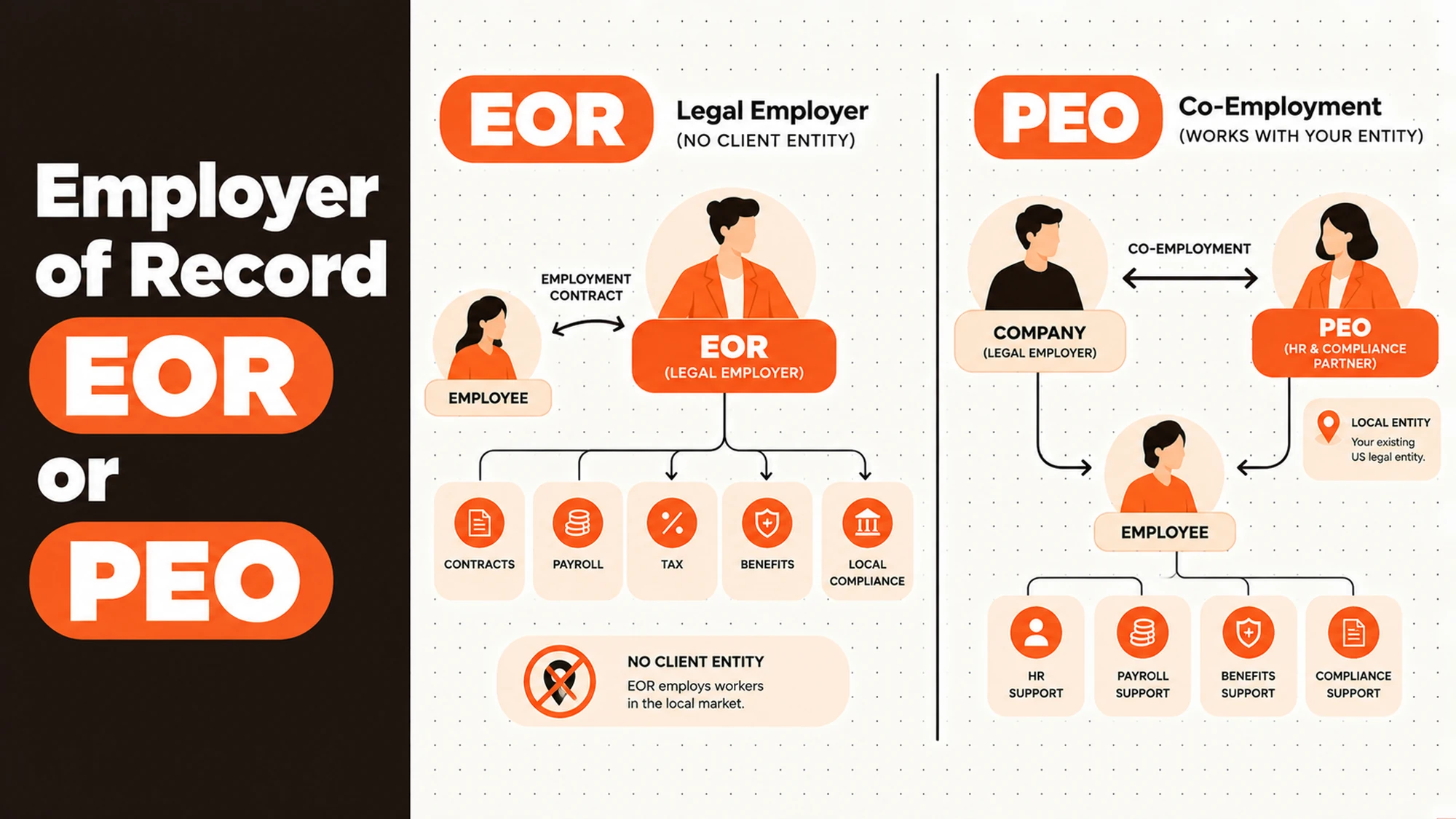
The difference that actually matters is structural and simple. One arrangement generally assumes you already have a presence in that country and works alongside it. The other generally exists precisely because you don't. That single fact determines which is even available to you, and it's frequently buried under paragraphs about partnership and support.
Best tools for Employer of Record (EOR) Tools
So here's the reframe. Stop trying to work out which acronym you need. Read each proposal and answer four questions about it: does this require me to have something in that country, whose name goes on the person's paperwork, who does the person contact about their engagement, and what happens as this grows. The answers tell you what you're actually being offered, regardless of what it's called.
That approach also survives the market's looseness with terminology, which nothing else does. A proposal answering those four questions clearly is comparable with any other proposal answering them, whatever either is labelled.
One boundary before we start. What either arrangement means legally, who stands in what position, and what follows from that differ by jurisdiction, by the specific arrangement and by circumstance, and several places have been changing. Nothing here tells you what applies to you, and nothing here says either arrangement is safer, permitted or compliant. Establish your own position with local advice for each country, before signing.
When You Genuinely Do Not Need to Act Yet
You have no need to engage anybody abroad. The question doesn't arise, and neither arrangement is a solution looking for a problem.
You have found somebody and no presence there. That narrows the field immediately, and the narrowing is the most useful thing to establish first.
You already have a presence in that country. Then more options are open to you, including ones that don't involve either arrangement, and the comparison is genuinely a comparison.
The edge case that forces it. Somebody has sent you a proposal and you can't tell which arrangement it describes. That's the situation this piece is written for, and the answer is to ask about structure rather than about the acronym.
Five Questions This Reader Asks at 11pm
Are these the same thing? No. They're different arrangements that overlap in what they do for you, and the most significant difference is whether you need an existing presence in the country. The terms are used loosely though, so the label on any specific proposal is a weak signal about what that proposal contains.
Do I need an entity? This is the question that sorts everything, and the honest answer is that it depends which arrangement is on the table. Broadly one of them assumes a presence and one exists because there isn't one. Ask it directly about the specific proposal rather than inferring from the name.
Which is cheaper? Not a comparison this piece will make, partly because pricing is structured differently enough that headline numbers aren't comparable, and partly because it depends entirely on the country and the situation. What's more useful is knowing what each price contains, which is a separate question worth asking of both.
Which is safer? Neither, as a general statement, and anybody telling you otherwise is making a claim about your specific situation that they can't know. What either arrangement means legally differs by country and by arrangement. That's one to establish with advice rather than to choose between on reputation.
What if we grow there? The most useful question people forget to ask. These arrangements suit different scales and different trajectories, and what happens as headcount increases in that country is worth understanding before you start rather than when it's already awkward.
The Labels Are Not Reliable
| The term | What it usually implies | Why the proposal rather than the label settles it |
|---|---|---|
| Employer of record | You have no presence, they engage the person | Some providers use the term for other arrangements |
| PEO | You have a presence, they work alongside it | The term covers several models in different markets |
| Global PEO | Frequently means the first thing | Marketing language rather than a distinct category |
| Employment solutions | Nothing specific at all | A container phrase covering either |
| Global employment | Nothing specific at all | Same |
| Umbrella arrangement | Varies enormously by market | Means different things in different countries |
| Co-employment | Describes an appearance, not a model | A phrase about relationships, not a product |
| Staffing arrangement | Frequently a different thing entirely | Worth establishing early, it may not be either |
The third row is the one that catches most people. Adding global to a familiar term produces something that sounds like a bigger version of what you already understand and frequently describes the other arrangement entirely.
The fourth and fifth rows are the honest ones, in a sense. A phrase that commits to nothing at least does not mislead anybody about which arrangement it describes, and it prompts the question that matters.
The seventh row is worth separating out because it appears in both conversations. It's a way of describing how a relationship looks rather than a category of service, and treating it as a product name will confuse a conversation quickly.
If a provider uses it as though it were a product, that is worth probing. Either they mean something specific, in which case ask what, or the term has drifted into their marketing, which tells you how carefully to read the rest.
The last row matters because the answer changes what you're buying substantially. An arrangement where an organisation supplies people to you is a different proposition from either of the two under discussion, and it sometimes arrives in the same conversation.
It is worth establishing which you are looking at in the first meeting rather than the third. The three are answers to different questions, and a shortlist containing all of them is not a shortlist.
Five Diagnostic Questions You Can Self-Assess Against
Do you have anything in that country? An entity, a registration, any form of presence. The answer determines which arrangements are even available and it's the first thing to establish.
Can you describe each proposal without its acronym? In two sentences, structurally. If you can't, you don't yet know what's being offered and the label is doing work it shouldn't.
It is a quick test and an uncomfortable one, because most people discover they have been carrying the acronym rather than the structure.
Whose name goes on the person's paperwork? Ask it of each proposal explicitly. It's concrete, the answer is knowable, and it tells you a great deal about the structure.
What happens at ten people in that country? Or fifty. The arrangements diverge as you scale, and the trajectory matters more than the first hire.
What have you established, and for which country? Not what either provider says about their own arrangement. What somebody accountable has told you about your position there.
Run these five before the second vendor conversation rather than after the fourth. The answers narrow the field enough that several meetings stop being necessary.
Six Ways These Arrangements Differ in Practice, Reviewed
Whether you need a presence in the country already
The structural difference and the one that sorts most situations. One arrangement generally works alongside something you already have there; the other generally exists because you have nothing.
Where it causes confusion is that proposals don't always say plainly which they assume. An organisation quoting you may not know whether you have a presence, and the document is written generically.
Telling them your position up front usually produces a more specific document. A provider who knows you have nothing in that country will write about what that means rather than hedging across both cases.
Ask it as the first question, of every proposal. If the answer is that they can work either way, ask what changes between the two, because something does.
The answer also determines how long anything takes to start. An arrangement assuming a presence you do not have is not a slightly different option, it is one that cannot begin until something else exists first.
Worth asking what counts as a presence for their purposes, too. Organisations use the word loosely, and a registration for one purpose is not always what a provider means when they ask whether you have something there.
Whose name appears on the person's paperwork
Somebody's name is on the engagement documents and the payslip, and which organisation that is differs between these arrangements and sometimes within them.
Where it causes difficulty is that this is the part the person actually experiences, and it's frequently left unspecified in proposals aimed at the buyer rather than the worker. The answer also shapes what the person says when anybody asks who they work for.
Ask it explicitly and ask to see a sample document. It's concrete, it distinguishes proposals sharply, and you should know what your colleague will be signing.
The sample is more informative than any description of the arrangement. A document written for a real person in a real country tells you what the structure actually is, in a way a proposal summarising it cannot.
It is also the thing your colleague will be asked about by anybody outside work. Knowing what name appears on it means you can prepare them rather than leaving them to explain something unfamiliar on their own.
Who the person contacts about their own engagement
When somebody has a question about their pay, their benefits or their documents, there's an organisation that answers, and which one differs between arrangements.
Where it causes difficulty is the experience. Some arrangements put the person in contact with an organisation they've never heard of; others route things through your own team. Neither is wrong and they feel completely different to somebody who's anxious about a payslip.
Ask what the person's support experience looks like, and ask for response times. The difference here is one of the more significant practical distinctions and it rarely appears in a comparison.
Ask about the hours as well as the speed. Support operating in a timezone that does not overlap with the person's working day is a different proposition from one that does, and the person feels that difference every time something is urgent.
It is also worth knowing what happens with a question nobody can answer quickly. How an unusual case gets escalated, and whether the person is told it has been, determines whether waiting feels like a process or like being ignored.
How benefits are arranged
Benefits get sourced somehow in that country, and the arrangements differ in who assembles them, what choice you have, and whether you can align anything with what your other people receive.
Where it causes difficulty is expectation. Organisations frequently assume more control than they have, discover the package is largely predetermined, and then have to explain a difference to somebody who compares with a colleague elsewhere.
The explanation is much easier when it was anticipated. Saying at the outset that packages are assembled locally and will differ is straightforward; saying it after somebody has noticed is a correction.
Ask who chooses, what the options are, and what adding something involves. What any country requires as a baseline is separate, differs everywhere, and needs local advice.
The control question is worth settling before anybody joins. Discovering after the fact that a package is fixed, when you had assumed you could shape it, means renegotiating something in front of a person who is already expecting a particular arrangement.
Ask what happens if you want to change something later, too. Adding to a package a year in is a different conversation from specifying it at the outset, and the answer is not always the same.
What happens as you grow in that country
The arrangements behave differently at scale. Cost structures change at different rates, the administrative experience shifts, and at some point a different approach entirely becomes worth considering.
Where it causes difficulty is that nobody asks at the start, because the first hire is the problem in front of them. Then there are several people, the arrangement is embedded, and reconsidering means unpicking something that involves real colleagues.
The unpicking is the part that makes this worth asking early. Changing a commercial arrangement is ordinary; changing one that several people's engagements sit inside is a different order of difficulty.
Ask what changes at various headcounts. A provider who can describe the trajectory plainly is giving you something more useful than a price for one person.
The honest providers will tell you where their arrangement stops making sense. Somebody willing to say that beyond a certain size you would be better off doing something else is demonstrating a kind of reliability that is hard to test any other way.
Worth asking what their largest arrangement in that country looks like. It tells you whether the trajectory they are describing is something they have seen or something they are projecting.
What it takes to stop
Every arrangement ends eventually, by growth, by change of direction, or because it isn't working, and what that involves differs.
Where it causes difficulty is that exit is the least discussed part of any proposal and the part that matters most when it arrives. And the thing being unwound isn't a contract, it's somebody's engagement, which is a considerably more serious matter.
Ask what ending involves, commercially and for the person, as two separate questions. What happens to somebody's engagement differs by jurisdiction and by circumstance and needs local advice rather than a general answer.
The two questions get answered as one and should not be. A provider can tell you about notice periods and commercial terms with precision; what happens to the individual is a question about that country and that person, and it belongs with somebody qualified.
Ask it while nothing is urgent. Every part of this is harder to establish when a specific person is waiting on the answer, which is invariably when the question actually arises.
The Decision Table
| Situation | Scale | Setup | Primary Pain | Recommended Starting Point |
|---|---|---|---|---|
| Nobody to engage abroad | Any | Any | None | The question does not arise |
| No presence in that country | One person | None | Options are narrower than they look | Ask which arrangement each proposal is |
| Presence already established | Any | Entity there | Genuinely more options | Compare structurally, not by label |
| Cannot tell what a proposal is | Any | Evaluating | The label is doing the work | Ask the four structural questions |
| Proposal says global PEO | Any | Evaluating | A term that means several things | Ask whether a presence is assumed |
| Comparing on price | Any | Evaluating | Structures are not comparable | Ask what each price contains |
| Choosing on which is safer | Any | Evaluating | A claim nobody can make generally | Local advice, per country |
| Planning one hire, expecting more | Any | Evaluating | Trajectory not considered | Ask what changes at scale |
| A staffing arrangement in the mix | Any | Evaluating | A third thing entirely | Establish which it is, early |
The fourth row is the situation most readers are in and the fix is a short set of questions rather than more research. What a proposal is called tells you less than what it says about presence, paperwork, support and scale.
The fifth row is the specific version of it that recurs most, because the term appears everywhere and means different things depending on who wrote the page.
The seventh row is worth resisting firmly. Choosing between these arrangements on a general impression of safety means acting on a claim nobody is in a position to make about your particular country and circumstances, and it's precisely the question to take to somebody qualified.
The ninth row is the one that derails an evaluation quietly. A proposal describing an organisation supplying people to you is neither of the arrangements under discussion, and it can sit in a shortlist for weeks before anybody notices it is answering a different question.
Ask About the Arrangement, Not the Acronym
Four questions do most of the work. Does this assume a presence. Whose name is on the paperwork. Who does the person contact. What changes as we grow. Answered for any proposal, those make it comparable with any other.
Put them in writing and send them to everybody. Identical questions to every provider produce answers you can set side by side, which is the thing the proposals themselves will never give you.
The label is a starting point at best. Terms in this market cover several models, differ between countries, and are used for marketing as much as for description. A proposal answering the four questions is worth more than one carrying a familiar acronym.
Nobody is being deceptive about this. The terms genuinely are used differently in different markets, and a provider using one loosely is usually reflecting their market rather than obscuring anything.
Presence is the sorting question. Whether you have something in that country determines which arrangements are open to you, and establishing it first prevents a lot of wasted comparison.
And it is a question about you, not about them. Which means you can answer it before speaking to anybody.
Price comparisons need structure first. These are priced differently enough that headline figures compare nothing useful. What each price contains is the comparable thing, and it takes asking.
Structure also tells you which comparisons are even meaningful. Two arrangements that assume different things about your presence are not competing for the same decision.
Nobody can tell you which is safer in general. What either arrangement means legally is specific to a country, an arrangement and a set of circumstances. That's an advice question, and treating it as a product-selection question is how organisations end up confident about something nobody established.
A provider saying so plainly is behaving well. Most will tell you to take your own advice if asked directly, and one that does is more reliable than one that reassures.
Ask about scale even for one person. The first hire is the immediate problem and the trajectory is the expensive one. Arrangements that suit a single person and arrangements that suit a team in that country aren't always the same.
And ask before you are committed rather than after. A trajectory question answered during an evaluation shapes the choice; the same question two years in only describes a position you are already in.
The practical position is that you can choose sensibly here without ever resolving what the acronyms mean, and trying to resolve them first is a detour. Structure is knowable. Terminology is not.
That is worth accepting early rather than fighting. Organisations lose weeks trying to establish a definitive meaning for terms the market does not use consistently, and the effort produces nothing the four questions would not have produced faster.
Where These Arrangements Go Wrong
| The failure | How it shows up | What would have to change |
|---|---|---|
| Choosing on the label | An arrangement that assumed something you lack | Ask about presence first |
| Comparing headline prices | Numbers that compare nothing | Ask what each contains |
| Choosing on which is safer | A claim nobody could make | Local advice, per country |
| Scale never discussed | Embedded arrangement, awkward to change | Ask what changes as you grow |
| Person's experience unexamined | Somebody dealing with strangers about their pay | Ask what support looks like |
| Exit never discussed | The hardest question, asked latest | Two separate exit questions, early |
The first row is the failure this whole piece exists to prevent, and it's easy to fall into because acronyms feel like categories. A proposal arrives with a familiar label, you match it to what you think that label means, and the mismatch surfaces when somebody asks whether you have a presence there.
The fifth row is the one that affects a real person rather than a process. The support experience differs substantially between these arrangements, it's rarely compared, and it's most of what the person engaged this way will actually notice about the structure.
The fourth row is the one that becomes expensive later. An arrangement chosen for one person, embedded across a team, and then found to fit badly is unpicked at a cost that involves colleagues rather than contracts.
What to Put in Writing
| Artefact | Who owns it | When it is written | What it prevents |
|---|---|---|---|
| Whether you have a presence there | Whoever evaluates | First | Comparing unavailable options |
| Each proposal described without its acronym | Whoever evaluates | During evaluation | The label doing the work |
| Whose name is on the paperwork | Whoever evaluates | Before signing | Not knowing your colleague's terms |
| What the person's support looks like | Whoever evaluates | Before signing | An experience nobody considered |
| What changes at scale | Whoever evaluates | Before signing | An arrangement that stops fitting |
| Your position, per country | You, with local advice | Before signing | Choosing on a general impression |
The second row is the one that makes everything else possible. Describing each proposal structurally, in two sentences without its acronym, forces out exactly the information the terminology obscures, and it's usually the point at which two apparently similar options separate.
The sixth row is the one to obtain before any of the others matter. A position established for the specific country turns the whole comparison from a judgement about vendors into a decision within known limits.
Questions to Ask Before You Commit
On presence. Does this assume we have something there? A bad answer is either way.
On paperwork. Whose name is on the person's documents? A bad answer is the local entity.
On support. Who does the person contact, and how? A bad answer is our platform.
On scale. What changes at ten people there? A bad answer is that it scales.
On price. What does this number contain? A bad answer is everything.
On exit. What does ending involve, for us and for them? A bad answer is notice.
What Getting This Wrong Costs
The first cost is choosing an arrangement that doesn't fit your actual situation. The terminology invites matching a familiar label to a rough understanding, and the mismatch surfaces at the point of implementation, when somebody asks a question about your presence in the country that reveals the proposal assumed something you don't have. That's a delay and a restart at a moment when you have already told somebody they have a job.
The person waiting is what makes it costly rather than merely annoying. Somebody who has resigned elsewhere on the strength of an offer is now holding a start date that has moved for reasons nobody can explain to them.
The second cost is a decision made on a comparison that compared nothing. Two prices structured differently, set against each other, produce a conclusion with no basis, and organisations regularly select on a headline figure and discover afterwards that the two numbers covered different sets of things. The fix is asking what each contains, which takes one question per proposal.
It also makes the later disappointment hard to attribute. An arrangement costing more than expected, where nobody established what the original figure covered, produces an argument about the provider rather than a recognition of how the comparison was made.
The third cost is confidence about a legal question nobody answered. Choosing between arrangements on a general sense that one is safer means acting on a claim about your specific country and circumstances that no provider and no article can make. It feels like diligence and it isn't, and the difference only becomes apparent if something ever needs examining.
The impression usually comes from tone rather than from content. A proposal written with more assurance reads as safer, and assurance in a sales document is a writing choice rather than evidence about anything.
So do three things before comparing anything. Establish whether you have a presence in that country, because it determines what's available. Describe each proposal in two sentences without using its acronym. And take the legal question to somebody qualified rather than treating it as a selection criterion.
The first two are free and take an afternoon between them. The third costs money and is the one that actually settles anything, which is the same uncomfortable arrangement that applies everywhere in this area.
When You Are Ready to Go Further
Start with presence, because it sorts the field faster than anything else. Whether you have an entity, a registration or any footing in that country determines which arrangements are genuinely open to you, and establishing it first prevents comparing options one of which was never available.
Check it with whoever actually knows rather than assuming. Organisations are occasionally registered somewhere for a reason nobody currently in the room remembers, and that changes the answer.
Then describe each proposal structurally, in your own words, without its acronym. Does it assume something exists there, whose name is on the paperwork, who the person contacts, what changes as headcount grows. Two documents that looked interchangeable will separate at that point, and the exercise takes an hour.
If you cannot write those two sentences from the proposal, that is the finding. Send the four questions back and ask for plain answers, and the quality of what comes back is itself a useful comparison.
Finally, keep the legal question entirely separate from the selection. What either arrangement means where you're operating is a matter for somebody accountable, per country, and it's neither a tiebreak between vendors nor something to infer from how confidently a proposal is written. Choosing on structure and establishing the position separately is the only version of this that holds up.
It also makes the advice cheaper. A narrow question about one arrangement in one country gets a faster and more useful answer than an open request to explain the whole area.
HROpsLab publishes independent comparison work across HR tooling and global employment. We sell nothing, we take no vendor money, and we publish no paid placements. If the next step is seeing how the providers in this space describe themselves, our comparison work is one place to start.
Frequently Asked Questions
What is the difference between an employer of record and a PEO?
They're different arrangements and the most significant distinction is structural: one generally assumes you already have a presence in the country and works alongside it, while the other generally exists precisely because you don't. That single fact determines which is even available to you. The complication is that the market uses both terms loosely, some organisations offer both with overlapping language, and the meanings shift between countries, so the label on a particular proposal is weak evidence about what it contains.
Do the terms mean the same thing?
No, though you'd be forgiven for thinking so from the marketing. They describe genuinely different structures. What makes them hard to tell apart is that the words are used inconsistently, terms like global PEO frequently describe the other arrangement entirely, and phrases such as employment solutions cover either without committing to one. The reliable approach is to ignore what a proposal is called and ask what it says about presence, paperwork, support and scale.
Do you need an entity for a PEO arrangement?
Broadly that's the assumption, and it's the question that sorts this whole decision, but it needs asking of the specific proposal rather than inferred from the term. Some organisations describe arrangements under that label which don't assume a presence, and some will say they can work either way, in which case the useful follow-up is what changes between the two. Establishing whether you have anything in that country, first, narrows the field before you compare anything.
Which arrangement suits a first hire in a country?
Usually the one that doesn't require a presence, since by definition a first hire in a country means you probably don't have one. The more useful question is what happens after the first hire, because arrangements that suit a single person and arrangements that suit a team there aren't always the same, and reconsidering later means unpicking something that now involves real colleagues. Ask what changes at various headcounts before you start.
What happens as headcount grows in that country?
The arrangements behave differently, cost structures move at different rates, the administrative experience shifts, and at some point a different approach altogether becomes worth considering. Almost nobody asks this at the outset because the first hire is the problem in front of them. A provider who can describe the trajectory plainly is giving you something considerably more useful than a price for one person, and it's a reasonable thing to ask during an evaluation.
How does the employee experience differ between them?
More than most comparisons acknowledge, and it's most of what the person actually notices. The arrangements differ in whose name appears on their paperwork and payslip, and in which organisation they contact about their pay, benefits and documents. Some put the person in touch with an organisation they've never heard of; others route things through your own team. Neither is wrong, and they feel completely different to somebody anxious about a payslip on a Friday afternoon.
Is the label on a proposal reliable?
Not very. Terms in this market cover several models, mean different things in different countries, and get used for positioning as much as for description. Adding global to a familiar term is particularly misleading, since it sounds like a larger version of something you understand and frequently describes the other arrangement. Treat the label as a starting point and establish the structure by asking four things: presence, paperwork, support, and what changes at scale.
What should you ask regardless of what it is called?
Does this arrangement assume we already have something in this country. Whose name goes on the person's engagement documents and payslip. Who does the person contact when they have a question about their own pay or benefits, and how quickly do they get an answer. And what changes as we grow there. Those four make any proposal comparable with any other, they're concrete enough to get concrete answers, and they work whatever either document is called.
Structure is knowable. The terminology is not, and you do not need it to be.