
TL;DR
- The core decision: whether you understand the arrangement you are about to put a person into.
- When doing nothing is right: when nobody needs engaging where you have no presence.
- What has to be true: you can say who does each thing, without using the word handles.
- How the options split: by which of six expectations the arrangement actually meets.
- Decision rule: establish your own position with local advice before signing, not after.
- Outcome to expect: somebody working for you, engaged by somebody else, in a place you do not know.
You Found the Person. Now What.
You need somebody in a country where your company has no presence. You have found the right person. And you have no way to put them on a payroll, because you have nothing there to put them on.
Somebody suggests an employer of record. You look it up, and every description uses the same handful of words. It handles employment. It manages compliance. It takes care of the complexity. You read four of these and you still could not explain to a colleague what would actually happen if you signed one.
That's not because you're missing something. It's because those descriptions are doing two jobs at once and only admitting to one. They're describing a set of activities, which is knowable and can be written down plainly. And they're implying something about who carries what, which is a legal question with an answer that differs by country, differs by the specific arrangement, and is not something a service description settles.
Best tools for Employer of Record (EOR) Tools
So here's the reframe this piece runs on. Ignore what the arrangement is called and what it claims to take care of. Ask what each party actually does: who pays the person, who tells them what to work on, who holds the paperwork, who they contact when something is wrong. Those are observable, they're the same questions in every country, and the answers tell you what you're buying.
What they don't tell you is where obligation sits, and no article can. That differs by jurisdiction, differs by arrangement, and is changing in several places. Establish your own position with local advice in each country where you engage somebody, before you sign rather than after. Everything below is about mechanism.
One other thing worth saying early. The most consequential feature of this arrangement is that there are now three parties where employment normally has two, and the person in the middle of it is somebody who didn't choose that and frequently doesn't understand it.
When You Genuinely Do Not Need to Act Yet
Nobody needs engaging where you have nothing. The question doesn't arise. Worth recognising, because this arrangement gets considered for situations it doesn't fit.
You have found somebody and no way to engage them. The common trigger and a reasonable one. The question then is which arrangement, and what each involves.
Somebody is already working for you informally. A person is doing work and the arrangement is unclear. That's a different and more urgent problem, and how it should be characterised is a question for local advice rather than a procurement decision.
The edge case that forces it. You're being asked to sign something with a deadline attached and nobody internally can explain the arrangement. That's the situation this article exists for, and the answer is to slow down rather than to read faster.
Five Questions This Reader Asks at 11pm
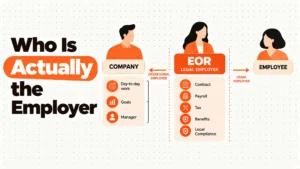
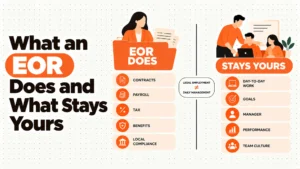
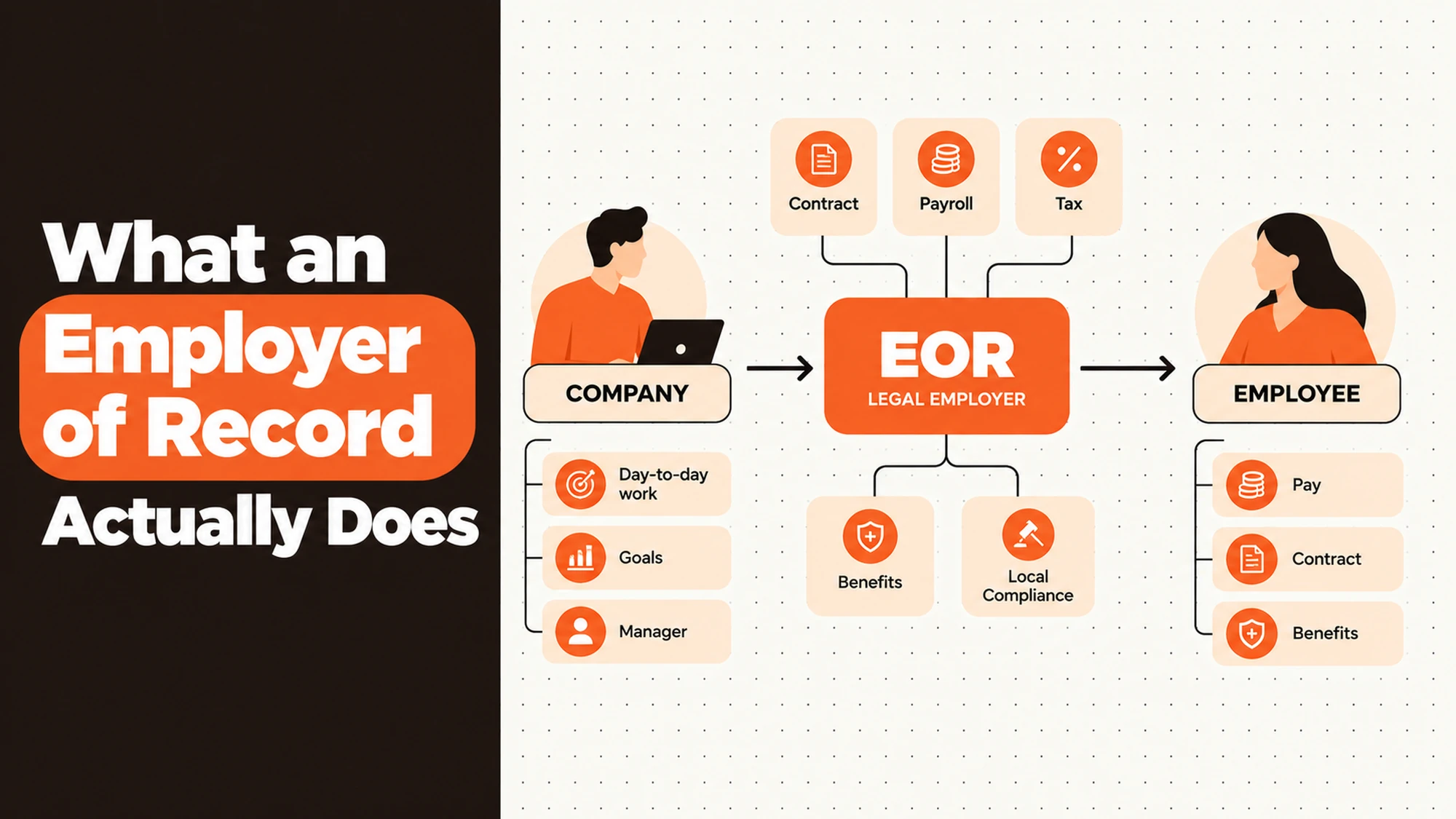
What actually happens if I sign this? Practically: a third party engages the person in their country, pays them, holds whatever paperwork is required there, and arranges benefits locally. You continue to decide what they work on. The person deals with the third party about their engagement and with you about their job.
Is the provider the employer? That's the legal question and it's the one thing this piece deliberately won't answer, because the answer differs by country and by arrangement and getting it wrong matters. What's observable is that the provider does several things employers normally do. What follows from that is for local advice.
Do I still manage the person? Yes, in the ordinary sense. You decide priorities, you give feedback, you have a working relationship. The arrangement sits underneath that rather than replacing it, and a provider that expected otherwise would be unworkable.
What does it not do? Decide anything about the work. It won't tell you whether the role is right, won't manage somebody's performance, won't have the conversation when something isn't working. Those stay entirely with you and they're frequently assumed away by the word handles.
What should I establish before signing? What applies to you, in that country, for that person, from somebody accountable for that answer. Not from a proposal, not from an article, and not from the provider's own description of what they do.
Three Parties Where There Are Normally Two
| The party | What they do in practice | What the person experiences from them |
|---|---|---|
| Your organisation | Decides the work, sets priorities, gives feedback | Their manager, their colleagues, the actual job |
| The provider | Pays them, holds paperwork, arranges benefits | A name on documents, a support address |
| A local party, sometimes | Whatever the provider does not do itself there | Usually nothing visible, occasionally everything |
| The person | The work | Being the only one in the company on this footing |
The first two rows are the split that matters and it's an unusual one. In ordinary employment the organisation directing somebody's work and the organisation on their paperwork are the same, and everything about how people think and talk about work assumes that. Here they're different, and almost every difficulty in this arrangement traces back to that separation.
The third row is the one nobody mentions and it's real. Providers don't always operate directly in every country they list, and where they don't, another organisation is involved. That arrangement is invisible in a proposal, and it matters when something needs resolving.
The last row is worth keeping in view throughout. Somebody is at the centre of this, they didn't design it, and they're frequently the only person in your organisation engaged this way, which is a lonelier position than anybody on your side imagines.
Five Diagnostic Questions You Can Self-Assess Against
Can you name who does each thing? Pays, instructs, holds paperwork, provides benefits, answers questions, ends the engagement. If any answer is that the provider handles it, you don't yet know.
What have you established, and from whom? Not what a proposal says. What somebody accountable has told you applies in that country, for that person, in writing.
Who does the person contact about what? Trace it. There are two organisations and the person needs to know which one to go to, and nobody will tell them unless you do.
Does the provider operate there directly? Ask about the specific country you need rather than the total on the map. The answer changes who's actually involved.
What happens if this doesn't work out? Both commercially and for the person. Those are separate questions with separate answers and the second one is the one that needs local advice.
Work through these five with whoever will actually manage the person rather than with whoever is running the purchase. The manager is the one who will field the questions, and their blanks are the ones that matter.
Six Things People Expect an Employer of Record to Do, Reviewed
Putting somebody on a payroll in a country where you have none
The core of it. The provider has the means to pay a person in that country and you don't, and that gap is the actual problem this arrangement addresses.
Where it falls short is that being able to pay somebody is not the whole of engaging them, and the rest of what engagement involves varies enormously by country in ways a proposal will summarise as handled.
Establish what engaging somebody in that specific country actually requires, with local advice, then read the proposal against it. The proposal will not tell you what the list is.
The reason to build the list independently is that a proposal describes what a provider does, which is not the same as what the country needs. Those two overlap substantially and the gap between them is invisible when you only have one of them.
It also makes two proposals comparable for the first time. Providers structure their descriptions differently enough that reading them side by side compares writing styles, and forcing both onto a list you wrote compares the thing you care about.
Holding the paperwork that engagement requires there
Documents get produced, signed and kept in a form that suits the country. It earns its place because nobody in your organisation knows what those documents are or what they need to say.
Where it falls short is that you're now relying on somebody else's judgement about a set of documents you can't evaluate, concerning a person who works for you. That's a reasonable position and it's worth being conscious of rather than assuming away.
Ask to see what the person will actually sign, in translation if necessary. It's the document defining their working life and you should know what it says.
This request is reasonable and surprisingly rarely made. Organisations sign an agreement with a provider, never see the document the person signs, and consequently cannot answer basic questions about their own colleague's terms.
It matters most where somebody later raises something. A manager who has never read what their team member agreed to is working from assumptions about a document that governs the relationship.
Arranging the benefits that come with it locally
The provider assembles whatever benefits apply and are customary there. It earns its place because benefits are the part of engagement most tied to local markets and local arrangements, and least transferable from what you do elsewhere.
Where it falls short is consistency. What your person receives will be shaped by that country and by what the provider can arrange there, which frequently differs from what colleagues elsewhere get, and nobody will have explained that to them.
Worth understanding before the person asks. What any country requires as a baseline is a separate question, differs everywhere, and belongs with local advice.
The question arrives eventually and usually from the person rather than from anybody on your side. Somebody comparing notes with a colleague elsewhere in the company notices a difference, asks why, and nobody has a ready answer.
Having one in advance costs nothing. The honest explanation, that benefits are arranged locally and local markets differ, is perfectly acceptable to most people when offered rather than extracted.
Handling the administration nobody in your organisation knows how to do
Registrations, filings, records, whatever the country expects on an ongoing basis. It earns its place as genuine specialist knowledge you would otherwise have to buy or build.
Where it falls short is verification. You can't check most of this, you won't see it happening, and the first indication of a problem is likely to be somebody contacting you about it. That's an argument for asking how you'd know it was being done rather than for assuming it isn't.
Ask what you'd see if something went wrong. A provider who can describe that plainly is telling you something useful.
The honest answer is usually that you would see very little until somebody contacted you, and a provider willing to say so is more trustworthy than one implying total visibility. What you are really testing is whether they will describe their own limits.
It is also worth asking who tells you and how quickly. A problem in another country, discovered by a third party, reaching you through a support queue, can take a while to arrive in front of somebody who can act.
Being the organisation the person formally deals with
The provider appears on the payslip and is the point of contact for anything about the engagement itself. It earns its place by giving the person somebody to go to for things your organisation genuinely can't answer.
Where it falls short is distance and confusion. The person now has two organisations in their working life and no natural way to know which handles what, and a question sent to the wrong one takes days to reach the right one.
Tell them explicitly, at the start, which questions go where. Nobody else will, and working it out by trial is a poor introduction.
A short note at the point of starting does the whole job. One organisation for pay, benefits and anything about their engagement; you for the work, the team and anything about their role.
Without it people default to asking their manager everything, which is understandable and means their manager spends months forwarding messages about matters they have no visibility of.
Absorbing a question you would rather not answer yourself
The expectation that entering this arrangement settles something you're uncertain about. It earns a place on this list because it's a real reason people sign, even where nobody says so out loud.
Where it falls short is that whether anything is actually settled is a legal question about your specific situation in a specific country, and a service description is not evidence about it. A proposal saying a provider handles something describes activity, not obligation, and those are different claims.
The one to take proper advice on, before signing, in each country. If the arrangement is being chosen partly because it resolves an uncertainty, that resolution is exactly the thing to verify independently rather than infer.
The uncertainty is frequently unspoken, which is what makes this difficult. Nobody writes down that part of the appeal is making a question go away, so nobody checks whether it actually has, and the assumption travels through the decision unexamined.
Naming it plainly in the internal discussion is the whole fix. Once somebody has said out loud which question they hope this settles, it becomes obvious that the question needs an answer from somebody qualified rather than from a proposal.
The Decision Table
| Situation | Scale | Setup | Primary Pain | Recommended Starting Point |
|---|---|---|---|---|
| Nobody to engage abroad | Any | Any | None | The question does not arise |
| Found somebody, no presence there | One person | None | No way to pay them | Establish local requirements first |
| Cannot explain the arrangement internally | Any | Evaluating | Buying something nobody understands | Write down who does what |
| Proposal says handles, itemises nothing | Any | Evaluating | Activity confused with obligation | Ask for the task list |
| Signing under a deadline | Any | Evaluating | Pressure, not information | Slow down, take advice |
| Person already working informally | Any | Ad hoc | A characterisation question | Local advice, urgently |
| Provider does not operate there directly | Any | Evaluating | A fourth party nobody mentioned | Ask about your specific country |
| Person does not know who to contact | Any | Live | Two organisations, no map | Tell them explicitly |
| Chose it to resolve an uncertainty | Any | Evaluating | Inference standing in for advice | Verify that specific point |
The third row is the one to act on before any other. An arrangement nobody in your organisation can describe is an arrangement you can't evaluate, and writing down who does each thing takes an afternoon and immediately shows you what you don't know.
The ninth row is the most consequential misreading available here. Entering this arrangement because it appears to settle a question is reasonable only if that specific point has been checked with somebody accountable, in that country, rather than inferred from how the service is described.
The sixth row deserves separating out because it is not a procurement question at all. Somebody already doing work under an unclear arrangement is a situation whose characterisation differs by jurisdiction and needs advice quickly, and choosing a provider is not the response to it.
What the Word Does Not Settle
A description of activity is not a statement about obligation. These get conflated constantly, and a proposal saying a provider handles employment is describing work being done. Where responsibility sits is a separate question with a different kind of answer.
Nothing general is true here. The position differs by country, by the specific arrangement, and by the individual's circumstances, and several jurisdictions have been changing. Any source telling you what this arrangement achieves, including this one, is telling you something it can't know about your situation.
Which is why this piece keeps declining to answer the obvious question. Not evasion: an answer given without knowing your country, your arrangement and the person's circumstances would be worth less than no answer.
Establish it per country, not once. Organisations engaging people in several places frequently find the answer isn't the same in each, and a single understanding applied everywhere is where that surfaces.
Before signing, not after. The cost of establishing your position is a conversation. The cost of discovering it during a problem is different in kind, and the problem will involve a specific person rather than an abstraction.
And the timing is not neutral. Advice taken before an arrangement exists can change what you sign; the same advice afterwards can only describe what you already did.
The provider is not a source on this. Not because anybody is being dishonest, but because a party to an arrangement describing its own effect is not independent evidence, and their description is written for every customer rather than for your situation.
They will usually say so if asked directly. Most will tell you plainly that you should take your own advice, and a provider that does is behaving better than one that reassures you.
The mechanics are knowable even where the law is not. Who pays, who instructs, who holds what, who the person contacts. All of that is answerable, none of it requires advice, and it's most of what you need to run the arrangement well.
So separate the two exercises deliberately. The mechanics you work out yourself in an afternoon; the position you obtain from somebody qualified. Mixing them is how an afternoon of reading turns into a conclusion nobody is accountable for.
The practical position is that you can understand this arrangement thoroughly as a set of activities, decide sensibly on that basis, and separately establish the legal position with somebody qualified. Trying to do both from the same source is how people end up confident about something nobody told them.
That split also makes the advice cheaper and better. Somebody qualified asked a narrow, specific question about one country gives a faster and more useful answer than somebody asked to explain the whole arrangement from scratch.
Where These Arrangements Go Wrong
| The failure | How it shows up | What would have to change |
|---|---|---|
| Nobody can describe the arrangement | Buying something unevaluated | Write down who does what |
| Handles read as a transfer of obligation | Confidence with nothing behind it | Establish the point with advice |
| No local advice taken before signing | Discovering the position during a problem | Take it per country, beforehand |
| Person not told who to contact | Questions to the wrong organisation | Explain it at the start |
| Provider works through an unnamed party | A fourth party surfacing in a problem | Ask about your specific country |
| Benefits difference never explained | An employee who feels treated differently | Explain it before they ask |
The second row is the failure with the most serious consequences and the easiest to fall into. The language used across this whole market invites it, nobody is deliberately misleading anybody, and the gap between what's described and what's established only becomes visible when something needs resolving.
The fourth row is the cheapest to fix on this list. A person entering this arrangement has two organisations in their life, and telling them plainly which one to contact about what costs one message and prevents months of small frustrations.
The sixth row is the one that reliably arrives without warning. Somebody compares their benefits with a colleague's, asks a reasonable question, and the absence of a prepared answer turns an ordinary difference into a suspicion of unfairness.
What to Put in Writing
| Artefact | Who owns it | When it is written | What it prevents |
|---|---|---|---|
| Who does each activity, plainly | Whoever is evaluating | Before signing | An arrangement nobody understands |
| What applies to you, per country | You, with local advice | Before signing | A position you inferred |
| Whether the provider operates there directly | Whoever is evaluating | Before signing | A party nobody mentioned |
| What the person will sign | Whoever is evaluating | Before they sign it | Not knowing their own terms |
| Who the person contacts, about what | Whoever manages them | Before they start | Questions going nowhere |
| What happens if it ends | Both, separately | Before signing | Two questions treated as one |
The second row is the one this whole piece keeps returning to, and it's the only item here that can't be done by reading. Establishing your own position needs somebody accountable for the answer, in that country, and it needs doing before the arrangement exists rather than when somebody is already relying on it.
The sixth row is worth writing because the two halves get answered together and shouldn't be. What happens commercially between you and a provider sits in an agreement; what happens to a person is a question for advice in their country, and conflating them produces a confident answer to only one of them.
Questions to Ask Before You Commit
On activity. Who performs each of these tasks? A bad answer is that it's handled.
On presence. Do you operate in this country directly? A bad answer is that it's covered.
On documents. What will the person actually sign? A bad answer is standard terms.
On visibility. What would we see if something went wrong? A bad answer is that it won't.
On contact. Who does the person go to, for what? A bad answer is support.
On ending. What happens to the person if we stop? A bad answer is that it's in the agreement.
What Getting This Wrong Costs
The first cost is a confident position nobody established. The language across this market is written in verbs that sound total, an organisation reads several proposals, forms an impression of what the arrangement achieves, and proceeds. Nothing improper has happened and nobody has been told anything false. What's missing is that the impression was formed from descriptions of activity rather than from advice about obligation, and the two only come apart when something needs resolving, which is the worst moment to discover the difference.
The impression also hardens as it travels internally. Repeated in a summary, then in a decision paper, then in a conversation with somebody senior, it acquires a certainty that nothing behind it ever had.
The second cost falls on the person. They're in an arrangement they didn't choose, dealing with an organisation they've never met about the most important parts of their working life, frequently the only person in the company on that footing, and nobody has explained any of it to them. Most of that is fixable with a conversation at the start, and most organisations never have it because from their side the arrangement is a procurement decision rather than an experience.
It shows up later as something that reads like disengagement. Somebody who feels structurally separate from their colleagues, for reasons nobody has explained, tends to behave like somebody who is not quite part of the team, and the cause is almost never identified correctly.
The third cost is the party nobody knew about. Where a provider doesn't operate directly in a country, another organisation is involved, and that's invisible in a proposal and entirely visible when something goes wrong and the answer takes a week to come back through two companies. Asking about your specific countries rather than the total on the map takes one question.
It also matters when that relationship changes. Providers alter who they work with in a given country, sometimes with little notice, and the experience in that country can change with it while nothing about your own agreement has moved.
So do three things before signing anything. Write down who performs each activity, in plain words, without using the word handles. Establish what applies to you in that country from somebody accountable for that answer. And ask whether the provider operates there itself, because the answer changes who is actually involved in your arrangement.
The first and third cost nothing and can be done this week. The second costs money and is the one that matters most, which is an uncomfortable combination and the reason it gets postponed.
When You Are Ready to Go Further
Start by writing the activity list, because it costs an afternoon and it immediately shows you the shape of what you're buying. Who pays, who instructs, who holds the paperwork, who arranges benefits, who the person contacts, who ends it. Any box you can't fill is a question for a proposal rather than an assumption to carry.
Do it before reading any proposal rather than from one. A list built from a vendor document inherits that vendor's categories, and the point of the exercise is to have something independent to hold proposals against.
Then take advice, per country, before you sign. This is the part that can't be shortcut and the part most often deferred, because it costs money at a moment when the arrangement still feels like a procurement exercise. What it buys is a position you actually hold rather than one you inferred from how a service describes itself, and the difference between those is invisible right up until it matters enormously.
Deferring it is understandable and rarely survives contact with a second country. Organisations that take advice once and apply it everywhere tend to find the answer was not the same in the second place, which is exactly the situation a single understanding was going to produce.
Finally, think about the person before they start. What they'll be told, what they'll sign, which organisation they contact about what, and why their benefits may differ from their colleagues'. Every one of those is a small conversation now and a difficult one later, and from their side this arrangement is not a structure, it's their job.
It is also the part nobody else in the process owns. A provider onboards them administratively and a procurement exercise ends at signature, so unless their manager does it, the explanation simply never happens.
HROpsLab publishes independent comparison work across HR tooling and global employment. We sell nothing, we take no vendor money, and we publish no paid placements. If the next step is seeing how the providers in this space describe themselves, our comparison work is one place to start.
Frequently Asked Questions
What is an employer of record?
It's an arrangement in which a third party engages somebody in a country where your organisation has no presence, pays them, holds the paperwork required there, and arranges local benefits, while you continue to decide what they work on. That describes the activity, which is the part anybody can state plainly. What it means for where obligations sit is a separate question whose answer differs by country, by the specific arrangement and by circumstance, and it needs establishing with local advice rather than inferring from any description, including this one.
What does an employer of record actually do day to day?
Very little that you see. It pays the person on whatever cycle applies there, maintains the records and registrations that country expects, administers their benefits, and responds when they raise something about their engagement. From your side the visible parts are an invoice and, occasionally, a question routed through. The ordinary working relationship continues to run through you: priorities, feedback, whether the work is going well. That division is the thing worth understanding, because most descriptions imply the provider does more than it does.
Is the employer of record the employer?
This is the question everything turns on and it's the one no article should answer, because the position differs by jurisdiction, by the specific arrangement and by the individual's circumstances, and it's been changing in several places. What can be said is what's observable: the provider performs several activities employers normally perform. What follows from that legally is a matter to establish with local advice in each country where you engage somebody, before signing rather than after, from somebody accountable for the answer.
Do you still manage somebody engaged this way?
Yes, in every ordinary sense. You decide what they work on, you set priorities, you give feedback, and they're part of your team. The arrangement sits underneath the working relationship rather than replacing it, and a provider expecting to direct the work would be unworkable for both of you. What changes is the administrative layer, not the day job. This surprises people who've read descriptions implying the provider takes care of employment, which tends to be read as more than it means.
What does an employer of record not do?
Anything about the work itself. It won't tell you whether a role makes sense, won't manage somebody's performance, won't have a difficult conversation on your behalf, and won't decide anything about that person's future with you. It also won't relieve you of the working relationship, which remains yours entirely. The other thing to be clear-eyed about is that a description of what a provider handles is a statement about activity, and whether anything else follows is a question for advice rather than for a proposal.
What should you establish before signing?
What applies to you, in that specific country, for that specific person, from somebody accountable for that answer and in writing. Not from a proposal, not from a provider's description of their own service, and not from an article. Separately and more cheaply, write down which party performs each activity in plain words: who pays, who instructs, who holds the paperwork, who arranges benefits, who the person contacts. That second exercise costs an afternoon and immediately reveals what you don't yet know.
Does the provider operate in every country it lists?
Frequently not, and the map won't tell you. Providers cover some countries through their own presence and others through another organisation, and which applies to the country you actually need is a question worth asking specifically rather than assuming from the total. It matters because it determines who's genuinely involved in your arrangement, how long a query takes to resolve, and what happens if that relationship changes. A provider that answers this plainly is giving you something useful.
What should you tell the person being engaged this way?
More than most organisations do, and at the start rather than when they ask. Which organisation appears on their paperwork and why, which one to contact about their pay and benefits, which one to contact about their work, and that their benefits may differ from colleagues elsewhere because of how they're arranged locally. They're frequently the only person in your company on this footing, they didn't choose it, and working it out alone is a poor introduction to a job.
The activities are knowable. Who carries what is not, and that needs somebody accountable.