
TL;DR
- The core decision: what to say when somebody asks who they work for.
- When doing nothing is right: when everybody already knows which party does what.
- What has to be true: you can name who performs each employer activity, separately.
- How the options split: by activity, because the legal question has no general answer.
- Decision rule: answer the observable question and route the legal one to advice.
- Outcome to expect: a person who understands their own arrangement.
The Question at the Dinner Table
Somebody you work with is asked, at a family dinner, who they work for. They give your company's name, because that's the honest answer about their daily life.
Then somebody asks what's on their payslip, and it's a different name. A company they've never heard of. And now they're explaining an arrangement they only half understand to a relative who is starting to look concerned, and by the end of the evening they're wondering whether they should be concerned too.
They come to you the next week and ask directly. Who do I actually work for? And you find that you don't have a clean answer either, because every way you might phrase it either sounds evasive or claims something you're not sure is true.
Best tools for Employer of Record (EOR) Tools
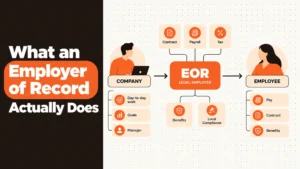
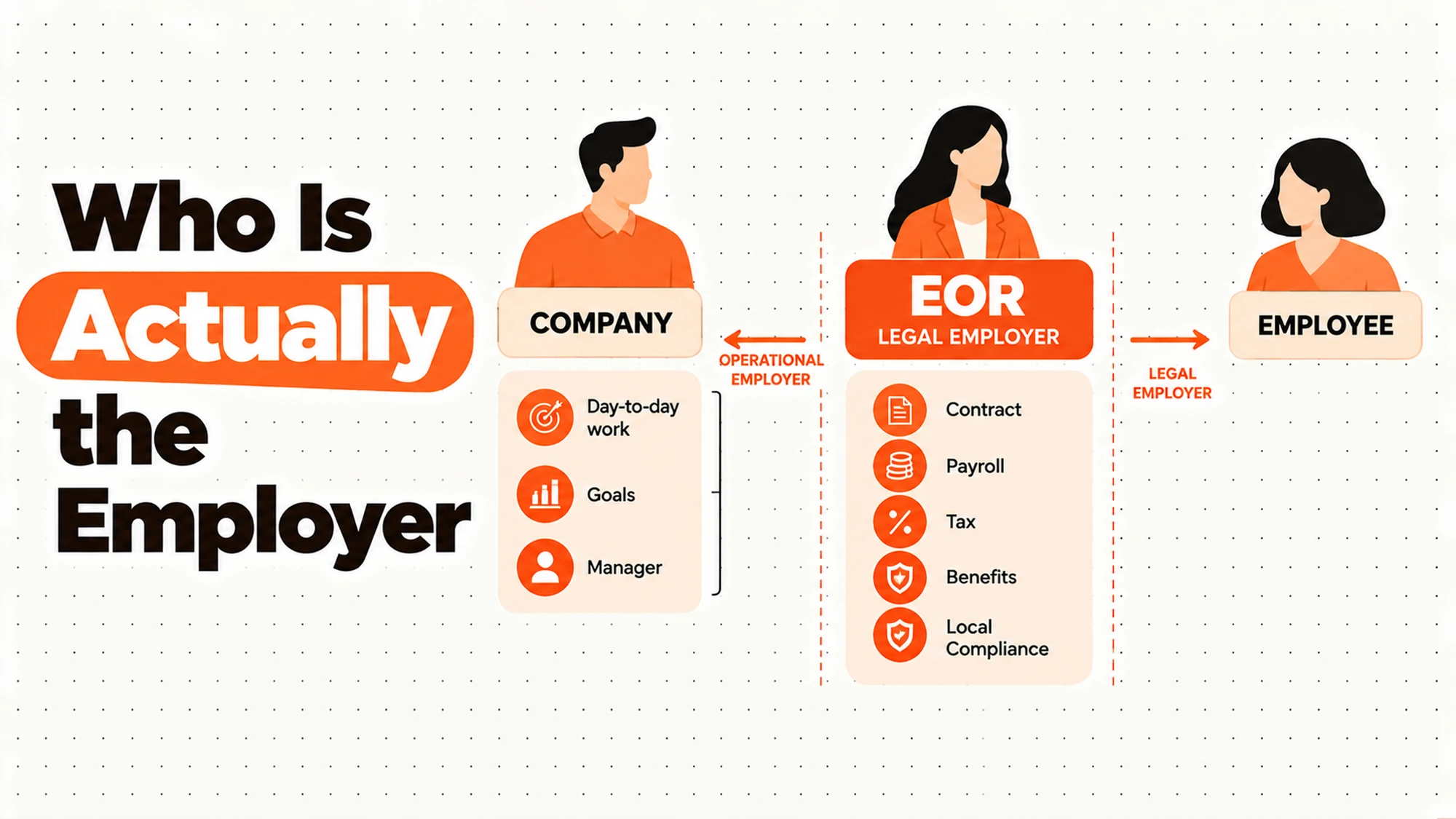
Here's the reframe that makes this answerable. In ordinary employment, one organisation both directs somebody's work and stands as their employer, and everything about how people talk about work assumes those are the same thing. In this arrangement they aren't. So the question who is the employer is doing double duty: it's asking about the daily reality, which you can answer plainly, and it's asking about legal status, which you can't.
Stop trying to answer it as one question. Break it into the specific things an employer normally does, say who performs each, and be honest that the legal characterisation is a separate matter with an answer that differs by country and needs establishing properly.
That's not a dodge. It's more informative than any single-word answer would be, and it's the version you can give somebody without telling them something you don't know to be true.
One boundary, stated plainly. Whether any particular arrangement makes two organisations employers in some sense, what follows from that, and who carries what are questions whose answers differ by jurisdiction, by the specific arrangement, and by circumstance, and several places have been changing. Nothing here tells you what applies to you. Establish it with local advice, per country, before it matters.
When You Genuinely Do Not Need to Act Yet
Everybody knows which party does what. The person understands the arrangement, knows who to contact, and isn't confused. That's the state everything else here is aiming at.
Somebody has asked and you couldn't answer well. Extremely common and worth fixing, because they're now less certain about their own position than they were before they asked.
The person has started routing things wrongly. Questions about pay coming to you, questions about their work going to a support address. That's a sign nobody explained the split.
The edge case that forces it. Somebody needs to prove something about their employment to a third party and nobody can tell them what to say. That's when the vagueness stops being abstract.
Five Questions This Reader Asks at 11pm
So who is the employer? As a legal matter, that differs by country and by arrangement and it genuinely isn't answerable here. As a practical matter, it's a split: your organisation directs the work and the provider performs the administrative employer functions. Saying that plainly is better than picking one and hoping.
What does co-employment mean? It's a phrase people use for the everyday situation where two organisations both stand in something like an employer position towards one person. It describes an appearance rather than settling anything. Whether it applies to a given arrangement, and what follows, is a legal question with an answer that differs by place.
What do I tell the person? The activity split, in plain words, plus the honest caveat. Which organisation pays them, which appears on their paperwork, which decides their work, who they contact for what. Most people find that clarifying rather than alarming, particularly compared with a vague reassurance.
Can I still manage them normally? Yes. Direction of work sits with you and that's the ordinary relationship. What you can't do is treat the administrative side as yours, because it isn't, and trying to handle it directly creates confusion in both directions.
What if they need to prove employment to somebody? This comes up for housing, credit, visas and other processes, and what any institution accepts differs by country and by institution. The person needs to establish that for their own situation. What you can do is make sure they know who can produce documentation and how to ask.
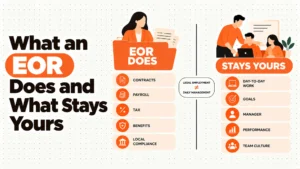
Where Each Activity Sits
| The activity | Who performs it in practice | What it means for the person |
|---|---|---|
| Deciding what the work is | Your organisation | Their real job, their real manager |
| Setting priorities and giving feedback | Your organisation | The relationship that shapes their days |
| Paying them | The provider | A name they may not recognise on a payslip |
| Holding engagement paperwork | The provider | Terms they agreed with somebody else |
| Providing benefits | The provider, arranged locally | A package that may differ from colleagues |
| Handling a question about their engagement | The provider | A support channel rather than a person |
| Handling a question about their work | Your organisation | Normal, and the part that feels like work |
| Ending the arrangement | Both, differently | Two processes they have to be told about |
The first two rows are why the honest everyday answer is your company. That's where the person's working life actually happens, that's who they'd describe as colleagues, and pretending otherwise would be strange.
It is also the answer the person wants to be able to give. Most people would rather say they work for a company whose work they can describe than one whose name means nothing to anybody they know.
The third and fourth rows are why the everyday answer isn't the whole answer. Somebody's payslip and their engagement terms carry a name they have no relationship with, and that's genuinely disconcerting the first time it comes up in a context outside work.
The sixth row is the one that produces most of the daily friction. A question about pay or benefits goes to an organisation with no relationship to the person, through a channel rather than to a colleague, and the answer takes longer than it would anywhere else.
Five Diagnostic Questions You Can Self-Assess Against
Can you fill in that table for your own arrangement? Activity by activity, without using the word handles. Most people find two or three boxes they can't complete.
What would you say if asked directly? Write the sentence now rather than composing it under pressure. If every version you draft sounds either evasive or overconfident, that's the finding.
Does the person know which organisation does what? Ask them. The answer tends to be partial, and the gaps are where their questions have been going astray.
Has anybody explained it to them? As distinct from it being explicable. Onboarding by a provider covers administration; nobody's job description includes explaining the structure.
What have you established about the legal position? For that country, from somebody accountable. If the answer is that the provider's materials describe it, that's not the same thing.
Run these five with the person's actual manager rather than with whoever arranged the contract. The manager is the one who gets asked, and the gaps in their answers are the gaps that reach the person.
Six Things an Employer Normally Does, Reviewed
Deciding what the work is and how it is done
Setting the role, the priorities, the standards. It sits with your organisation and it has to, because nobody else knows the work.
Where it causes confusion is that this is the part people mean when they say who somebody works for, so the everyday answer and the administrative answer point in different directions. Both are honest and they're answering different questions.
That is also why insisting on a single correct answer makes the conversation worse. Two true statements about different aspects of the same arrangement is the accurate picture, and treating one of them as the real one discards information the person needs.
Say plainly that the work relationship is with you. That's true, it's what the person experiences, and it doesn't claim anything about the rest.
It also matters to them more than the administrative question does. Most people care first about whether they are genuinely part of the team and only second about whose name is on a document.
Watch for the ways an organisation accidentally signals otherwise. Being left off a distribution list, excluded from a system everybody else is in, or missing from a team page are small administrative artefacts that read as a statement about belonging.
Paying the person
Money reaches somebody on a schedule, with deductions applied and a payslip produced. The provider does this because it can and you can't, which is the practical reason the arrangement exists.
Where it causes difficulty is the name. A payslip from an organisation the person has no relationship with is the single most common trigger for the whole question, and it arrives every single pay period.
Tell them in advance whose name will appear and why. It's a small thing that prevents a recurring low-level unease.
The first payslip is the moment to have pre-empted. Somebody who has been told to expect an unfamiliar name reads it as administration; somebody who has not reads it as a discovery, and the first reaction to a discovery about your own pay is rarely calm.
It also comes up whenever they show a payslip to anybody else, which is more often than people expect. Lenders, landlords and various processes all ask, and each time the person is explaining an arrangement on their own.
Holding the engagement paperwork
The documents that formalise somebody's engagement in that country, in whatever form is expected there. The provider produces and holds them.
Where it causes difficulty is that your organisation frequently hasn't read them. The manager of a person engaged this way often can't say what that person actually agreed to, which becomes awkward the moment anything needs discussing.
Ask to see the documents, in translation if needed. Knowing what your colleague's terms say is reasonable and surprisingly rarely done.
The awkward version of not having done it is a conversation where the person refers to something they agreed and their manager has no idea what they mean. That is a poor position to be in and entirely avoidable.
It is also worth checking that what the documents describe matches what you think you arranged. A description agreed commercially and a document produced locally are two different artefacts and they do not always say the same thing.
Providing the benefits
Arranging whatever benefits apply, sourced locally. The provider does this through arrangements in that country.
Where it causes difficulty is comparison. The person will eventually compare with a colleague elsewhere, find a difference, and ask about it, and the honest explanation involves how benefits are assembled locally rather than anything about their value to you.
Prepare the explanation before it's requested. What any country requires as a baseline is a separate question, differs everywhere, and belongs with local advice.
The explanation that works is mechanical rather than reassuring. Saying that benefits are arranged in each country from what is available there, so packages differ between colleagues in different places, is both true and usually accepted.
What does not work is implying the difference reflects anything about the person. Left unexplained, that is precisely the inference people draw, and it is a difficult one to correct afterwards.
Handling a problem the person raises
When somebody has a difficulty, somebody has to deal with it. Which organisation depends entirely on what kind of difficulty it is, and that's not obvious from the person's side.
Where it causes difficulty is exactly that ambiguity. A problem with a colleague is yours. A problem with a payslip is the provider's. Something that's both, or something sensitive, has no obvious home and tends to sit unaddressed while the person works out who to tell.
The combined cases are more common than the neat ones. A difficulty about pay that is really about how a manager set expectations, or a benefits problem that has become a trust problem, does not sort cleanly into either channel.
Give them a clear route for each kind, and make sure somebody on your side is reachable for anything they're unsure about. Being uncertain who to tell is how things go unraised.
The catch-all route is the important part. Any routing scheme has gaps, and the value of a named person on your side is that anything falling outside the scheme still reaches a human rather than stalling.
It is worth saying explicitly that they can bring anything there, including things they suspect belong elsewhere. People hesitate to use a route they think is the wrong one, and hesitation is what produces the silence.
Ending the arrangement
An engagement stops, for whatever reason, and administrative steps follow in that country.
Where this needs care is that what ending an engagement requires, what notice applies, and what anybody is owed all differ by jurisdiction and by circumstance. None of that is inferable from an arrangement's structure. Global HR's material covers the employment side of this and it needs local advice regardless.
Establish it before you need it rather than when somebody specific is involved. Working out the position during a live situation means doing it under time pressure with a person waiting.
What's worth knowing here is only the practical split: your organisation decides, the provider performs administration in that country, and the person needs telling by a human rather than through a process.
That last part is the one most likely to go wrong under time pressure. An administrative process can technically deliver the news, and a person learning that their engagement is ending from a system notification is an outcome nobody would defend if they had thought about it in advance.
Decide in advance who has that conversation. It should be somebody the person knows, which in this arrangement means somebody on your side rather than the organisation whose name is on the paperwork.
The Decision Table
| Situation | Scale | Setup | Primary Pain | Recommended Starting Point |
|---|---|---|---|---|
| Everybody knows who does what | Any | Live | None | Change nothing |
| Cannot fill in the activity table | Any | Any | You do not know your own arrangement | Fill it in, box by box |
| Person asked and got a vague answer | Any | Live | They are now less sure than before | Give them the split, plainly |
| Questions routed to the wrong party | Any | Live | Delay, and things going unraised | A route per kind of question |
| Manager has not read the terms | Any | Live | Cannot discuss their own colleague's terms | Ask for the documents |
| Benefits difference unexplained | Any | Live | A difference read as unfairness | Prepare the explanation |
| Person needs to prove employment | Any | Live | Nobody can tell them what to say | Establish who produces what |
| Nothing established legally | Any | Any | A position nobody holds | Local advice, per country |
| Something sensitive, no obvious route | Any | Live | It goes unraised | A named person on your side |
The third row is the one worth acting on today. Somebody who asked and received a vague answer is in a worse position than before they asked, because they now know the question is difficult and they don't know why.
The fifth row is quietly embarrassing and easy to fix. A manager who has never seen their colleague's engagement documents is negotiating every related conversation from memory of a summary.
The ninth row is the quiet failure in this arrangement. A person with a sensitive difficulty, unsure whether to raise it with their manager or with an administrative support channel in another country, will frequently raise it with neither.
The seventh row produces the most acute version of the confusion. Somebody mid-application for housing or a visa, needing documentation quickly, discovering that the organisation holding it is unfamiliar and reachable only through a queue, is dealing with a genuine deadline and no obvious route.
The Question the Person Asks
Answer the daily question with your company's name. That's true and it's what they mean most of the time. The work, the team, the manager, the actual job.
Then say the rest anyway. Answering only the easy half is how people end up discovering the other half from a payslip.
Then explain the split, before they have to ask. Which organisation pays them, whose name is on the paperwork, and why. Volunteered, it's an explanation. Extracted, it feels like something that was being kept from them.
The timing carries most of the meaning here. The same sentence lands completely differently on day one and in month six.
Be honest about the legal part. Saying that the legal characterisation differs by country and has been established with proper advice is a respectable answer. Making one up is not, and inventing reassurance about somebody's own employment position is a serious thing to get wrong.
People accept I do not know far better than a wrong certainty. Particularly about their own position, where they will eventually find out either way.
Give them the routing. Pay, benefits and paperwork one way; work, role and team the other; anything they're unsure about to a named person on your side. One short note, at the start.
Repeat it once, later. Nobody absorbs administrative detail in their first week, and a second mention a month in lands on somebody who now has actual questions.
Expect the question outside work. It arrives when somebody applies for something, or over dinner, and the person is answering alone without you there. What you tell them is what they'll have to use.
So give them something they can repeat. A sentence that works in front of a relative or a lender is more useful than an accurate description they cannot summarise.
Notice that they're on their own with it. Frequently the only person in the company on this footing, explaining an unusual arrangement to people who find it odd, with nobody to compare notes with. That isolation is real and almost never acknowledged.
Where there are several, introduce them. People in the same arrangement in different countries can answer each other's questions faster than anybody on your side can, and they will not find each other without help.
The practical version of all this is short. Fill in the activity table, tell the person what's in it, give them a route for each kind of question, and be straight that the legal position is a matter you've had properly established rather than something you're characterising yourself.
None of those four needs a provider's cooperation or anybody's budget, which is unusual for anything in this area. They are things you decide to do and then do, in an afternoon between them.
Where These Arrangements Go Wrong
| The failure | How it shows up | What would have to change |
|---|---|---|
| A single-word answer to a split question | Evasive, or claims something unknown | Answer by activity |
| Nobody explains it at the start | Confusion surfacing months later | A short note on day one |
| Routing never made explicit | Questions to the wrong organisation | A route per kind of question |
| Manager has not read the terms | Cannot discuss their colleague's own terms | Ask for the documents |
| Legal position characterised internally | Confident statements nobody verified | Local advice, per country |
| Sensitive matters have no route | Things nobody ever hears about | A named person, reachable |
The first row is the trap almost everybody falls into, because a question phrased in the singular invites an answer in the singular. Any single name you give is either incomplete or claims something you haven't established.
The sixth row is the one that costs most and shows least. Nothing visible happens when somebody decides not to raise a difficulty, which is precisely why it persists.
The fifth row is the one with real consequences. Somebody internally characterises the arrangement, that characterisation gets repeated to the person concerned, and it turns out to be a statement about their legal position that nobody qualified ever made.
The third row is the failure that produces the others. Without an explicit routing, everything defaults to whoever the person knows best, which is their manager, who then forwards things they cannot see into a process they do not control.
What to Put in Writing
| Artefact | Who owns it | When it is written | What it prevents |
|---|---|---|---|
| The activity table, filled in | Whoever manages the person | Now | Not knowing your own arrangement |
| What you say when asked | Whoever manages the person | Before being asked | Composing it under pressure |
| The routing, given to the person | Whoever manages the person | Day one | Questions going nowhere |
| What the person actually signed | Whoever manages the person | Before they start | Discussing terms you have not read |
| Who produces employment documentation | Whoever manages the person | Now | A person stuck mid-application |
| What applies, per country | You, with local advice | Before it matters | A position nobody holds |
The second row is worth drafting deliberately. Composed in advance, it's a clear explanation of a split arrangement. Improvised when somebody asks, it tends to come out either vague or overconfident, and both are worse than the truth.
The fourth row is the one most organisations skip and later wish they had not. Reading what your own colleague agreed to takes twenty minutes and is the difference between discussing their terms and guessing at them.
Questions to Ask Before You Commit
On the split. Who performs each activity? A bad answer is that it's a partnership.
On documents. What does the person actually sign? A bad answer is a local contract.
On routing. Who do they contact, for what? A bad answer is the platform.
On proof. Who can produce employment documentation? A bad answer is that it's available.
On sensitivity. Where does a difficult matter go? A bad answer is the support team.
On position. What have we established, and who from? A bad answer is the provider's materials.
What Getting This Wrong Costs
The first cost is somebody less certain about their own position than they should be. They asked a reasonable question about who they work for, got something vague, and concluded that either nobody knows or nobody wants to say. Neither is reassuring, and it's a strange thing to be uncertain about regarding your own job. The information that would have settled it is mostly plain and mostly available.
Uncertainty of that kind also tends to be reinterpreted over time. A vague answer that felt merely unsatisfying in the moment starts to look like evasion a few months later, particularly if anything else about the arrangement goes wrong.
The second cost is things that never get raised. When a person isn't sure whether a difficulty belongs with their manager or with an administrative channel in another country, the default is to raise it with neither, particularly if it's sensitive or if they're unsure of their footing. Nobody hears about it, nothing appears in any record, and the first indication is usually that somebody has left.
The silence also looks like contentment from your side. A person raising nothing reads as a person with nothing to raise, which is exactly the wrong inference in an arrangement where the route for raising things is unclear.
The third cost is a characterisation nobody was qualified to make. Somebody internally decides how to describe the arrangement, repeats it to the person, and it becomes what that person believes about their own employment position. If it turns out to be wrong, it was told to them by their employer, which is a materially worse situation than their having been told nothing.
It also travels. What one person is told becomes what they tell a lender, a landlord or an official process, and a characterisation invented internally can end up being relied on well outside your organisation.
So do three things. Fill in the activity table for your own arrangement, box by box, and notice what you can't complete. Write the sentence you'd use if somebody asked directly, before they do. And make sure there's a named person on your side reachable for anything the person isn't sure where to take.
The third of those matters most to the person and costs least to arrange. Knowing there is somebody who will take any question, including the ones that probably belong elsewhere, removes the hesitation that produces the silence.
When You Are Ready to Go Further
Start with the table, because it's the whole of the practical answer and it takes half an hour. Who decides the work, who pays, who holds the paperwork, who arranges benefits, who fields which kind of question, who does what when it ends. The boxes you can't fill are the questions to put to a provider.
Do it for a real person rather than in the abstract. A specific colleague in a specific country produces a table you can actually check, and the abstract version tends to be completed with assumptions.
Then tell the person, at the start, without waiting for them to ask. What's in the table, whose name will be on their payslip and why, where to take each kind of question, and that their benefits are arranged locally so may differ from colleagues elsewhere. Volunteered on day one this is an orientation; extracted six months later it reads as something that had been left unsaid.
Keep it short and written down. A page they can return to beats a conversation they half remember, and they will want to check it again the first time somebody outside work asks them about it.
Finally, keep the legal question separate and treat it seriously. Establish the position with somebody accountable, per country, and when the person asks, say that it's been properly established rather than offering your own characterisation. That's both a better answer and the only one you're in a position to give.
It is also the answer that holds up if anything is ever examined. A position obtained from somebody qualified and a position assembled internally look similar right up until somebody asks where it came from.
HROpsLab publishes independent comparison work across HR tooling and global employment. We sell nothing, we take no vendor money, and we publish no paid placements. If the next step is seeing how the providers in this space describe themselves, our comparison work is one place to start.
Frequently Asked Questions
What does co-employment mean?
It's an everyday phrase for a situation where two organisations both appear to stand in something like an employer position towards one person: one directing the work, another performing administrative employer functions. The phrase describes an appearance rather than settling anything. Whether it accurately characterises any particular arrangement, and what consequences follow if it does, are legal questions whose answers differ by jurisdiction, by the specific arrangement and by circumstance. That needs establishing with local advice rather than adopting the label.
Who is the employer in an employer of record arrangement?
As a legal matter this genuinely isn't answerable in general, because it differs by country, by the specific arrangement and by the individual's circumstances, and several jurisdictions have been changing their position. What can be answered is the practical split: your organisation decides the work and manages the relationship, while the provider pays the person, holds the engagement paperwork and arranges benefits. Giving somebody that split, plus an honest note that the legal characterisation has been properly established, is better than picking a single name.
Who does the employee report to?
You, in the ordinary sense that matters day to day. They have a manager in your organisation, they're part of a team, they receive feedback and direction from you, and that's the relationship that shapes their working life. The provider isn't involved in how the work is done and wouldn't want to be. This surprises people who've read descriptions suggesting the provider takes care of employment, which tends to be read as covering more than it does.
Whose policies apply to somebody engaged this way?
Partly yours and partly not, and the split is worth establishing explicitly rather than assuming. Your ways of working, your expectations about how the team operates and your standards apply in the ordinary sense. Matters formalised in their engagement documents sit with the provider and reflect what's usual in that country. Which is which differs by arrangement, so the practical step is to read what the person actually signed, which is a request most organisations never make.
What do you tell an employee who asks who they work for?
The truth, in two parts. Your company is where their work happens, who their colleagues are and who manages them, and that's the honest answer to what people usually mean. The provider is the organisation that pays them, holds their engagement paperwork and arranges their benefits, which is why a different name appears on their payslip. Volunteering both at the start is an orientation; producing it when they ask months later reads as something that had been withheld.
Can you still manage somebody engaged through an employer of record?
Yes, and normally. Setting priorities, giving feedback, discussing their development and having ordinary conversations about the work are all yours, and an arrangement that prevented them would be unworkable. What isn't yours is the administrative side: their paperwork, their pay mechanics and their benefits sit with the provider, and trying to deal with those directly creates confusion in both directions. The practical rule is that the work is yours and the engagement administration isn't.
Who handles a problem the employee raises?
It depends on the kind of problem, which is obvious from your side and not at all obvious from theirs. Something about pay, a payslip or benefits goes to the provider. Something about the work, the team or a colleague is yours. The difficulty is anything sensitive, or anything that's both, because there's no obvious home for it and the person frequently raises it with neither. Having a named person on your side who's reachable for anything they're unsure about closes most of that gap.
What happens when somebody needs to prove their employment?
It arrives for housing, credit, visa processes and similar, and what any particular institution accepts differs by country and by institution, so the person needs to establish that for their own situation rather than relying on general advice. What you can do in advance is make sure they know which organisation can produce documentation about their engagement and how to request it, because discovering that mid-application, from an unfamiliar support channel in another country, is a difficult position to be in.
The daily answer is your company. The rest is a split, and worth explaining.