TL;DR
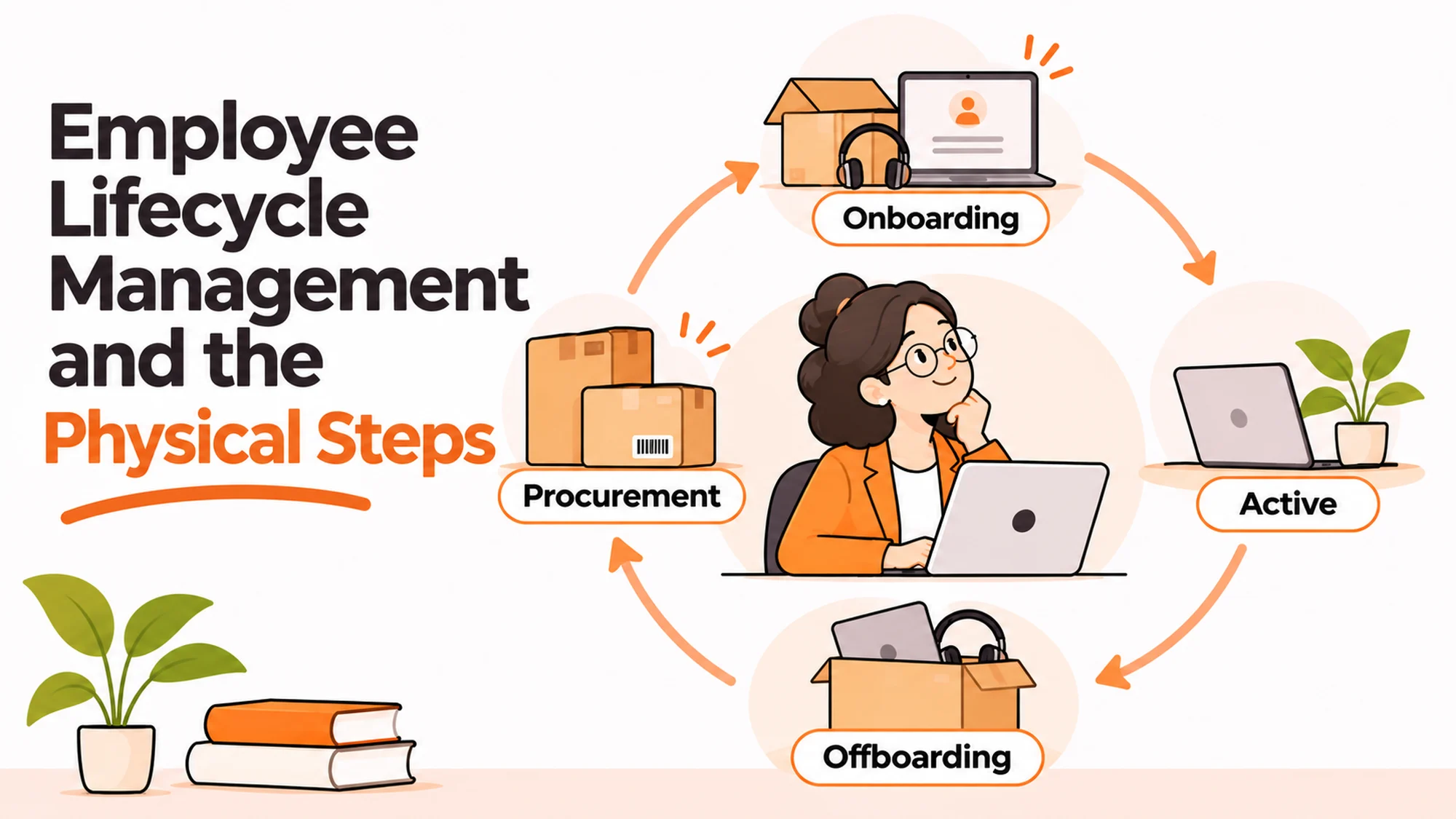
Employee lifecycle management is usually drawn as a loop of software events: offer accepted, account created, review scheduled, account disabled. Every stage also has a physical step attached to it, and those are the ones that fall between owners because no system raises a ticket when they do not happen.
- Each stage has a physical step the diagram omits.
- Day one fails on hardware, not on accounts.
- Internal moves are the least tracked stage.
- Leaving disables access in minutes and leaves the laptop.
- Give every physical step a named owner.
- Measure the gap, not the process diagram.
Every stage has a physical twin
The standard model runs attract, hire, onboard, develop, retain, offboard. Each has something tangible attached and the tangible half is rarely in the same system.
Hire needs hardware ordered against a start date that can still move.
Best tools for HR Operations
Onboard needs that hardware in somebody’s hands, configured, on day one and not day four.
Develop and retain covers refresh cycles, repairs and the upgrade somebody has been asking for since March.
Internal moves change what a person needs and almost never trigger a hardware review.
Offboard needs the device back, wiped, and either reissued or disposed of with evidence.
Your HR system knows all six dates. It does nothing about any of the physical halves, which is reasonable, since it was never meant to.
Day one fails on hardware
Ask anybody who has onboarded remotely what actually went wrong, and it is rarely the account.
Accounts are created from a trigger in a system and happen reliably. Hardware needs a purchase, a delivery address that may not be the one on file, a customs process if a border is involved, and enough lead time that somebody had to act two weeks before the start date.
Each of those can slip independently, and the combination is why a new joiner spends their first week on a personal laptop or on nothing.
Three things fix most of it. Trigger the hardware order from offer acceptance rather than from start date. Confirm the delivery address with the person rather than using whatever HR holds. And have a stated fallback for when it does not arrive.
day one equipment readiness covers the readiness side in detail. The structural point is that the hardware trigger must fire earlier than the account trigger, because it has a physical lead time and the account does not.
Internal moves are the blind spot
The least tracked stage in most companies, and the one that quietly degrades your records.
Somebody transfers from support to engineering. Their access changes, because access is governed and somebody reviews it. Their laptop does not, because nothing asks whether it should.
Two consequences accumulate. People work on hardware unsuited to the job, which is a productivity cost nobody attributes. And the asset register keeps saying support when the person sits in engineering, which makes every later report slightly wrong.
The fix is small: add a hardware question to whatever internal transfer process already exists. Does this role need different equipment, and does the record need updating?
| Stage | Usually triggered | Physical step owner |
|---|---|---|
| Offer accepted | Automatically | Often nobody |
| Day one | Automatically | IT, if told in time |
| Internal move | Manually | Nobody |
| Leaving | Automatically | Nobody, after access |
Leaving is where the model breaks
The most predictable failure in the whole lifecycle, and it is not a software failure.
Somebody resigns. Access is disabled within minutes, which is the identity layer doing its job well. The laptop is at their home. It may be powered off, it may be kept deliberately, and it may simply be forgotten by everybody including them.
No system resolves that. The device is unreachable, the person no longer has a reason to cooperate, and recovery becomes less likely the longer it runs.
Four things help and three are process rather than software. Ask for the device back before the last day rather than after it. Send packaging rather than instructions. Give it a named owner with a deadline. And track it as an open item until it is physically back or written off deliberately.
RemoAsset’s laptop lifecycle management covers the recovery side where distance makes it impractical to do yourself.
Give every physical step a name
The cheapest intervention available and the one most companies have not made.
Go through the six stages and write down who performs the physical step at each. Not which team. Which person, by name, with a deputy.
Where a stage has no name against it, you have found a gap. It will fail eventually and nobody will have been responsible for it failing, which is the worst combination.
Two stages are usually blank: internal moves, and the period between a leaver returning hardware and it being reissued. The second is where devices sit in cupboards for months while the company buys replacements.
writing an employee equipment policy covers the policy framing that makes the request legitimate at offboarding, which is the stage where the authority to ask is most often questioned.
Measure the gap, not the diagram
Four numbers, and none of them is process compliance.
New joiners with working equipment on day one, as a share of starters.
Days from leaving date to device recovered, as a median rather than an average, because a handful of never-returned devices will distort a mean beyond use.
Devices with no assigned person. These accumulate silently and are the ones that disappear.
Devices not seen in sixty days.
The first two measure the process. The second two measure whether your records survived it, and they usually degrade first because software keeps working while a process depends on somebody remembering during a busy week.
the NIST Cybersecurity Framework is a reasonable structure if you need to present these alongside other controls.
What no HR system will do
Worth stating plainly, because lifecycle software is frequently bought in the belief that it closes these gaps.
An HR platform holds the dates and the people. A good one triggers tasks at each stage. What it cannot do is buy a laptop, ship it across a border, clear customs, collect it from somebody who has left, store it between employees, or dispose of it with evidence.
Those are physical operations with a supplier attached. the EPA on electronics and batteries management covers handling at end of life and NIST Special Publication 800-88 on media sanitization is the standard any wiping evidence is judged against, which concerns the completed operation rather than a command issued.
So a lifecycle project that buys software and stops has automated the half that was already working. The half that fails is still unowned.
HSE guidance on home working is a reasonable reference on the home working side generally, which is where most of the physical steps now land.
The stage that pays back fastest
Reissue. The gap between a leaver returning a device and the next joiner receiving one is where most companies quietly buy hardware they already own.
A returned laptop that sits in a cupboard for four months while two replacements are ordered is a cost nobody books, because the purchase looks ordinary and the cupboard is not on anybody’s report. Giving that stage an owner and a target turnaround is the single cheapest improvement in the whole lifecycle.
The question worth asking at the end
Which of the six stages would fail tomorrow if the person who informally handles it were away for a fortnight? That is usually a shorter list than people expect, and a more useful one than the process map.
Your HR system knows the dates. RemoAsset handles the hardware at each one, in 80+ countries. See RemoAsset’s laptop lifecycle management or RemoAsset’s pricing.
Frequently asked questions
What does employee lifecycle management usually leave out?
The physical half of every stage. The standard model runs attract, hire, onboard, develop, retain and offboard, and each has something tangible attached: hardware ordered against a start date, that hardware configured and in somebody’s hands on day one, refresh cycles and repairs, equipment changes on internal moves, and the device back and wiped at the end. The HR system knows all six dates and does none of it.
Why does day one fail so often?
Because accounts are created from a system trigger and happen reliably, while hardware needs a purchase, a delivery address that may not be the one on file, a customs process if a border is involved, and enough lead time that somebody acted two weeks earlier. Each can slip independently. Trigger the hardware order from offer acceptance rather than start date, and confirm the address with the person.
What is the biggest blind spot?
Internal moves. Somebody transfers from support to engineering, their access changes because access is governed and reviewed, and their laptop does not because nothing asks whether it should. People then work on hardware unsuited to the job, and the asset register keeps saying support when they sit in engineering. Add a hardware question to whatever transfer process already exists.
Why does offboarding break the model?
Because it is not a software problem. Access is disabled within minutes, which is the identity layer working well, but the laptop is at somebody’s home, possibly powered off or kept deliberately. No system resolves that: the device is unreachable and the person has no reason to cooperate. Ask before the last day, send packaging, give it an owner with a deadline, and track it until resolved.
What is the cheapest thing we can fix?
Give every physical step a named person with a deputy, not a team. Where a stage has no name against it you have found a gap that will fail eventually with nobody responsible, which is the worst combination. Two stages are usually blank: internal moves, and the period between a leaver returning hardware and it being reissued, which is where devices sit in cupboards while replacements are bought.
What should we measure?
Four things, none of them process compliance. New joiners with working equipment on day one as a share of starters. Days from leaving date to device recovered, as a median rather than an average, since a few never-returned devices distort a mean. Devices with no assigned person. And devices not seen in sixty days. The last two usually degrade first.
Will lifecycle software close these gaps?
No, and it is frequently bought in that belief. An HR platform holds the dates and the people, and a good one triggers tasks at each stage. It cannot buy a laptop, ship it across a border, clear customs, collect it from a leaver, store it between employees or dispose of it with evidence. A project that buys software and stops has automated the half that already worked.