TL;DR
- Both spread the cost of hardware over time. Only one includes the work, and that is the entire difference.
- A finance lease is a money product. Device as a Service is an operational product with financing attached, and the two get compared as though they were the same purchase.
- If you already have somebody who procures, ships, tracks and recovers devices, a lease is cheaper because you are not paying for a service you already run.
- If you do not, a lease leaves you with spread payments and all of the work, which is the worst of both arrangements.
- Nobody in this category publishes a price. Six vendors checked on their own pages on 14 October 2026 and not one shows a figure.
- The residual and the end-of-term position decide more of the total cost than the monthly figure does. Ask about both first.
Two Products, One Conversation
The confusion is reasonable, because from a distance both look identical. You stop paying a large sum once and start paying a smaller sum monthly. The machines arrive. Somebody else's balance sheet carries them.
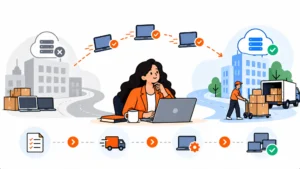
A finance lease is a financing arrangement. A lender buys the hardware and you pay to use it over a term, with a defined position at the end. What arrives is a laptop in a box. Everything after that is yours: configuring it, shipping it, tracking it, recovering it, deciding what happens when it breaks.
Device as a Service is an operational arrangement with financing inside it. The vendor buys, configures, ships, tracks, replaces and recovers, and spreads the cost. What arrives is a working machine with somebody else accountable for it continuing to work.
Best tools for Device Management
So the monthly figures are not comparable and comparing them is the commonest error in this decision. One covers hardware. The other covers hardware plus a service you would otherwise staff or buy separately.
What the Lease Leaves With You
Listed plainly, because this is the list that decides it.
Procurement and specification. Choosing what to buy, in which country, from whom. A lease funds the purchase; it does not make it.
Configuration. Enrolling the machine into a management system, applying policy, encrypting the disk. A leased laptop arrives sealed.
Shipping and customs. Getting it to a home address across a border, with duty handled and somebody named as importer of record.
Tracking. Knowing which serial sits with whom, where, since when. Lessors track the asset for their own purposes and that is not the same as an operational register you can use.
Replacement when it fails. Yours to arrange and usually yours to fund, since the lease covers the original machine rather than its continued availability.
And recovery at the end. Getting every machine back by the end-of-term date, in a condition the lessor accepts. This is the one that surprises people and it is covered below.
| Job | Finance lease | Device as a Service |
|---|---|---|
| Funds the hardware | Yes | Yes |
| Procures and specifies | No | Yes |
| Configures before dispatch | No | Usually |
| Ships and handles duty | No | Yes |
| Maintains a usable register | Not for your purposes | Yes |
| Replaces on failure | No | Usually included |
| Recovers at end of term | You, to a deadline | Vendor |
The End of Term Is the Expensive Part
With a lease, the term ending is an event with a date and consequences, and it is where companies get caught.
Every machine must come back, usually by a fixed date, in acceptable condition. That means recovering devices from people across however many countries you operate in, within a window, including from anybody who has left and not returned theirs. If you have no retrieval process, you are building one against a deadline.
Condition matters financially. A lessor assessing returned hardware against a standard will charge for damage, missing accessories and devices that do not come back at all. Those charges are real and they are the part nobody budgets.
Or you buy them out, at a residual the agreement defines. Sometimes that is good value and sometimes it is the lessor's margin, which is why the residual terms matter more than the monthly figure.
With DaaS the same moment is a refresh rather than a deadline. The vendor recovers and replaces as part of the arrangement, which is precisely the service you are paying for, and the recovery problem is theirs.
That difference compounds across a fleet. One machine coming back is the same job under either arrangement. Three hundred machines coming back within ninety days, from people spread across several countries, some of whom have left, is a project with a critical path. Under a service arrangement it is distributed across the whole term as people join and leave naturally, which is the same total work spread thinly enough that nobody notices it.
So ask one question early of any lease: what happens on the last day, who collects, and what do unreturned machines cost? The answer frequently reframes the comparison.
Five Questions That Decide It
Do you already run device operations? If somebody procures, configures, ships and recovers today and does it adequately, a lease is cheaper because you are not buying that twice. If not, a lease hands you spread payments and all the work.
What is your real average device tenure? Not policy, last year's actual figure. Leases are priced to a term, and a company that keeps machines four years against a three-year lease is making a different trade from one that refreshes early.
How confident are you about recovery? If your last offboarding round left machines unreturned, an end-of-term deadline across every device at once will go badly. That is an argument for DaaS almost on its own.
Does finance prefer one treatment? Whether equipment sits as capital or operating expenditure, and whether anything appears on the balance sheet, is a real consideration in your own organisation and it has nothing to do with device logistics. Ask before deciding.
And how many countries? A lease across one country is straightforward. A lease across nine, with recovery to a deadline in all of them, is an operational undertaking that a lease does not help you with at all.
A sixth question if you are already partway through something. What does your current arrangement actually cover? A surprising number of companies describe themselves as leasing when the agreement includes service elements, or as buying DaaS when the vendor is funding hardware through a lessor behind the scenes. Read the contract you have before comparing it to anything, because the labels in this category are used loosely by everybody including the vendors.
The Lease That Ended Badly
A 260-person company leased three hundred laptops on a three-year term. The monthly figure was comfortably below the DaaS quote they had considered, the finance treatment suited them, and for most of the term the arrangement was entirely fine.
Then the end-of-term date arrived. Machines sat with people across eleven countries. Roughly forty had been issued to staff who had since left, and about half of those had never been collected because nobody had a process and nobody had been chasing. The company had ninety days to return three hundred devices.
What followed was two people working on nothing else for a quarter. They recovered most of it. The charges for unreturned machines, missing chargers and devices assessed as damaged came to a figure nobody had budgeted, and when somebody finally totalled the lease payments plus the end-of-term charges plus the quarter of two salaries, it exceeded the service quote that had been rejected three years earlier as too expensive.
The arithmetic at signature was correct. The comparison was between a financing product and an operational one, and only one of them included somebody whose job it was to get the laptops back.
Where the Monthly Figures Diverge
It helps to see what each payment is actually buying, because the gap is not margin.
A lease payment covers the hardware cost spread over the term, plus the lender's return, minus the residual value they expect to recover. That is the whole calculation. A lower residual assumption means a higher payment, which is why the end-of-term terms and the monthly figure move together and should be read together.
A service payment covers all of that, or the hardware cost under a different arrangement, plus procurement, configuration, shipping, duty handling, tracking, replacement and recovery. Those are real costs performed by real people, and the difference between the two monthly figures is roughly what it costs to have somebody else do them.
So the useful question is not why the service costs more. It is whether you would otherwise spend that amount internally, in salary, in time, or in the consequences of not doing the work at all.
Price your own version before comparing. Hours per month on procurement and shipping, plus whatever you spend on recovery, plus a realistic figure for the devices you fail to recover each year. That total against the gap between the two quotes is the actual decision, and most companies have never calculated the third item.
The Options
RemoAsset, named below, is owned by the same people who publish HROpsLab. Its limitations are stated as plainly as everybody else's.
RemoAsset
Procurement, deployment, tracking and retrieval for distributed teams, with devices enrolled into your management system before dispatch.
Relevant here: it sits on the service side of this comparison, covering the jobs a lease leaves with you. Its limits stand plainly: it publishes no price and requires a demo, it is weaker for hardware it did not supply, which matters if you are coming off a lease with machines you bought out, and it is not a device management system.
Workwize
Hardware lifecycle with owned warehouses. Its domain is now goworkwize.com and the older address no longer resolves, verified 14 October 2026.
Relevant here: warehousing makes end-of-life recovery and redeployment genuinely stronger, which is the exact capability a lease requires you to supply yourself. No published price.
Firstbase
Equipment on a subscription basis with retrieval and replacement included by design.
Relevant here: the closest thing in this group to pure DaaS, with the service bundled into a per-person figure and no residual asset at the end. If the appeal of a lease was predictable monthly cost rather than ownership, this delivers that with the work included. No published price.
GroWrk and allwhere
Both scope arrangements per customer, GroWrk across a wide country list and allwhere closer to a managed service.
Relevant here: either can be scoped to sit alongside a lease, covering the operational half while the lessor funds the hardware. That hybrid is discussed below and it is a legitimate structure. Neither publishes a figure.
Deel IT
Devices attached to an employment platform.
Relevant here: covers the operational jobs for the population employed through it, and nothing for anybody employed directly. No published price.
The Comparison
| Option | Funds hardware | Covers the work | End of term is | Pricing |
|---|---|---|---|---|
| Finance lease | Yes | No | A deadline you must meet | Varies by lessor |
| RemoAsset | Verify | Yes | A refresh | Quote-based, demo required |
| Workwize | Verify | Yes, with warehousing | A refresh | Quote-based |
| Firstbase | Yes, in subscription | Yes, by design | A refresh | Quote-based |
| GroWrk | Verify | Yes, scoped | A refresh | Quote-based, tailored |
| allwhere | Verify | Yes, managed | A refresh | Quote-based |
The third column is where the two products genuinely differ, and it is the column nobody looks at while comparing monthly figures.
The Decision Table
| Situation | Scale | Setup | Primary Pain | Recommended Starting Point |
|---|---|---|---|---|
| Capable IT team already running this | Any | Finance lease | Paying twice for a service you run | Lease, keep operations in house |
| No IT function at all | Under 200 | DaaS or a service vendor | Spread payments and all the work | DaaS, not a lease |
| Recovery has failed before | Any | DaaS | End-of-term deadline across the fleet | DaaS, the recovery is theirs |
| Many countries, recovery to a date | 150 plus | DaaS or lease plus a service vendor | Building retrieval against a deadline | Do not lease without a retrieval plan |
| Finance wants operating treatment | Any | Either, confirm the treatment | Assuming the structure decides it | Ask finance before shortlisting |
| Want the asset at the end | Any | Lease with a clear buyout | Subscription leaves no residual | Lease, and read the residual terms |
| Keep machines longer than the term | Any | Lease term matched to real tenure | Paying to refresh earlier than you do | Match the term to last year's figure |
| Already leasing, no process | Any | Add a service vendor alongside | Lease funds it, nobody runs it | Hybrid: lessor funds, specialist operates |
The Hybrid Nobody Proposes
The two options are usually presented as alternatives and they are not mutually exclusive.
A lessor funds the hardware and a service vendor operates it. You get whichever financial treatment suits, and somebody else does the procurement, configuration, shipping and recovery. This is a perfectly reasonable structure and it is rarely offered because neither party sells it.
The cost is two relationships and a register that has to span both, which is the recurring condition in every arrangement with more than one supplier: keep one register you control, or the whole thing degrades.
It makes most sense when finance has a strong preference about treatment and you have no operational capability, which is a combination that occurs more often than you would think, particularly at companies that have grown quickly without building an IT function.
Worth knowing before you ask: a lessor will generally be comfortable with this and a DaaS vendor may be less so, because the financing is part of what they are selling. That is not an objection, it is a negotiation, and it is easier to have before you have signed anything.
The practical detail to settle in a hybrid is who holds title and therefore who the service vendor is acting for. The lessor owns the hardware, the service vendor touches it, and you sit between them. That works smoothly when all three agree in writing who handles a damaged device, who assesses condition at return, and who bears the cost of a machine that never comes back. Settle those three before the first laptop ships rather than at the first incident.
What to Read in a Lease Agreement
Four clauses carry most of the risk, and all four are findable in a document you can read in twenty minutes.
The return condition standard. What counts as acceptable wear, what counts as damage, and who assesses it. A standard written by the lessor and assessed by the lessor is normal and it is worth knowing how it is applied, so ask what proportion of returned devices typically attracts a charge.
What must come back besides the laptop. Chargers, cases, docks. These are individually trivial and they are charged individually, and across three hundred devices a missing charger on a third of them is a real number.
The residual and buyout mechanism. What you pay to keep a machine at the end, how it is calculated, and whether you can buy out part of the fleet rather than all of it. Partial buyout is frequently useful and is not always permitted.
And what happens if you are late. Extension terms, holdover rates, and the charge for devices never returned. A ninety-day window with a punitive holdover rate behaves very differently from one with a monthly extension at the normal payment.
One more if you operate across borders: who handles the physical return from each country, because the lessor usually does not. A lease signed in one jurisdiction covering devices in eleven leaves the international recovery entirely with you, and that is the single most underestimated part of the arrangement.
When the Lease Is Clearly Right
This article leans towards service, so it is worth stating the cases where a lease is straightforwardly the better answer.
You have a functioning IT operation. Somebody procures, images, ships and recovers today, and does it well. Buying a service layer on top means paying for coordination your own people will route around within two quarters.
Your fleet is concentrated in one or two countries. Recovery to a deadline is a genuinely manageable exercise when most machines are within a short radius and a few people can collect them.
Your refresh cycle is predictable and matches a standard term. If you replace machines on a three-year rhythm anyway, a three-year lease adds financing to something you were already going to do.
And finance has a clear preference that the lease structure satisfies. That is a legitimate reason on its own and it frequently decides the question before any operational argument is heard.
In those conditions a lease is cheaper and simpler, and the service premium buys you nothing you do not already have. The failure described earlier was not a failure of leasing; it was leasing by a company that met none of these four conditions.
What Getting This Wrong Costs
The common failure is leasing without an operational plan. The monthly figure looked better than a DaaS quote, which it did because it covered less, and the company arrives at the end of a three-year term with devices spread across several countries, no retrieval process, and a date by which everything must be returned.
What follows is a scramble, charges for unreturned and damaged machines, and a total that exceeds the DaaS quote that was rejected as expensive. The arithmetic was never wrong. The comparison was between two different products.
The opposite failure is quieter and less expensive. A company with a capable IT team buys DaaS and pays for coordination it already performs, then finds its own people working around the vendor because their existing process is faster. That wastes money and nobody is harmed, which is why it persists for years.
And there is the tenure mismatch, which costs a little every month rather than a lot at once. A lease term shorter than your real refresh cycle means paying to replace machines earlier than you would choose; longer means holding hardware past the point where it should have gone.
Ask it this way before signing either. On the last day of the term, who physically collects every machine, and what does each one that does not come back cost?
Building the Recovery Capability Either Way
Whichever option you choose, recovery is the capability that decides whether it works, and it is worth building even if a vendor is doing it for you.
The trigger is the weak link. Something has to connect a resignation to a device collection, and at most companies nothing does. The leaver process lives in an HR system that knows nothing about hardware, so collection starts when somebody remembers, which is after the last working day, which is when the person stops answering.
Packaging decides the return rate more than anything else. A former employee asked to find a box and book a courier mostly does not. A prepaid, pre-labelled container arriving at their door recovers materially better, and the gap is larger than any other single factor.
Condition records are only useful if they exist at both ends. A machine returning with a cracked screen is an argument you cannot win without a dispatch note and a photograph, and that applies equally to a lessor assessing your returns at end of term.
And some devices are not worth recovering. Write the rule in advance based on age and location, because the alternative is three months of chasing followed by the same conclusion. Under a lease this rule has a cost attached, since the lessor charges for what does not come back, so the arithmetic differs from an owned fleet.
So if you lease, build this in year one rather than month thirty-four. The end-of-term exercise is simply this capability applied to the whole fleet at once, and a company that has been recovering competently throughout will find it routine rather than alarming.
When You're Ready to Choose
Three things to produce first, and none requires a vendor.
Your real average device tenure from last year, not your policy. This sets the term and it is the figure most often assumed rather than measured.
An honest answer about operational capability. Is there somebody who procures, configures, ships and recovers today, with the time to keep doing it? A name, not a function. This single answer points at a lease or at a service more reliably than anything else in this article.
And finance's position on treatment, asked before shortlisting rather than discovered during approval. It does not decide the question and it narrows it, and finding out late is how a well-run evaluation gets reopened on grounds nobody considered.
With those three, the conversation becomes straightforward. A lease is cheaper when you already do the work. A service costs more and includes the work. And if the honest answer is that nobody does the work today, the lease that looks cheaper is the one that will cost more, three years from now, on a deadline.
One final thing worth doing regardless of which way you go. Write down the end-of-term plan on the day you sign, not in the last year of the term. Who collects, from which countries, triggered by what, and what the rule is for devices not worth recovering. Half a page, filed with the contract.
Under a service arrangement that page is a check on what the vendor has committed to. Under a lease it is the thing that turns a deadline into a scheduled exercise. Either way it costs twenty minutes at the point where you have the most information and the least pressure, which is the opposite of the conditions under which it otherwise gets written.
Frequently Asked Questions
What is the difference between DaaS and a finance lease?
A finance lease is a money product: a lender funds the hardware and you pay over a term, and a laptop arrives in a box with everything afterwards left to you. Device as a Service is an operational product with financing inside it, where the vendor procures, configures, ships, tracks, replaces and recovers. The monthly figures are therefore not comparable, because one covers hardware and the other covers hardware plus a service.
Which is cheaper?
A lease, if you already have somebody who procures, configures, ships and recovers devices competently, because you are not paying twice for a service you already run. If nobody does that work today, a lease gives you spread payments and all of the work, which is the worst combination and usually costs more by the end of the term than the service quote you turned down.
What happens at the end of a lease?
Every machine must come back by a fixed date in acceptable condition, or be bought out at the residual the agreement defines. That means recovering devices across every country you operate in within a window, including from people who have already left, and charges apply for damage, missing accessories and anything that does not return. It is the part nobody budgets and it frequently reframes the whole comparison.
What should I ask a lessor first?
What happens on the last day: who collects, by when, and what an unreturned machine costs. Ask about the residual and buyout terms in the same conversation, because those decide more of the total than the monthly figure does, and they are the numbers most likely to be glossed over while attention sits on the payment.
Can I combine a lease with a service vendor?
Yes, and it is a legitimate structure that neither party tends to propose because neither sells it. A lessor funds the hardware while a service vendor handles procurement, configuration, shipping and recovery, which suits a company whose finance function has a strong preference about treatment and which has no operational capability. It costs two relationships and a register spanning both.
How do I choose the lease term?
From last year's actual average device tenure rather than your policy, because the two differ more than people expect. A term shorter than your real refresh cycle means paying to replace machines earlier than you would choose, and a longer one means holding hardware past the point where it should have gone, and both cost a little every month rather than visibly.
Do any of these vendors publish prices?
None of the six checked on 14 October 2026 shows a currency figure on its own pricing page, so neither side of this comparison can be assessed from public information. Lessors vary and quote individually as well, which means producing your own expected total before asking is the only benchmark available to you.
HROpsLab takes no vendor money and publishes no paid placements.