

TL;DR
- The core decision: Moving away from Remote means legally terminating every international employee to execute new local agreements.
- When to stay put: Remote's owned-entity model is highly protective if your primary concern is intellectual property ownership.
- The EOR reality: Providers shield you from direct foreign compliance by absorbing local payroll duties.
- Market division: Some providers own their legal entities entirely while others rent local partner networks.
- The decision rule: Choose based on the complexity of your existing workforce rather than a marginal drop in monthly fees.
- The likely outcome: A migration takes months. It surfaces hidden notice-period quirks that require a dedicated internal project manager.
| Provider | Rating | Pricing | Trial | Best for |
|---|---|---|---|---|
| Remote (your current provider) | 4.7/5 | From $299/month per employee | Free demo available | Best EOR for IP protection and owned legal entities |
| Deel | 4.8/5 | From $49/month per contractor | Free demo available | Best overall EOR for global teams of any size |
| Multiplier | 4.6/5 | Pricing on request | Free demo available | Best EOR for fast employee onboarding |
| Papaya Global | 4.5/5 | Pricing on request | Free demo available | Best enterprise EOR with automated compliance |
| Oyster HR | 4.5/5 | From $399/month per employee | Free demo available | Best EOR for employee experience and benefits |
| Velocity Global | 4.4/5 | Pricing on request | Free demo available | Best EOR for complex employment compliance |
| Globalization Partners | 4.3/5 | Pricing on request | Free demo available | Best EOR for large enterprise global operations |
| Remofirst | 4.3/5 | From $199/month per employee | Free plan + free demo | Best affordable EOR for growing global teams |
| Atlas HXM | 4.2/5 | Pricing on request | Free demo available | Best EOR when transitioning to a local entity |
| Horizons | 4.2/5 | Pricing on request | Free demo available | Best EOR for Asia-Pacific hiring |
The True Cost of Switching
It's 4pm on a Thursday. Your CFO has just sent you a spreadsheet showing that a competitor charges fifty dollars less per head. They want to know why you're still paying Remote $299 a month for an employee in Spain. You stare at the screen. You know exactly what moving means.
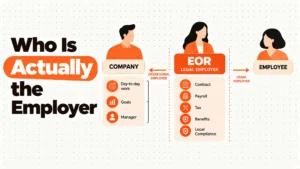
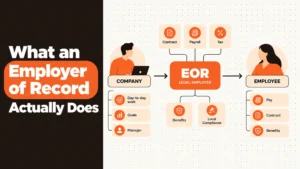
Changing an Employer of Record isn't a software migration. You're firing your lead engineer in Madrid from one legal entity. You're then attempting to hire her into another. This requires her explicit consent. It resets her statutory tenure. It might accidentally trigger a mandatory severance payout under local laws that nobody in your office understands. An Employer of Record sits directly between you and real employment law.
The financial model rarely accounts for this friction. Executives see a line item they can shrink. They miss the human anxiety. They ignore the weeks of legal busywork. The real issue isn't whether another vendor is cheaper, it's whether your current provider is putting your company at legal risk.
Best tools for Employer of Record (EOR) Tools
When Remote is Still the Right Answer
Your setup is genuinely fine when everyone gets paid accurately. Remote owns 100 percent of its legal entities in every operating country. They never rely on third-party aggregator partnerships. If your team is tech-heavy, tearing up their contracts to save a few dollars is a poor trade. You sleep well at night knowing your intellectual property assignment clauses are bulletproof. Remote includes comprehensive IP assignment clauses in every single employment contract across all supported jurisdictions. This protects your company's intellectual property fully.
Cost friction appears when the team scales rapidly. A large international headcount gets expensive at a starting price of $299 per month per employee. You start wondering if you're overpaying for strong legal accountability. You might not strictly need ironclad invention assignment protections for junior customer support staff. The monthly invoice simply gets too large to ignore.
Real risk emerges when contractor onboarding speed becomes a bottleneck. Remote handles contractors slower than alternatives like Deel. If your business model relies on deploying freelancers rapidly, this lag hits your revenue hard. Your hiring managers will start complaining about delays.
The edge case is when you need extremely tangled multi-country support. Remote does an excellent job managing ESOP plans. They handle stock options and equity grants across multiple countries beautifully. The platform tracks vesting schedules perfectly. They even manage jurisdiction-specific tax reporting for exercise events. But complex dual-status employment usually breaks standard systems. That's when you actually outgrow the platform entirely.
Five Questions You Ask Yourself at 11pm
What happens if my EOR gets flagged for Permanent Establishment? You face severe back taxes. Local authorities might decide your worker is actually generating direct revenue in their jurisdiction. The provider takes care of employment taxes but they don't protect your corporate tax status.
Who owns the IP if the EOR uses a third-party aggregator? The local aggregator technically holds the contract. Inserting a middleman complicates your chain of title. Investors hate a messy chain of title during a funding round.
What if the new provider drops a country entirely? You have to scramble. You must either relocate the employee or let them go completely. Providers occasionally exit difficult markets when compliance costs get too high.
Will a migration reset my employee probation periods? Yes, it often does. A new legal employer usually means a new employment contract. The local government sees this as a brand new job starting on day one.
Can an employee refuse to sign the new agreement? Absolutely. If they refuse, you're stuck managing two EOR platforms simultaneously. You can't force someone to resign from their current legal employer.
How This Market Actually Splits
The Owned Entity Model. Providers like Remote build their own legal entities in every operating country. This is right when intellectual property protection is your absolute priority. It offers the strongest legal accountability. It fails when you need to hire someone in a tiny jurisdiction where the provider hasn't yet built a company. Building an entity takes months.
The Partner Network Model. These providers rely on local third-party agencies to act as the legal employer. This setup is right when you need vast geographical coverage immediately. It allows platforms to advertise huge country counts. It fails when a payroll error happens. You submit a ticket to your vendor. They email the local partner. Fixes move incredibly slowly.
The Transition Specialists. Some platforms exist to help you move off an EOR entirely. This is right when your headcount in one country hits a critical mass. It gives you an advisory partner for your own corporate setup. It fails if you just want a hands-off global employment wrapper indefinitely.
Five Diagnostic Questions
Do you hold extremely sensitive intellectual property? If your software patents are the entire valuation of your business, the chain of IP assignment must be perfectly clean. An owned-entity structure provides the safest legal container for this asset class.
How many countries are you actually hiring in? Companies often buy access to 150 countries. They usually only ever hire in three. Don't overpay for a global map you won't use. Focus on the depth of compliance in your specific markets.
Are you hiring full-time employees or freelance contractors? A provider charging $199 for an employee might charge entirely different fees for a contractor. Look at your actual workforce split to find the true cost. Some platforms bundle contractor management for free.
Does your board plan to establish local entities next year? If you intend to open an office in London soon, you need a partner who will actively assist with that transition. A pure EOR platform can't help you incorporate. They only rent you their entity.
Who handles your global payroll? Using one vendor for EOR and another for payroll across owned entities creates messy reconciliation issues. Your finance team will waste days matching up the data. Consolidated platforms solve this headache.
The Nine Alternatives, Reviewed
Deel
Deel is the best overall EOR for global teams of any size because it offers rapid contractor onboarding alongside global payroll across ninety jurisdictions. You can hire contractors across 150 countries from just $49 a month using a single unified flow featuring automated tax document generation. It earns its top place by combining fast EOR functionality with comprehensive local statutory deductions and native language payslips. But it can become noticeably expensive for large employee counts while some obscure country-specific edge cases still require frustrating manual handling.
Multiplier
Multiplier is the best EOR for fast employee onboarding because it gets employees signed and enrolled in local statutory benefits within 48 hours. The platform builds highly competitive country-specific packages covering health insurance and provident funds benchmarked against local market norms. It earns its place through highly effective multi-currency payroll handled by in-country teams across major markets like Singapore and India. But pricing is strictly on request, and its total country coverage is narrower than the top competitors while suffering from a less established brand outside the Asia-Pacific region.
Papaya Global
Papaya Global is the best enterprise EOR with automated compliance for large companies deploying more than 500 global employees. It earns its place through deep AI-powered compliance checks across 160 jurisdictions that scan every single payroll run for statutory errors. The platform delivers real-time payroll cost dashboards that integrate beautifully with external business intelligence tools for complex financial planning. However, implementation time for enterprise deals takes a long while and pricing is completely on request.
Oyster HR
Oyster HR is the best EOR for employee experience because it publishes transparent pricing from $399 per month without hiding fees behind sales calls. It earns its place through a beautifully designed employee self-service portal alongside Equity-Plus packages offering highly competitive health and pension benefits. These supplemental benefits sit above statutory minimums to actively reduce the painful attrition common with remote workers. But the underlying per-employee cost is inherently higher while the total country coverage remains smaller than what competitors like Deel offer.
Velocity Global
Velocity Global is the best EOR for complex employment compliance because it actively tackles dual-status workers and executive-level contracts that most standard platforms decline. It earns its place through expert multi-jurisdiction equity grant management covering tax reporting at exercise alongside coordinated immigration support services. They simplify the complicated employee relocation process by managing work permit applications concurrently with local EOR employment duties. But pricing is available on request rather than published, and the platform relies far less on self-service mechanics than newer alternatives.
Globalization Partners
Globalization Partners is the best EOR for large enterprise global operations requiring a documented 15-year history of compliance incident management. It earns its place by providing serious in-country legal expertise for real-time employment law guidance rather than relying solely on automated contract templates. The comprehensive technology platform reliably covers time off tracking alongside expense reimbursement through a solid self-service employee portal. But the user interface feels noticeably less modern than recent software entrants, and pricing is strictly on request for identical geographical coverage.
Remofirst
Remofirst is the best affordable EOR for growing global teams because it provides solid coverage across 170 countries from a highly attractive $199 per month. It earns its place by making global hiring actually affordable for startups while throwing in basic contractor management completely for free. You can administer country-specific health insurance alongside mandatory pension benefits to test international relationships before upgrading to full EOR employment. But their support team is much smaller than the industry giants and they offer less depth when dealing with particularly complex compliance scenarios.
Atlas HXM
Atlas HXM is the best EOR when transitioning to a local entity because they combine basic EOR employment with deep company registration advisory services. It earns its place through dedicated in-country advisors who provide guidance on corporate structure expertise across complex emerging markets in Africa. This advisory support is highly valuable because third-party EOR aggregators are riskiest in regions requiring delicate market entry strategies. But it isn't suitable if you only want a pure EOR solution indefinitely, and pricing is exclusively on request.
Horizons
Horizons is the best EOR for Asia-Pacific hiring because they operate dedicated in-house teams across China and Japan instead of relying on third parties. It earns its place through excellent multi-currency payroll handling local statutory reporting in RMB and JPY alongside deep China-specific social insurance expertise. Their in-house Shanghai staff manage complex housing fund contributions accurately to handle the most difficult EOR market in Asia. But pricing is strictly on request, and their coverage across the Americas is decidedly thinner.
The Decision Table
| Situation | Scale | Setup | Primary Pain | Recommended Starting Point |
|---|---|---|---|---|
| Heavy IP protection required | Any | EOR only | IP leakage risk | Remote |
| Rapid contractor scaling | 50+ | Contractors | Slow onboarding | Deel |
| Expanding into Asia | 10-100 | EOR | Local benefits setup | Multiplier |
| Complex dual-status employment | 500+ | Mixed | Multi-country compliance | Velocity Global |
| Tight budget for wide reach | 1-50 | EOR + Contractors | High per-seat fees | Remofirst |
| Bridging to owned entities | 100+ | EOR transitioning | Entity setup advice | Atlas HXM |
| Enterprise automated payroll | 1000+ | Owned entities | Compliance errors | Papaya Global |
The Cost of Getting This Wrong
Changing your provider is a legal tear-down. If you botch the migration, the second-order costs dwarf any monthly software savings. You might leave an employee entirely unpaid for a month while two competing vendors argue over a local tax cutoff date. Your finance lead will spend weeks trapped on support calls trying to fix the mess.
Then you face misclassification exposure. An employee might get caught between two different interpretations of a local labor code. Their statutory tenure quietly resets. Next quarter, you suddenly discover your new vendor can't legally hire in a country you desperately need. You're suddenly forced to look for a third vendor.
The disruption bleeds into productivity. Employees talk to each other when their contracts change. Morale drops when people feel their employment status is insecure. Good engineers leave when payroll gets messy. Ask yourself this before you sign a new contract: are you solving a real business problem or just appeasing a spreadsheet?
Moving Beyond a Basic Setup
Scaling a global workforce eventually breaks simple tools. You hit a point where template contracts no longer cover your executive compensation packages. Finding the right operational partner becomes a major strategic advantage. You need vendors who understand local context instead of just building better dashboards.
HROpsLab exists to clarify these exact transitions. We conduct independent review work across the entire employment sector. We test platforms. We interview users to figure out where the marketing claims fall apart. We read the fine print so you don't have to.
We don't sell software. We are a review publication dedicated to giving HR professionals honest data. You can trust our assessments because we sit on your side of the table. We want you to make decisions based on reality.
Frequently Asked Questions
Do I need my employees' consent to change EOR providers?
Yes. Moving from one provider to another requires terminating the original local employment contract entirely. The employee must voluntarily sign a brand new agreement with the incoming legal entity under new local terms. If they refuse to sign the paperwork, you can't legally force the transfer under any circumstances. You're then left with the difficult choice of managing a legacy employee on your old platform or negotiating a mutual separation agreement.
Will changing providers reset my team's statutory tenure?
It often does because the local government views the transition as a brand new job starting on day one. Your employee is technically starting fresh with a completely different corporate entity. Their continuous service clock restarts for the purposes of statutory redundancy pay and protected leave accrual. You must take local legal advice to ensure you structure the transition to protect their existing rights without accidentally triggering immediate severance liabilities.
Does an EOR shield me from all permanent establishment risk?
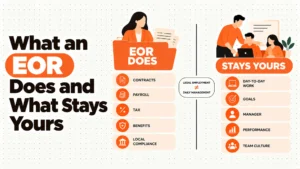
No. An Employer of Record primarily handles local payroll duties alongside basic HR compliance. If your remote worker actively negotiates major sales contracts or acts as a dependent agent for your business, local tax authorities will take notice. They can still claim you've created a taxable corporate presence regardless of who runs the payslips. An EOR shields you from employment law breaches but it doesn't protect your underlying corporate tax status.
How long does a typical EOR migration take?
A standard transition usually requires at least two full months of overlapping service between the two providers. You have to carefully map out local notice periods to ensure nobody is left without legal employment for a week. You must coordinate the offboarding dates precisely while ensuring the new payroll cycles align perfectly with the old ones. Rushing this process inevitably leads to missed tax filings and furious employees who miss their mortgage payments.
Can I keep my contractors on one platform and move my employees to another?
You can. Many finance teams use a specialist platform for cheap contractor payments while retaining a premium EOR service for full legal employment. You can absolutely split your workforce this way to optimize your monthly software fees. This dual setup creates slightly more administrative work for your finance department during month-end reconciliation. However, the substantial cost savings on contractor seats usually justify the minor operational inconvenience.
What happens to accrued vacation time during a vendor switch?
The original Employer of Record usually pays out any accrued vacation as a mandatory lump sum during the final termination process. The employee then starts with a zero vacation balance at the new legal entity. You can choose to manually honor the old balance internally by tracking it on a separate spreadsheet. This prevents resentment from staff who feel they lost their hard-earned time off during a corporate vendor switch.
Are third-party aggregator networks inherently bad?
Not always. They allow software platforms to offer immense geographical coverage very quickly without spending years incorporating local companies. This partner model is highly effective for standard payroll processing in straightforward legal jurisdictions. But the layered communication drastically slows down problem resolution when a complicated local payroll issue arises. You end up waiting days for your vendor to email their partner who then has to consult a local accountant.
We deliver clarity for global HR teams.