

TL;DR
- The core decision: Moving away from your current Employer of Record means legally firing your international team and asking them to sign new contracts with a stranger.
- When staying put is right: If you've dual-status workers or executive equity plans running through Velocity Global, the friction of moving likely outweighs any monthly fee savings.
- What an EOR actually does: They sit directly in the line of fire for local employment law and tax compliance.
- How this market splits: Providers either own their legal entities in the target country or they rent space on someone else's corporate structure.
- The decision rule: Don't migrate providers simply to chase a cheaper monthly platform fee.
- The outcome to expect: A successful transition requires months of project management and individual calls with every affected employee.
| Provider | Rating | Pricing | Trial | Best for |
|---|---|---|---|---|
| Velocity Global (your current provider) | 4.4/5 | Pricing on request | Free demo available | Best EOR for complex employment compliance |
| Deel | 4.8/5 | From $49/month per contractor | Free demo available | Best overall EOR for global teams of any size |
| Remote | 4.7/5 | From $299/month per employee | Free demo available | Best EOR for IP protection and owned legal entities |
| Multiplier | 4.6/5 | Pricing on request | Free demo available | Best EOR for fast employee onboarding |
| Papaya Global | 4.5/5 | Pricing on request | Free demo available | Best enterprise EOR with automated compliance |
| Oyster HR | 4.5/5 | From $399/month per employee | Free demo available | Best EOR for employee experience and benefits |
| Globalization Partners | 4.3/5 | Pricing on request | Free demo available | Best EOR for large enterprise global operations |
| Remofirst | 4.3/5 | From $199/month per employee | Free plan + free demo | Best affordable EOR for growing global teams |
| Atlas HXM | 4.2/5 | Pricing on request | Free demo available | Best EOR when transitioning to a local entity |
| Horizons | 4.2/5 | Pricing on request | Free demo available | Best EOR for Asia-Pacific hiring |
The Real Cost of Switching
You get a Slack message on a Tuesday morning from your lead engineer in Berlin. She has found a house to buy and needs an employment verification letter. When she forwards you the document provided by the local Employer of Record, you notice her start date is listed as three months ago. She has been working for you for four years. The previous HR director changed EOR platforms over the summer to save fifty dollars a head.
This is the moment you realize what EOR migration actually entails. It isn't a software implementation. It's a mass termination and re-hiring exercise across multiple foreign jurisdictions. Every employee has to consent to the move. They have to read a new local employment contract. They have to worry about their probationary periods resetting.
So when your finance lead asks if you can find a cheaper alternative to Velocity Global before the next renewal cycle, you've a difficult conversation ahead. Lowering the monthly invoice is easy. Doing it without triggering a localized severance event is hard. The real issue isn't the monthly software subscription fee, it's the profound legal exposure of migrating your entire international workforce.
Best tools for Employer of Record (EOR) Tools
When to Stay Put
Sometimes the best migration plan is no migration at all. Velocity Global holds a 4.4/5 rating for a reason. Their core strength lies in complex, highly specific employment scenarios that modern software-first competitors quietly decline during the sales process.
If your setup is genuinely fine and employees are paid accurately in local currency, leave it alone. The platform interface might feel a little dated compared to newer tools. But aesthetic friction doesn't justify risking your team's livelihood. The disruption of moving an employee to a new legal entity will cost you more in lost productivity than you'll save on the license fee.
Cost friction is usually what starts the search for alternatives. You see a startup advertising a flat rate and wonder why you pay significantly more. You have to ask yourself what that premium covers. When real risk materializes, such as an aggressive local tax authority questioning a dual-status worker, you want a provider with deep local legal counsel.
The true edge case belongs to multi-country equity and immigration. If you grant complex executive stock options across borders or require constant work permit sponsorship, Velocity Global is actively protecting you. Most low-cost providers will force you to manage these compliance headaches yourself. Re-papering those specific employment contracts is a genuine reason to stay exactly where you're.
The Midnight Panic Questions
What is our permanent establishment risk right now?
Your EOR shields you from local employment law. It doesn't completely shield your corporate entity from being taxed locally if your foreign employee is signing major sales contracts. You need to know if your provider monitors this specific threshold.
What happens if the provider drops a country?
Geopolitics shift rapidly. If your EOR decides to exit a specific market because the compliance burden got too high, your employees there instantly lose their legal employer. You need a contingency plan for your most remote workers.
Will this transition trigger mandatory severance?
In many European jurisdictions, firing an employee from one legal entity to hire them in another triggers statutory severance payouts. You have to know if the new provider has a legally binding continuity of service agreement ready to deploy.
Who owns the IP if the aggregator goes bankrupt?
If your platform uses third-party local partners, your intellectual property assignment flows through a company you've no direct contract with. If they fail, your codebase ownership might be contested.
Does a tenure reset restart the probation period?
When an employee signs a new contract with a new EOR, local law might default to a new probationary period. You must manually ensure the new contracts explicitly waive probation to maintain trust with your veteran staff.
How the EOR Market Actually Splits
This industry isn't a monolith. The primary divide separates providers that own their local legal entities from those that rely on a local partner network. This structural difference dictates how fast a payroll error gets fixed.
Providers with fully owned legal entities build their own corporate infrastructure in every market they sell. Remote operates this way. When you hire someone in Spain, they're employed by a Spanish company entirely controlled by Remote. This is the right approach when intellectual property protection is your highest priority. It fails when you need to hire rapidly in an obscure emerging market where the provider hasn't built an entity yet.
Aggregator networks rely on local third-party employment agencies. They provide a beautiful software interface that sits on top of a fragmented global supply chain. This allows them to offer massive country coverage almost instantly. It's ideal for testing a new market before committing resources. But it fails when an employee has a complex tax grievance. Your support ticket gets passed from the software vendor to the local partner, adding days to the resolution time.
The all-in-one software layers try to blend these models. Deel uses owned entities in major markets and partners elsewhere. They bundle contractor management and global payroll into a single dashboard. This is perfect for finance teams who want one login for all international spend. It struggles when you demand deep, consultative legal advice for a single, highly unusual executive hire.
Five Questions to Ask Before Moving
How complex is your current equity structure? If you offer standard non-qualified stock options, most platforms can track them. If you run complex multi-jurisdiction vesting schedules tied to performance metrics, you need specialized administrative support.
Are you hiring senior executives or entry-level contractors? Executive contracts require intense negotiation and custom clauses. Many automated platforms reject non-standard contract amendments outright.
What is your risk tolerance for misclassification? Moving from EOR to independent contractor status saves money. It also opens you up to massive retroactive tax penalties if the local government audits your relationship.
Do you plan to open your own legal entity eventually? If your strategy is to use an EOR as a temporary bridge for two years, you need a provider that specializes in transitioning employees off their platform and onto your own payroll.
Have you actually asked your international team what they want? Sometimes the benefits package offered by your current provider is the only reason an employee stays. Changing providers means changing their local health insurance network.
The Nine Alternatives, Reviewed
Deel
Deel is best for companies requiring a massive global footprint and fast onboarding. They handle full-time EOR employment across 90+ countries and support independent contractors in over 150 jurisdictions. You get local contracts and multi-currency payments in a single software interface.
It earns its top position because it consolidated an entirely fragmented industry into one predictable workflow. The onboarding speed is unmatched for standard employment scenarios. Deel operates with a 4.8/5 rating and transparent pricing starting from $49/month per contractor.
But the platform can be expensive for large employee counts on the full EOR product. If your workforce has highly unusual country-specific edge cases, you'll find their automated workflows frustratingly rigid.
Remote
Remote exists for tech companies terrified of intellectual property leakage. They own 100% of their legal entities rather than relying on third-party aggregators. This model guarantees that your IP and invention assignment clauses are legally airtight in the local jurisdiction.
It belongs on your shortlist if you're preparing for an acquisition or an IPO. Investors hate sloppy IP chains. Remote secures a 4.7/5 rating and manages ESOP and stock options natively across its owned entity network. Pricing begins from $299/month per employee.
Their strict compliance model comes at a cost. Contractor onboarding is noticeably slower than Deel. The higher price point makes them a tough sell for companies operating on thin margins.
Multiplier
Multiplier is built for teams focused on the Asia-Pacific region. They excel at incredibly fast onboarding. An employee in Singapore or India can be documented and enrolled in local benefits within 24 to 48 hours.
They earn a place here by providing highly competitive local statutory benefits packages. They benchmark health insurance and provident fund contributions against local market norms. Multiplier holds a 4.6/5 rating. Pricing on request.
Their global reach simply doesn't match the largest players. The country coverage is narrower than Deel or Remote. They have less brand recognition outside of APAC.
Papaya Global
Papaya Global serves large enterprises managing hundreds of global employees. They operate an AI-powered compliance engine that scans every payroll run for statutory errors. They cover EOR operations and standard payroll in over 160 countries.
This platform shines when finance teams need deep integration. They offer real-time payroll cost dashboards with budget versus actual reporting. Papaya Global maintains a 4.5/5 rating. Pricing on request.
You don't buy this software for a quick launch. Implementation time for enterprise deals is notoriously long. The pricing structure is significantly less transparent than startups expect.
Oyster HR
Oyster HR prioritizes the actual human being signing the contract. They deliver the best employee self-service portal in the market. Workers get beautifully designed interfaces for accessing payslips and managing expense reimbursements.
They win deals by being entirely transparent. Full pricing is published on their website starting from $399/month per employee. They offer competitive health and pension benefits that sit above statutory minimums. Oyster holds a 4.5/5 rating.
That premium employee experience costs money. The per-employee fee is higher than budget alternatives. Their total country coverage remains smaller than the category leaders.
Globalization Partners
Globalization Partners is the legacy choice for cautious enterprise operations. They possess a 15+ year track record in the EOR space. They employ dedicated in-country legal experts rather than relying on automated template libraries.
They're the safest bet for highly complex corporate structures. They offer documented public case studies and a massive compliance incident history to satisfy aggressive procurement teams. Globalization Partners maintains a 4.3/5 rating. Pricing on request.
The technology feels a generation behind. The interface is less modern than Remote or Deel. They're consistently more expensive than newer competitors for the exact same country coverage.
Remofirst
Remofirst targets growth-stage companies with tight budgets. They offer flat-rate EOR employment from $199/month per employee. They maintain coverage across 170+ countries while including basic contractor management at no extra cost.
This is the platform you choose when you need broad geographical reach without the premium markup. They handle country-specific health insurance and pension deductions effectively. Remofirst secures a 4.3/5 rating.
You get what you pay for in customer service. The support team is smaller than the market leaders. They lack the legal depth required for incredibly complex, dual-status compliance scenarios.
Atlas HXM
Atlas HXM serves as a bridge for companies planning to open their own foreign entities. They combine standard EOR employment with deep corporate registration advisory. They want to employ your staff today and help you register your own local branch tomorrow.
They excel in emerging markets. If you need to hire in Africa or the Middle East, their dedicated in-country advisors understand the local regulatory environment intimately. Atlas maintains a 4.2/5 rating. Pricing on request.
They're not designed to be a permanent software layer. They're less suitable as a pure EOR-only solution. The core technology investment lags behind Deel.
Horizons
Horizons is the regional specialist for building distributed teams in Asia. They maintain dedicated in-house teams in China and Singapore. They don't rely on local partner networks for their core APAC geographies.
Their China employment expertise is unmatched. They handle complex social insurance and housing fund deductions with specialized in-house staff in Shanghai. Horizons holds a 4.2/5 rating. Pricing on request.
Outside of Asia, the value proposition drops. Their coverage in the Americas is noticeably thinner. They lack brand recognition in European markets.
The Decision Table
| Situation | Scale | Setup | Primary Pain | Recommended Starting Point |
|---|---|---|---|---|
| IP Protection is critical | 10 to 500 employees | High equity compensation | Need guaranteed IP assignment | Remote |
| Global hiring at speed | 1 to 1000+ employees | Mix of contractors and EOR | Disconnected payroll systems | Deel |
| Retaining veteran employees | Enterprise | Complex dual-status workers | Fear of compliance audits | Velocity Global |
| Asia-Pacific expansion | 10 to 200 employees | Local entity plans | Need fast APAC onboarding | Multiplier |
| Transitioning to owned entity | 50 to 500 employees | Emerging markets focus | Need local corporate advisory | Atlas HXM |
| Tight startup budget | 1 to 50 employees | Standard local hires | High monthly platform fees | Remofirst |
| Executive global mobility | Enterprise | Multi-country immigration | Work permit management | Velocity Global |
| Deep China market entry | 10 to 500 employees | RMB payroll required | Local social insurance rules | Horizons |
The Second-Order Costs
Do the math on a botched transition. You terminate an employee in France under the old EOR. The new EOR miscalculates the mandatory notice period. The employee is left unpaid for a month while two separate legal departments argue over liability. The employee resigns in disgust. You just spent thirty thousand dollars recruiting their replacement to save a fraction of that on software fees.
Then look at misclassification exposure. You decide to bypass the EOR model entirely and move a European worker to an independent contractor agreement. Two years later, the local tax authority audits your relationship. They determine the worker was a de facto employee. You owe two years of back taxes and severe financial penalties.
Even a smooth transition carries hidden debt. If tenure quietly resets during the contract migration, you've effectively wiped out an employee's accrued legal protections. When you eventually need to conduct layoffs, that tenure reset alters your entire severance calculation. Are you actually prepared to manage that localized financial fallout?
Moving Beyond the Basics
Finding the right employment partner requires looking past the polished marketing websites. Every provider claims to offer total global compliance. Only a few actually have the localized legal infrastructure to defend you when a foreign tax authority opens an investigation.
This is why independent verification matters. You need to read raw feedback from finance leaders who have survived an EOR audit. You need to know which platforms quietly drop support tickets and which ones put a local employment lawyer on the phone within an hour.
HROpsLab tracks these exact metrics. We analyze EOR performance data to help founders make better infrastructural decisions. We don't sell EOR software. We provide the unvarnished analysis you need before you force your international team to sign a new set of employment contracts.
Frequently Asked Questions
What happens to employee benefits during an EOR transition?
The new Employer of Record must secure a completely new benefits package from local insurance carriers. This rarely results in an exact match. Deductibles change, coverage networks shift, and employees often lose access to their preferred doctors. You must audit the proposed benefits package line by line before asking any employee to sign a new contract.
Do I have to pay severance when changing EOR providers?
In many strict jurisdictions, terminating a worker from one EOR legally triggers statutory severance, regardless of your intention to rehire them immediately. The incoming provider must carefully draft a continuity of service agreement. If the local government rejects that agreement, you'll be liable for the full severance payout.
Can a provider legally operate without an owned entity?
Yes. Many platforms operate as aggregators by forming commercial partnerships with local, fully licensed employment agencies. The local agency acts as the legal Employer of Record on paper. The software platform simply handles the money movement and the user interface.
Why do EOR platforms charge flat fees instead of percentages?
A flat fee structure protects the provider from currency fluctuations and makes revenue forecasting predictable. It also prevents the provider from being financially penalized for hiring lower-wage workers in emerging markets. Flat fees ensure the HR technology company margins remain stable regardless of the employee's localized salary.
Is an EOR responsible for employee daily management?
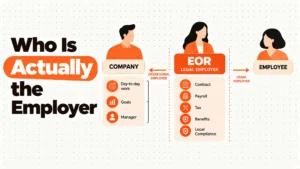
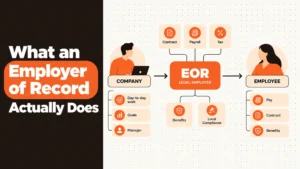
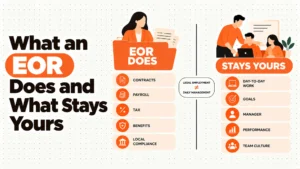
No. The Employer of Record handles payroll taxes, local benefits, and statutory compliance. You retain complete control over the employee's daily tasks, performance reviews, and project management. The EOR exists solely to shield you from foreign corporate tax liabilities.
Can I transition EOR employees to my own local entity later?
Yes. Most providers offer specific transition services for this exact scenario. When your local headcount grows large enough to justify the overhead of running your own payroll, the EOR will terminate the workers so you can hire them directly into your newly registered local branch.
Does EOR software integrate with my main HRIS?
The major platforms offer native integrations with systems like Workday and BambooHR. This ensures that when you update a salary in your central HRIS, the change pushes automatically to the EOR payroll engine. You must verify this API functionality during the sales process to avoid manual double-entry.
Global payroll doesn't have to be a blind spot.