Lattice and Culture Amp stand out as the best performance management software for organizations that want 360-degree feedback built directly into their workflow rather than bolted on as a side survey tool. If you run under 100 employees and need something lighter, 15Five or PerformYard cover the basics without the enterprise price tag. Teams already inside Workday or SAP SuccessFactors for HRIS should stay put and activate their native 360 modules before shopping elsewhere — switching costs rarely pencil out. Anyone still collecting peer feedback through Google Forms and spreadsheets should stop reading reviews and start a trial; the operational drag of manual 360 cycles costs more in HR hours than any subscription fee. This guide breaks down which performance management software with 360 feedback actually fits your headcount, budget, and review cadence.
TL;DR
- Pick Lattice if you're a 200-1,000 employee company that wants 360 feedback, OKRs, and engagement surveys in one contract.
- Pick Culture Amp if 360 feedback quality and people-science rigor matter more to you than raw feature count.
- Pick 15Five if you're under 200 employees and want 360 feedback without a six-figure annual commitment.
- Pick PerformYard if you need flexible review cycles and 360 feedback but your budget caps out around $10-15 per employee per month.
- Stay on Workday or SAP SuccessFactors if you already run payroll or core HR there — activate the native 360 module instead of buying a third tool.
- Walk away from any vendor that can't show you anonymized reviewer aggregation in a live demo — that's the feature most likely to be oversold.
- Budget for change management, not just software — a poorly rolled out 360 cycle damages trust faster than no 360 cycle at all.
Quick comparison table
| Vendor | Built-in 360 feedback | Best for | Starting price (approx., 2026) | OKR/goals module | Notable limitation |
|---|---|---|---|---|---|
| Lattice | Yes, native | Mid-market (200-1,000) | ~$11/user/mo base + 360 add-on | Yes | Add-on pricing stacks up fast |
| Culture Amp | Yes, native | Companies prioritizing feedback science | Custom quote, typically $10-15/user/mo | Limited (partner integrations) | Less mature goal-tracking than Lattice |
| 15Five | Yes, native | SMB (under 200 employees) | ~$8-14/user/mo | Yes | 360 features weaker at scale |
| PerformYard | Yes, native | Budget-conscious mid-market | ~$5-10/user/mo | Basic | Reporting less polished |
| Workday | Yes, native module | Enterprise already on Workday HCM | Bundled into HCM contract | Yes | Expensive and slow to configure standalone |
| SAP SuccessFactors | Yes, native module | Large enterprise, global workforce | Bundled/custom enterprise pricing | Yes | Heavy implementation lift |
What is the best performance management software with built-in 360-degree feedback?
For most mid-market companies, Lattice and Culture Amp are the strongest performance management platforms with 360-degree feedback built directly into the review cycle, not sold as a bolt-on survey tool. Both let you launch peer, manager, and self-assessments from the same workflow that drives formal reviews, so feedback data feeds directly into calibration and development conversations instead of living in a separate export.
The "best" answer depends heavily on what you're optimizing for. If you want one platform that handles 360 feedback, quarterly OKRs, engagement pulses, and manager 1:1s, Lattice is built for that breadth — it's essentially trying to be the operating system for people management, and 360 feedback is one module among several that talk to each other. Culture Amp takes a narrower but arguably deeper approach: its 360 feedback question libraries are built with input from organizational psychologists, and its reporting emphasizes statistical rigor (response rate thresholds, bias flags in written comments) more than any competitor in this price range.
Best tools for Performance Management
Why "built-in" matters more than "available"
A lot of platforms technically offer 360 feedback — BambooHR, for example, supports peer feedback through its performance module — but the difference between "available" and "built-in" is whether the 360 cycle shares data structures with your regular review cycle. If your 360 results live in a separate report that a manager has to manually reconcile with the formal review score, you haven't actually solved the workflow problem; you've just added another tool to check.
Where Workday and SAP SuccessFactors fit
If you're already running Workday HCM or SAP SuccessFactors for core HR and payroll, the calculus changes. Both platforms have native 360/multi-rater feedback modules, and the integration argument for buying a separate best-of-breed tool weakens considerably once you factor in single sign-on, existing org-chart data, and one less vendor contract to negotiate. The tradeoff is configuration time — enterprise suites typically take weeks longer to stand up a 360 cycle than a purpose-built tool like Lattice or 15Five.
What to do:
- Shortlist based on whether 360 data flows into the same review record as manager ratings, not a separate report.
- Ask each vendor to demo the manager-facing view of aggregated 360 results, not just the admin dashboard.
- If you're on Workday or SAP SuccessFactors, get a configuration cost estimate before assuming you need net-new software.
How does 360-degree feedback work inside a performance management platform?
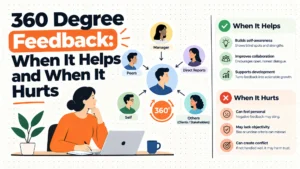
360-degree feedback inside a performance platform typically runs as a scheduled cycle where an employee's manager, peers, direct reports, and sometimes cross-functional stakeholders complete a structured questionnaire, and the platform aggregates responses into a report the employee and manager review together. The mechanics differ by vendor mainly in how anonymity is handled and how the data connects to formal ratings.
The typical cycle sequence
Most tools follow a similar sequence: an HR admin or manager initiates a 360 cycle, the employee (or manager) selects reviewers, the platform sends automated reminders, responses get collected over a window (usually 1-3 weeks), then results are compiled into a report. Lattice and Culture Amp both let you set minimum reviewer thresholds — typically requiring at least three respondents per category before showing aggregated scores — specifically to protect anonymity. Fall below that threshold, and the system withholds the breakdown or merges it into a broader category.
Quantitative vs. qualitative feedback
Every platform in this category mixes rating scales (usually 1-5 or 1-7 Likert items on competencies like collaboration or communication) with open-text questions. The better tools — Culture Amp in particular — apply natural-language processing to flag potentially identifying comments before they reach the subject, and some (Lattice included) offer AI-assisted summarization of open-text responses so managers aren't reading twenty paragraphs of unstructured feedback before a calibration meeting.
Anonymity models: full, semi, and attributed
There are three common models. Fully anonymous means the subject never sees who said what, even in aggregate breakdowns by relationship type. Semi-anonymous shows results grouped by relationship (e.g., "peers said," "direct reports said") without naming individuals, which is the most common default. Attributed feedback ties comments to names and is typically reserved for manager and self-assessments, not peer input. Most companies run peer feedback semi-anonymously and manager feedback attributed, and the software needs to support mixing models within a single cycle — not every vendor does this cleanly.
Checklist:
- Confirm minimum-reviewer thresholds before results are shown to the subject.
- Verify the platform supports mixed anonymity models within one cycle (peer semi-anonymous, manager attributed).
- Ask whether AI summarization of open-text feedback is included or a paid add-on.
- Test the reviewer selection workflow — self-nominated peer lists need a manager approval step to prevent gaming.
Lattice vs 15Five vs Workday: Which handles 360 feedback best?
Lattice wins on integration depth, 15Five wins on price-to-feature ratio for smaller teams, and Workday wins only if you're already an enterprise Workday HCM customer who values consolidation over best-of-breed features. None of the three is objectively "best" — the right pick depends on headcount and existing HRIS investment.
Lattice: breadth and workflow integration
Lattice's 360 feedback module sits inside the same product as its performance reviews, goal-tracking (OKRs), and engagement surveys. The practical benefit: when a manager sits down for calibration, the 360 scores, self-review, goal completion rate, and manager rating are all visible in one screen. That reduces the manual stitching-together that HR teams do in spreadsheets. The tradeoff is cost — 360 feedback is often sold as an add-on module on top of the core performance plan, and companies report the full-featured bundle (performance + 360 + engagement + OKRs) landing well above the advertised base per-seat price.
15Five: right-sized for growth-stage companies
15Five built its reputation on manager check-ins and weekly pulse surveys, and its 360 feedback feature ("Best-Self Review" style cycles in some packaging) is solid without trying to be Culture Amp-level scientific. For a 80-150 person company running its first structured performance cycle, 15Five's simpler configuration and faster time-to-launch (often days, not weeks) makes it a realistic option that a two-person HR team can actually administer without dedicated admin headcount.
Workday: consolidation over specialization
Workday's 360/multi-rater feedback functionality lives inside Workday HCM's Talent module. It's capable — large enterprises run global 360 cycles on it — but it wasn't designed as a standalone best-of-breed feedback tool, and it shows in the user experience: more clicks to launch a cycle, less flexible question customization, and reporting that's capable but requires someone fluent in Workday's report-writer to extract insight. The argument for Workday isn't feature superiority; it's that if you already pay for Workday HCM, adding a third-party 360 tool means duplicate employee records, duplicate SSO configuration, and a second vendor relationship to manage for a feature you may already own.
A worked comparison scenario
Picture a 350-person SaaS company already on Workday for payroll and core HR but frustrated that nobody actually uses the 360 module because it's buried three menus deep. The realistic options are: (1) invest in Workday configuration and change management to surface the existing module better, or (2) layer Lattice on top for performance and 360 specifically, accepting the integration overhead of syncing org data between two systems. Most companies in this position choose option 2 for the user experience gain, then revisit the decision at contract renewal once they've measured actual 360 completion rates.
What to do:
- If evaluating Lattice, get an itemized quote showing base performance pricing separate from the 360 module add-on cost.
- If evaluating Workday, sit with an actual manager and time how many clicks it takes to launch a 360 cycle.
- Compare 15Five and Lattice specifically on question-library customization if your competency framework is nonstandard.
Do you need a standalone 360 tool or a built-in module?
Most companies with fewer than 500 employees are better served by a built-in 360 module inside their performance management platform rather than a standalone specialist tool like Spidergap or Trakstar's feedback add-ons. The exception is organizations with heavy compliance or leadership-development-specific 360 needs that justify a dedicated tool.
The case for built-in
A built-in module means one login for employees, one data model connecting 360 results to review scores and goal completion, and one vendor relationship to manage. When the best performance management software options like Lattice, 15Five, or PerformYard include 360 feedback natively, you avoid the classic integration headache of syncing org charts, employee IDs, and review dates between two separate systems — a problem that eats HR admin hours every single cycle, not just at setup.
The case for standalone
Standalone 360 tools tend to win on two fronts: depth of psychometric validation and executive/leadership-specific competency models. If you're running 360 feedback specifically for a leadership development program — say, assessing your VP-and-above cohort against a custom leadership competency framework tied to an external coaching engagement — a specialist tool often has more sophisticated normed benchmarking (comparing your leaders' scores against industry percentiles) than what's baked into a general performance platform. Some coaching and leadership-development vendors require you to run 360s through their proprietary instrument anyway, in which case the question is moot.
A cost and complexity tradeoff table
| Factor | Built-in module | Standalone tool |
|---|---|---|
| Vendor contracts | 1 | 2 (performance platform + 360 tool) |
| Data reconciliation effort | Low — same record | Medium-high — manual or API sync |
| Competency model depth | Adequate for most companies | Often deeper, more customizable |
| Cost at 300 employees | Bundled into per-seat pricing | Additional $3,000-15,000/year typically |
| Best fit | General annual/semi-annual review cycles | Leadership development, executive coaching |
Realistic scenario
A 220-person logistics company runs semi-annual reviews for all employees and wants peer feedback folded into that process. A built-in module in PerformYard or 15Five handles this without friction. Contrast that with a company running a dedicated high-potential leadership program for 15 senior directors, using external executive coaches who require a specific validated 360 instrument — that's a case for a standalone tool used only for that cohort, run alongside (not instead of) the built-in module for everyone else.
What to do:
- Map your use case: annual/semi-annual reviews for all staff (built-in) vs. leadership development for a specific cohort (consider standalone).
- Ask coaching or leadership-development vendors whether they require a proprietary 360 instrument before buying a general platform.
- Calculate the admin hours currently spent reconciling data between two systems if you already run a standalone tool alongside a performance platform.
How much does performance management software with 360 feedback cost?
Expect to pay approximately $8-15 per employee per month for mid-market platforms with built-in 360 feedback, with enterprise suites like Workday or SAP SuccessFactors priced as part of a broader HCM contract that's harder to isolate to a per-seat number. 360 feedback is frequently sold as an add-on module rather than included in the base performance tier, so the advertised starting price rarely reflects your actual invoice.
Why the "base price" understates real cost
Vendors commonly quote a low anchor price for their core performance review functionality, then charge separately for 360 feedback, engagement surveys, and OKR/goals tracking as add-on modules. Lattice, for instance, has historically structured pricing this way — a company buying "just performance reviews" pays one rate, but adding 360 feedback and engagement surveys can push the effective per-seat cost up by 30-50%. Always ask for a quote that includes every module you actually intend to use, not the entry-level SKU.
Implementation and admin overhead costs
Beyond subscription fees, budget for: initial competency framework design (if you don't already have one, expect to spend HR/consultant hours building it before any software matters), manager training on how to deliver 360 feedback constructively, and ongoing admin time running cycles. A 300-person company running semi-annual 360 cycles should expect the HR admin managing the platform to spend meaningful time each cycle on reviewer selection audits, reminder follow-ups, and calibration prep — software reduces but doesn't eliminate this.
Contract term considerations
Most vendors in this space push annual contracts, and multi-year deals often come with 10-15% discounts. Be cautious about locking into a 2-3 year contract before you've run at least one full 360 cycle on the platform — feedback tool satisfaction often depends heavily on how well the reviewer-selection and reporting UX actually performs in practice, which is hard to evaluate from a demo alone. Negotiate a shorter initial term or a pilot period covering one full review cycle if possible.
What to do:
- Request an itemized quote covering base performance, 360 feedback, and any OKR/engagement modules separately.
- Ask for a pilot or shorter initial contract term covering at least one full 360 cycle before committing multi-year.
- Budget separately for competency framework design if you don't already have a documented one.
What should you look for in a 360-degree feedback question library?
The strongest 360 feedback question libraries offer pre-built, research-backed competency frameworks that you can customize without breaking the statistical validity of the scoring. Weak libraries either force generic questions that don't map to your actual role levels, or let you customize so freely that year-over-year comparisons become meaningless.
Pre-built vs. fully custom frameworks
Culture Amp's question library leans heavily on frameworks developed with organizational psychologists, covering competencies like psychological safety, growth mindset, and collaboration with wording tested for bias. Lattice and 15Five offer customizable libraries where you can start from templates and edit freely — good for flexibility, riskier if your HR team edits questions without understanding how phrasing changes affect response distribution. A poorly worded question ("Does this person work hard?") produces mushy, unhelpful data compared to a behaviorally anchored one ("This person meets commitments and deadlines consistently").
Role-level and department customization
A single generic competency set rarely fits an engineering IC, a sales manager, and a customer support lead equally well. Better platforms let you assign different question sets by role, level, or department while still rolling results up into a comparable overall competency score for calibration purposes. Check whether the platform supports this natively or requires manually building separate cycles for each group — the latter multiplies admin work considerably at companies with more than a handful of job families.
Comment prompts and bias mitigation
Rating scales alone rarely give managers enough to act on; open-text prompts matter as much as the numeric questions. Look for platforms that pair every competency rating with a specific behavioral prompt ("What's one thing this person could do differently to be more effective in this area?") rather than a single generic "any other comments" box at the end. Some tools, Culture Amp among them, flag language patterns associated with gender or racial bias in written comments before they're finalized — a feature worth asking about directly if your organization has faced pay equity or promotion-bias scrutiny.
A worked example
A 150-person healthcare tech company customized its 360 question library by copying a generic leadership template and editing five questions internally without HR review. Six months later, calibration meetings surfaced wildly inconsistent scores across departments because two departments had drifted from the original wording, effectively measuring different things. The fix was reverting to a single locked core question set with department-specific supplemental questions layered on top — a structure most platforms support but few companies configure correctly on the first try.
Checklist:
- Confirm the platform supports role- or department-specific question sets that still roll up to comparable scores.
- Lock your core competency questions after the first cycle; only add supplemental questions, don't edit the core set.
- Ask whether bias-flagging on open-text comments is included or a premium feature.
- Pilot the question library with one department before rolling out company-wide.
How do you roll out 360 feedback without wrecking trust?
Rolling out 360 feedback successfully requires transparent communication about how data will and won't be used, a pilot with a smaller group before company-wide launch, and manager training on delivering feedback constructively — skipping any of these three is the most common reason 360 programs fail. The software matters less than the change management surrounding it.
Communicate the "why" before the "how"
Employees who've experienced a bad 360 cycle elsewhere (feedback used punitively, anonymity broken, no follow-up action) will approach a new rollout skeptically. Before you launch anything in Lattice, Culture Amp, or whichever platform you've chosen, communicate explicitly what the feedback will and won't influence — is it tied to compensation decisions, or purely developmental? Companies that are vague on this point see lower response rates and more guarded, unhelpful written feedback.
Pilot before company-wide launch
Run your first 360 cycle with one department or one leadership cohort rather than the entire company. This surfaces configuration problems — wrong reviewer thresholds, confusing question wording, reminder emails going to spam — before they affect 500 people at once. A pilot group of 30-50 employees is usually enough to catch the majority of practical issues, and it gives you a reference group of managers who can advocate for the process once it goes wide.
Train managers on delivering feedback, not just reading reports
The software generates a report; it doesn't run the conversation. Managers need explicit guidance on how to deliver 360 results — leading with strengths, contextualizing outlier comments, and turning feedback into a concrete development plan rather than reading scores aloud. Platforms like Lattice include manager enablement content and templates for this conversation, but budget time for actual training, not just access to a help article.
Protect anonymity mechanically, not just by policy
If your policy says feedback is anonymous but your platform shows a manager a report with only two respondents in the "peers" category, anonymity is broken in practice even if the software technically withheld names. This is the single fastest way to destroy trust in a 360 program — one employee figures out who said what, tells colleagues, and the next cycle's response rate craters. Enforce minimum reviewer thresholds strictly, even if it means merging categories or delaying results for small teams.
Checklist:
- Communicate explicitly whether 360 results influence compensation or are purely developmental — before launch, not after.
- Pilot with 30-50 employees or one department before a company-wide rollout.
- Schedule manager training specifically on delivering 360 feedback conversations, not just platform navigation.
- Enforce strict minimum reviewer thresholds even when it delays or merges results for small teams.
Can small teams (under 200 employees) justify built-in 360 feedback?
Yes, small teams under 200 employees can justify built-in 360 feedback, provided they choose a right-sized platform like 15Five or PerformYard rather than an enterprise suite, and they run cycles no more than twice a year to keep admin overhead manageable. The justification comes down to whether informal feedback culture alone is producing the development conversations leadership actually wants.
The informal-feedback ceiling
Many small companies believe they don't need structured 360 feedback because "everyone talks to everyone anyway." That informal culture works until the company crosses roughly 80-120 employees, when managers can no longer track development conversations by memory and cross-team visibility drops. A structured 360 cycle, even a lightweight one, becomes the mechanism that ensures every employee gets feedback beyond their direct manager's perspective — valuable for spotting collaboration issues that a single manager wouldn't otherwise see.
Right-sizing the tool choice
At under 200 employees, an enterprise suite like Workday or SAP SuccessFactors is almost certainly overkill — both the cost structure and implementation complexity assume a headcount and HR team size that small companies don't have. 15Five and PerformYard are built with lighter admin requirements in mind: faster cycle setup, simpler question customization, and pricing that doesn't require a six-figure annual commitment. A two-person HR team can realistically run a 360 cycle on either platform without dedicating a full-time administrator to it.
Frequency matters more than tooling at this size
For a 120-person company, running 360 feedback quarterly is usually excessive — it creates survey fatigue and diminishing response quality. Semi-annual or even annual cycles, tied to formal review periods, tend to produce better response rates and more thoughtful written feedback than frequent short cycles. This is a process decision more than a software one, but it affects which pricing tier you actually need — some vendors charge based on cycle frequency or number of active cycles per year.
A worked example
A 140-person marketing agency piloted 360 feedback using 15Five ahead of its annual review cycle, running it with just the account management department first (22 people). The pilot surfaced that reviewer selection needed manager approval — several employees had nominated only friendly peers, producing artificially inflated scores. After adding an approval step, the company-wide rollout six months later had noticeably more balanced reviewer pools and higher-quality written feedback.
What to do:
- Evaluate 15Five or PerformYard before considering enterprise suites if you're under 200 employees.
- Default to semi-annual or annual 360 cycles rather than quarterly to avoid survey fatigue.
- Add a manager approval step to reviewer selection from cycle one, not as a fix after the fact.
- Pilot with one department before full rollout even at small headcounts.
How does 360 feedback data integrate with reviews, OKRs, and compensation?
The strongest platforms feed 360 feedback data directly into the same review record used for formal ratings and calibration, while keeping it clearly separated from — but visible alongside — goal completion (OKR) data and compensation decisions. How tightly these systems connect determines whether 360 feedback actually changes outcomes or just generates a report nobody references again.
Feedback as input, not the sole determinant
Best practice, and what most mature platforms support, is treating 360 feedback as one input among several (self-assessment, manager assessment, goal completion, 360 results) that feed into a final calibrated rating — not a standalone score that mechanically determines compensation. Lattice and Culture Amp both support this multi-input calibration view, showing a manager all data sources side by side during calibration sessions rather than forcing 360 scores into a single averaged number that obscures nuance.
The compensation linkage question
This is one of the more contentious configuration decisions. Tying 360 feedback scores directly and transparently to compensation outcomes tends to backfire — reviewers know their input might affect a colleague's raise, and that knowledge measurably changes what they're willing to write, usually toward blander, less useful feedback. Most HR practitioners recommend using 360 feedback developmentally, with compensation decisions driven primarily by manager assessment and goal achievement, with 360 data as supporting context rather than a scored input into a comp formula. Check how your chosen platform's compensation module (if it has one) handles this — some make it too easy to auto-weight 360 scores into a comp recommendation, which conflicts with this guidance.
OKR and goals integration
When 360 feedback and OKR tracking live in the same platform (as in Lattice or 15Five), managers can see whether feedback themes ("doesn't communicate proactively with stakeholders") correlate with missed goals tied to cross-functional collaboration. That correlation is genuinely useful for development planning but requires the platform to present both data sets in one view — exporting two separate reports and manually cross-referencing them defeats the purpose.
A realistic integration scenario
Consider a product manager whose 360 feedback consistently flags weak stakeholder communication, while her OKR completion rate is strong. Viewed in isolation, the OKR data suggests she's a top performer; viewed alongside 360 feedback, her manager sees a specific development area worth coaching before a promotion decision. Platforms that separate these data streams into different tools make this kind of synthesis much less likely to happen in practice, because it requires deliberate manual effort rather than appearing automatically in a single dashboard.
What to do:
- Confirm whether your platform lets managers view 360 results, goal completion, and self-assessment side by side during calibration.
- Decide explicitly whether 360 scores will factor into compensation formulas, and communicate that decision to employees before launch.
- Check your compensation module's default weighting settings — disable automatic 360-to-comp scoring if you want feedback to stay developmental.
What are the data privacy and anonymity risks in 360 feedback tools?
The main data privacy risks in 360 feedback tools are re-identification through small reviewer pools, feedback data retention beyond its useful life, and third-party AI features processing sensitive comments without clear data-handling disclosures. HR and IT should review each vendor's specific safeguards before rollout, not just take "anonymous" at face value.
Small-pool re-identification
The most common real-world privacy failure isn't a data breach — it's a reviewer pool small enough that an employee can deduce who wrote what based on writing style, timing, or content specificity. A team of four where three are on vacation the week feedback closes makes the fourth reviewer's identity obvious even with names stripped. Platforms mitigate this with minimum-reviewer thresholds (commonly three or more per category before showing results), but the threshold is a policy setting, not a hard technical guarantee — admins can often override it, and should be trained not to.
AI features and data processing disclosure
As more platforms add AI-assisted summarization of open-text feedback (Lattice and others have rolled this out), it's worth asking specifically where that processing happens: is employee feedback text sent to a third-party LLM provider, and under what data retention terms? Vendors vary considerably in transparency here, and this is a reasonable question for IT/security review to ask directly rather than assume, especially for companies in regulated industries or with strict data residency requirements.
Data retention and access controls
Ask how long 360 feedback data is retained after an employee leaves the company, who can access historical 360 records (does a new manager inherit visibility into an employee's feedback history from before they managed them?), and whether HR can pull individual-level data outside of the aggregated reporting the platform normally shows. Overly broad admin access — where any HR team member can see raw, non-aggregated 360 responses — undermines the anonymity promise made to employees, even if the interface normally shows only aggregated views.
A realistic risk scenario
A mid-size company discovered during an internal audit that its HR system administrator had unrestricted backend access to view individual 360 responses, bypassing the reviewer-threshold protections the interface normally enforced. No misuse had occurred, but the discovery — surfaced during a routine security review — required disclosing the gap to employees and re-earning trust in the next cycle. The fix was restricting backend data access to a named, audited role rather than general HR admin permissions.
What to do:
- Require vendors to disclose whether AI features send feedback text to third-party model providers, and under what retention terms.
- Set and audit minimum reviewer thresholds; don't allow blanket admin override without a documented reason.
- Restrict backend/raw-data access to a named, audited role rather than general HR admin permissions.
- Define and document data retention periods for 360 feedback tied to departed employees.
Migration and rollout: What to expect switching from spreadsheets or legacy tools
Migrating from spreadsheets or a legacy performance tool to a platform with built-in 360 feedback typically takes 6-10 weeks from contract signature to first live cycle, and the bulk of that time goes to competency framework design and historical data decisions, not technical setup. Underestimating this timeline is the most common planning mistake HR teams make.
What actually takes time
The software configuration itself — setting up review cycles, question templates, and reviewer permission structures — is usually the fastest part, often completable in one to two weeks with vendor implementation support. What takes longer: deciding whether and how to migrate historical review data (most companies don't fully migrate spreadsheet-based history; they start fresh and keep old records in an archive), building or finalizing a competency framework if one doesn't already exist in usable form, and getting manager buy-in through training sessions that have to be scheduled around existing workloads.
Data cleanup before migration
Before importing employee data into a new platform, audit your org chart data for accuracy — outdated manager relationships and org structure errors are the single most common cause of a bumpy first 360 cycle, because reviewer suggestions and approval workflows depend on accurate reporting lines. A worked example: a company migrating from spreadsheet-based reviews to PerformYard discovered during setup that its HRIS org chart hadn't been updated after a reorg three months earlier, meaning the platform's auto-suggested reviewers (based on reporting structure) were wrong for roughly 15% of employees. Fixing this required a manual audit before launch rather than after.
Security and procurement review
Enterprise buyers should expect a security review cycle running in parallel with implementation — SOC 2 report requests, data processing agreements, and SSO/SCIM configuration with your identity provider. This typically adds one to three weeks depending on how quickly your security team and the vendor's can align, and it's worth starting in parallel with contract negotiation rather than after signature to avoid delaying launch.
Training and adoption timeline
Plan for manager training to happen in the two weeks immediately before the first live cycle launches, not months earlier — training retention drops significantly if there's a long gap between the session and actual use. Employee-facing communication (what's changing, why, what to expect) should go out roughly one week before reviewer selection opens, giving people time to ask questions without so much lead time that the announcement is forgotten.
Checklist:
- Audit org chart and manager-relationship data before migration, not during.
- Decide upfront whether to migrate historical review data or start fresh with an archive.
- Start security/procurement review (SOC 2, DPA, SSO/SCIM) in parallel with contract negotiation.
- Schedule manager training within two weeks of the first live cycle, not earlier.
Pricing breakdown
Pricing for performance management software with 360 feedback varies widely by company size and module bundling, and as of 2026 most mid-market vendors price per employee per month with 360 feedback as either an included feature or a paid add-on tier. Enterprise suites bundle pricing into broader HCM contracts that are harder to isolate to a single number, so always request a quote scoped to your actual headcount and module list rather than relying on published starting prices.
| Vendor | Base performance pricing (approx.) | 360 feedback | Typical minimum commitment |
|---|---|---|---|
| Lattice | ~$11/employee/mo | Add-on module, often +$3-5/employee/mo | Annual contract |
| Culture Amp | Custom quote, ~$10-15/employee/mo | Included in core feedback product | Annual contract |
| 15Five | ~$8-14/employee/mo | Included in mid/upper tiers | Annual, some monthly options |
| PerformYard | ~$5-10/employee/mo | Included | Annual contract |
| Workday | Bundled into HCM suite pricing | Included in Talent module | Multi-year enterprise contract |
| SAP SuccessFactors | Bundled/custom enterprise pricing | Included in Performance & Goals module | Multi-year enterprise contract |
These figures are approximate and change frequently; always confirm current pricing directly with each vendor, since published rates often shift with company size tiers, contract length, and module bundling. For a broader breakdown of performance platform pricing across more vendors, see HR Ops Lab's performance management software pricing guide.
Related reading
Frequently asked questions
Does BambooHR include 360-degree feedback?
BambooHR offers peer feedback functionality within its performance management add-on, but it's less solid than purpose-built 360 modules in Lattice or Culture Amp — fewer anonymity controls and less flexible reviewer-threshold settings. Companies wanting BambooHR primarily for HRIS but needing stronger 360 feedback often layer a specialist tool alongside it rather than relying on the native feature alone.
Is 360-degree feedback worth the extra cost over standard performance reviews?
For companies over roughly 100 employees, yes — 360 feedback surfaces collaboration and communication issues that a single manager's perspective misses, which materially improves development planning. Below that size, informal feedback channels sometimes cover the gap, making the extra software cost harder to justify until headcount grows.
Can you run 360 feedback without dedicated software?
Yes, using survey tools like Google Forms or SurveyMonkey, but you'll manually handle anonymity protection, reminder tracking, and aggregation — a significant admin burden above roughly 50 employees. Most companies find the manual approach breaks down at exactly the headcount where 360 feedback becomes most valuable.
How long should a 360 feedback cycle run?
Most platforms and practitioners recommend a two to three week response window — long enough for reviewers to schedule time thoughtfully, short enough to maintain momentum and avoid the process dragging into the next quarter's priorities.
Does 360 feedback work well for remote and distributed teams?
Yes, arguably better than in-office settings, since remote employees often have fewer informal feedback touchpoints and rely more heavily on structured cycles. Platforms with strong async written-feedback tools (Culture Amp, Lattice) tend to perform well here since remote reviewers aren't relying on in-person conversation to supplement written input.
What's the biggest reason 360 feedback programs fail?
Poor change management — specifically, unclear communication about how results will be used and insufficient manager training on delivering feedback constructively — causes more failures than any software limitation. Choosing the right platform matters less than the rollout plan surrounding it.
Should HR see individual 360 feedback responses?
Generally, no — HR should see aggregated results and completion rates, with raw individual responses restricted to a narrow, audited admin role, if accessible at all. Broad HR access to raw responses undermines the anonymity commitment made to employees, even when the standard interface only shows aggregated data.
Final verdict
- Best overall for mid-market companies (200-1,000 employees): Lattice, for its integration of 360 feedback with OKRs and formal reviews in one workflow.
- Best for feedback quality and psychometric rigor: Culture Amp, especially for companies prioritizing bias mitigation and research-backed question design.
- Best for small teams under 200 employees: 15Five, for faster setup and lighter admin overhead without enterprise pricing.
- Best for budget-constrained mid-market: PerformYard, for solid 360 functionality at a lower per-seat cost than Lattice or Culture Amp.
- Best if already on an enterprise HCM suite: Workday or SAP SuccessFactors — activate the native module before buying a third-party tool.
- Best for leadership-development-specific 360 needs: A standalone specialist tool used alongside your general performance platform, not instead of it.
Choosing the right performance management software with 360 feedback comes down to matching platform depth to your actual headcount, existing HRIS investment, and rollout readiness — not chasing the vendor with the longest feature list. For a fuller side-by-side across the broader performance management category, including vendors not covered in depth here, review HR Ops Lab's complete performance management software comparison before you send a shortlist to procurement.