

TL;DR
- The core decision: whether you treat culture as something you describe, or as the pattern of what your organisation actually rewards and tolerates.
- When doing nothing is right: when people at every level would describe the place the same way, and that description matches what you'd say to a candidate.
- What has to be true: somebody can name three recent decisions and say what each one signalled about what matters here.
- How the options split: by where you think culture lives, which determines what you'd change to change it.
- Decision rule: if a statement about your culture couldn't be contradicted by a decision, it isn't describing your culture. It's describing your intentions.
- Outcome to expect: a shorter and less flattering description of your company, and a much clearer view of what would have to change.
Everybody in the Meeting Means Something Different
Somebody gets asked to do something about culture. It's usually prompted by a specific thing: a survey result, a resignation that stung, a leadership team that senses the place has changed. So a meeting gets booked, and within ten minutes it's clear that nobody in the room means the same thing by the word.
One person means how it feels to work here. Another means the values on the careers page. A third means the social side, the team lunches, whether people stay for a drink. Somebody senior means the founder's personality, though they won't say it that way. And the person who called the meeting means something they can't articulate yet, which is why they called it.
The conversation then splits along those lines and never recovers. The people who think culture is atmosphere propose events. The people who think it's values propose a values refresh. Both get approved, because they're cheap and visible, and neither touches the thing that prompted the meeting. A year later the same conversation happens with different people in the room.
Best tools for Leadership & Culture
The real problem isn't that culture is vague. It's that the common definitions point at things that are easy to change and don't matter, while the thing that does matter is set somewhere nobody's looking. Culture is the pattern of what actually gets rewarded, tolerated and punished here. That definition is unglamorous, it's harder to say in a meeting, and it's the only one that tells you what to do differently on Monday.
When You Genuinely Do Not Need to Act Yet
Your current setup is genuinely fine. People at different levels describe the place in similar terms, and those terms match what you'd say to a candidate. That alignment is rare and it means the thing is working. Running a culture project on a healthy culture is a reliable way to damage it, because it signals to everybody that something's wrong when nothing is.
Friction is starting to show. New joiners are surprised by something in their first month, or you've noticed the description in your recruitment materials doesn't match the conversation you'd have with a friend about the place. That gap is the first real signal, and it's worth naming before it widens. The cheapest check is to ask three recent hires what surprised them.
It has become a real cost. People are leaving for reasons that aren't money and aren't the work, or you've heard the same complaint from three different teams. At this point you don't have a communication problem, you have a pattern, and the pattern was set by decisions rather than by what anyone said. Adding a values statement here makes things worse, since it advertises the gap to the people living in it.
The edge case that forces it. You've grown past the point where everybody knows the founders, or you've merged two groups with different habits, or the people who carried the culture informally have left. In all three, something that used to transmit by proximity has stopped transmitting, and nobody notices until the new intake behaves differently and gets blamed for it.
Five Questions This Reader Asks at 11pm
Is culture the same as values? No, and conflating them is the most common error in this subject. Values are what you say matters. Culture is what actually gets rewarded when the two conflict, which they do regularly. A company can hold a genuine value and have a culture that contradicts it, and everybody inside knows which one is real.
Can you change a culture? Yes, but not by describing a different one. Culture changes when the pattern of rewards and consequences changes, which means it changes through decisions about who gets promoted, what gets escalated, and what happens when somebody senior behaves badly. That's slower and less pleasant than a launch, and it's the only route that works.
Who owns it? Whoever makes the decisions people watch. That's usually not the person assigned to culture, which is where most culture work fails: it's given to somebody without the authority to change what's rewarded. HR can hold the mirror and run the process, but if the leadership team's behaviour is the culture, only the leadership team can change it.
How long does it take? Longer than a quarter and shorter than people say when they want to avoid trying. The first visible change is usually a specific decision that goes differently from how it would have gone before, and people notice that faster than any announcement. What takes years is the belief that it'll keep going that way.
Is our culture good or bad? Wrong question, and it's the one leaders most want answered. Cultures aren't good or bad in general; they're a fit or a mismatch for what the organisation is trying to do and for the people in it. A demanding culture with high standards is excellent for some work and some people, and genuinely harmful for others. The useful question is whether yours is the one you need and whether you're honest about it with the people joining.
Three Honest Categories the Approaches Split Into
Culture as something you declare. You write the values, publish them, put them in onboarding, and reference them in communications. It's right as a starting point when nothing has ever been articulated and people genuinely don't know what's expected, and it's right when the stated values actually match observed behaviour, in which case writing them down helps new people learn faster. It fails when there's a gap between statement and practice, because publishing the statement doesn't close the gap, it publicises it. Every person who's watched the opposite behaviour go unaddressed now has a document to measure it against, and cynicism is the reliable result.
Culture as something you build through experience. Offsites, rituals, shared moments, social time, the things that make people feel part of something. It's right for connection, which is a real need and does real work: people who know each other collaborate more easily and give each other more benefit of the doubt. It fails as a lever on culture itself, because it doesn't touch what gets rewarded. A team can enjoy each other's company enormously and still work somewhere where raising a problem ends badly. When this is the whole approach, it reads to employees as a company treating a structural issue with entertainment.
Culture as the pattern in decisions. You look at what actually happens: who gets promoted, what gets tolerated, which requests get approved, what happens when a senior person behaves badly. It's right because it's the only one that identifies causes rather than symptoms, and because it points at things somebody can change deliberately. It fails on comfort, mostly. It requires a leadership team to accept that the culture is a result of their own choices rather than a mysterious property of the organisation, and that conversation is harder than approving a values refresh. It's also slow to show results and hard to put in a board update.
Five Diagnostic Questions You Can Self-Assess Against
Name the last three people promoted here. What did each one signal? This is the highest-signal question available and it takes ten minutes. Promotions are the loudest statement an organisation makes about what it rewards, and people read them carefully. If the stated value is collaboration and the last three promotions went to people known for delivering alone, everyone already knows which is real.
What behaviour would get somebody in trouble here, and what wouldn't? Ask it about specific behaviours rather than in general. Missing a deadline, pushing back on a senior person, being unpleasant to a junior colleague, taking a risk that didn't pay off. The set of things that carry consequences is a more accurate description of your culture than any document.
Ask three recent hires what surprised them. Do it in their first two months, before they normalise. New people can see the culture and long-tenured people can't, which is why this window is valuable and short. The surprises are usually specific and unflattering, and they're the most honest description of the place you'll get for free.
What do people say about the company when they think it's off the record? You won't get this directly, and pretending you can is how leaders end up confidently wrong. The proxy is whether anything genuinely uncomfortable ever reaches you unprompted. If the last surprising thing you heard came from an exit conversation, information isn't travelling, and that itself is a cultural fact.
Read your own careers page and mark what isn't true. Be ruthless, alone, with nobody watching. Most careers pages describe an aspiration in the present tense, which is a small dishonesty with a real cost: it sets an expectation that the first month contradicts. The gap between that page and the place is a usable measure of the work in front of you.
Five Things People Mean by Culture, Reviewed
Culture as stated values
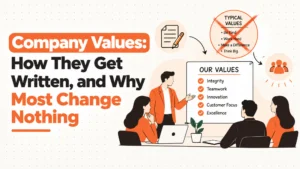
The written values, the principles on the wall, the language in the handbook and the careers page. It earns its place as a coordination device. In a company past the point where everybody works within earshot, some statement of what's expected genuinely helps people make decisions the same way, and new joiners learn faster when it exists than when they have to infer it.
Where it falls short is that a statement has no force of its own. It changes behaviour only when it's used to decide something: when a promotion goes differently, when a piece of work is rejected on those grounds, when somebody senior is told their behaviour doesn't fit. Without that, the statement is a claim, and people test claims against what they observe. The version that does harm is the one that's contradicted regularly and never revised, because it converts an honest gap into a visible hypocrisy.
Use it, but treat publication as the beginning rather than the end. A value nobody has ever used to say no is not yet a value.
Culture as atmosphere and perks
How the place feels: the office, the social side, the flexibility, the tone of internal communications, whether people laugh in meetings. It earns its place because it's real and it matters to people's daily experience, and because it's the fastest thing to improve. A team that eats together does collaborate more easily.
It falls short as an explanation, because atmosphere is downstream of the things that actually set culture. A pleasant atmosphere can coexist with an organisation where bad news doesn't travel and one team is quietly miserable, and it frequently does, because the pleasantness is partly what stops people raising things. Treating this as culture also leads to a specific failure mode: when a real problem surfaces, the response is another social initiative, which employees correctly read as being managed rather than heard.
It's worth investing in on its own terms. Just don't expect it to answer a question about why people are leaving.
Culture as what gets rewarded
The pattern in promotions, praise, escalation, resourcing and consequences. It earns its place because it's causal. If you want to know why people behave a certain way here, look at what that behaviour gets them, and the answer is almost always sufficient without any reference to personality or values.
Its limitation is that it's uncomfortable and diffuse. The pattern is set by many small decisions made by many people, most of whom weren't thinking about culture when they made them, so there's no single place to intervene. It also implicates the people who'd have to lead the change, which is why this framing is frequently acknowledged in the room and then quietly replaced by something more actionable.
If you only take one thing from this article, take this one. It's the definition that survives contact with the question of what to actually do.
One clarification matters, because this framing is often heard as cynicism. Saying that behaviour follows incentives isn't saying people are calculating or insincere. Most of the reading happens below the level of deliberate thought: somebody notices that raising an objection went badly for a colleague, and months later finds themselves choosing not to raise one, without connecting the two. That's why the pattern is so durable and so hard to talk about. Nobody decided to stop speaking up, and nobody could tell you when they did.
Culture as shared assumptions nobody says out loud
The things everybody here knows without being told: how much disagreement is acceptable, whether deadlines are real, what a request from that department actually means, whether the stated process is the real process. It earns its place by explaining the thing new joiners find hardest, which is that the rules they were given aren't the rules that operate.
It falls short on tractability. Assumptions are invisible to the people holding them, which makes them nearly impossible to work on directly, and attempts to surface them tend to produce either platitudes or defensiveness. The practical use isn't to change them but to detect them, and the only reliable detector is somebody who's recently arrived and hasn't yet stopped noticing.
Treat this as a diagnostic rather than a lever. It tells you what's really going on. It doesn't tell you what to do.
Culture as the founder's personality, reproduced
The observation that early-stage companies take on the characteristics of whoever started them, including the unattractive ones, and that this persists long after the founder stops being involved in daily work. It earns its place because it's largely true and it explains patterns that have no other explanation, particularly the ones that seem to serve nobody.
It falls short as a place to stop. Used as an explanation it becomes fatalism: the culture is like this because he's like this, and nothing can be done. It also gets less true over time, as the organisation accumulates people and decisions that had nothing to do with the founder, and continuing to explain everything this way lets everyone else off the hook for choices they're making now.
Its genuine use is narrow and important: it tells a founder that their behaviour is being copied with more fidelity than they'd like, including in the parts they'd describe as personal quirks rather than leadership.
The Decision Table
| Situation | Scale | Setup | Primary Pain | Recommended Starting Point |
|---|---|---|---|---|
| Everyone describes the place the same way | Any | Any | None | Leave it alone |
| Nothing has ever been articulated | Under fifty | Any | New people learn by guessing | Write down what is already true |
| Statement and practice have visibly diverged | Any | Any | Cynicism about the stated values | Change a decision, then revise the statement |
| Grown past everybody knowing everybody | Over one hundred | Any | Transmission by proximity has stopped | Make the implicit rules explicit |
| Two groups merged, habits differ | Any | Any | Each side thinks the other is wrong | Name both patterns before choosing either |
| People leaving for reasons that are not pay | Any | Any | A pattern nobody has named | Look at promotions and consequences |
| A senior person behaves badly and nothing happens | Any | Any | Everyone is watching what you do next | This is the whole problem, start here |
| Survey says culture is poor, leaders disagree | Over fifty | Any | Information is not reaching the top | Ask three recent hires what surprised them |
The row worth pausing on is the second to last, because it's the situation where the least gets done and the most is at stake. When somebody senior behaves in a way that contradicts the stated culture and there's no visible consequence, every other culture activity in the company is neutralised at once. People conclude, reasonably, that the rules apply downward only, and no amount of subsequent communication reverses that conclusion.
Where Culture Is Actually Set
Culture transmits through a small number of moments where people can see what the organisation really values. Most of them aren't culture activities at all, which is why they're rarely examined. They're ordinary decisions that happen to be watched.
| The moment | What it signals | What people conclude from it |
|---|---|---|
| Who gets promoted | What behaviour is actually rewarded | This is what I should do to get on |
| What happens when someone senior behaves badly | Whether standards apply upward | Either the rules are real or they are for us |
| How a mistake is handled the first time | Whether it is safe to be wrong here | Either report problems early or hide them |
| What gets resourced when budgets are tight | What the organisation truly prioritises | The stated priority is or is not the real one |
| Who speaks in meetings and who is interrupted | Whose judgement carries weight | Where I sit in an order nobody printed |
| What happens to an unpopular objection | Whether disagreement is genuinely wanted | Say it out loud or say it afterwards in private |
| Who gets the interesting work | What the path looks like and who is on it | Whether there is a future here for someone like me |
| Whether a stated process is followed under pressure | Whether the process is real or decorative | Which rules to take seriously |
The first row does more work than the rest combined. People study promotions with an attention that no internal communication ever receives, and they draw conclusions from them that are usually accurate. If you want to change a culture and can only change one thing, change what gets somebody promoted here and make the reasoning visible.
The last row is the one most often overlooked. Processes that are followed when convenient and abandoned under pressure teach people that the pressure version is the truth, which means every process in the company is quietly rated by whether it survives a bad quarter.
What these moments share is that none of them is announced as being about culture. They're ordinary operating decisions, made under time pressure by people thinking about the decision rather than about what it teaches. That's precisely why they're believed. An employee discounts a message written to be read and takes seriously a decision that was made for other reasons, because the second one reveals a preference rather than stating one. If you want to know what your organisation actually values, watch what it does when it thinks nobody is drawing conclusions.
How to Describe Your Culture Honestly
There's a version of this description worth writing, and it isn't the careers page version. The test is whether somebody who works there would recognise it without wincing, and that requires including the parts that aren't flattering.
Start from what's observably true rather than from what you'd like. The method is unglamorous: take a set of real decisions from the last year, ask what each one revealed, and look for the pattern. What you'll find is usually a small number of consistent traits, some of which you're proud of and some of which you're not, and the honest description contains both.
Then say what each trait costs. A culture that moves fast is a culture where some things are done badly. A culture with very high standards is hard on people who are still learning. A culture that prizes consensus is slow, and one that prizes decisiveness will sometimes decide wrongly with confidence. Every real cultural trait has a cost, and a description with no costs in it is marketing rather than description.
Be specific about who thrives here and who doesn't. This is the part that does the most good and gets cut most often, because it feels like admitting a limitation. It isn't. A person who'd be unhappy here and joins anyway is a loss on both sides, and the honest description is what prevents it. Candidates who are right for the place are not put off by knowing what it's actually like; they're reassured by it.
Finally, separate what's true now from what you're working towards, and mark which is which. Aspirations stated in the present tense are the single most common failure in culture communication, and they're read accurately by everybody who's already inside. Writing "we're trying to get better at this and we aren't there yet" costs nothing and buys a great deal of credibility.
What to Put in Writing
Most of what determines culture is never recorded, which is why the same conversation recurs every few years with no institutional memory of the last one.
| Artefact | Who owns it | When it is written | What it prevents |
|---|---|---|---|
| The honest description, costs included | The leadership team | Once, revisited yearly | A careers page the first month contradicts |
| Why each recent promotion happened | The manager and the approver | At the decision | The most-watched signal being unexplained |
| What behaviour carries a consequence here | The leadership team | Before it is tested | Standards that turn out to apply downward only |
| What recent hires said surprised them | Whoever runs onboarding | Month two, every intake | Losing the only unclouded view of the place |
| Which stated processes survive pressure | Operations | After any crunch | Processes that are known to be decorative |
The second row is the cheapest high-value habit in this article. A promotion with visible reasoning teaches the whole organisation what's rewarded; a promotion without it invites everybody to invent a reason, and the invented reasons are usually more cynical than the truth.
Questions to Ask Before You Commit
On the definition. When you say culture, what specifically do you mean, and could a decision contradict it? A bad answer describes a feeling.
On ownership. Who has the authority to change what gets rewarded here? A bad answer names someone who can run a project but cannot change a promotion.
On evidence. What are the three decisions from this year that best describe us? A bad answer reaches for the values statement.
On the gap. Where does our stated culture differ from our actual one, and who already knows? A bad answer is that there is no gap.
On cost. What does our culture cost, and who does it suit least? A bad answer lists only strengths.
On the test. What happened the last time a senior person contradicted a stated value? A bad answer is that it has not come up.
What Getting This Wrong Costs
The first cost is the cheapest to name and the easiest to underestimate: you spend real money and attention on things that don't touch the problem. Events, refreshes, campaigns and surveys all consume budget and, more importantly, they consume the organisation's willingness to engage. Every initiative that visibly fails to change anything makes the next one harder, and after two or three, people stop responding to culture work entirely.
The second cost lands on hiring, and it compounds. A description that doesn't match the place produces people who accept an offer on the strength of something that isn't true, discover it in their first month, and either leave or stay unhappily. Both are expensive, and the second is worse, because a person who feels they were sold something inaccurate becomes a source of the very cynicism that made the description necessary. You then hire more people against the same description.
The third cost is the one nobody counts, which is what happens to the honest people. In an organisation where the stated culture and the real one have diverged, the people who take the stated version seriously are punished for it: they raise the objection, they refuse the shortcut, they escalate the problem. They're usually the people you'd least like to lose, and they leave first, because the gap is most visible to those who believed the statement. What remains is an organisation that's better adapted to itself and worse at everything you wanted.
So before you commission anything, answer a narrower question: is this a clarity problem, a consistency problem, or a fit problem? Clarity means nobody has ever said what's expected, and writing it down genuinely helps. Consistency means you've said it and your decisions contradict it, and no amount of further saying will fix that. Fit means the culture is working as designed and is wrong for what you're now trying to do, which is the hardest of the three and the one most likely to be misdiagnosed as the other two.
When You Are Ready to Go Further
Nothing in this article needs a budget. It needs a leadership team willing to look at the last three promotions and say what they signalled, an honest description with the costs left in, and one decision made differently because of it.
The step after that is structural. Once you know what actually sets culture here, the question becomes which of those moments you can make consistent across managers rather than dependent on which one somebody happens to report to. That's a systems question rather than a culture question, and it's where most of the durable improvement lives.
HROpsLab publishes independent comparison work across HR tooling, applicant tracking and payroll. We sell nothing, we take no vendor money, and we publish no paid placements. If the next step is looking at how consistently your organisation makes the decisions people watch, our comparison work is one place to start.
Frequently Asked Questions
What does company culture actually mean?
It's the pattern of what gets rewarded, tolerated and punished in an organisation, which people learn by watching rather than by being told. That's different from the values on the wall, which describe intentions, and different from the atmosphere, which describes how the place feels day to day. The reason this definition is worth holding onto is that it's the only one that tells you where to look when you want something to change: not at the statement and not at the social calendar, but at promotions, consequences, resourcing and what happens when somebody senior behaves badly. Everything else in the subject is downstream of those.
Can company culture be changed?
Yes, but not by describing a different one, which is how most attempts begin and end. Culture shifts when the pattern of rewards and consequences shifts, so the levers are decisions rather than communications: who gets promoted and why, what actually happens when a standard is breached, what gets funded when money is short. The first change people notice is usually a single decision that goes differently from how it would have gone before, and that registers faster than any announcement. What takes a long time isn't the first change, it's people believing the change will hold, and that belief is only built by the second and third instance.
Who is responsible for company culture?
Whoever makes the decisions that people watch, which in practice means the leadership team rather than whoever has culture in their job title. This is the structural reason culture programmes fail: the work gets assigned to someone with the responsibility to improve it and no authority over promotions, consequences or resourcing. HR can do a great deal here, running the diagnosis, holding the mirror and making the pattern visible, but if the leadership team's own behaviour is the culture then only they can change it. Any plan that doesn't require anything of the people at the top is a plan to produce activity.
What is the difference between culture and values?
Values are what an organisation says matters. Culture is what it does when those things conflict with something else it wants, such as speed, revenue or avoiding a difficult conversation. The two can match, and when they do, the written values are genuinely useful because they help people decide consistently. When they don't match, everyone inside knows which is real within a few months, and the written version becomes a liability rather than a neutral document, because it gives people a precise measure of the distance between what was promised and what happens.
How long does culture change take?
Longer than a quarter, and the honest answer depends on how consistently the new pattern holds rather than on elapsed time. A single decision that contradicts the old pattern is visible immediately and is usually read as an exception. It becomes a change when it happens again in a different context with different people, and that's the point at which behaviour starts to shift, because people are now predicting rather than observing. The common failure isn't moving too slowly. It's a burst of visible activity followed by a decision that reverts to the old pattern, which resets the clock to worse than where it started.
Does a small company have a culture?
Yes, and it's usually stronger and less examined than in a large one, because it transmits by proximity. When everyone can see how the founders react to things, the pattern is learned quickly and completely without anyone writing anything down. The risk is specific to that transmission method: it works until the company outgrows earshot, at which point it stops working without anybody noticing, and the first sign is a cohort of newer people who behave differently and get described as not getting it. They aren't a different sort of person. They simply weren't in the room where the culture was being taught.
How can you tell if your culture is good?
Replace good with fit, because cultures aren't good or bad in the abstract. A demanding culture with very high standards is right for some work and some people and genuinely harmful for others, and the same is true of a consensus-driven one or a highly autonomous one. The two questions worth asking are whether the culture you have is the one your strategy actually needs, and whether you describe it honestly to people before they join. An organisation that answers yes to both is in good shape even if the culture is hard, and one that answers no to the second is creating a problem it will pay for repeatedly.
Do remote companies have a culture?
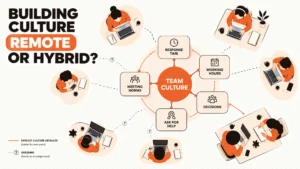
Yes, and the mechanism is the same: people learn what's rewarded by watching what happens. What changes is the transmission channel. In an office a great deal is absorbed incidentally, from overheard conversations and visible reactions, and none of that exists by default when everyone is distributed. The result is that remote organisations have whatever culture their written defaults produce, whether or not anyone chose them: expected response times, what gets decided in a meeting versus in a document, whether the working day has edges. Those defaults are doing the teaching, so they're worth deciding deliberately rather than letting them settle.
Culture is not what you say about the place. It's what people learn by watching what happens here.