
TL;DR
- The core decision: what you stop doing, because the new job has no spare capacity and nobody will take the old work off you unless you hand it over.
- When doing nothing is right: almost never in the first month, and the exception is a team in the middle of something where any change costs more than it buys.
- What has to be true: you can name the parts of your old job that are now somebody else's, and say who.
- How the options split: by what you do with the first month, which sets what the rest is available for.
- Decision rule: in month one, change nothing structural and find out everything. Judgement before action, because you'll only get one chance to see the team unaltered.
- Outcome to expect: less of your own output, more of the team's, and a period in the middle where you feel useless.
The Promotion That Changes the Job
Somebody is good at the work. They're reliable, people ask their opinion, and when something difficult comes up they're the one who takes it. So they get promoted, which in most organisations means being handed a team on a Tuesday and a calendar invite for a one-to-one on the Thursday.
What nobody says out loud is that the job just changed completely. The old one rewarded output you produced yourself, and you got good at it over several years. The new one rewards output produced by other people, which is a different skill, and your experience of the first is only partly useful for the second. In fact some of it is actively unhelpful: being the person who takes on the difficult thing is exactly the instinct that will ruin your first three months.
So the new manager does what anyone would do. They keep doing the work they know how to do, and they manage in the gaps between it. This feels responsible, it keeps their output visible during an uncertain period, and it's the single most common way the first ninety days go wrong. The team gets the leftover hours. The handover never happens. And six months in, the manager is doing two jobs badly and can't work out why they're always behind.
Best tools for Leadership & Culture
The real problem isn't time management. It's that nobody has told them the old job is over, so they're waiting for permission to stop doing it. That permission isn't coming, and giving it to yourself is most of the work of the first ninety days.
When You Genuinely Do Not Need to Act Yet
Your current setup is genuinely fine. You've inherited a team that's delivering, with an outgoing manager who left things in order and a clear handover. This is rare and it means the honest answer for week one is to observe, not to establish yourself with a change nobody needed. The instinct to prove you deserve the job by doing something is the most expensive instinct available in a healthy team.
Friction is starting to show. You've noticed you're working later than before, or that your one-to-ones keep getting moved because something urgent came up in your own workload. Both are the same signal: the old job is still yours and it's winning. The cheapest check is to look at last week and count the hours that went to work only you could do versus work you could have handed over.
It has become a real cost. The team is waiting on you for things, or somebody has raised that they don't know what's expected. At this point the cost has moved from you to them, which is worse, because the team's output is now capped by your availability. This is the point where handing something over stops being a development exercise and becomes urgent.
The edge case that forces it. You're managing people who were your peers last month, or somebody on the team applied for your job. Both are normal and both need addressing directly and early, because the longer the conversation is postponed the more the relationship settles into something awkward that then has to be undone. The other version is inheriting a team in trouble, where the luxury of a month's observation doesn't exist and you have to act on partial information.
Five Questions This Reader Asks at 11pm
Should I still be doing the work? Some, for a while, and less each month. Keeping a small amount of hands-on work is genuinely useful: it keeps you credible and stops you making decisions from a distance you don't understand. What ruins the transition is keeping a full workload and treating management as an addition, because when both compete for the same hour the individual work always wins, since it's more familiar and its deadlines are louder.
How do I manage people who were my peers? By naming it once, early, in private with each of them. Say that it's awkward, say what will change and what won't, and ask what they're worried about. The mistake is pretending nothing has changed, which everybody can see isn't true, or overcorrecting into formality, which reads as a personality transplant. The relationship does change. Saying so is what makes it survivable.
Should I change things straight away? Rarely, and the pressure to do so usually comes from your own discomfort rather than from the situation. A new manager has a short window in which they can see the team as it actually is, before their own presence alters it, and spending that window on changes wastes the most valuable information you'll ever have about this team. The exception is a visible problem everyone is waiting for you to fix, where inaction reads as weakness.
What do I do in the first one-to-one? Ask and listen, and resist the urge to fill the silence with your plans. Useful questions: what should I know that isn't obvious, what's the most frustrating part of your week, what would you change if you could, what do you want that you haven't asked for. Take notes visibly. Then do something small about one of the answers within two weeks, because that's what turns the next conversation from polite into real.
What if someone on the team wanted my job? Address it directly rather than hoping they've moved on. Acknowledge they applied, tell them you'd like them to stay and why, and be honest about what would need to be true for them to get there. What you can't do is avoid them, over-manage them, or compensate by giving them special treatment, all of which are visible to the rest of the team and all of which make it worse.
Three Honest Categories the Approaches Split Into
Continuity, changing as little as possible. You keep the team's existing patterns, meetings and priorities, and spend your attention on understanding rather than altering. It's right in most cases, particularly in a functioning team, and it's right when you've come from outside and genuinely don't yet know why things are as they are. It fails in a team that's been waiting for a change, where continuity reads as a decision to endorse the status quo, and it fails when the previous manager left problems that everyone knows about and expects you to address. Deliberate patience needs to be said out loud, or it's indistinguishable from not noticing.
Early action, establishing direction immediately. You make visible changes in the first weeks to set expectations and demonstrate that things are different now. It's right when you've been brought in specifically to change something, when the team is in trouble, or when the problem is already well understood by everyone. It fails when the changes are made from the wrong model of the situation, which is the default state in your first month, and it fails socially: a manager who changes things before understanding them teaches the team that their knowledge isn't valued, and they'll stop offering it.
Listening first, then acting on what you heard. You spend the first weeks in structured conversations with the team and the people around it, then make changes that visibly trace back to what you were told. It's right almost always, and it's the approach that builds the most durable authority, because the changes arrive with a reason people recognise. It fails in one specific way, which is common enough to name: the listening happens, nothing follows, and the team concludes that the exercise was theatre. A listening round with no visible consequence is worse than never having asked.
Five Diagnostic Questions You Can Self-Assess Against
Look at last week. What did you do that only you could have done? Be strict, because the honest number is usually small. Everything else was either work somebody on your team could have done, which means you're holding onto it, or work nobody needed, which means you're filling time with the familiar. This single review, done weekly for the first two months, does more than any amount of reading.
When your team is blocked, how long does it take you to notice? If the answer is that they tell you, that's healthy. If the answer is that you find out in the one-to-one three days later, your channels are too slow for the role, and if you find out from somebody outside the team, they're not working at all. The fix is usually a short, boring, regular checkpoint rather than an open door.
What are you still doing that you did in your old job? Write the list, then mark each item as handed over, being handed over, or still yours with no plan. The third category is where your first ninety days will be lost. It's usually the interesting work, which is why it survives every attempt to delegate it.
Can each person on your team say what's expected of them? Ask them, in those words, and be prepared for a vaguer answer than you expect. New managers routinely assume the previous manager covered this, and previous managers routinely assumed it was obvious. The gap gets discovered at the first review conversation, months later, which is the worst possible moment.
What have you changed because somebody told you to? In the first ninety days this is the measure of whether your listening is real. One visible change traceable to a specific conversation is worth more than a month of asking good questions, because it's the evidence that answering you is worth the effort.
Five Ways New Managers Spend the First Month, Reviewed
Keeping the old workload and managing in the gaps
You continue as an individual contributor at close to full capacity and fit the management around it. It earns its place briefly and narrowly. In the first two or three weeks there's usually work genuinely mid-flight that can't be handed over cleanly, and finishing it is the responsible thing. It also keeps you credible with a team who need to see that you haven't forgotten how the work is done.
Where it falls short is that it becomes permanent without anybody deciding it should. Individual work has visible deadlines and familiar satisfactions; management work has neither, so in any competition for the same hour the old job wins. The team notices before you do. What they experience is a manager who's always busy, always slightly late to things, and unavailable at exactly the moments that matter, and they adapt by not asking.
If you're in this state past the first month, the fix isn't discipline. It's a conversation with your own manager about what comes off your plate, because most new managers are never told it's allowed.
Changing things immediately to establish authority
You arrive with a set of changes and implement them quickly to make clear that a new person is in charge. It earns its place when you've been hired explicitly to change something, when the team is failing and everyone knows it, or when there's an obvious problem the previous manager wouldn't address. In those cases, acting fast is what builds credibility, and hesitating costs it.
It falls short because the first month is when you know least about why things are the way they are. Practices that look inefficient from outside frequently exist because of a constraint you haven't met yet, and reversing one publicly is expensive to walk back. It also sends a message you probably don't intend: that the team's accumulated knowledge isn't relevant to decisions about the team's work. Once people conclude that, they stop volunteering it, and you lose the information you needed.
If you must act early, act on something small and reversible, and say explicitly what you're leaving alone until you understand it.
Changing nothing and observing
You deliberately hold off on decisions, watch how things actually run, and use the time to build a picture. It earns its place as the default, because the observation window is short and doesn't come back. Once you've been there three months the team has adjusted to you, and you'll never again see how they behaved before you arrived.
It falls short when the patience is silent. A team that's been waiting for a problem to be addressed experiences a quiet new manager as another one who won't deal with it, and the goodwill you're spending is invisible to you. It also fails if observation is passive: sitting in meetings and forming impressions is much weaker than asking specific questions, and a month of watching can produce less insight than five good conversations.
Say what you're doing. Telling a team that you're deliberately not changing anything for a month, and why, converts silence into a plan.
Running a listening round with every person
You meet everyone individually with a consistent set of questions, take real notes, and look for patterns across the answers. It earns its place because it produces more usable information per hour than anything else available to you, and because it establishes a norm: in this team, the manager asks and the answers matter.
It falls short in one way and it's the one that does damage. If nothing visible follows, you've taught people that speaking up here is a formality, and that lesson is harder to reverse than the original ignorance. The second failure is asking questions you aren't willing to act on. If you can't do anything about pay, don't open the conversation as though the answer is in play, because the honest constraint is better received than false hope.
The rule that makes it work: before the round starts, decide that at least one thing will change because of it, and say so when you've done it.
Asking the outgoing manager for the handover nobody wrote down
You spend real time with your predecessor on the things that aren't in any document: who works well with whom, what the last reorganisation did to people, which promises were made and to whom, what's about to become a problem. It earns its place because this information exists in exactly one place and it's about to leave.
It falls short when the previous manager is leaving unhappily, when they were part of the problem, or when the handover is a single hour scheduled between other commitments. There's also a bias to correct for: their account of each person is one person's view, formed over years, and inheriting it wholesale means inheriting their blind spots. Somebody described as difficult may have been difficult with them specifically.
Take the information, weight it, and check it against your own observation over the following weeks rather than treating it as settled.
The Decision Table
| Situation | Scale | Setup | Primary Pain | Recommended Starting Point |
|---|---|---|---|---|
| Team functioning, clean handover | Any | Any | None | Observe deliberately, and say that you are |
| Promoted from within the same team | Under twelve | Any | Relationships have changed and nobody says so | Name it individually in week one |
| Someone on the team applied for your job | Any | Any | Avoidance is visible to everyone | Address it directly, early, in private |
| Inherited a team in visible trouble | Any | Any | Waiting reads as not noticing | Act on the known problem, observe the rest |
| Hired from outside into an unfamiliar function | Any | Any | You cannot assess the work itself | Listening round, and lean on a trusted practitioner |
| Still carrying a full individual workload | Any | Any | The old job wins every scheduling conflict | Agree with your manager what comes off |
| Previous manager left unhappily | Any | Any | The handover is partial and coloured | Take it, then verify against your own view |
| Managing managers for the first time | Over twenty | Any | Doing their job through them | Devolve the judgement, not just the tasks |
The row most first-time managers are actually in is the sixth, and it's the least likely to be acted on, because it requires asking for something. Almost nobody is told explicitly that their old workload should reduce, so they assume it shouldn't, and they spend the first ninety days proving they can do both.
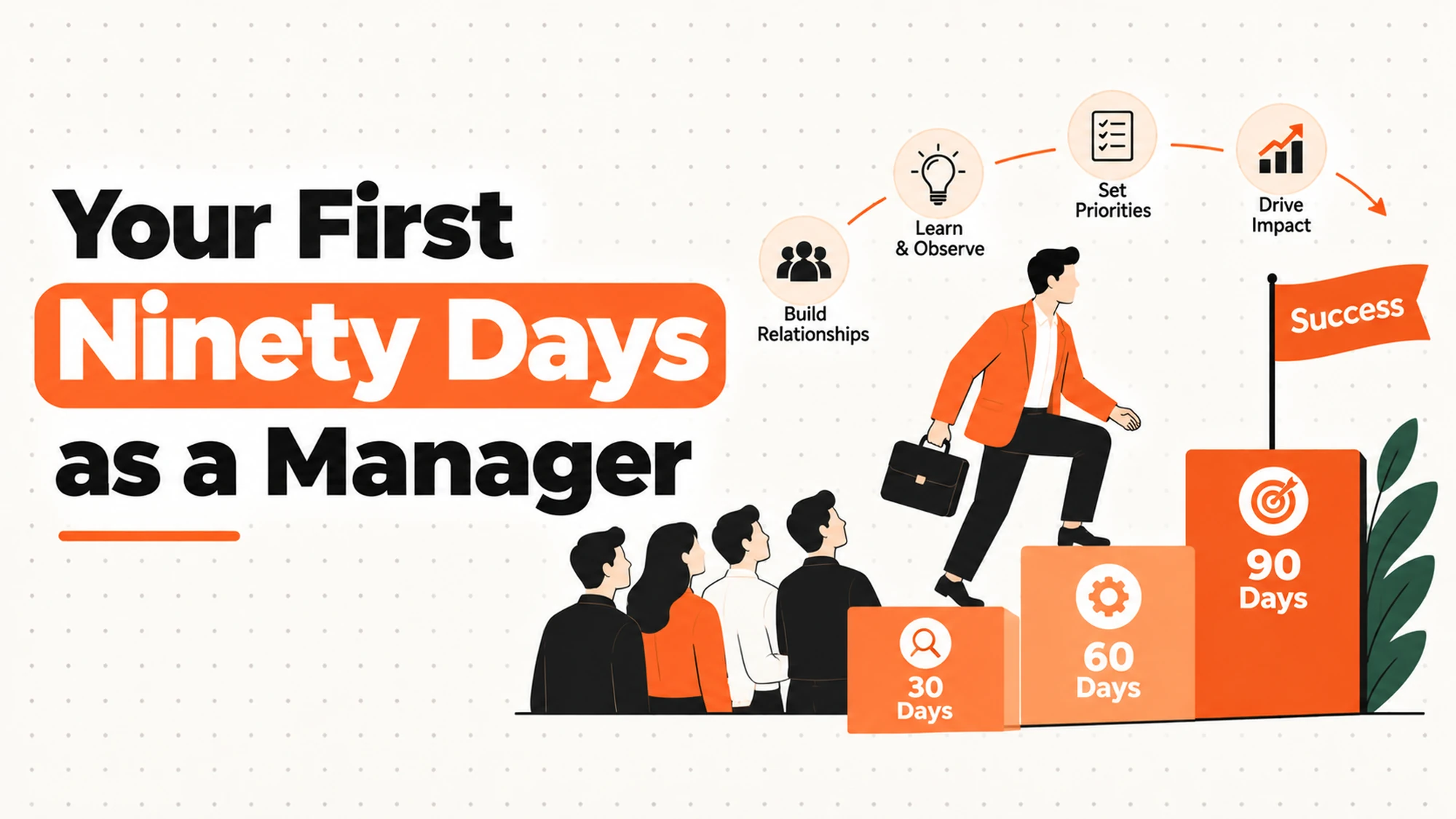
What to Do in Each of the Three Months
The ninety days aren't one period, they're three with different jobs. Treating them as a single block is why most of it goes to whatever was loudest.
| Month | The question to answer | What to do | The mistake it invites |
|---|---|---|---|
| One | What is actually going on here? | Listening round, sit in everything, write down what you see | Changing something to prove you are in charge |
| Two | What has to change, and who owns what? | Make the first visible change, hand over your first real thing | Acting on every problem at once |
| Three | Is this holding without me? | Step back deliberately, check what happens, adjust | Taking work back at the first wobble |
Month one is the only month with a non-renewable resource in it, which is your ignorance. You can only see the team as it was before you arrived once, and anything you change in that window contaminates the sample. The discipline is to write things down rather than act, including the things that look obviously wrong, because a proportion of them will turn out to have reasons.
Month two is where the transition actually happens, and it hinges on one thing: handing over something real. Not a task, a piece of ownership, with the outcome agreed and the method left alone. Most new managers delay this because the handover costs more time than doing it themselves, which is true for the first few weeks and wrong after that.
Month three is the uncomfortable one, and the feeling it produces catches people out. If the first two months went well, you'll feel less essential than you did as an individual contributor: the work is happening and you aren't doing it. That feeling is the job working correctly, and the most common error at this point is manufacturing a reason to get involved again.
What You Have to Stop Doing
The handover is the real content of the first ninety days, and it fails in predictable places. Four categories of old work need to go, and they resist differently.
The work you're best at. This is the hardest and it goes last, if it goes at all, because there's always a defensible reason to keep it: it's faster, the deadline is tight, nobody else has done it before. Every one of those is true and none of them survives repetition. If you're still the person who does this in six months, you haven't transitioned, you've added a title.
The work that's how people know you. Being the person who handles the difficult client, or who fixes the thing when it breaks, is an identity as much as a task, and giving it up feels like becoming less valuable. It isn't, but it does feel that way, and naming the feeling makes it easier to push through than pretending it isn't there.
The decisions you've always made. These are rarely handed over explicitly, so they keep arriving at you by habit. The fix is to say out loud, to the person and to the team, that this now belongs to somebody else, and then to send the next one to them rather than answering it yourself. Redirecting it once is worth more than any announcement.
And the work you enjoy. This deserves its own mention, because it's the one that gets kept under cover of the other three. There's nothing wrong with retaining a small piece of hands-on work you like, provided you're honest that you're keeping it because you like it rather than because it can't be moved. The dishonest version is the one that quietly consumes the hours your team needed.
For each of these, the handover needs the same four things: what the outcome is, what the constraints are, when you'll talk about it, and what should bring them back to you sooner. Skip those and you'll get the thing back in a month, and conclude that delegation doesn't work here.
What to Put in Writing
Nothing about a management transition is recorded in most organisations, which is why every new manager rediscovers the same things and why nobody can tell afterwards whether the first ninety days went well or badly.
| Artefact | Who owns it | When it is written | What it prevents |
|---|---|---|---|
| What comes off your individual workload | You, agreed with your manager | Week one | The old job quietly winning every scheduling conflict |
| What you are deliberately not changing, and why | You, shared with the team | Week one | Patience being read as failure to notice |
| What each person told you in the listening round | You | As you go | Patterns across answers being lost to memory |
| The four agreements for each handover | You, with the person taking it | At the handover | Work coming back in a month |
| What each person is expected to deliver this quarter | You, with each person | Month two | A gap discovered at the first review conversation |
| What changed because of what you were told | You, said out loud | When it changes | A listening round that reads as theatre |
The first row is the one almost nobody writes and the one that determines the rest. A new manager who has not agreed, in writing, what they are no longer responsible for is a new manager carrying two jobs, and the conversation gets much harder to have three months in than it would have been in week one.
Questions to Ask Before You Commit
On the old job. What comes off your plate, and who agreed it? A bad answer is that you will fit it in.
On the window. What are you deliberately not changing in month one, and have you told the team? A bad answer is that you are still settling in.
On the handover. What is the first real piece of ownership you will give away, and to whom? A bad answer names a task rather than an outcome.
On the peer question. Who did you use to work alongside, and have you had the conversation? A bad answer is that it has not been an issue.
On expectations. Can each person say what is expected of them this quarter? A bad answer is that it has not changed.
On the listening. What will change because of what you were told? A bad answer is that you are still gathering.
What Getting This Wrong Costs
The first cost lands on you and it's the one people accept too readily: a long stretch of working more hours than the job should take, doing two roles at partial quality. That's survivable for a quarter and corrosive over a year, and it's usually worn as evidence of commitment rather than diagnosed as a structural problem. Organisations tend to notice only when the person either burns out or declines the next step, at which point the explanation offered is capacity rather than the handover that never happened.
The second cost lands on the team, and it's larger. A manager who's still doing their old job is a manager who's unavailable, and a team adapts to unavailability by deciding less, escalating less and waiting more. That looks like a team that needs a lot of direction, which is then used to justify the manager staying hands-on, and the loop closes. Several months of that produces a group of people with materially less autonomy than they had under the previous manager, and nobody involved can point to when it changed.
The third cost is the one that's hardest to recover from, which is the first impression of how you handle information. If you run a listening round and nothing follows, or if you change something significant in week two based on a misunderstanding, the team draws a conclusion about how decisions get made under you. Those early conclusions are sticky, and reversing one takes far more evidence than forming it did.
So before you plan anything: is the problem in front of you a capacity problem, an authority problem, or an information problem? Capacity means you're doing work that should be somebody else's, and the answer is a handover and a conversation with your own manager. Authority means the team could act and doesn't believe it's allowed, and the answer is to say explicitly what's theirs. Information means you don't yet know enough to decide, and the answer is to say so and set a date by which you will.
When You Are Ready to Go Further
None of this needs a course. It needs a written list of what you've stopped doing, one real handover with the four agreements in place, and a weekly ten minutes reviewing what you did that only you could have done.
The step beyond your own transition is organisational. Most companies promote people into management with no defined handover, no reduction in individual workload and no statement of what the new job actually is, then treat the resulting struggle as a matter of individual aptitude. Fixing that is a question of how promotions into management are designed, not how hard any particular new manager tries.
HROpsLab publishes independent comparison work across HR tooling, applicant tracking and payroll. We sell nothing, we take no vendor money, and we publish no paid placements. If the next step is looking at how your organisation supports people into management, our comparison work is one place to start.
Frequently Asked Questions
What should a first-time manager do first?
Find out what's actually going on before changing any of it, and say out loud that's what you're doing. The first month contains a resource you'll never have again, which is a view of the team before your presence has altered how they behave, and spending it on changes wastes that. Meet everyone individually with the same handful of questions, take visible notes, and write down the things that look wrong without acting on them yet, because a fair proportion will turn out to have reasons you haven't encountered. The exception is a team in visible trouble where everyone is waiting for an obvious problem to be addressed, and there, waiting reads as not noticing.
Should a new manager keep doing individual work?
A reduced amount, for a limited period, deliberately chosen rather than defaulted into. A small piece of hands-on work keeps you credible and stops you making decisions at a distance you don't understand, and in the first few weeks there's usually something mid-flight that can't be handed over cleanly. What ruins the transition is keeping a full workload, because individual work has louder deadlines and more familiar satisfactions, so it wins every competition for the same hour. If you're still carrying your old load after a month, the fix isn't personal discipline. It's a conversation with your own manager about what comes off, which most new managers never have because nobody told them it was allowed.
How do you manage people who used to be your peers?
Name it once, early, in a private conversation with each of them rather than addressing it to the group. Say that it's awkward, say what will change and what won't, and ask what they're concerned about. The two failure modes are opposite and equally visible: pretending nothing has changed, which everyone can see isn't true, and overcorrecting into formality, which reads as a personality transplant and damages relationships that were working. Expect the friendships to change shape, because they will, and expect a period where some conversations are stilted. Acknowledging that directly is what stops it settling into something permanent.
What should you cover in the first one-to-one?
Ask and listen, and resist filling the time with your plans, which is the natural instinct when you feel you should be demonstrating something. Four questions do most of the work: what should I know that isn't obvious, what's the most frustrating part of your week, what would you change if it were yours to change, and what do you want that you haven't asked for. Take notes where they can see you doing it. Then act on something small from one of those answers within a fortnight, because that's what converts the second conversation from polite to useful, and nothing else you say will achieve the same effect.
Should a new manager change things early?
Usually not, and the pressure to do so tends to come from your own discomfort at feeling unproven rather than from anything the situation requires. Early changes are made with your worst understanding of why things are the way they are, and practices that look inefficient often exist because of a constraint you haven't met yet. There are real exceptions: if you've been brought in explicitly to change something, if the team is failing and everyone knows it, or if there's a problem your predecessor wouldn't address, then acting quickly is what builds credibility. If you do act early, pick something small and reversible, and say clearly what you're leaving alone until you understand it.
What do you do about a team member who wanted your job?
Address it directly and early rather than waiting for it to settle, because it won't. Acknowledge that they applied, tell them plainly whether you want them to stay and why, and be honest about what would need to be true for them to get there, including if the answer is that it isn't likely here. What causes lasting damage is any of the three avoidance strategies: staying away from them, managing them more tightly than everyone else, or compensating with special treatment. All three are visible to the rest of the team, and all three are read correctly.
What training do new managers need?
Less than is usually provided, and different from what's usually provided. Most management training covers models and frameworks, which are easy to teach and don't survive the first difficult week. The things that actually determine how the first ninety days go are narrower and more practical: how to hand over a piece of work so it stays handed over, how to run a conversation where somebody hears something they don't want to hear, and an explicit statement that the old job is supposed to reduce. A single experienced manager willing to talk through real situations weekly is worth more than a course, and costs the organisation almost nothing.
How long does it take to feel competent as a manager?
Longer than ninety days, and the feeling arrives in a different form than people expect. The competence you're waiting for isn't the feeling of having produced something good, because you're no longer producing it, and that absence is disorienting for anybody who got promoted on the strength of their own output. What replaces it is quieter: the team handles something well without you, a decision you devolved goes differently from how you'd have made it and turns out fine, somebody tells you a problem early. Most people report the shift somewhere between six months and a year, and almost everyone goes through a stretch in the middle of feeling useless.
The first ninety days aren't about what you start doing. They're about what you're willing to stop.