TL;DR
- The core decision: whether you try to recreate the office socially, or write down the defaults that the office used to transmit for free.
- When doing nothing is right: when people know what's expected without asking, work gets decided in places everyone can see, and nobody is unclear about when they're allowed to stop.
- What has to be true: you can state your team's expected response time, and two people would give the same answer.
- How the options split: by whether they add contact or reduce ambiguity, which are different problems with different solutions.
- Decision rule: if a new joiner has to ask a colleague privately how things really work here, that's a default you haven't written down.
- Outcome to expect: a duller set of artefacts than an offsite, and considerably less of the low-grade anxiety that distributed work produces by default.
The Virtual Social Nobody Wanted
A distributed team is described as having a culture problem. The evidence is soft: people seem disconnected, the video calls are transactional, somebody said in a survey that they don't feel part of anything. So the response is an event. A monthly social call, a quiz, a coffee roulette, something optional that everybody understands is not really optional.
Attendance is fine for two months and then declines. The people who come are the ones who were already comfortable, and the people the exercise was designed for are the ones with the best reasons not to attend. Eventually it quietly stops, and the conclusion drawn is that remote culture is just harder, which is true in a way that has almost nothing to do with the social calendar.
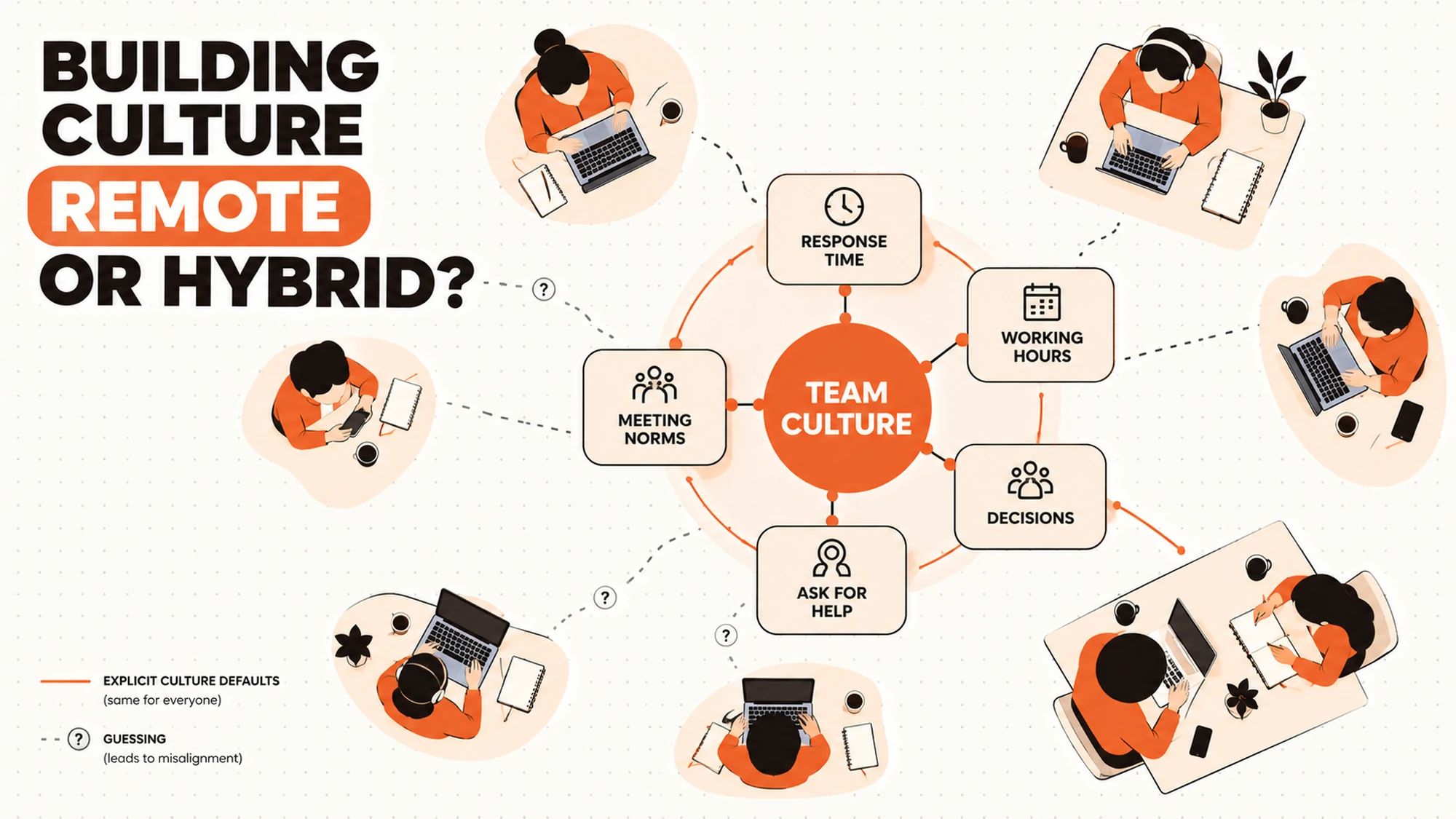
The reason events don't work here is that they're aimed at the wrong thing. What an office provides isn't mainly social contact, though it provides that too. It's a continuous, low-effort transmission of how things work: you see when people arrive and leave, you overhear how a decision got made, you notice that nobody replies to messages after six, you watch somebody ask a question you were afraid to ask. None of that is scheduled, and none of it survives the move to distributed work.
Best tools for Leadership & Culture
What replaces it, if nobody decides, is a set of defaults that assemble themselves out of guesses. Everyone infers the expected response time from the fastest responder. Everybody works out the boundaries of the day by watching whoever works latest. The team ends up with rules nobody chose and nobody can point at, and the anxiety that produces is the actual problem behind most complaints about remote culture.
When You Genuinely Do Not Need to Act Yet
Your current setup is genuinely fine. New joiners get up to speed without a private guide, people stop working at a reasonable hour without apologising, and decisions are visible to everybody they affect. If that's true, you have the thing that matters, and a culture initiative would be adding ceremony to a working system.
Friction is starting to show. Somebody has asked whether they're expected to reply in the evening, or a new joiner has been quietly briefed by a colleague on how things really work. Both mean an unwritten default is operating, and the cheapest check is to ask two people what the expected response time is and see whether the answers match.
It has become a real cost. People are working longer than they should, or the same question is being answered privately over and over, or decisions are being made in a call and discovered later by the people they affect. At this point the ambiguity is producing measurable waste and low-grade stress, and writing four things down fixes most of it.
The edge case that forces it. You've gone hybrid, with some people in a room and others on a screen, or you've spread across enough time zones that no single hour works for everyone. Both create structural inequality that no amount of goodwill resolves, and both need explicit design rather than a general commitment to being inclusive.
Five Questions This Reader Asks at 11pm
Do virtual socials actually work? For connection between people who already like each other, somewhat. For the thing usually meant by culture, no. They're optional, which means they self-select for the people who need them least, and they're scheduled, which means they carry the awkwardness of enforced fun. They're not harmful when they're genuinely voluntary and short. They're just not a substitute for knowing how things work here.
How often should we meet in person? Less often than the argument suggests and more deliberately. The value of in-person time is concentrated in things that are genuinely hard remotely: forming first relationships, working through a contentious decision, and the unstructured hours around the scheduled sessions. A gathering built around presentations wastes the one thing the format is good for. If you can only do it rarely, spend it on new relationships and hard conversations.
Is hybrid worse than fully remote? Often, yes, and it's rarely acknowledged. Fully remote at least puts everyone in the same position. Hybrid creates two experiences of every meeting and two levels of access to information, and the people in the room reliably underestimate the gap because they can't see it. It's workable, but it requires deliberate design rather than the assumption that people will include each other.
How do I tell if our remote culture is failing? Look for people asking permission for ordinary things, questions being asked privately that should be public, or a new joiner taking much longer than expected to be productive. All three are symptoms of the same cause, which is that the rules exist but aren't written anywhere, so everybody is inferring them at some cost.
Should I turn my camera on? Have a team answer rather than an individual one, because the ambiguity is what does the damage. Any of the reasonable positions works if it's stated: cameras on for small discussions, off for large presentations, always optional, whatever suits. What doesn't work is leaving it unstated, which makes it a status signal and puts the cost on whoever is least comfortable.
Three Honest Categories the Approaches Split Into
Add contact. Socials, coffee pairings, more frequent calls, team gatherings. It's right for the specific problem of people not knowing each other, which is real and does affect how readily they collaborate, and it's right early in a team's life or after several new joiners arrive. It fails when used against ambiguity, because it doesn't touch it: a team can have excellent relationships and still be collectively unsure about when the working day ends. It also fails on fairness, since optional social time is easiest for people with the fewest constraints outside work, and hardest for those with caring responsibilities or a difficult time zone.
Reduce ambiguity. Write down the defaults: response times, what gets decided where, meeting norms, when people are expected to be available. It's right for almost everything that gets described as a remote culture problem, and it's the cheapest intervention available, since a page of agreements costs an afternoon. It fails when the written version doesn't match what leaders actually do, which people spot immediately, and it fails if it becomes a policy document rather than a set of team agreements. Four things people follow beat twenty they've never read.
Change how decisions get made. Move decisions from synchronous meetings into written proposals with a comment period, so the record is public and time zones stop determining influence. It's right for distributed teams across time zones and for anybody trying to stop the pattern where being in the call is the only way to matter. It fails on speed for genuinely contentious decisions, where a conversation resolves in twenty minutes what a document takes three days to settle, and it fails when written culture is adopted partially, so the real decision still happens in the call and the document records it afterwards.
Five Diagnostic Questions You Can Self-Assess Against
Ask two people what the expected response time is. Do it separately and compare. Different answers mean the default is unwritten and everybody is guessing, usually upward, since the safest guess is faster than reality. This single question uncovers more of the real problem than a survey will.
How long does a new joiner take to be useful? Compare it to when you were co-located, if you can. A significant increase is usually the cost of things nobody wrote down, because the new person is reconstructing by observation what used to be absorbed automatically. Ask them what they had to work out for themselves, in their second month, and write those things down.
Where was the last significant decision actually made? Trace one. If it happened in a call and was communicated afterwards, the people not in the call had no route to influence it, and over time that teaches them where the real conversation is. If it happened in a document that anybody could comment on, your decision-making survives distribution.
Who works latest, and does everybody know it? In distributed teams, one person's habits become the team's perceived standard, because their messages are the visible evidence of when work happens here. If your most senior person sends messages at eleven at night, the stated policy on working hours is irrelevant.
What do people ask privately that should be public? Look at your own direct messages for a week. Questions that arrive privately and have general answers are a reliable indicator that asking in the open carries some cost, or that nobody knows where the answer lives. Both are fixable and neither is fixed by a social.
Six Approaches to Remote Culture, Reviewed
Scheduled social time
A recurring call with no agenda, a quiz, a virtual coffee. It earns its place in a narrow set of cases: a brand-new team with no existing relationships, a period after several people have joined at once, and teams whose work gives them almost no reason to interact. In those cases, manufactured contact is better than none.
Where it falls short is that it's aimed at connection and usually deployed against ambiguity, which it can't touch. It's also self-selecting in the wrong direction, since attendance is easiest for the people who are already comfortable and hardest for the ones the exercise was meant to reach. And the optional framing rarely survives contact with reality: people know who attends.
If you do it, keep it short, make it genuinely optional in a way that's demonstrated rather than stated, and don't schedule it for late afternoon in whichever time zone happens to suit you.
An in-person gathering
Bringing the team together physically, once or a few times a year. It earns its place because a small number of things are genuinely much easier face to face: forming a first relationship, working through a contentious decision, and repairing something that's gone wrong between two people. Those are real and the return on them is high.
It falls short when the agenda is filled with content that would work better as a document. A gathering spent watching presentations has spent the expensive resource on the cheap activity, and everybody leaves feeling it was nice without being able to say what it achieved. It also creates an access gap, since whoever can't travel misses more than the sessions.
Design it around conversations rather than content, protect unstructured time deliberately, and work out in advance what happens for the people who can't be there.
Written working agreements
A short document stating the team's defaults: response times, meeting norms, what gets decided where, when people are expected to be reachable. It earns its place as the highest-value thing in this list and the least exciting. It directly addresses the actual mechanism, which is that the office used to transmit these rules for free and nothing has replaced it.
It falls short when it becomes a policy exercise. A long document that nobody reads is worse than nothing, because it creates the impression that the question has been handled. It also fails immediately if leaders contradict it: a stated expectation about evening messages means nothing next to the manager who sends them.
Keep it to a single page, cover the four or five things that actually cause confusion, and revisit it when somebody asks a question it should have answered.
Defaulting to asynchronous decisions
Significant decisions are proposed in writing with a period for comment, rather than made in a meeting. It earns its place in any team spread across time zones, because it decouples influence from attendance, and it produces a durable record of why things were decided that new joiners can read.
It falls short on speed and on contention. Genuinely disputed decisions can take days in writing that would take twenty minutes in a call, and the written format lets disagreement circle rather than resolve. It also fails when adopted halfway, where the real decision still happens in a call among the people who happen to overlap and the document is written afterwards, which is worse than either pure approach because it's opaque.
The workable version is a default rather than a rule: proposals in writing, with an explicit escalation to a call when the comments show it's genuinely contested.
Structured informal contact
Randomly paired calls, rotating partners, a standing slot with somebody you don't usually work with. It earns its place as the closest available substitute for the incidental relationship-building an office produces, and it has one real advantage over open social time: it distributes contact evenly rather than concentrating it on the most outgoing people.
It falls short on enthusiasm. A forced conversation with a stranger is genuinely unpleasant for some people, and pairings that produce nothing become a recurring obligation that people start declining. It also decays quickly once the novelty passes.
Where it works, it's usually because it's short, genuinely optional, and has a light prompt so neither person has to invent the conversation from nothing.
It also works better when the pairing has a small purpose attached rather than none. Asking two people to spend twenty minutes on what each of them is currently working on gives the conversation somewhere to go, and it produces the incidental discovery that the office used to generate: somebody learns that another team has already solved the thing they started on Monday. Pure social pairing relies on both people being good at small talk with strangers, which is a narrower group than most schemes assume.
Doing nothing deliberate
No socials, no agreements, no rituals, on the basis that culture emerges and forcing it is worse. It earns its place more often than it's given credit for, particularly in small teams of experienced people who have worked together before and already share their assumptions.
It falls short as the team changes. Emergent defaults are still defaults, and they form around whoever is loudest or works longest rather than around anything anybody chose. New joiners pay for this most, since they have to infer rules that nobody can state, and they'll be quietly told by a colleague what's actually expected.
The honest version isn't doing nothing, it's doing the minimum: write down the four things that cause the most confusion and leave the rest to emerge.
The Decision Table
| Situation | Scale | Setup | Primary Pain | Recommended Starting Point |
|---|---|---|---|---|
| Defaults are known, nobody is unclear | Any | Remote | None | Leave it alone |
| Two people give different response times | Any | Remote or hybrid | Unwritten defaults, guessed upward | Write one page of working agreements |
| New joiners take much longer to be useful | Any | Remote | Nothing replaced incidental learning | Write down what they had to work out |
| Brand new team, no existing relationships | Under twenty | Remote | People genuinely do not know each other | Structured contact, and an early gathering |
| Decisions made in calls, discovered later | Any | Spread across time zones | Influence depends on attendance | Written proposals with a comment period |
| Some in a room, others on a screen | Any | Hybrid | Two experiences of every meeting | Design the meeting, do not rely on goodwill |
| People working visibly late | Any | Remote | The busiest person sets the standard | Leaders change their own visible behaviour |
| Questions arriving privately | Any | Remote | Asking in public carries a cost | Answer them publicly, once, and say why |
The second row is where most teams described as having a culture problem actually sit, and it's the least satisfying diagnosis because the remedy is an afternoon of writing rather than anything that feels like leadership. The gap between how dull the fix is and how significant the problem feels is the main reason teams reach for an event instead.
The Defaults That Carry Culture
These are the things an office communicated without anybody deciding to. Distributed, they still exist, they're just invisible and inferred, which means everybody is operating on a private guess.
| The default | What happens when it is unstated | What to write instead |
|---|---|---|
| Expected response time | People guess from the fastest responder and check constantly | A stated window, with a separate route for genuine urgency |
| When the working day ends | Inferred from whoever works latest, usually the most senior | Stated hours, and leaders visibly keeping them |
| What gets decided in a meeting versus in writing | Decisions happen wherever the loudest people are | A stated default, with a named escalation to a call |
| Whether cameras are expected | It becomes a status signal and costs the least comfortable most | Any clear position, stated out loud |
| How to ask for help | People sit with problems rather than appear to be struggling | A named place, and somebody senior using it first |
| What counts as urgent | Everything arrives with the same weight | A short list of what genuinely justifies interrupting |
| Where the source of truth lives | Institutional knowledge sits in private messages | One place, and a habit of moving answers there |
| How disagreement is raised | It stops being raised, because there is no obvious venue | An explicit statement that comments on proposals are wanted |
The first row produces more low-grade harm than the rest combined. Without a stated expectation, people calibrate to the fastest responder they can observe, which is nearly always faster than anybody actually requires, and the result is a team that never fully stops. It's also the cheapest to fix: one sentence, stated and then honoured by the people most likely to break it.
The fifth row is the one that costs new joiners most. In an office, asking for help is low-stakes because it's a turn of the head. Remotely it's a message that feels like an interruption and a permanent record of not knowing something, so people delay much longer than they would have. The fix isn't encouragement, it's somebody senior visibly asking a basic question in public.
The Hybrid Problem Nobody Names
Hybrid is usually treated as a compromise between two working models. In practice it creates a specific structural problem that neither pure model has, and it's rarely named because the people best placed to see it are the ones least affected.
When some people are in a room and others are on a screen, there aren't two ways of attending one meeting. There are two different meetings. The people in the room have side conversations, read each other's reactions, and continue talking as they leave. The people on the screen get the formal part and none of the rest. Everybody involved knows this in the abstract, and the people in the room consistently underestimate it, because the part the remote people miss is invisible from inside the room.
The same asymmetry runs through everything else. Informal decisions get made at lunch. Information circulates in a corridor. Somebody in the office is more likely to be thought of when an opportunity comes up, which is a consequence people rarely intend and rarely track. None of this requires bad intent, and none of it is fixed by encouraging people to be inclusive.
Three responses actually work. The first is to make the meeting uniform: everybody joins from their own device, even the people in the building, so there's one conversation rather than two. It feels absurd to sit in separate rooms in the same office, and it's the only version that genuinely equalises. The second is to schedule the days rather than the policy, so the whole team is in on the same days and remote on the same days, which removes the mixed meeting rather than trying to make it fair. The third is to accept the asymmetry and compensate for it deliberately, which means tracking who gets the interesting work and checking the pattern against who's in the building.
What doesn't work is the common approach: a policy about days in the office, a general statement about inclusion, and the assumption that people will manage the rest. That leaves the cost with whoever is remote, and it's paid in influence rather than in anything that shows up in a survey.
What to Put in Writing
Almost everything in this subject is a writing problem, which is why the artefacts matter more here than in a co-located team.
| Artefact | Who owns it | When it is written | What it prevents |
|---|---|---|---|
| The team's working agreements, on one page | The manager, with the team | When the team forms or when confusion appears | Defaults that assemble themselves around the loudest person |
| Expected response time and what counts as urgent | The manager | Immediately, and honoured by leaders | A team that never fully stops |
| Where decisions get made, and where the record lives | The manager | When the team forms | Influence depending on being in a call |
| What new joiners had to work out for themselves | The new joiner, in month two | Every intake | Losing the only clear view of what is undocumented |
| Who gets the interesting work, and where they sit | The manager | Quarterly, in hybrid teams | An office-presence bias nobody intended |
The fourth row is the most underused and costs nothing. Somebody two months in is the only person who can see which rules are unwritten, and they'll lose that view within weeks. Ask them what they had to ask a colleague privately, and the answer is your missing documentation.
Questions to Ask Before You Commit
On defaults. What's the expected response time, and would two people say the same thing? A bad answer is that it depends.
On decisions. Where was the last significant one actually made? A bad answer is that it was discussed in various places.
On the day. When does work stop here, and who works latest? A bad answer cites a policy rather than observed behaviour.
On new joiners. What did the last one have to be told privately? A bad answer is that onboarding covers it.
On hybrid. In a mixed meeting, are there one or two conversations? A bad answer is that everybody is included.
On the diagnosis. Is this a connection problem or an ambiguity problem? A bad answer proposes an event before answering.
What Getting This Wrong Costs
The first cost is a constant background tax that nobody reports as a problem because it has no single moment. In the absence of stated defaults, people resolve ambiguity by over-delivering: replying faster than required, staying visible longer than needed, checking messages in the evening in case. Individually each of those is small, and collectively they produce a team working meaningfully more hours than anybody asked for, with the tiredness attributed to workload rather than to the ambiguity actually causing it.
The second cost lands on new joiners and is usually misread as a hiring problem. Somebody who takes twice as long to become productive remotely is rarely a weaker hire; they're reconstructing, by observation and private questions, everything that used to be absorbed by sitting near people. Where the team concludes that remote hiring produces worse candidates, the more likely explanation is that the team's undocumented knowledge has become an obstacle course.
The third cost is the one hybrid produces and almost nobody measures: influence concentrating with the people in the room. Not through favouritism, just through availability. Over a year that shows up as a pattern in who gets the interesting work, who's thought of for the opportunity, and who ends up being promoted, and by the time it's visible it looks like a performance difference rather than a proximity one.
So before you plan anything, settle which problem you have. A connection problem means people don't know each other and can't easily collaborate, and contact genuinely helps. An ambiguity problem means nobody's sure how things work here, and only writing things down helps. An access problem means some people are structurally further from where decisions happen, and it needs the meeting and decision design changed rather than either of the other two. Most teams have the second, describe it as the first, and buy a quiz.
When You Are Ready to Go Further
None of this requires a platform or a budget. It needs one page of working agreements covering the four things that cause the most confusion, a stated response time that your most senior people actually honour, and a conversation with your newest joiner about what they had to work out alone.
The step beyond a single team is consistency, and distributed organisations vary more here than co-located ones do. Two teams in the same company can have completely different unwritten rules about availability and decision-making, and somebody moving between them gets no warning. That's a question about what the organisation states rather than what each manager improvises.
HROpsLab publishes independent comparison work across HR tooling, applicant tracking and payroll. We sell nothing, we take no vendor money, and we publish no paid placements. If the next step is looking at how consistently your distributed teams operate, our comparison work is one place to start.
Frequently Asked Questions
How do you build culture in a remote team?
By writing down the defaults that an office used to transmit for free, which is duller than it sounds and considerably more effective than the alternatives. In a shared space people learn how things work by observation: when colleagues start and stop, how quickly messages get answered, where decisions actually happen, whether asking a basic question is safe. None of that survives distribution, and what fills the gap is a set of guesses, usually calibrated to whoever is fastest and works latest. One page covering response times, meeting norms, where decisions are made and how to ask for help addresses more of what people mean by remote culture than any amount of scheduled social time.
Do virtual social events work?
For connection between people who already get on, moderately. For the thing usually meant by culture, no, because they're aimed at relationships and the underlying problem is almost always ambiguity. They also select in the wrong direction: attendance is easiest for people who are already comfortable and hardest for those the exercise was meant to reach, particularly anyone with caring responsibilities or an awkward time zone. They aren't harmful when they're short and genuinely optional. They just shouldn't be the response to a team that doesn't know what's expected of it.
How often should a remote team meet in person?
Less often than the debate implies, and with a much narrower purpose. The things genuinely easier face to face are forming first relationships, working through a contentious decision, and repairing something that's gone wrong between people. Everything else works as well or better remotely. The common mistake is filling the agenda with presentations, which spends an expensive and rare resource on the one activity that would have been fine as a document. If you gather infrequently, protect the unstructured time, put new relationships first, and decide in advance what happens for anybody who can't travel.
What should a remote working agreement cover?
Four or five things, on one page, chosen because they're what people actually get wrong. Expected response time, with a separate route for genuine urgency. When the working day is understood to end. What gets decided in a meeting versus in writing, and where the record lives. Where to ask for help. If cameras are contentious, add a clear position on those too. What matters more than the contents is that leaders visibly follow it, since a stated expectation about evening messages is worthless next to a manager who sends them, and people believe the behaviour rather than the document.
How do you include people who are not in the room?
In a mixed meeting, the honest answer is that you can't, not reliably, because there aren't two ways of attending one meeting, there are two different meetings. The people in the room have side conversations, read each other's reactions and keep talking as they leave. The fix that genuinely works is to make attendance uniform: everybody joins from their own device, including the people in the building. It feels ridiculous and it's the only version that equalises. The alternative is to schedule so the whole team is together or entirely apart, which removes the mixed meeting rather than trying to make it fair.
Is hybrid worse than fully remote?
Frequently, yes, and it's underacknowledged because the people best placed to notice are the least affected. Fully remote puts everybody in the same position. Hybrid produces two experiences of every meeting, two levels of access to informal information, and a quiet bias in who gets thought of when an opportunity appears, none of which requires anybody to behave badly. It's workable with deliberate design, meaning uniform meetings or synchronised days plus actually tracking who gets the interesting work against where they sit. What doesn't work is a policy about office days plus a general commitment to inclusion.
How can you tell if remote culture is failing?
Three signals are reliable and none needs a survey. People asking permission for ordinary things, which means the boundaries are unclear and they're guessing conservatively. Questions arriving privately that have general answers, which means asking in the open carries some cost or nobody knows where answers live. And new joiners taking noticeably longer to become productive than they used to, which means they're reconstructing undocumented knowledge by observation. All three point at the same cause, which is rules that exist without being written anywhere, and none of them is improved by adding social contact.
What should a remote manager do differently?
Two things, mostly. Write down what you'd otherwise have communicated by being visible, since your team can't see when you work, how you react to a problem, or whether you're comfortable with somebody not knowing something. And be deliberate about your own visible behaviour, because in a distributed team the manager's message timestamps are the most-read document in the organisation. If you send things at eleven at night, that's the working-hours policy regardless of what's written. Beyond that, the practice that matters most is asking a basic question in public occasionally, which does more to make help-seeking safe than any amount of encouragement.
Remote culture isn't built at the quiz. It's built in the four things nobody wrote down.