
TL;DR
- The core decision: whether what you're seeing is a badly run company, which people inside can sometimes fix, or a harmful one, which they usually can't.
- When doing nothing is right: when the thing bothering you is incompetence with no victim, and the people responsible would fix it if they knew.
- What has to be true: you can describe what you've seen as specific events rather than as a general feeling, even if only to yourself.
- How the options split: by whether the damage is a side effect of how the place is run or a product of it.
- Decision rule: look at what happens to the person who raises something. That single test separates the two categories better than any list of symptoms.
- Outcome to expect: a clearer view of whether this is fixable from where you sit, and a more honest answer about what you'd be staying for.
The Word That Stopped Meaning Anything
Somebody describes their workplace as toxic. It might mean that their manager is unpleasant in meetings. It might mean the workload is unsustainable and nobody will say so. It might mean something much more serious, involving conduct that would be unlawful in most places. The word covers all of it, which is why it has stopped being useful at exactly the moment people most need a way to describe what's happening to them.
The cost of that vagueness falls on the person trying to work out what to do. They've been told they're overreacting, or that every job is like this, or that they should be grateful, and they have no way to check. There's no shared standard to measure against, so the question becomes whether they're being too sensitive, which is the least useful question available and the one they'll spend months on.
Most published lists don't help either, because they're lists of symptoms. High turnover, poor communication, gossip, unclear expectations. Every one of those appears in ordinary badly run companies that nobody would call harmful, and several of them appear in companies that are perfectly decent and simply disorganised. Matching symptoms to a list produces a diagnosis that could describe half the organisations in existence.
Best tools for Leadership & Culture
The distinction that actually holds is about cause. In some organisations the damage is a side effect: nobody intends it, the people responsible would fix it if they understood it, and the harm is the byproduct of incompetence, growth, or neglect. In others the damage is produced by how the place works, and the behaviour that hurts people is the behaviour that gets rewarded. The first kind can often be improved by the people already there. The second usually can't, and knowing which one you're in is the only question that changes what you should do.
When You Genuinely Do Not Need to Act Yet
Your current setup is genuinely fine. Work is sometimes frustrating, your manager is sometimes wrong, and the company sometimes makes decisions you disagree with. None of that is what this article is about. Ordinary organisational friction is not harm, and a workplace where nothing ever irritates you is not a realistic standard to hold.
Friction is starting to show. You've noticed you're managing your behaviour around one person, or you've stopped raising things you'd previously have raised. That adjustment is the first genuine signal, and it's worth taking seriously precisely because it's something you're doing rather than something being done. Write down what you've stopped doing and when it changed.
It has become a real cost. You're anxious before work, or you've watched somebody be treated in a way you wouldn't accept for a friend, or you're rehearsing conversations at night. At this point the question isn't whether the place is objectively toxic, it's that it's harming you specifically, and that's sufficient reason to act regardless of how it would look on any list.
The edge case that forces it. Something has happened that may be unlawful: harassment, discrimination, retaliation against somebody who raised a concern, or a request to do something you believe is illegal. That's a different situation from a difficult culture and needs different handling. Protections and procedures vary sharply between jurisdictions, and some have time limits, so take local advice early rather than waiting to see whether things improve.
Five Questions This Reader Asks at 11pm
Am I overreacting? Possibly, and the way to find out isn't introspection, it's specifics. Write down three events with dates and what was said. Feelings are hard to evaluate and easy to dismiss, including by yourself, and a written list of specific things that happened is much harder to argue away. If the list is thin, that's informative. If it fills a page in ten minutes, that's informative too.
Is this just what work is like? Some of it, honestly, yes: most jobs contain periods of pressure, difficult colleagues and decisions that make no sense from where you sit. What isn't normal is a sustained pattern where raising a problem makes things worse for the person who raised it. That's the line, and it's more useful than any measure of how unpleasant things feel.
Is it the company or just my manager? Frequently just the manager, which is much better news than it feels like, because it's a solvable problem: a move, a different team, or an escalation. The test is what happens when the behaviour becomes visible to somebody above them. A company that acts is a company with a bad manager. A company that protects them has told you which category you're in.
Should I say something? It depends on what you'd be risking and what you'd be hoping for. If you have evidence, a specific ask and somewhere credible to take it, saying something is often worthwhile. If the pattern is that people who raise things are managed out, then raising it is a decision to leave on a timeline you don't control, and it's fair to weigh that honestly rather than treating silence as cowardice.
If I leave, am I giving up? No, and this framing does a lot of damage to people who deserve better. You aren't responsible for fixing an organisation that doesn't want to be fixed, and staying to prove something has a cost you pay alone. Leaving a place that's harming you is a reasonable response to the situation, not a personal failure, and the people telling you otherwise are rarely the ones paying for it.
Three Honest Categories the Approaches Split Into
Badly run, with no intent. The damage is real and nobody meant it: managers who've never been trained, a company that grew faster than its structures, workloads nobody has recalculated in two years. It's identifiable by what happens when problems become visible, which is usually embarrassment followed by an attempt to fix them. This category is worth staying in and working on, because the people with authority are on the same side as you. It fails as a diagnosis when it's used charitably for too long: an organisation told about the same problem repeatedly, which does nothing each time, has stopped being unaware.
Harmful by design of the incentives. Nobody set out to create it, but the behaviour that hurts people is the behaviour that gets rewarded: the manager who delivers results and burns people through is promoted, the person who raises concerns is described as negative. It's identifiable by consistency, because the same pattern recurs across different teams and different people. This is the category people most often misdiagnose as the first one, because everybody involved is pleasant, well-intentioned in person, and would sincerely deny the pattern. It's rarely fixable from below, because the fix requires the people benefiting from it to act against their own incentives.
Actively harmful, and known. The behaviour is visible at senior level and continues, or people who raise concerns are removed, or there's conduct that would be unlawful in most jurisdictions. It's identifiable by the response to information rather than by the behaviour itself: the organisation knows and has chosen. In this category the only useful advice is protective. Document things, take local advice on your position, and work on an exit, because the thing that distinguishes this category is precisely that internal routes have already been tested by somebody and found to fail.
Five Diagnostic Questions You Can Self-Assess Against
What happened to the last person who raised something? This is the single most informative question in the subject and most people can answer it immediately. If they were listened to and something changed, you're in a functional organisation with problems. If nothing happened, that's a bad sign. If their situation got worse afterwards, whether through exclusion, reassignment, a sudden performance concern, or just a change in how they were spoken about, you have your answer and you don't need any other evidence.
Do the rules apply to everyone? Watch how the same behaviour is treated at different levels. Lateness, missed commitments, being unpleasant to colleagues, expenses, working hours. A gap between how these are handled for senior and junior people is present in most organisations to some degree, and the size of it is a good measure of how much the stated standards actually mean.
Where does the real conversation happen? If the substantive discussion consistently takes place after the meeting, in private messages and small groups, information isn't moving through the organisation's formal channels. That's a structural fact rather than a personality one, and it's usually caused by something specific that happened to somebody who spoke openly.
Is anybody visibly afraid? Look for the person who changes when a particular individual enters the room, or the team that goes quiet before a specific meeting. Fear is difficult to hide and easy to explain away as respect or seriousness, and it's one of the few signals that's rarely present in a merely disorganised company.
Has your own behaviour changed? This is the most reliable test available to you because you have full access to the evidence. Are you saying less than you used to, checking messages at night, rehearsing ordinary conversations, or keeping records you didn't used to keep? People adapt to an environment before they consciously evaluate it, and your adaptations are data about the place rather than about your character.
Six Signs, Reviewed
High turnover concentrated in one team
People leave the whole organisation at some rate. What matters is the distribution: one team losing people repeatedly while comparable teams don't is a specific signal rather than a general one. It earns attention because it's the rare symptom that's visible from the outside and difficult to explain away, and because the concentration usually points at a single cause.
Where it misleads is in the obvious inference. The cause is often the manager, and sometimes it isn't: a team doing genuinely unpleasant work, or absorbing the consequences of a decision made elsewhere, will lose people regardless of who leads it. The other confound is a team that's a natural stepping stone, where leaving quickly is the designed career path.
The clarifying question is whether the organisation has asked. A company that has noticed and investigated is in one category; a company where everyone knows and nobody has looked is in another.
Information that only travels privately
Substantive things are discussed in side channels, and the formal meeting covers a version that everybody knows is partial. It earns attention because it's rarely accidental. People choose private channels when public ones have a cost, and the cost was usually demonstrated by something that happened to somebody.
It misleads when it's simply a communication habit, particularly in organisations that grew quickly or run distributed, where informal channels filled a gap that nobody ever closed. It's also normal for some conversations to be private, and the presence of side discussions isn't the signal. The signal is whether the private version and the public version consistently disagree.
Ask what would happen if somebody said the private thing in the meeting. If the answer makes people wince, you've learned what you needed.
Rules applied differently by seniority
The same behaviour draws a consequence at one level and nothing at another. It earns attention because it's the mechanism by which stated standards get emptied out, and because everybody observes it accurately even when nobody mentions it. It also tends to be the thing people cite first when they eventually explain why they left.
It misleads only in degree. Some difference in treatment is present in nearly every hierarchy and isn't sinister: senior people have different responsibilities and different latitude. What matters is whether the difference covers things that harm other people, since latitude on working hours is a different matter from latitude on how colleagues are treated.
The test worth applying is whether anybody senior has ever faced a visible consequence. If nobody can recall an instance, the standards apply downward only.
Meetings where the real conversation happens afterwards
The decision is taken, everybody agrees, and then the corridor conversation reveals that several people thought it was wrong. It earns attention because it's an efficiency problem and a safety problem at once: the organisation is making decisions without the information it holds, and people have learned that objecting in the room isn't worth it.
It misleads in that it's extremely common and often mild, produced by nothing worse than a dominant personality or a meeting culture where speaking up is awkward. Plenty of decent organisations have this and would fix it if it were pointed out.
The question that separates mild from serious is what happens to somebody who does say the thing in the room. If the answer is nothing much, this is a habit. If people can name somebody who did and regretted it, it isn't.
People who are visibly afraid of one person
Somebody's arrival changes the room. People check whether they're on a message thread before writing. A team has an unspoken protocol for handling them. It earns attention because it's one of the few signals that's genuinely rare in a merely disorganised company, and because the fear is usually well founded rather than imagined.
It misleads occasionally, in that some people are simply brusque and read as intimidating without any consequence behind it, and some cultures treat directness as aggression. The distinguishing feature is whether the fear is about how they'll behave or about what they can do: discomfort around an abrasive colleague is different from wariness about somebody who can end your career quietly.
If this exists and senior people know, you've learned about the organisation rather than about the individual.
A gap between what leaders say and do that nobody mentions
Leadership states a value or a commitment, acts otherwise, and there's no visible reaction anywhere. It earns attention less for the gap itself, which is common, than for the silence around it. Organisations where people can name the contradiction aloud are in a different state from ones where everybody sees it and nobody says it.
It misleads when the gap is a matter of interpretation or of constraints the audience can't see, which is more often the case than employees assume. Leaders regularly have reasons they can't share, and what looks like hypocrisy is sometimes a decision made under information nobody else has.
The useful version of the test is whether the contradiction can be raised. A company where somebody can ask the question in an all-hands and get a straight answer is healthy, whatever the gap. One where the question is unaskable has told you something about itself.
The Decision Table
| Situation | Scale | Setup | Primary Pain | Recommended Starting Point |
|---|---|---|---|---|
| Ordinary frustration, no pattern | Any | Any | None | Nothing, this is work |
| Disorganised, leaders fix things when told | Any | Any | Damage without intent | Raise it specifically, with an ask |
| Problem is one manager, above them unaware | Any | Any | Contained but real | Escalate, and watch the response |
| Problem is one manager, above them aware | Any | Any | The organisation has chosen | Plan an exit, document as you go |
| Pattern repeats across teams and people | Any | Any | The incentives produce it | Rarely fixable from below |
| People who raise things get worse outcomes | Any | Any | The route out is closed | Protect yourself first, take local advice |
| You have adapted without deciding to | Any | Any | Harm is landing on you specifically | Act on that alone, regardless of the label |
| Possible harassment, discrimination or retaliation | Any | Any | This is not a culture question | Take local advice early, note time limits |
The third and fourth rows are the same situation at different stages, and moving between them is the most informative event available to you. Escalating a bad manager is a test of the organisation as much as a remedy for the problem: what happens next tells you which company you work for, and it tells you faster and more reliably than years of observation.
Symptom to Cause
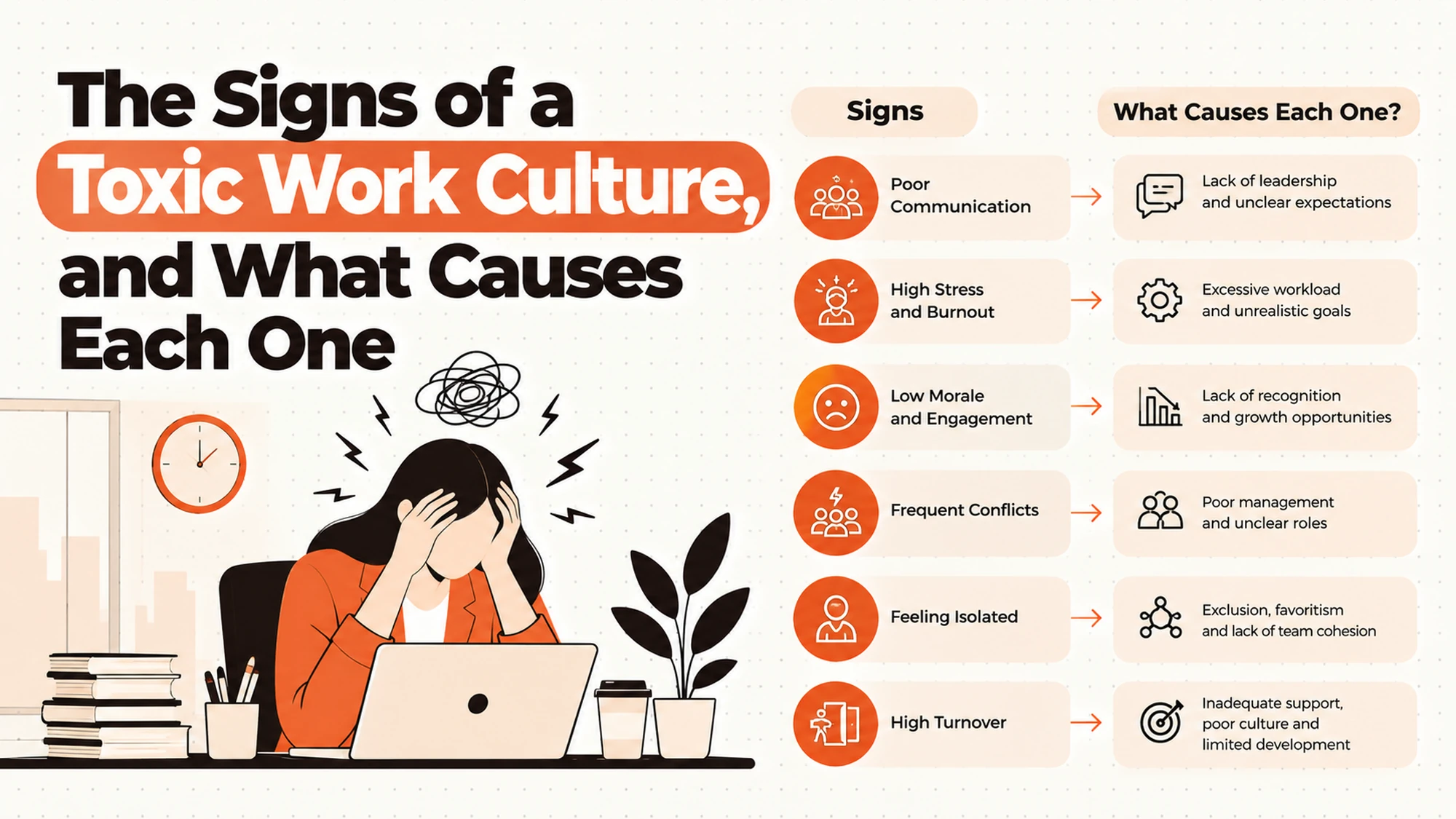
Symptoms are shared across categories, which is why lists of them are so unhelpful. The cause is what determines whether anything can be done from where you sit.
| Sign | The usual cause | Fixable from inside? |
|---|---|---|
| Turnover concentrated in one team | One manager, or work nobody has recalculated | Often, if above them will look |
| Everything decided privately | Something happened to somebody who spoke openly | Sometimes, and slowly |
| Rules applied differently by level | Nobody has ever applied a standard upward | Rarely, without a leadership change |
| Real conversation happens after the meeting | Either meeting habit or a demonstrated cost | Yes if habit, no if cost |
| Visible fear of one individual | Behaviour that continues because results excuse it | Only if senior people act on it |
| Say-do gap nobody mentions | Questions of this kind are not askable here | Rarely |
| Unsustainable workload treated as normal | A plan that assumed a headcount nobody approved | Often, if it is named as a number |
| Reorganisations nobody can explain | Decisions made above the level anyone will discuss | No, but it is not usually harm either |
The third column is the one to focus on, because it's the only one that changes what you should do. Several genuinely unpleasant situations are fixable if somebody raises them properly with the right person, and several pleasant-seeming ones aren't fixable at all. The question isn't how bad it feels, it's whether the people with the authority to change it want it changed.
The last row is included deliberately. Confusing frustration with harm is common in this subject and it isn't harmless, because it makes it harder to be believed about the things that matter. A company that reorganises confusingly is annoying to work for and isn't hurting anybody, and treating the two the same devalues the word.
What You Can Actually Do From Where You Sit
The honest set of options is smaller than most advice implies, and which ones are available depends entirely on the category rather than on your determination.
Write things down, starting now. Specific events, dates, who was present, what was said. This is worth doing whatever you decide, because it converts a feeling into evidence, it protects you if things become formal, and it lets you re-read in three months and see whether the pattern is real or whether a bad fortnight has coloured everything. Keep it somewhere personal rather than on a company system, and keep it factual rather than characterising.
Raise it once, properly, if the route is credible. That means a specific ask, specific evidence and somebody with the authority to act. Vague complaints are easy to absorb and change nothing, and they spend the credibility you'd need for a second attempt. Before you do this, be honest with yourself about what happened to the last person who tried, because that's the best available prediction of what will happen to you.
Protect the part you control. Your own behaviour towards the people around you, the standards you hold in your own team if you have one, and the boundaries you keep on your time. In a bad organisation this is genuinely valuable and genuinely limited: you can make your corner better and you can't make it safe, and pretending otherwise puts the weight of the organisation's failures on your shoulders.
Talk to somebody outside. Not for sympathy, for calibration. People inside a difficult culture lose their sense of what's normal remarkably quickly, and describing a specific incident to somebody with no stake is the fastest way to find out whether your reaction is proportionate. It's also the most common route by which people discover that what they've been tolerating isn't ordinary.
And consider leaving, seriously and without shame. This is the option people treat as failure and it's frequently the correct answer. If the organisation knows and hasn't acted, no amount of individual effort changes that, and the cost of staying is paid in your health and your confidence rather than in anything anyone will thank you for. Where the situation may involve unlawful conduct, take local advice before you resign as well as before you complain, since your position and any time limits differ by jurisdiction.
What to Put in Writing
The record matters more here than in most subjects, and it's the thing people start too late.
| Artefact | Who owns it | When it is written | What it prevents |
|---|---|---|---|
| Specific events, dates, who was present | You, kept personally | As they happen | A pattern you cannot later evidence |
| What you raised, to whom, and what followed | You | At the time | A claim that nobody was ever told |
| What you have stopped doing, and when it changed | You | When you notice | Losing track of how much you have adapted |
| The outside perspective you were given | You | After the conversation | Recalibrating to an environment you should not accept |
The first row is the one to start today rather than when things get worse, because memory reconstructs and dates blur, and an account written months afterwards is weaker in every way than notes written at the time. The distinction that keeps a record useful is between what happened and what you concluded: write the first, because the second is what somebody will attack if this ever becomes formal.
Questions to Ask Before You Commit
On specifics. Can you describe three events with dates? A bad answer describes a feeling.
On the test. What happened to the last person who raised something? A bad answer is that nobody has.
On scope. Is this one person or the organisation? A bad answer has never been tested by an escalation.
On the route. Is there somebody with authority who would act? A bad answer names a process rather than a person.
On yourself. What have you stopped doing? A bad answer is nothing, given without thinking about it.
On the line. Could any of this be unlawful, and have you taken advice? A bad answer is that you will wait and see.
What Getting This Wrong Costs
The first cost falls on the person who stays too long in the second category believing it's the first. Charitable interpretation is a virtue and it has a limit, and the people who suffer most in difficult organisations are frequently the ones who kept assuming good faith and kept trying one more constructive approach. Each attempt costs something, and the accumulated cost is usually paid in confidence, which takes far longer to rebuild than a job takes to replace.
The second cost is the opposite error, and it's real even though it's less discussed. Labelling an ordinary badly run company as harmful and leaving quickly means abandoning situations that could have improved, sometimes with one conversation, and it can become a pattern that follows somebody through several jobs. It also devalues the language: an organisation where the word is applied to every frustration is one where the serious cases are harder to hear.
The third cost is the one organisations pay and rarely measure. The people who leave a difficult culture first are the ones with the most options, which means the most capable, and the people who stay longest are the ones who can least afford to go. Over a few years that selects for a workforce that's more tolerant of the problem and less able to change it, which is why these situations tend to get worse rather than reaching an equilibrium.
So before you decide anything, settle which question you're actually asking. Is this place harmful, is it harmful to me, and is it fixable from where I sit? They're three different questions with three different answers, and the second one is sufficient on its own. A workplace that others find tolerable and that's damaging you is a reason to leave regardless of how it scores on anybody's list.
When You Are Ready to Go Further
None of this needs anybody's permission. It needs a written record of specific events, one honest answer about what happened to the last person who spoke up, and a conversation with somebody outside who can tell you whether what you're describing is ordinary.
If you're on the other side of this, responsible for an organisation rather than surviving one, the step that matters is narrower than a culture programme. Find out what actually happened to the last three people who raised something, in detail, including what happened to them afterwards. That answer tells you more about your organisation than any survey, and it's the one thing most leadership teams have never asked.
HROpsLab publishes independent comparison work across HR tooling, applicant tracking and payroll. We sell nothing, we take no vendor money, and we publish no paid placements. If the next step is looking at how consistently concerns are handled across your organisation, our comparison work is one place to start.
Frequently Asked Questions
What makes a workplace toxic?
The most useful definition isn't about how unpleasant it feels but about what causes the damage. In some organisations harm is a side effect of incompetence, growth or neglect: nobody intends it and the people responsible would address it if they understood it. In others the harmful behaviour is what the organisation rewards, so it recurs across different teams and different people, and pointing it out changes nothing because the incentives are producing it. The single test that separates them best is what happens to somebody who raises a problem. Where that person is listened to, you have a badly run company. Where their situation gets worse afterwards, you have the other kind.
Does one bad manager make a culture toxic?
Not on its own, and this distinction is worth holding onto because it's usually good news. A difficult manager in an organisation that doesn't know is a contained and solvable problem, addressable by a move, an escalation or a change of team. What turns it into something about the culture is the organisation's response once it becomes visible. If senior people know and the person continues, or if raising it produces consequences for the person who raised it, the manager has stopped being the problem and has become evidence of it. Escalating is therefore both a possible remedy and the most informative test available to you.
How do you tell a toxic culture from a badly managed one?
Look at the response to information rather than at the symptoms, because the symptoms are nearly identical. Badly managed organisations produce real damage through disorganisation, untrained managers and workloads nobody has recalculated, and when these are pointed out clearly the usual response is embarrassment followed by an attempt to fix them. Harmful ones have usually been told already, more than once, and the pattern persists because the behaviour that causes it is also the behaviour that gets rewarded. Ask what happened the last three times somebody raised a concern. Two different categories give visibly different answers to that question.
Should you report a toxic work culture, and to whom?
It depends on whether there's a credible route and on what you'd be risking, and both deserve an honest assessment rather than a principled one. A report works best when it has specific evidence, a specific ask and a recipient with the authority to act, since vague complaints are easy to absorb and spend credibility you'd want later. Before you decide, look at what happened to the last person who tried, because that's the best available prediction. Where the conduct may be unlawful, such as harassment, discrimination or retaliation, the calculation changes: protections, procedures and time limits differ by jurisdiction, so take local advice early rather than waiting.
Can a toxic culture be fixed?
Sometimes, and the determining factor is whether the people with authority want it fixed rather than how bad it currently is. Where the harm is a byproduct of neglect, naming it specifically to somebody who can act often produces genuine change, and these situations are more common than the language around this subject suggests. Where the harmful behaviour is what the organisation rewards, it's rarely fixable from below, because the fix requires the people benefiting from the arrangement to act against their own interests. Change in that case almost always requires a leadership change, and waiting for one while absorbing the cost is a decision worth making consciously.
What do you do if the problem is your own boss?
First work out whether the organisation above them knows, since that single fact determines everything else. If they don't, an escalation is both a legitimate remedy and a test, and the response will tell you which sort of company you're in faster than any other evidence. Prepare it properly: specific incidents with dates, the effect on the work, and a clear ask. If the organisation above them does know and nothing has changed, the situation has already been tested and you have your answer, in which case the useful energy goes into a move or an exit rather than another attempt.
How do you raise a concern without becoming a target?
Be specific, be factual, and be narrow. Concerns framed as characterisations of a person are easy to dismiss and easy to reframe as a personality clash, whereas a description of three specific events with dates and effects is much harder to absorb. Keep your own record, in a personal place rather than on a company system. Ask directly what will happen next and by when, so there's a commitment rather than an acknowledgement. And be realistic: in an organisation where raising things reliably ends badly, no amount of careful framing changes that, and the honest choice is between accepting the risk knowingly and not raising it.
When should you leave a toxic workplace?
When the organisation knows and hasn't acted, when the harm is landing on you specifically regardless of how others experience it, or when you've begun adapting in ways you wouldn't have accepted a year ago. Any one of those is sufficient. The framing that keeps people in place longer than they should be is the idea that leaving is a form of giving up, which puts responsibility for an organisation's choices onto an individual who never had the authority to change them. It isn't a failure. Where the situation may involve unlawful conduct, take local advice before resigning as well as before complaining, since your position and any deadlines vary by jurisdiction.
The question that matters isn't how bad it feels. It's what happened to the last person who said something.