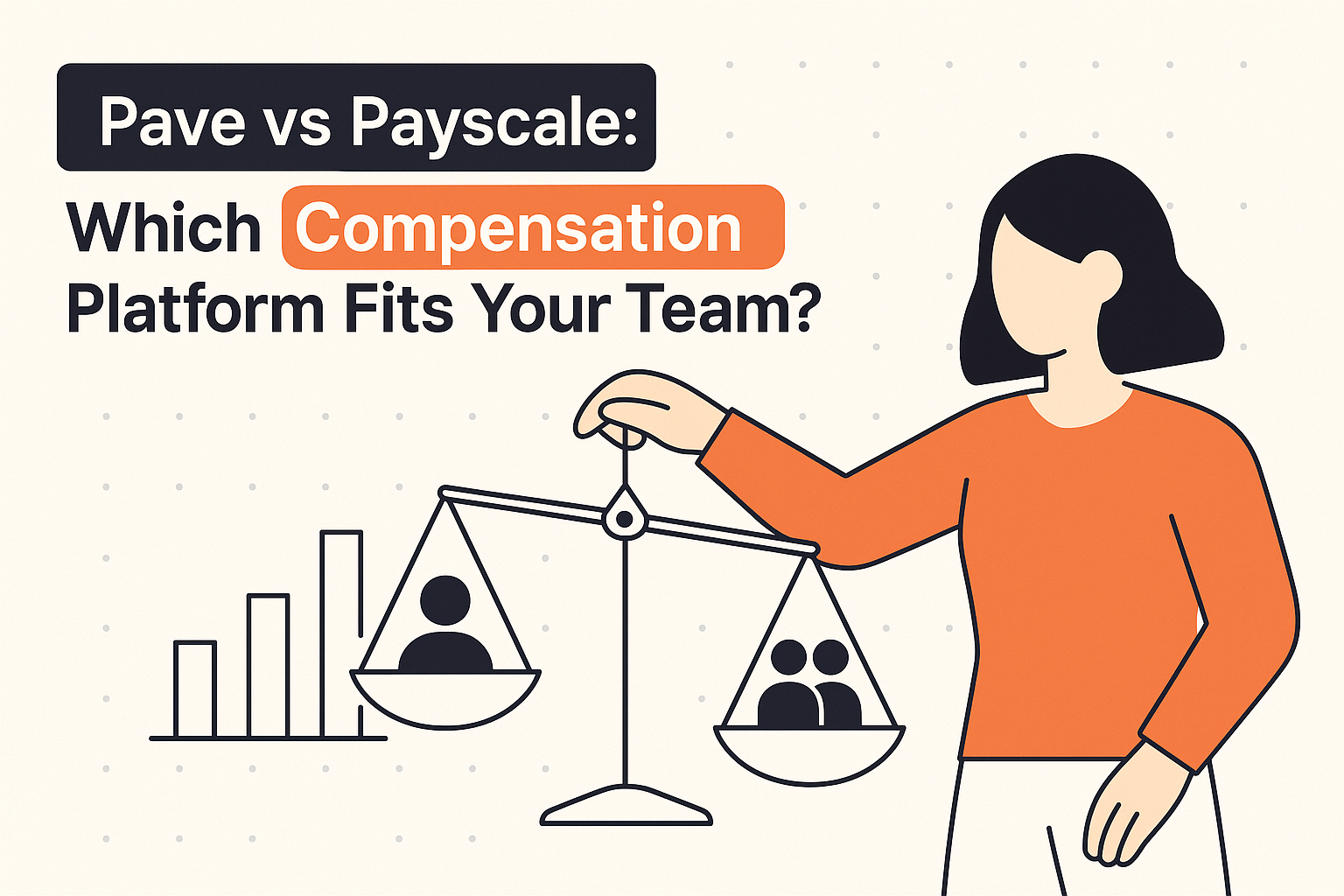
Evaluating pave vs payscale requires compensation leads to look beyond basic software subscriptions and examine how market data is sourced, validated, and applied across your organization. For People Ops teams at 100 to 1,500 employee companies preparing for upcoming pay transparency legislation, selecting the right platform is an operational priority with a strict timeline. This detailed analysis breaks down how real-time integrations compare against traditional survey-based benchmarking so you can deploy a defensible compensation strategy.
TL;DR
- The Primary Differentiator: Pave relies on real-time API integrations directly into systems like Gusto and ADP Workforce Now, whereas Payscale relies primarily on traditional survey-based market pricing methodologies.
- Pricing Models: Pave uses an employee-per-month model ranging from approximately $7 USD per employee per month on basic tiers up to $20 USD on advanced tiers, while Payscale uses custom, quote-only tiered pricing averaging about $27,000 USD per year according to Vendr estimates.
- Compliance Urgency: The June 2026 EU Pay Transparency Directive and expanding US state-level salary disclosure laws require defensible, auditable compensation ranges, turning market pricing tools into mandatory compliance infrastructure.
- Best for Fast-Growing Tech & Startups: Choose Pave if your team needs rapid setup, real-time equity and salary benchmarks, flexible workflows, and seamless connection to your modern technology stack.
- Best for Traditional Enterprises: Choose Payscale if you require deeply structured job descriptions, custom market survey submissions, and legacy job-matching frameworks across traditional enterprise verticals.
- Operational Drawbacks: Pave can experience coverage gaps in specialized non-tech positions or niche geographies, while Payscale frequently faces user complaints regarding clunky UI, rigid workflows, slow implementations, and locked multi-year contracts.
Pricing at a glance
Understanding the financial commitment required for modern compensation management software requires looking at published rates, variable headcount tiers, and estimated market averages. The market broadly divides software options into three operational categories: real-time data platforms (such as Pave, Ravio, and OpenComp), survey-based market pricing providers (such as Payscale and Salary.com), and planning-first compensation tools.
Pave publishes structural tier estimates based on per-employee rates alongside observed annual platform fee bands. Payscale operates entirely on a custom quote-only pricing model without a public rate card. The table below outlines the core financial parameters for both platforms based on established market data and vendor estimates.
Best tools for Payroll Software
| Pricing Metric | Pave | Payscale |
|---|---|---|
| Pricing Model | Per Employee Per Month (PEPM) plus annual platform fee bands | Custom tiered pricing; quote-only (no public rate card) |
| Basic Tier Pricing | From approximately $7 USD per employee per month | Quote-only baseline |
| Advanced Tiers | Up to $20 USD per employee per month | Quote-only enterprise tier |
| 100–500 Employee Fee Band | Typically $15,000 to $40,000 USD per year | Typically customized based on module and scope |
| 500–1,500 Employee Fee Band | Typically $40,000 to $90,000 USD per year | Customized based on employee count and datasets |
| Average Annual Spend | Tied directly to headcount and selected module tier | Estimated at about $27,000 USD per year (Vendr estimate) |
| Contract Structure | Annual subscriptions with headcount scaling | Frequently locked multi-year contracts |
| Data Sourcing Model | Real-time integrations with payroll and HRIS platforms | Survey-based market pricing and self-reported datasets |
When comparing these options, People Ops teams must evaluate direct platform costs alongside implementation velocity and internal administrative effort. Integrating modern tools alongside established payroll engines like Paychex Flex or Patriot often depends on whether your organization prioritizes automated real-time data streaming or human-matched survey benchmarks.
Understanding the core architecture: Real-time vs. survey-based market pricing
The underlying data architecture represents the fundamental division between Pave and Payscale. Selecting between them is less about feature lists and more about how your HR team defines, gathers, and trusts market compensation data.
Pave belongs to the category of real-time data platforms. Instead of relying on annual HR surveys that require manual data submission, cleaning, and aggregation, Pave connects directly via live APIs into connected systems, including systems like Gusto, Paychex Flex, or ADP Workforce Now. When an employee receives a salary adjustment, equity refresh, or promotional increase in a connected payroll platform, that anonymized data point flows into Pave's centralized engine. This allows teams to analyze active offer data, recent hires, and live base salary distribution across modern technology and professional roles. The primary operational benefit is speed: compensation bands update continuously as market rates shift, eliminating the traditional 6 to 12-month data lag inherent in survey cycles.
Payscale represents the traditional survey-based market pricing model. Historically, compensation benchmarking required compensation analysts to participate in annual salary surveys, submitting structured data files in exchange for aged, aggregate reports. Payscale modernized this model by blending traditional HR-submitted survey data with proprietary algorithms, company-submitted structures, and self-reported candidate inputs. However, its core mechanism remains anchored in periodic survey methodologies and deep job-matching taxonomies.
This structural distinction creates clear operational trade-offs:
- Data Refresh Rate: Pave updates continuously through background API synchronizations; Payscale updates on set publishing schedules tied to survey intake cycles.
- Data Provenance: Pave relies exclusively on verified payroll records and active HR systems; Payscale combines verified company submissions, traditional survey data, and broader statistical models.
- Job Matching Mechanism: Pave uses automated algorithmic mapping based on standardized job families, levels, and tracks; Payscale relies on custom job evaluation matrices where compensation analysts manually map internal titles to canonical survey jobs.
- Equity Visibility: Pave captures live equity grant values, cap table distribution, and vesting schedules directly from systems; Payscale handles equity primarily as static dollar inputs or target annual incentive percentages.
For organizations building salary bands to withstand regulatory scrutiny, choosing between live payroll telemetry and traditional survey methodologies defines how defensible your pay ranges will be during pay equity audits.
What is Pave? Features, real-time data integration, and platform capabilities
Pave is a compensation management platform engineered around real-time market data, transparent merit cycle planning, and total rewards communication. Founded to replace static spreadsheets and outdated annual salary surveys, Pave centers its functionality on direct API integrations across human resource information systems (HRIS), applicant tracking systems (ATS), and equity management tools.
At its core, Pave offers three interconnected core modules:
- Market Data & Benchmarking: By pulling anonymized data directly from thousands of connected company systems, Pave delivers real-time compensation benchmarks. Compensation leads can slice data by job family, level, location, company valuation, and funding stage. This eliminates the manual effort of filling out annual salary survey spreadsheets.
- Compensation Planner: Pave provides a dedicated workflow engine for managing merit cycles, promotion distribution, and equity allocation. Managers receive guided budgets, guardrails tied directly to target salary bands, and real-time visual alerts if a proposed merit raise creates internal equity pay compression or violates transparency thresholds.
- Total Rewards Statements: To improve employee retention and offer acceptance rates, Pave generates interactive candidate offer letters and employee total compensation portals. These visual dashboards display base salary, cash bonuses, health benefits, and live equity valuations that update based on company share price adjustments.
Pave is particularly flexible for smaller organizations and mid-market companies (typically between 100 and 1,500 employees) that require rapid deployment, simple administrative dashboards, and modern visual workflows. Rather than spending months mapping complex internal positions to legacy job codes, Pave uses standardized job taxonomies that map automatically during initial HRIS connection.
Because Pave links directly with modern HR and payroll setups—ranging from lightweight providers like Gusto to mid-market enterprise tools like ADP Workforce Now—the administrative burden on HR teams is significantly reduced. This direct link ensures that target pay bands, pay range transparency links, and internal equity audits operate on live payroll reality rather than historic estimates.
What is Payscale? Features, legacy survey benchmarks, and enterprise structure
Payscale is an established market pricing platform designed to help organizations benchmark positions, manage internal pay structures, and maintain comprehensive job descriptions. Positioned primarily as an enterprise platform, Payscale has built its reputation over decades by serving large institutional employers, healthcare systems, manufacturing operations, and traditional corporate enterprises.
Payscale’s architecture centers on enterprise compensation governance:
- Market Pricing Engine: Payscale provides access to extensive salary databases combining employer-reported survey data, traditional industry compensation surveys, and algorithmically modeled market rates. Compensation teams can conduct detailed job matches, adjusting for geographic differentials, company size, revenue, and specialized industry requirements.
- Job Description & Architecture Management: Payscale includes tools for constructing, maintaining, and auditing internal job descriptions. Teams can define canonical job structures, align essential duties, assign FLSA exemption statuses, and establish standardized salary grades across multi-subsidiary corporate structures.
- Pay Structure Building: The platform allows compensation analysts to construct complex salary structures, including broadbands, step-rates, and multi-tier geographic pay structures. Analysts can simulate structure adjustments, track compa-ratios, and model annual structure movement across various business units.
- Compensation Planning: Payscale offers merit cycle planning tools that enable enterprise HR leaders to allocate merit pools, model bonus distributions, and enforce organizational compensation policies across decentralized division managers.
Despite its robust analytical depth, Payscale is frequently cited by users for operational challenges. Common complaints documented across peer reviews include a clunky UI, rigid workflows, slow implementation timelines, and locked multi-year contracts that limit flexibility when company requirements change.
For large enterprises requiring highly customized survey job-matching across niche non-tech industries, Payscale offers extensive market data scope. However, for mid-sized organizations seeking agility, intuitive user experience, and fast time-to-value, Payscale’s traditional architecture can introduce unwanted administrative overhead.
How pricing really works for Pave and Payscale
Evaluating the overall financial commitment for compensation software requires looking beyond baseline software rates to consider hidden administrative costs, contract commitments, and implementation fees. Both Pave and Payscale use distinct pricing mechanics that reflect their underlying technology architectures.
Pave operates on a transparent model structured around a Per Employee Per Month (PEPM) fee schedule combined with defined annual platform fee bands. The basic plan starts from approximately $7 USD per employee per month, covering core benchmarking and simple band visualization. Advanced plans—which add advanced compensation cycle planning, total rewards portals, and granular equity modeling—scale up to $20 USD per employee per month.
For mid-sized organizations, Pave converts these PEPM rates into predictable annual platform fee ranges:
- Companies with 100 to 500 employees typically see annual platform fees ranging from $15,000 to $40,000 USD.
- Companies with 500 to 1,500 employees typically see annual platform fees ranging from $40,000 to $90,000 USD.
Pave’s pricing model scales directly with your headcount, allowing growing companies to project future software expenditures accurately. Implementation costs are generally low or included, as data ingestion occurs automatically via native API connectors.
In contrast, Payscale utilizes custom tiered pricing with no public rate card. Every contract is calculated via sales-led quotes based on company headcount, the number of market data modules purchased, geographic scope, and administrative user seats. Industry procurement data from Vendr estimates that organizations pay about $27,000 USD per year on average for a standard Payscale implementation.
However, Payscale contracts often contain additional financial terms that buyers must account for:
- Multi-Year Commitments: Payscale frequently requires multi-year contracts (typically 2 to 3 years) with built-in annual escalator clauses.
- Implementation & Professional Services: Setting up custom job descriptions, legacy survey data ingestion, and complex HRIS integrations can require separate professional services fees.
- Module Add-Ons: Access to specialized industry salary surveys, job description management modules, and advanced reporting often carries additional modular subscription costs.
To evaluate total software expenditure, People Ops leaders must assess both direct licensing costs and indirect administrative expenses. To explore how compensation platform fees align with overall human resource software budgets, view our guide on modern HRIS systems.
Total cost analysis at 150, 400, and 1,000 headcounts
To clarify the financial differences between Pave and Payscale, we can project expected platform expenses across three realistic headcount tiers: 150 employees, 400 employees, and 1,000 employees. These estimates draw strictly from Pave’s PEPM and platform fee bands alongside Payscale’s average procurement benchmarks.
Scenario A: 150 Employees (Mid-Market Entry)
- Pave Calculation:
- Basic Plan: $7 USD × 150 employees × 12 months = $12,600 USD per year.
- Advanced Plan: $20 USD × 150 employees × 12 months = $36,000 USD per year.
- Typical Contract Floor: Pave’s typical annual platform fee floor for a 100–500 employee organization ranges from $15,000 to $40,000 USD per year. Thus, a 150-employee contract will generally anchor between $15,000 USD (Basic floor) and $36,000 USD (Advanced tier).
- Payscale Calculation:
- Custom Tiered Pricing: Based on Vendr procurement estimates, the average annual spend sits at about $27,000 USD per year. For a 150-person company purchasing core market pricing modules, initial quotes frequently land near this $27,000 USD benchmark.
Scenario B: 400 Employees (Scaling Mid-Market)
- Pave Calculation:
- Basic Plan: $7 USD × 400 employees × 12 months = $33,600 USD per year.
- Advanced Plan: $20 USD × 400 employees × 12 months = $96,000 USD per year.
- Typical Contract Band: For organizations with 100–500 employees, typical annual platform fees cap between $15,000 and $40,000 USD per year. On standard commercial terms, Pave contracts for 400 employees typically cap around $40,000 USD per year unless advanced enterprise planning suites are added.
- Payscale Calculation:
- Custom Tiered Pricing: For 400 employees, custom quotes typically hover around the baseline average of $27,000 USD per year for basic setups, scaling upward to $35,000–$45,000 USD per year when adding job description management and multi-region survey modules.
Scenario C: 1,000 Employees (Upper Mid-Market / Enterprise)
- Pave Calculation:
- Basic Plan: $7 USD × 1,000 employees × 12 months = $84,000 USD per year.
- Advanced Plan: $20 USD × 1,000 employees × 12 months = $240,000 USD per year.
- Typical Contract Band: For companies with 500–1,500 employees, Pave’s annual platform fees typically range from $40,000 to $90,000 USD per year. A 1,000-employee company can expect an annual platform commitment near $80,000 to $90,000 USD per year.
- Payscale Calculation:
- Custom Tiered Pricing: At 1,000 employees, Payscale transitions into higher custom enterprise tiers. While the average market spend is estimated at $27,000 USD per year, 1,000-employee configurations frequently escalate to $45,000–$65,000 USD per year depending on data modules and contract length.
The table below summarizes these financial projections:
| Company Headcount | Pave Projected Annual Spend | Payscale Projected Annual Spend | Financial Mechanics & Notes |
|---|---|---|---|
| 150 Employees | $15,000 – $36,000 USD | ~$27,000 USD (Vendr average) | Pave calculated at $7–$20 PEPM within the $15k–$40k band floor; Payscale near average baseline quote. |
| 400 Employees | $33,600 – $40,000 USD | $27,000 – $45,000 USD | Pave Basic yields $33.6k (capped at $40k band); Payscale scales with added modules. |
| 1,000 Employees | $40,000 – $90,000 USD | $45,000 – $65,000 USD | Pave fits squarely into the 500–1,500 headcount fee band; Payscale reflects enterprise tiered custom quote. |
When analyzing total cost of ownership, teams must weigh Pave’s higher advanced PEPM rates against Payscale’s potential multi-year locking terms and custom module additions. Connecting compensation modules directly into comprehensive integrated HR platforms helps streamline these software commitments.
Regulatory deadline: The June 2026 EU Pay Transparency Directive and pave vs payscale compliance requirements
The operational requirement for defensible pay data is no longer driven solely by competitive talent acquisition; it is mandated by expanding international laws. Compensation leads evaluating pave vs payscale face a major regulatory deadline: the June 2026 EU Pay Transparency Directive.
This landmark European Union directive introduces stringent compliance standards for companies operating within EU member states, while setting a regulatory benchmark that influences global compensation standards:
- Right to Information: Job applicants have the right to receive transparent pay ranges prior to interviews without being asked about their compensation history.
- Gender Pay Gap Reporting: Employers with more than 100 employees must publicly disclose gender pay gap figures. If an unexplainable pay gap exceeding 5% exists within a job category, employers must conduct a formal joint pay assessment in conjunction with worker representatives.
- Burden of Proof Shift: In legal claims regarding pay discrimination, the legal burden of proof shifts to the employer, who must prove that compensation differentials are based on objective, gender-neutral criteria.
Simultaneously, state-level salary disclosure laws across the United States (including California, New York, Washington, and Colorado) mandate that companies publish clear, defensible salary ranges on every external and internal job posting.
This regulatory shift changes how HR teams evaluate Pave and Payscale:
[Regulatory Mandate: EU Directive June 2026 & US State Laws]
│
┌────────────────┴────────────────┐
▼ ▼
[Real-Time Audit Trail: Pave] [Survey Benchmark Audit: Payscale]
• Live API payroll sync • Custom survey job-matching
• Continuous band validation • Periodic grade adjustments
• Automated compression alerts • Historical survey logs
Pave addresses transparency requirements by generating real-time pay ranges based on live market adjustments. Because Pave integrates directly with your core payroll engine, compensation leads can demonstrate that published ranges match actual internal equity profiles. Furthermore, Pave’s automated guardrails prevent managers during compensation reviews from awarding non-compliant merit increases that widen gender or demographic pay gaps.
Payscale approaches compliance through its survey market pricing and job description frameworks. Teams can build formal job evaluation points, establish objective job grades, and document gender-neutral pay criteria. However, because survey data updates periodically rather than continuously, HR teams using Payscale must manually audit their internal structures against lagging survey points to ensure published hiring bands remain defensible when challenged.
With the June 2026 deadline approaching, compensation leads must implement a platform that generates objective, auditable pay bands without creating excessive manual administrative workloads.
Where Pave wins: Modern workflows, integration speed, and equity visibility
Pave has established a strong presence in the compensation management market by targeting the key pain points of modern People Ops teams: implementation delays, administrative overhead, and poor equity visibility.
Key advantages of choosing Pave include:
Rapid API Integration and Fast Time-to-Value
Traditional compensation platforms often require weeks or months of data formatting, manual field mapping, and consultant-led setup. Pave connects directly to modern cloud HRIS platforms (such as Gusto, Paychex Flex, and ADP Workforce Now), ATS systems, and equity platforms via native pre-built APIs. Initial integration typically takes hours or days rather than months, allowing compensation teams to access real-time benchmark visualizer dashboards almost immediately.
Live Market Telemetry Replacing Survey Delay
Rather than waiting for annual salary survey releases, Pave users access live market data pulled continuously from connected systems. This real-time telemetry is particularly valuable for fast-moving technology roles, executive compensation, and rapidly evolving remote compensation models where static 12-month-old survey data can lead to misaligned offer packages.
Integrated Equity and Total Rewards Visualizations
Equity compensation is often a complex element for employees to evaluate. Pave natively integrates with equity management systems to display real-time equity valuations, vesting schedules, and unvested dollar projections. During recruitment and annual merit cycles, candidate offer letters and employee total rewards portals automatically render dynamic equity scenarios, significantly boosting offer acceptance rates and internal retention.
Intuitive Compensation Cycle Planning
Pave’s compensation planning interface replaces clunky, error-prone spreadsheets with an intuitive, modern workspace. HR leaders can easily design merit frameworks, set budget caps, and establish clear manager recommendation guardrails. Line managers can execute compensation allocations within a clean interface that provides real-time feedback on compa-ratios, budget consumption, and pay parity impact.
For mid-market organizations seeking speed, modern design, and minimal ongoing administrative friction, Pave provides a streamlined end-to-end platform.
Where Payscale wins: Enterprise depth, custom job matching, and traditional benchmarks
While Pave excels in modern tech-forward environments, Payscale remains a compelling platform for large enterprises, multi-industry conglomerates, and traditional organizations requiring specialized market pricing architectures.
Key advantages of choosing Payscale include:
Comprehensive Industry and Regional Data Coverage
Payscale’s data footprint spans thousands of traditional job titles, unionized trades, healthcare specialties, manufacturing operations, and public-sector positions that may lack coverage in tech-focused real-time databases. For companies employing specialized operational roles outside technology and corporate business functions, Payscale offers extensive market data coverage.
Granular Custom Job Matching Capabilities
In complex corporate structures, standard job titles rarely tell the whole story. Payscale allows compensation analysts to perform detailed custom job matching. Analysts can weight specific job duties, adjust for organizational revenue thresholds, layer on industry-specific survey filters, and modify geographic differentials down to specific metropolitan statistical areas.
Advanced Job Architecture and Description Governance
Payscale provides dedicated software modules for managing enterprise job description libraries. HR teams can draft, audit, and approve job descriptions, align essential physical and educational requirements, assign FLSA classifications, and establish structured salary grade hierarchies. This capability helps large HR departments maintain governance across multi-subsidiary organizations.
Deep Multi-Tier Salary Structure Modeling
For enterprise compensation leads who build traditional broadbands, step-rate structures, or union pay scales, Payscale offers advanced mathematical modeling tools. Analysts can design complex pay structures, calculate mid-point differentials, model structure adjustments across corporate divisions, and run long-term financial simulations before finalizing salary bands.
For established enterprise teams with dedicated compensation analysts who prioritize detailed job matching over real-time API integrations, Payscale provides time-tested structural capabilities.
Where each tool struggles: Real-time coverage gaps vs. clunky UI and rigid contracts
Neither platform is without operational drawbacks. Evaluating pave vs payscale requires honest examination of where each solution encounters practical limitations during day-to-day use.
Where Pave Struggles:
- Coverage Gaps in Traditional Industries: Because Pave relies on real-time API integrations from connected employer systems, its dataset is heavily concentrated in technology, high-growth, remote-first, and venture-backed corporate sectors. Organizations with large frontline workforces—such as healthcare providers, heavy manufacturing, construction, or specialized retail—may find sparse benchmark coverage for specialized operational titles.
- Standardized Job Taxonomies: Pave’s automated mapping relies on standardized job families and tracks. Organizations with unique, highly customized, or hybrid job titles may find Pave’s automated categorization too rigid, requiring manual adjustments to align internal positions with standard market tracks.
- Pricing Floor for Smaller Teams: On basic tiers ($7 USD PEPM) up to advanced tiers ($20 USD PEPM), small companies under 100 employees may hit Pave’s annual platform fee floors ($15,000 USD minimum), resulting in a higher effective per-employee cost than lightweight alternatives.
Where Payscale Struggles:
- User Interface and User Experience: A dominant complaint among Payscale users is its clunky UI and outdated navigational workflows. Line managers and HR leads often describe the interface as unintuitive, requiring significant training during compensation review cycles.
- Implementation Delays and Administrative Friction: Setting up Payscale, mapping job descriptions, and configuring custom survey modules frequently requires lengthy implementation cycles. HR teams must invest substantial manual effort to align internal structures with Payscale’s data engines.
- Rigid Multi-Year Contracts: Payscale regularly requires multi-year contracts without transparent public rate cards. Users report feeling locked into long-term financial commitments while encountering unexpected price escalations for supplementary data modules.
- Data Refresh Lag: Despite incorporating online algorithmically derived data, Payscale’s reliance on traditional survey intake methodologies means market shifts can take months to reflect across benchmark reports.
Understanding these operational friction points prevents surprises after contract execution and ensures your team chooses a platform aligned with its operational capabilities.
Migration and switching considerations: Transitioning data and workflows
Switching compensation platforms—whether transitioning from static spreadsheets to Pave, moving from Payscale to real-time platforms, or consolidating disparate HR software—requires a structured migration plan. A poorly executed transition risks distorting historical pay records, corrupting job architectures, and disrupting merit cycles.
When planning a platform migration, People Ops teams should prioritize three core operational phases:
[Phase 1: Job Architecture Cleanup] ──► [Phase 2: Data Extraction & Verification] ──► [Phase 3: Integration & Validation]
• Standardize internal job codes • Export historical pay & equity records • Connect HRIS/Payroll live APIs
• Define FLSA & level frameworks • Validate salary range structures • Run parallel comp cycle tests
Phase 1: Job Architecture Standardization
Before ingesting data into a new platform, clean up your internal job architecture:
- Standardize job titles, job families, and career levels across all departments.
- Ensure clear distinctions between individual contributor (IC) tracks and management tracks.
- Verify that core employee fields in your core HRIS—such as Gusto, Paychex Flex, or ADP Workforce Now—are accurately populated.
Phase 2: Historical Data Extraction and Equity Alignment
Extract historical compensation records, pay band structures, and equity grant logs:
- When migrating from Payscale to Pave, export custom job description files, historical compa-ratio benchmarks, and established salary grade ranges. Verify how internal job grades will translate into Pave's real-time job families.
- When migrating from spreadsheets to either tool, ensure historical merit increases, promotion logs, and base salary bases are fully reconciled against live payroll records to prevent reporting errors during audits.
Phase 3: Integration Configuration and Parallel Validation
Establish API connections between the compensation platform and your primary HR systems:
- Test data sync connectors between your ATS, HRIS, and equity management software.
- Run a parallel compensation review simulation. Execute a test merit cycle in the new environment alongside your existing setup to verify that compa-ratios, budget caps, and range spreads calculate correctly.
- Establish clear data governance protocols to ensure that compensation changes made during merit planning sync back accurately to core payroll systems.
For comprehensive advice on managing core system migrations and establishing clean underlying database architectures, consult our detailed resource on core HRIS infrastructure.
Negotiation advice: Securing fair terms, rate locks, and contract structures
Procuring compensation software requires procurement leads to navigate sales processes effectively. Both Pave and Payscale offer opportunities for negotiation, but securing optimal commercial terms requires different strategies for each vendor.
Negotiating with Pave:
- Leverage Headcount Bands: Pave’s annual platform fees operate within defined headcount ranges (e.g., $15,000–$40,000 USD for 100–500 employees; $40,000–$90,000 USD for 500–1,500 employees). If your organization sits near the lower boundary of a headcount band (e.g., 110 employees or 520 employees), negotiate for a rate calculated precisely on your active headcount rather than being bumped to the middle of the platform fee tier.
- Cap Advanced Tier Upcharges: If you require Pave’s Advanced features—such as compensation planning and custom equity visualizations—push to anchor your rate closer to the basic $7 USD PEPM threshold or secure capped bundled pricing rather than the full $20 USD PEPM cap.
- Request Implementation Fee Waivers: Because Pave relies on automated API connections, push back against high professional services or onboarding fees by emphasizing the low administrative overhead of API setups.
Negotiating with Payscale:
- Challenge Multi-Year Lock-ins: Payscale frequently defaults to multi-year contracts. If forced into a multi-year agreement, insist on an opt-out clause tied to performance milestones or demand a firm cap (e.g., 0% to 3%) on annual renewal price increases.
- Unbundle Unnecessary Survey Modules: Payscale quotes often bundle extra geographic datasets, specialized industry surveys, or job description tools. Force sales reps to unbundle these options, paying only for the specific industry and geographic datasets your team requires.
- Leverage Market Benchmarks: Cite industry baseline quotes—such as the Vendr average spend estimate of ~$27,000 USD per year—as a reference point during price negotiations to prevent overpaying for core market pricing tiers.
By entering negotiations with clear market rate awareness, People Ops teams can secure favorable pricing structures, contract terms, and feature access.
Head-to-head comparison matrix: Features, data model, and usability
The detailed matrix below provides a direct, head-to-head functional comparison between Pave and Payscale across core software operational dimensions.
| Operational Feature | Pave | Payscale | Operational Impact |
|---|---|---|---|
| Primary Data Source | Real-time live API integrations with HRIS/Payroll | Employer-submitted surveys, algorithm models | Pave provides current live market rates; Payscale provides traditional historical survey depth. |
| Pricing Transparency | PEPM rates ($7–$20) + structured platform fee bands | Custom tiered pricing; quote-only ($27k avg) | Pave allows headcount-based budgeting; Payscale requires direct sales negotiation. |
| Implementation Speed | Hours to days via native pre-built API connectors | Weeks to months involving manual matching | Pave offers faster time-to-value; Payscale requires dedicated configuration effort. |
| User Experience (UI) | Modern, intuitive visual interface and dashboards | Enterprise-focused, frequently rated as clunky UI | Pave reduces manager training needs; Payscale may require extra admin oversight. |
| Equity Visualization | Real-time equity grant, vesting, and valuation tools | Static annual incentive / target equity inputs | Pave provides comprehensive total rewards views for equity-heavy offers. |
| Job Description Tools | Standardized job taxonomies and level mapping | Comprehensive job description management module | Payscale provides deeper formal job description governance and documentation. |
| Compensation Planning | Modern, guided merit review planner with guardrails | Flexible, enterprise merit modeling software | Both handle merit cycles well; Pave offers a more modern user experience. |
| EU Directive Compliance | Automated real-time pay band validation and logs | Structural pay grade modeling and audit files | Pave simplifies ongoing live compliance; Payscale supports formal job grade audits. |
| Industry Data Depth | Tech, high-growth, remote, and corporate roles | Broad scope: manufacturing, healthcare, trades | Payscale covers traditional industries better; Pave excels in high-growth corporate tiers. |
This comparison highlights that selecting between these tools depends on aligning their functional strengths with your organization's specific technical ecosystem, industry sector, and internal administrative capacity.
Who should pick which platform: Decision framework for 100-1,500 employee teams
Selecting the right compensation platform requires matching your organization's operational profile with the appropriate software architecture. Below is a structured decision framework to guide People Ops and compensation leads at 100–1,500 employee companies.
[Decision Point: Compensation Strategy]
│
┌──────────────────────────────┴──────────────────────────────┐
▼ ▼
[High-Growth / Tech / Remote] [Traditional / Specialized]
• Needs real-time market data • Requires custom survey matching
• High equity compensation mix • Specialized frontline / trade roles
• Fast API integrations (Gusto, ADP) • Complex legacy job descriptions
• Prefers intuitive manager UI • Dedicated comp analyst team
│ │
▼ ▼
Select: PAVE Select: PAYSCALE
Choose Pave If:
- You Are a High-Growth, Tech, or Modern Professional Services Firm: If your employee population consists primarily of tech, product, marketing, corporate, and remote professional roles, Pave’s real-time API integrations deliver highly relevant market benchmarks.
- Equity Is a Major Component of Your Total Rewards: Pave natively visualizes option value, RSU vesting schedules, and equity projections, making it an effective tool for talent acquisition and retention.
- You Require Rapid System Deployment: If your team wants to deploy a compensation platform within days without hiring external implementation consultants, Pave’s pre-built connectors to platforms like Patriot, Gusto, or Paychex Flex streamline setup.
- You Prioritize Manager Self-Service and Ease of Use: Pave’s intuitive interface ensures line managers can execute merit reviews with minimal HR hand-holding and administrative friction.
Choose Payscale If:
- You Operate in Traditional or Specialized Industries: If your workforce includes healthcare personnel, specialized manufacturing technicians, construction trades, or unionized workers, Payscale provides broad traditional survey coverage.
- You Maintain Complex, Legacy Job Architectures: If your enterprise requires deep custom job matching, weighted point-factor job evaluations, and extensive formal job description maintenance modules, Payscale delivers robust structural tools.
- You Employ Dedicated Compensation Analysts: Payscale’s analytical depth is best utilized by experienced compensation specialists who prefer manually tweaking market pricing models and conducting multi-source survey evaluations.
- Your Procurement Strategy Favors Enterprise Custom Contracting: If your corporate organization routinely negotiates multi-year enterprise software contracts, Payscale fits seamlessly into traditional enterprise vendor management frameworks.
By grounding your decision in data architecture, administrative capacity, and organizational strategy, you can select the platform that best positions your company for long-term compensation transparency and compliance.
Related reading
Frequently asked questions
What is the main structural difference in the pave vs payscale comparison?
The main structural difference is data architecture. Pave uses real-time API integrations directly into payroll and HRIS platforms to deliver live market compensation data. Payscale relies primarily on traditional survey-based market pricing methodologies combined with algorithmically derived data models. Pave offers modern, automated workflows, whereas Payscale provides traditional enterprise job-matching depth.
How does the June 2026 EU Pay Transparency Directive affect this decision?
The June 2026 EU Directive mandates transparent, defensible salary ranges and gender pay gap disclosures. Selecting between Pave and Payscale impacts how easily your team can generate auditable pay bands. Pave automatically validates live payroll data against pay bands to catch pay compression real-time, while Payscale requires manual structures built around periodic market surveys.
What are the typical annual costs for Pave versus Payscale?
Pave charges basic plans from about $7 USD per employee per month up to $20 USD for advanced tiers, resulting in annual platform fees of $15,000–$40,000 USD for 100–500 employees and $40,000–$90,000 USD for 500–1,500 employees. Payscale uses quote-only tiered pricing with no public rate card, averaging about $27,000 USD per year based on Vendr estimates.
Can Pave or Payscale connect directly with modern payroll systems?
Pave connects via native, real-time APIs directly to systems like Gusto, Paychex Flex, and ADP Workforce Now to automatically pull live salary data and sync merit increases. Payscale can ingest HRIS data files, but typically relies on structured data imports or custom enterprise connectors rather than real-time telemetry APIs, often requiring manual configuration during setup.
Which platform handles equity compensation benchmarking better?
Pave handles equity compensation benchmarking significantly better by pulling live equity grant values, cap table data, and vesting schedules directly from equity management tools. It renders dynamic total rewards visualizers for offer letters and employee dashboards. Payscale treats equity primarily as static cash equivalents or target incentive percentages without live option or RSU tracking.
What are the most common user complaints for both platforms?
Pave’s main drawbacks include benchmark coverage gaps in specialized non-tech industries (like healthcare or heavy manufacturing) and rigid automated job mapping taxonomies. Payscale users frequently report a clunky user interface, unintuitive manager workflows, slow implementations, and rigid multi-year locked contracts that restrict operational flexibility when company needs evolve.