
TL;DR
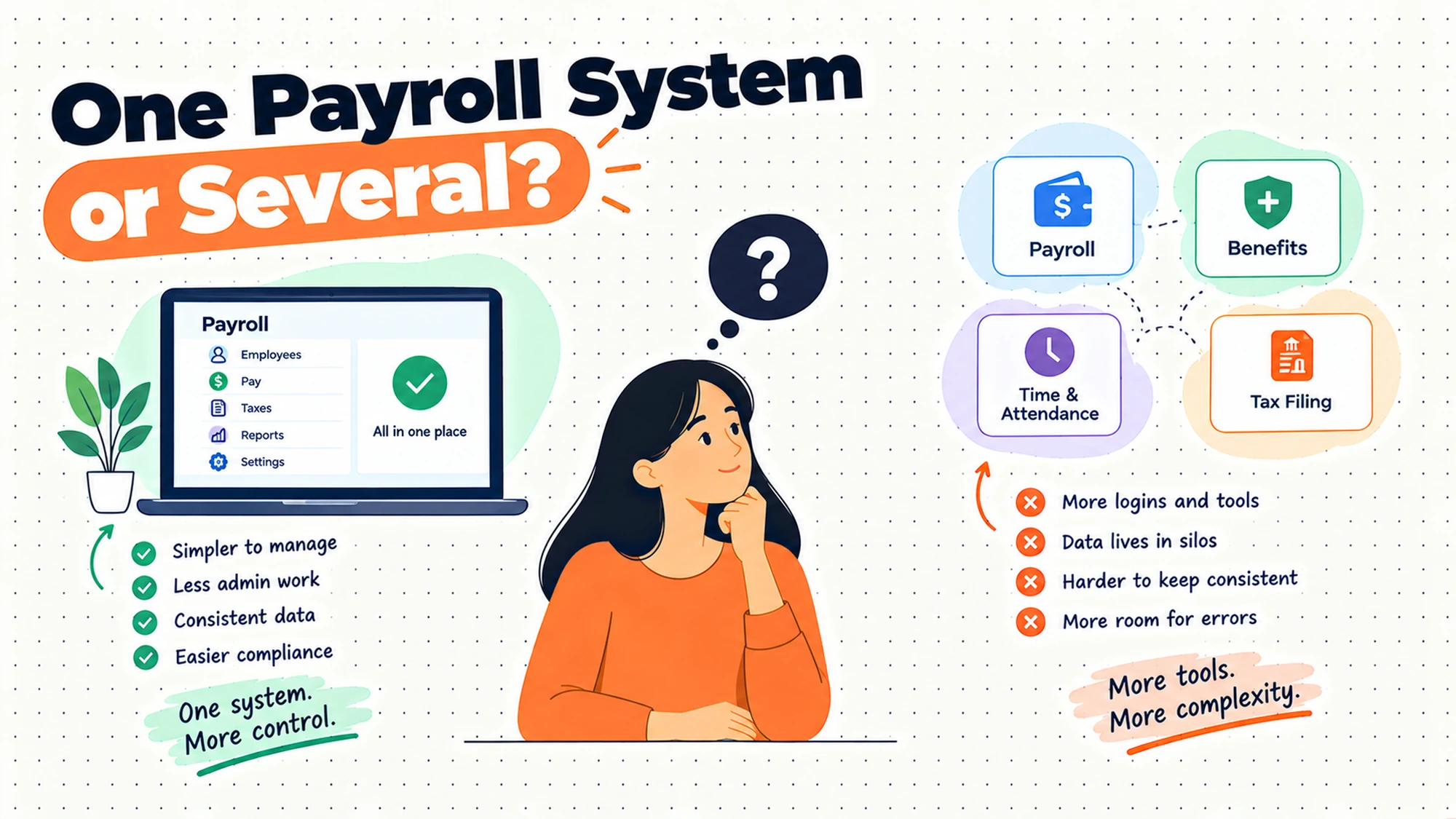
- The core decision: whether to consolidate payroll onto one system or accept that several will coexist.
- When doing nothing is right: when each arrangement works and nobody is trying to compare across them.
- What has to be true: somebody can answer a question that spans more than one payroll.
- How the options split: by how much genuinely unifies, which is usually reporting rather than processing.
- Decision rule: if you only need to see across them, you need a view, not a system.
- Outcome to expect: fewer places to look, and the same local requirements underneath.
The Question You Cannot Answer
Somebody asks what your total employment cost was last quarter. Not per country, not per entity, just the number.
If you pay people in more than one place, this is harder than it sounds. One payroll reports in one currency and one structure, another in a different one, a third comes as a document from an external party in a format nobody can aggregate. Somebody rebuilds the answer in a spreadsheet, and it takes most of a week, and the number is approximately right in a way nobody wants to say out loud.
The obvious conclusion is that you need one system. That conclusion is frequently wrong, and it's wrong in a specific way worth understanding before anybody starts looking at options.
Best tools for Payroll Software
What you couldn't do was answer a question across several payrolls. That's a reporting problem. Consolidating the systems would solve it, and so would several much smaller things, at a fraction of the effort and disruption. The reason this matters is that payroll consolidation is one of the most demanding changes an organisation can attempt, and attempting it to fix a reporting gap is a poor trade.
Underneath the question is something that doesn't change whatever you buy. Paying people in a given place means meeting that place's requirements, and those differ substantially. A single system can present a common interface over that, which is genuinely useful. It doesn't remove the underlying differences, and any option implying otherwise is describing an interface rather than a reality.
What actually applies in each place you pay people is a matter for local advice, and it changes. Nothing here tells you what those requirements are. Establish them per jurisdiction, from somebody accountable for that answer, before evaluating anything, because a system can only be judged against obligations you've already defined.
When You Genuinely Do Not Need to Act Yet
Each payroll works and nobody needs to compare. If every population is paid correctly and nobody is trying to answer questions across them, several arrangements coexisting is a perfectly reasonable state. Consolidating would be change for its own sake.
Somebody is rebuilding numbers by hand. Every period, somebody assembles a cross-payroll view from exports. That's a real cost and it's usually a reporting problem rather than a systems problem. Worth solving, probably not by replacing anything.
Nobody can see the whole picture at all. Questions about total cost, headcount or a person's history across a move can't be answered. At that point the fragmentation is limiting decisions, and something needs to change, though still not necessarily the processing systems.
The edge case that forces it. A person moves between places, or one population needs treatment nobody's arrangement covers, and nobody can trace what happened to them. Individual records spanning arrangements is the one problem that genuinely needs the arrangements to talk to each other.
Five Questions This Reader Asks at 11pm
Is a single global payroll system actually possible? In the sense of one system presenting one interface across several places, frequently yes. In the sense of one calculation engine handling every jurisdiction identically, no, and nobody should want that, because the differences it would be flattening are real. Most arrangements sold as global are coordinating local capability behind a common surface, which is a reasonable thing to buy provided you understand that's what it is.
What do you actually gain from consolidating? Usually one place to look, consistent reporting, and a single relationship. Those are real. What you gain less often is less work, because local requirements persist and somebody still has to meet them. The gain is coherence rather than effort.
What do you lose? Local flexibility and, sometimes, local expertise. An arrangement covering many places may handle each one adequately rather than well, and a local arrangement that knew your specific situation is hard to replace. The trade is breadth against depth, and which matters more depends on how unusual your populations are.
Do you need consolidation or just reporting? Ask what question you're unable to answer. If it's about totals, trends or comparisons, that's reporting, and a data layer over several payrolls solves it at far lower cost. If it's about a person whose record spans arrangements, that's harder and may need more.
What about one system per region? A common middle position and frequently the sensible one. Regions tend to share enough structure that a system covering several places within one is doing something coherent, while spanning very different regimes stretches further than any single arrangement comfortably reaches.
What Unifies and What Does Not
| Aspect | Does it genuinely unify | What stays local regardless |
|---|---|---|
| Employee record and identity | Yes, and this is the main prize | Nothing, this unifies well |
| Reporting and totals | Yes, once the data is comparable | Making the data comparable |
| The calculation itself | No, and it should not | Every local rule, unchanged |
| Statutory elements and rates | No | Maintained per place, by somebody |
| Filings and submissions | Rarely | Format, timing and recipient, all local |
| Pay dates and cycles | Partly, if you choose to align them | Whatever local practice or agreement sets |
| Approval and release | Yes, as a process | Who is authorised locally |
| Banking and payment | Varies considerably | Usually more local than expected |
| Local expertise | No | Somebody has to know each place |
The first row is the strongest argument for consolidating and it's underrated. One record per person, spanning every place they've been paid, makes questions answerable that are otherwise genuinely hard: what somebody's history is, what changed when they moved, what a population costs in total. Fragmented records make every such question a reconstruction exercise.
The third row is the one that gets oversold. Calculation does not unify, because the rules differ, and an arrangement covering many places is running different logic per place behind a common interface. That's fine and it's what you want. It matters because it means adding a place is real work rather than a configuration change.
The last row is the one to watch in any evaluation. Coverage in a list is not the same as depth, and the question worth asking is who actually knows each place, whether that's people inside the provider or local parties they work with.
Five Diagnostic Questions You Can Self-Assess Against
What question can you not answer today? Write it precisely. Most reasons for consolidating turn out to be one or two specific unanswerable questions, and naming them tells you whether you need reporting or something larger.
How many places do you actually pay in, and how many people in each? Consolidation effort scales with the number of places, while benefit scales with the number of people. A long tail of places with very few people each is the hardest shape to justify and the most common one.
Do people move between your populations? If they do, and their records don't follow, that's the problem that reporting alone won't fix. If they don't, the case for connecting the arrangements is weaker than it looks.
Who knows each place? For every location, name who would notice a rule change. If some places have no answer, that's a gap to close regardless of what system you end up with.
What would you do if one place had to change? Adding, closing or restructuring a location is more common than expected. An arrangement that makes that straightforward is worth a lot; one that treats it as a project is worth knowing about in advance.
Run these five with the people who actually operate each payroll rather than with the centre. The centre usually has a tidier picture than the reality, and the difference between the two is where most of the surprises in this decision live.
Six Ways Multi-Location Payroll Is Handled, Reviewed
Separate arrangements, unconnected
Each place has its own payroll, chosen locally, with no link between them. It earns its place on fit: every arrangement suits its own location, uses local knowledge, and can be changed without affecting anything else.
Where it falls short is visibility. Nothing can be answered across the set without manual assembly, records don't follow people who move, and nobody has a view of the whole. It also tends to accumulate rather than be designed, so the number of arrangements grows quietly.
Reasonable where populations are genuinely independent and nobody needs to compare. Keep a simple central register of which arrangement covers what, or nobody will be able to say.
The register matters more than it sounds. Organisations in this shape routinely discover a payroll nobody at the centre knew about, usually a very small one set up locally for good reasons and never reported upward. Until the list exists, the scope of any future decision is unknown.
The second thing worth doing is agreeing a common format for what each arrangement reports back, even while they stay separate. That is a small ask made once, and it is the groundwork for any reporting view you later want, so the cost is near zero and the option value is real.
Separate arrangements with a reporting layer over them
Each payroll stays as it is; a data layer collects outputs into a common structure. It earns its place as the best effort-to-benefit trade available here, because it answers the cross-payroll questions without touching any processing.
Where it falls short is that the layer only knows what it's given. Different arrangements report differently, so making outputs comparable is real and ongoing work, and the layer inherits any error upstream. It also doesn't give you a single record per person.
The right starting point for most organisations whose stated problem is reporting. Build it before considering anything larger, because it frequently turns out to be sufficient.
The work that makes it succeed is definitional rather than technical. Deciding what a term means consistently across locations, so the same word describes the same thing everywhere, is the part that takes time and the part that carries forward into any later decision.
Be clear about what it will not do. It will not give you one record per person, it will not catch an error inside a payroll, and it will not reduce anybody's workload. It answers questions. That is a narrower promise than a new system implies and it is usually the promise that was actually needed.
One system for your largest population, separate for the rest
Your main location runs a full system; smaller populations are handled locally by whatever fits. It earns its place by putting effort where the people are, and most organisations are shaped this way whether or not they chose it.
Where it falls short is the tail. Small populations get least attention and are where errors and unnoticed obligations concentrate, precisely because they're too small to justify scrutiny. The main system also tends to be treated as the system of record when it holds only part of the picture.
A pragmatic shape. Make sure the tail has a named owner, because it's the part that goes wrong quietly.
The specific risk is that the main system becomes treated as authoritative when it covers only part of your population. Headcount, cost and reporting drawn from it will be wrong in a way that looks right, because nothing indicates the missing part. Label it clearly as covering one population, not the organisation.
The tail also tends to grow without anybody deciding it should. Each addition is individually sensible and the accumulated result is a set of arrangements nobody chose. Reviewing the list once a year is enough to keep it deliberate.
One system per region
Coverage is grouped into regions, each with an arrangement spanning several places. It earns its place by matching a real boundary: places within a region frequently share enough structure that one arrangement covering them is doing something coherent rather than stretching.
Where it falls short is the boundary itself. Regions are commercial constructions, not regulatory ones, and a place sitting awkwardly between them gets handled by whichever arrangement claims it rather than whichever suits it. Cross-region questions also stay unanswered.
Often the sensible middle. Check how each specific place is actually covered rather than trusting the regional label.
The question to press is what happens to a place at the edge. Every regional arrangement has locations that sit awkwardly, and how those are handled tells you more about the provider than the places at the centre, which are always covered well.
Also establish whether reporting spans regions or stops at each boundary. Organisations in this shape frequently end up with two or three good views and still no total, which is the same problem they started with, arranged more tidily.
One system with local processing behind it
A single interface and record, with local capability, sometimes partners, doing the actual calculation per place. It earns its place by giving you the record and reporting consolidation delivers, without pretending one engine handles everywhere.
Where it falls short is variable depth. The experience can be very good in some places and thin in others, depending on who is behind it, and that isn't visible from a coverage list. Issues in one place can also take longer to resolve because they route through a layer.
Frequently the right answer at real scale. Ask specifically who handles each place that matters to you, and what changes when that party does.
The thing to test before signing is how an issue actually gets resolved. A query about a specific person in a specific place has to reach somebody who knows that place, and the number of steps in that path determines how long every problem takes. Ask them to walk you through a real example.
Partner changes are the other thing to understand up front. Providers change who delivers a given place, sometimes with little notice, and the experience in that place can change with it. Ask how often it has happened and what the notice looks like.
One arrangement covering everything, including employment
A single external party handles payroll across locations as part of a wider arrangement involving employment. It earns its place where you have no presence in most places and setting one up isn't proportionate.
Where it falls short is that payroll is the smallest part of what you're deciding. These arrangements carry implications for the employment relationship that differ substantially by jurisdiction, and evaluating on payroll convenience means deciding something large on something small.
Where under consideration, take local advice on the whole arrangement, per place, not on the payroll experience.
The practical caution is that these arrangements are easy to start and harder to unwind. An organisation that grows a population somewhere through one of these and later wants a direct presence faces a transition that is considerably more involved than the original setup, and that asymmetry is rarely visible at the outset.
They also tend to be evaluated by whoever needed the first hire rather than by whoever will own the result, which is how a decision with wide implications gets made on narrow criteria.
The Decision Table
| Situation | Scale | Setup | Primary Pain | Recommended Starting Point |
|---|---|---|---|---|
| Each payroll works, no cross questions | Any | Separate | None | Change nothing |
| Somebody rebuilds totals by hand | Any | Separate | Reporting, not processing | A reporting layer over what exists |
| People move and records do not follow | Any | Separate | Fragmented individual history | Consolidate the record, not the processing |
| Long tail of tiny populations | Any | Mixed | Unwatched obligations | Name an owner for the tail |
| Several places within one region | Regional | Mixed | Duplicated effort | One arrangement for that region |
| Many places, no local presence | Any | Fragmented | No expertise anywhere | Establish obligations, then buy coverage |
| Coverage list looks complete | Any | Consolidated | Breadth without depth | Ask who handles each place specifically |
| Adding a location takes months | Any | Consolidated | Rigidity you did not price | Test this before signing |
| Nobody knows who watches for changes | Any | Any | Silent exposure | Name a person per jurisdiction |
The second row is the most common real situation and the one most often misdiagnosed as needing a new system. Build the reporting layer first. If it answers the questions, you've solved the problem for a fraction of the cost, and if it doesn't, you'll know precisely what else you need.
The seventh row is the failure mode of consolidation. A provider listing many places is stating reach, not depth, and the places that matter to you may be handled by very different arrangements behind that list. Ask about your specific locations.
What Makes Consolidation Harder Than It Looks
Your data is not comparable yet. Different payrolls hold different things, structured differently, with different meanings attached to similar words. Making that comparable is most of the work in any consolidation and it's rarely in the plan, because it looks like a technical task and is actually a definitional one.
Every place has its own calendar. Pay dates, cut-offs and cycle shapes differ, sometimes by local practice and sometimes by agreement with the people being paid. Aligning them is possible in some places and not in others, and it affects people directly, so it isn't purely an internal decision.
Local knowledge lives in people, not systems. The person who knows why a particular population is treated a certain way frequently isn't documented anywhere. Consolidation projects that move processing without capturing that knowledge lose it, and the loss surfaces later as an unexplained figure nobody can defend.
The tail is where the risk is. Small populations attract least attention during a move and are where obligations get missed, because nobody senior is watching a place with a handful of people. Those are exactly the places where an unmet obligation is most likely and least likely to be noticed.
Cutover is per place, not global. You don't move one payroll; you move several, each with its own timing constraints, and each carrying the risk of a wrong first run. Sequencing that so no population is exposed is the actual project, and it's longer than the systems work.
Somebody has to keep the old arrangement running. Until every place has moved, both the old and the new exist in parallel, which means the team is operating two setups at once while also doing the migration. That period is where people burn out, and it lasts longer than the plan says because each place slips independently.
The pattern is that the difficulty is organisational rather than technical. Systems can be configured. Definitions, calendars, knowledge and sequencing are all human problems, and they're the reason these projects run long.
It is also why the plan produced at the start is almost always optimistic. Technical scope can be estimated; definitional scope cannot, because nobody knows how much disagreement exists about what terms mean until they ask. Build in room for that rather than discovering it halfway through.
The corollary is that the parts you can do now, before any decision, are the parts that take longest. Definitions, the location list and knowledge capture are all useful immediately and all independent of what you eventually buy.
Where These Arrangements Go Wrong
| The failure | How it shows up | What would have to change |
|---|---|---|
| Consolidating to fix a reporting gap | Large project, small benefit | Build the reporting layer first |
| Coverage assumed to mean depth | Thin handling in a place that matters | Ask who handles each place specifically |
| The tail left unowned | An obligation nobody watched | A named owner per location |
| Records still fragmented after the move | The same unanswerable questions | Consolidate the record deliberately |
| Local knowledge lost in transition | A figure nobody can explain | Capture it before people move on |
| One cutover planned, several needed | A bad first run somewhere | Sequence per place, with room |
The first row is the expensive mistake and it's entirely avoidable by naming the unanswerable question before choosing a response. Reporting problems have reporting solutions.
The fourth row catches organisations that consolidated processing without consolidating the record. It's possible to end up with one provider and still have no single view of a person, because the underlying records stayed separate. That's the worst outcome available: the cost of the project without its main benefit.
The sixth row is the one that causes actual harm to people. A cutover planned as a single event, rather than as a sequence of local moves each with its own constraints, produces a first run somewhere that is wrong, late or both. Every place needs its own date, its own parallel period and its own room to fail safely.
What to Put in Writing
| Artefact | Who owns it | When it is written | What it prevents |
|---|---|---|---|
| The question you cannot answer today | Whoever asked it | Before evaluating anything | A system bought to fix a report |
| Every place you pay, and how many people | Whoever runs payroll | Before evaluating anything | A tail nobody knew about |
| Obligations per jurisdiction | You, with local advice | Before evaluating anything | Coverage defined by a proposal |
| Who knows each place | Whoever runs payroll | Now, regardless | Silent exposure somewhere small |
| What a common record has to hold | Whoever runs payroll | Before any consolidation | One provider, still no single view |
| Cutover sequence, per place | Whoever runs payroll | Before any move | A bad first run somewhere |
The second row surprises organisations more than any other item here. Counting the places you actually pay people, including the ones handled by somebody else, including the single individuals, frequently produces a longer list than anybody expected, and that list is the real scope of the decision.
The fourth row is the item worth doing today, whatever else happens. Naming a person per jurisdiction who is responsible for knowing what applies there, and for noticing when it changes, costs nothing and closes the most likely source of a genuine problem. It is also the artefact that survives every change of system.
Questions to Ask Before You Commit
On scope. Which specific places, and who handles each? A bad answer is a coverage map.
On depth. Who knows the place that matters most to us? A bad answer is that it's fully supported.
On the record. Will one person have one record across every place? A bad answer is that data is available.
On change. What happens when we add a location? A bad answer is that it's straightforward.
On the tail. How do you handle a place with two people? A bad answer is the same as everywhere else.
On cutover. How is the move sequenced? A bad answer is a single date.
What Getting This Wrong Costs
The first cost is a large project that solves a small problem. Payroll consolidation is expensive, slow and risky in a way that's proportionate to the benefit only when the benefit is genuinely structural. Undertaking it because somebody couldn't produce a total is the clearest case of mismatched response available in this area, and the reporting layer that would have solved it usually stays unbuilt afterwards because the appetite is gone.
The pattern is recognisable from the outside. A question gets asked at a senior level, somebody says the systems are fragmented, and within a month the response has become a platform decision rather than a reporting one. Nobody involved is wrong individually, and the collective result is a project nobody would have approved if the actual requirement had been written down first.
The second cost is depth traded for breadth without noticing. An arrangement covering many places is frequently adequate everywhere and excellent nowhere, and if one of your locations had a local arrangement that genuinely understood it, that understanding is what you gave up. The loss shows up as slower answers and less confidence, rather than as an error, which is why it's rarely attributed to the decision that caused it.
The third cost is the tail, which is where unmet obligations concentrate. Small populations get least scrutiny during any change, and a place with a few people can carry the same requirements as a place with hundreds. An obligation missed there is not a small problem in proportion to the population.
The fourth cost is time, and it is the one most consistently underestimated. Because the hard parts are definitional rather than technical, the schedule depends on how quickly people can agree what things mean across locations, and that is not something anybody can estimate at the outset. Projects in this area routinely run well past their plan for reasons that were never about systems.
So do three things before evaluating anything. Write the question you can't answer. Count every place you pay people, including the ones you forgot. And establish, per jurisdiction, what you're actually obliged to do, with local advice. Those three turn a vague sense of fragmentation into a decision with a defined shape.
When You Are Ready to Go Further
Start with the reporting layer, whatever you eventually decide. Getting outputs from every payroll into one comparable structure is useful under every future arrangement, it's the cheapest thing on this list, and it answers most of the questions that prompted the conversation. It also produces the data definitions any consolidation would need anyway.
Then handle the tail. Name somebody for every location, however small, whose job is to know what's required there and to notice when it changes. That costs almost nothing and closes the gap where exposure actually sits.
Only then consider whether the processing should consolidate. By that point you'll know what you can and can't answer, what each place actually requires, and whether the remaining problem is big enough to justify the largest change available. Frequently it isn't, and knowing that with evidence is a better outcome than a project.
If you do proceed, sequence by risk rather than by size. Move a place you understand well and where a problem would be recoverable, learn from it properly, and only then approach the populations where a wrong run would be hardest to put right. The temptation is always to start with the largest population because it carries the most benefit, and it is the wrong order.
HROpsLab publishes independent comparison work across HR tooling, payroll and global employment. We sell nothing, we take no vendor money, and we publish no paid placements. If the next step is understanding what your current tooling supports across locations, our comparison work is one place to start.
Frequently Asked Questions
What is multi-country payroll?
It describes paying people in more than one jurisdiction, and in practice it covers several very different arrangements rather than one thing. At one end, separate local payrolls run independently with no connection between them. At the other, a single provider presents one interface across every place, with local capability doing the actual calculation behind it. What the term never means is one calculation handling everywhere identically, because the rules differ by place, and any arrangement is coordinating local capability rather than replacing it.
Should you use one payroll system for every country?
It depends on what problem you're solving, and the honest answer for many organisations is no. If the difficulty is producing totals or comparisons across payrolls, that's a reporting problem with a much cheaper solution. If it's that a person's record doesn't follow them between locations, consolidation of the record helps and consolidation of the processing may not be needed. The case for one system is strongest where you pay in many places, people move between them, and nobody can see the whole.
What actually unifies when you consolidate payroll?
The employee record, reporting, and the approval process unify well, and those are genuine gains. The calculation does not unify, and should not, because local rules differ and an arrangement covering many places runs different logic per place behind a common surface. Statutory maintenance, filings and local expertise also stay local, whoever performs them. Understanding that split is the most useful thing to hold in any evaluation, because it separates what a system can deliver from what it can only present differently.
Is a regional payroll system a good compromise?
Frequently, yes, and it's a more defensible shape than either extreme for many organisations. Places within a region often share enough structure that one arrangement covering them is coherent rather than stretched, which is not true of an arrangement spanning very different regimes. The two things to check are how a place sitting awkwardly between regions is actually handled, and whether questions spanning regions can still be answered, because a regional boundary tends to become a reporting boundary too.
What is the hardest part of consolidating payroll?
Making the data comparable, which sounds technical and is actually definitional. Different payrolls hold different things with different meanings attached to similar terms, and agreeing what each one means across locations is most of the work in any consolidation. After that comes calendars, because pay dates and cut-offs differ and aligning them affects people directly. The systems configuration is rarely the constraint; definitions, knowledge capture and per-location sequencing are what make these projects run long.
How do you report across several payrolls without replacing them?
Build a layer that collects each payroll's output into a common structure, which means agreeing definitions first and then getting exports into them on a regular cycle. It's the cheapest useful thing available in this area, it answers most cross-payroll questions, and it stays useful whatever you decide later, because any consolidation would need the same definitions anyway. Its limits are that it only knows what it's given, and it doesn't produce a single record per person.
What happens to small populations in a multi-country setup?
They tend to receive the least attention and are where unmet obligations concentrate, which is disproportionate to their size because a place with a few people can carry similar requirements to a place with many. During any change they're also sequenced last and scrutinised least. The practical response is to name somebody for every location, however small, whose job is to know what's required there and notice when it changes. That costs very little and closes the gap where exposure genuinely sits.
How do you evaluate a global payroll provider's coverage?
Ignore the coverage map and ask about your specific locations, one at a time: who handles this place, are they part of your organisation or a partner, and what happens if that changes. A long list of countries states reach rather than depth, and the places that matter to you may be handled by very different arrangements behind the same list. Also ask what adding a location involves, because that's the question you'll be asking again later and the answer is rarely as simple as the first conversation suggests.
Consolidation buys you one place to look. What has to be done in each place is unchanged.