
TL;DR
- The core decision: where the cut-off sits, because everything else in the cycle is a consequence of it.
- When doing nothing is right: when runs finish comfortably and nothing has been late.
- What has to be true: somebody can name what happens on each day between cut-off and pay date.
- How the options split: by whether the calendar was designed backwards from the pay date or inherited from a configuration.
- Decision rule: if there is no day in the cycle where somebody could be ill without consequence, you have no slack.
- Outcome to expect: the same pay date, reached without two frantic days.
Two Days of Everything at Once
Payroll week arrives. The cut-off was yesterday. The pay date is Friday.
Between now and then: hours have to come in from three managers, two of whom haven't sent theirs. A leaver's final pay needs calculating and somebody has to confirm the last working day. There's a new starter whose details arrived incomplete. The run has to be processed, checked, approved by somebody who is in meetings all day, and the payment file has to reach the bank in time to clear.
Every one of those is ordinary. None of them is a crisis. Together, compressed into two days, they produce a week where the payroll person eats lunch at their desk and nobody can be ill.
Best tools for Payroll Software
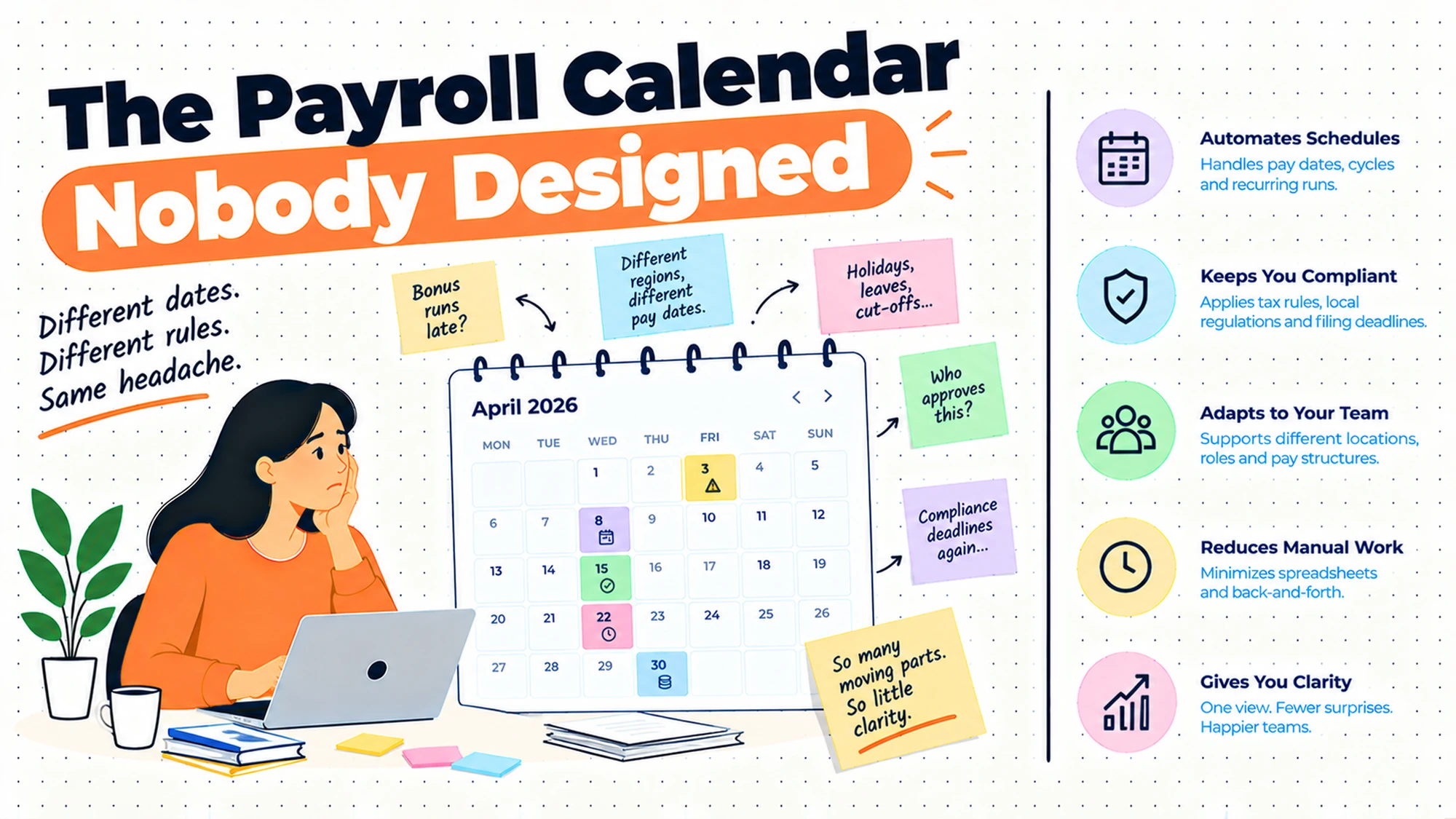
And it happens every single period, which is the part worth noticing. This isn't a bad month. It's the calendar working exactly as configured, and the configuration was almost certainly never designed. Somebody set the cut-off when the system was implemented, probably by accepting a default or copying whatever came before, and it has never been revisited because it technically works.
The reframe worth holding is that a payroll calendar is a slack allocation. The gap between the last input arriving and the money leaving is the only buffer the process has, and its size is a choice somebody made, usually without realising they were making it.
Most organisations try to solve the compression by working faster. The thing that actually creates room is moving the cut-off earlier, which nobody wants to do because it means asking other people to submit sooner. That's the whole tension, and it's worth confronting directly rather than absorbing every period.
When You Genuinely Do Not Need to Act Yet
Your current setup is genuinely fine. The run completes without drama, nothing has been late, and somebody could be unexpectedly away without the pay date being at risk. That's a well-designed calendar whether or not anybody designed it, and it needs no attention.
Friction is starting to show. One person routinely works late in payroll week, inputs arrive after cut-off and get accepted anyway, or approval happens in a rush because the approver was unavailable. These are the early signals and they're about the shape of the cycle rather than anybody's effort.
It has become a real cost. Corrections are routine because things arrived too late to include, somebody couldn't take leave in payroll week, or a run nearly missed its date. At that point the calendar is producing errors and constraining people's time off.
The edge case that forces it. Your pay date falls near a period when payments don't clear normally, you pay across places with different banking patterns, or a filing obligation sits inside the cycle. These compress things further and the timing differs by jurisdiction, so establish what applies where you pay people with local advice rather than discovering it in a month where the dates are awkward.
Five Questions This Reader Asks at 11pm
What is a payroll cut-off? The point after which changes don't make it into this run. Everything submitted before it is included; anything after waits for the next cycle or becomes a correction. It's the single most consequential date in the calendar because it determines how much time exists to do the work, and it's usually the one nobody chose deliberately.
How far before the pay date should it sit? Far enough that every step between the two has room, plus one day nobody has allocated. That's deliberately not a number: the right gap depends on how many steps there are, how many people have to act, and how long your payments actually take to clear. Work it backwards from the pay date rather than copying a gap from somewhere else.
What happens when an input arrives late? In most organisations, it gets accepted anyway, which is kind and is also why the cut-off stops meaning anything. Once people learn that late submissions are absorbed, the effective cut-off becomes the last possible moment rather than the published one, and the compression is permanent.
Should we publish the calendar? Yes, and further ahead than feels necessary. Managers submitting hours, people asking about a change taking effect, and anybody planning leave all benefit from knowing the dates. Publishing also makes the cut-off a shared fact rather than a request from payroll, which changes how people treat it.
Can different groups have different calendars? They can, and each additional one multiplies the work rather than adding to it. Separate cycles for separate populations are sometimes genuinely necessary, and they mean separate cut-offs, separate approvals and separate reconciliations. Be sure the reason is real before accepting the cost.
What Has to Happen Between Cut-Off and Pay Date
The useful exercise is to list the steps and the day each one lands on. Most teams have never done this and are surprised by how many there are.
| Step | Who owns it | What it costs when compressed |
|---|---|---|
| Collecting outstanding inputs | Payroll, chasing managers | Chasing replaces checking |
| Entering changes and one-off amounts | Payroll | Typing errors, no second look |
| Running the calculation | Payroll or the provider | Little, this step is fast |
| Checking the output before approval | Payroll | The check becomes a glance |
| Getting approval | Somebody outside payroll | Approval given without looking |
| Producing and sending the payment file | Payroll or finance | No room to fix a rejection |
| Clearing time before the money lands | Outside your control entirely | Late pay, with no remedy |
| Producing documents and records | The system, usually | Deferred, then forgotten |
The fourth and fifth rows are where compression does its real damage, and it's invisible because both still happen. The check gets performed and becomes a glance at totals. The approval gets given and becomes a signature without inspection. Nothing is skipped, so nothing looks wrong, and the two controls that exist to catch errors before money moves have quietly stopped functioning.
The seventh row is the one people forget when setting a pay date. The gap between sending an instruction and money arriving isn't yours to compress, it varies by method and by day, and it's longer around non-working days. A calendar that assumes same-day arrival will fail in the month where the dates fall badly.
Five Diagnostic Questions You Can Self-Assess Against
What happens on each day between cut-off and pay date? Write it out for the last real cycle. Most teams find steps they hadn't counted and at least one day where three things are happening at once.
When did somebody last submit after the cut-off and have it accepted? If the answer is every period, your published cut-off is decorative and the real one is later. That's worth knowing before you design anything, because you're designing against the real one.
Could the approver be away without a problem? Approval is usually the narrowest point, because it depends on one specific person with a full calendar. If there's no named alternate, one absence puts the pay date at risk.
Could the payroll person be ill on any given day of the cycle? Go day by day. If there's no day where that's survivable, you have no slack, and the arrangement is relying on nobody being unlucky.
Does anything else sit inside the cycle? Filings, reporting or transfers with their own deadlines. What applies and when differs by jurisdiction and changes, so establish it locally rather than assuming the calendar you inherited accounted for it.
Six Ways Payroll Calendars Get Set, Reviewed
Inherited from whoever configured the system
The dates are whatever was entered at implementation, possibly copied from a previous arrangement, possibly a default. It earns its place through inertia alone: it works, people know it, and changing it requires telling everybody.
Where it falls short is that nobody chose it against your actual process. The gap may be generous or brutal, and which one you got is essentially arbitrary. It also ossifies: as the organisation adds people, populations and steps, the calendar stays fixed while the work inside it grows.
Worth revisiting once, deliberately, by mapping the steps against the days. Most organisations find the cut-off is in the wrong place by a couple of days in one direction or the other.
The direction is worth knowing before you assume. A cut-off that is too early is a real cost too, because it means more changes miss the run and arrive as corrections, and because managers submitting long before the pay date are estimating rather than reporting. Compression is the more common failure and it is not the only one, so map before deciding which way to move.
Set by the provider's deadlines, worked backwards
Whoever processes the payment imposes a deadline, and everything is arranged to hit it. It earns its place because it's anchored to a real constraint rather than a preference, which makes it defensible when somebody asks for an exception.
Where it falls short is that the provider's deadline is the latest acceptable moment, not a target. Building the calendar so that your file arrives exactly at the deadline means any internal delay becomes an external failure. There's also a tendency to treat the imposed date as the only fixed point when the pay date is equally fixed from the employee's side.
Use it as a hard boundary and put your own buffer inside it. Arriving early costs nothing and converts a missed step from a crisis into an inconvenience.
Confirm what the deadline actually means, too, since the stated time and the practical one can differ. A file accepted up to a certain point may still be queued behind others, and a submission that technically arrives in time can miss the batch it was aimed at. Ask what happens to something sent an hour before the limit rather than assuming the boundary is as sharp as it looks.
Set by the pay date, everything squeezed before it
The pay date is decided first, usually for good reasons, and the process compresses to fit whatever space remains. It earns its place because the pay date genuinely is the thing that matters most: people plan around it and moving it is disruptive.
Where it falls short is that the squeeze lands entirely on the steps with least visibility. Nobody consciously decides to shorten the checking window, it just becomes whatever is left after everything else has taken its time.
Keep the pay date fixed and move the cut-off rather than absorbing the compression. That's the only lever that creates room without changing what employees experience.
Be explicit about why when you ask for the earlier submission, because the request sounds like payroll making its own life easier. Explaining that the gap is what allows the run to be checked before money moves reframes it as a shared control rather than an administrative preference, and managers tend to respond to that better than to a deadline with no stated purpose.
A different calendar per population or entity
Separate cycles for separate groups: different pay frequencies, different entities, different arrangements. It earns its place where the populations genuinely differ, such as groups paid at different frequencies or people processed through a different arrangement entirely.
Where it falls short is the multiplication. Each calendar has its own cut-off, its own checking window, its own approval and its own reconciliation, and the person running them is switching context constantly. Two calendars is more than twice the work because the overlap creates weeks where something is always mid-cycle.
Consolidate wherever the reason has lapsed. Plenty of separate calendars exist because two arrangements were merged years ago and nobody revisited it.
Where separation is genuinely required, at least align what can be aligned. Two cycles that share an approval day, or a checking convention, or a single published document covering both, cost considerably less to run than two arrangements that differ in every particular for no reason other than having been designed separately.
A rolling calendar with no fixed cut-off
Changes are processed as they arrive, with the run assembled from whatever is in at processing time. It earns its place in very small operations where the volume is low enough that there's no real queue.
Where it falls short is that there's no moment when the input set is final, which means no clean point to check against. It also makes it impossible to tell somebody whether a change will make this period, because the answer depends on when processing happens to occur.
Introduce a fixed cut-off as soon as more than one person is submitting anything. It costs nothing and it converts an ambiguous process into one people can plan around.
The moment worth watching for is the first time somebody asks whether a change will make this month's pay. That question has no answer under a rolling arrangement, which is the signal that the process has outgrown it. It usually arrives well before anybody feels the volume justifies structure.
A calendar with a deliberate buffer built in
Dates set so that at least one day in the cycle has nothing scheduled. It earns its place as the only arrangement here that survives an ordinary bad week, and it's the version organisations arrive at after a near miss rather than by design.
Where it falls short is that the buffer is the first thing sacrificed when somebody asks for a later cut-off. Unless it's named and defended as a step in its own right, it gets quietly absorbed and nobody notices until the next time something goes wrong.
Put it in the published calendar as a named day rather than leaving it as unallocated space. Anything unnamed will be claimed.
Defending it is easier if the name says what it is for. A day labelled contingency invites the question of whether it is needed this month. A day labelled reserved for a rejected payment file, or for a query that has to be resolved before approval, describes a scenario people recognise, and it is considerably harder to argue that this particular month will definitely not produce one.
The Decision Table
| Situation | Scale | Setup | Primary Pain | Recommended Starting Point |
|---|---|---|---|---|
| Runs finish comfortably, nothing late | Any | Any | None | Change nothing |
| Two frantic days every period | Any | Any | Cut-off too close to pay date | Move the cut-off, not the pay date |
| Late inputs accepted every period | Any | Any | The published cut-off is decorative | Decide what late actually means |
| Approval given without looking | Any | Any | The window collapsed | Give approval its own day |
| Approver unavailable puts the date at risk | Any | Single approver | No alternate | Name a second approver |
| Corrections routine for late items | Any | Any | Cut-off after the inputs arrive | Align the cut-off to the input source |
| Several calendars, overlapping cycles | Any | Multiple populations | Multiplication, not addition | Consolidate where the reason has lapsed |
| Payment timing misjudged | Any | Any | Clearing assumed, not measured | Measure it on the worst day |
| Filing deadline inside the cycle | Any | Regulated or multi-jurisdiction | External timing, not yours | Establish locally, then design around it |
The third row is the one to settle before anything else, because it determines whether the rest of the exercise is real. A cut-off that gets extended whenever somebody asks isn't a cut-off, and redesigning a calendar around a date nobody respects produces a nicer diagram and the same week.
Settling it does not have to mean refusing everything. A stated position with a named limit works well: items of one kind are accepted late, items of another are not, and anything beyond a specific point goes to the next period regardless. What breaks a cut-off is not flexibility but flexibility applied case by case, because each individual exception is defensible and the cumulative effect is that nobody knows what the deadline is.
The second row contains the actual advice of this piece. The instinct when payroll week is compressed is to find efficiency inside the window. The room is created by moving the boundary, and the reason people resist is that it means asking other teams to submit earlier, which is a conversation rather than a configuration change.
Where the Slack Actually Comes From
There are only a few places to find room, and they're worth knowing because effort spent elsewhere doesn't produce any.
Moving the cut-off earlier. The largest and least popular lever. Every day the cut-off moves back is a full day added to every step after it. The resistance is real: managers submitting hours would have to do so sooner, and their week is busy too. But the cost of not doing it lands entirely on one team, every period, permanently.
Removing a step rather than shortening it. Some steps exist because of a problem that has since been solved, or because somebody wanted visibility once and it became a stage. An approval that has never resulted in a change is a delay with a signature attached, and converting it to a notification recovers its time without losing anything.
Fixing the input source rather than chasing it. If the same manager is late every period, the fix is upstream of payroll. Perhaps their own data isn't ready by your cut-off, in which case their constraint is the real constraint and chasing them harder will never work.
Ask them rather than inferring, because the answer is usually specific and frequently solvable. A manager who cannot confirm hours until a shift pattern closes has a genuine dependency, and the options then are to move your cut-off, move theirs, or accept an estimate with a correction rule.
Moving work outside the window. Plenty of what happens in payroll week doesn't need to. Setting up a new starter, configuring a recurring change, confirming a leaver's last day: all can be done when they arise rather than saved for the cycle. Teams accumulate work into the window because the window is when they think about payroll.
This is usually the easiest of the levers to act on, because it needs nobody else's agreement. It is entirely within the payroll team's control, it does not change any published date, and it tends to remove more from the window than people expect once they start listing what is actually being done in there that could have been done a fortnight earlier.
Accepting a later pay date. The lever nobody wants and it's worth naming for completeness. It affects employees directly, so it's a genuine trade rather than a free improvement, and it's rarely the right answer. But an organisation with an impossibly compressed cycle and an immovable cut-off has only this one left.
What doesn't create slack, despite constant attempts: working faster, starting earlier on the same day, or promising to be more organised. Those are the responses that feel like solutions and they're absorbed within a cycle or two, because the structure that produced the compression is unchanged.
Automation belongs on that list too, with a caveat. Removing typing from a step genuinely shortens it, and it shortens the step that was rarely the constraint. The binding constraint in a compressed cycle is almost always waiting for somebody else to act, which no amount of processing speed addresses. Automate for accuracy and for the person's week, and expect the calendar to look much the same afterwards.
One practical note on buffers. A buffer that exists as unallocated space at the end of the cycle will be consumed by the first thing that overruns. A buffer that appears in the published calendar as a day with a name, even something as plain as contingency, tends to survive, because claiming it requires somebody to say out loud that they're taking it.
Where Payroll Calendars Go Wrong
| The failure | How it shows up | What would have to change |
|---|---|---|
| Cut-off inherited, never reviewed | Permanent compression, every period | Map the steps against the days once |
| Late inputs always accepted | The published cut-off means nothing | Decide what late actually means |
| Checking and approval squeezed | Both still happen, neither catches anything | Give each its own day |
| Single approver with no alternate | One absence risks the pay date | Name a second, before you need them |
| Clearing time assumed | A late pay date in an awkward month | Measure it on the worst day |
| Buffer left unnamed | Absorbed by the first overrun | Put it in the calendar as a step |
The third row is the most consequential and the hardest to see, because nothing is skipped. Somebody does look at the output and somebody does approve it. What changes under compression is the depth: a check that was a comparison becomes a glance at a total, and an approval that was a review becomes a click. Both controls report as complete while catching nothing.
The fourth row has an easy fix that almost nobody applies in advance. Naming a second approver costs a conversation and a permission, and it's always done after the first time somebody was unreachable rather than before.
The alternate needs the same briefing as the primary, which is the part that gets skipped. Somebody granted approval rights but never shown what to look at will approve whatever is in front of them, which satisfies the process and defeats its purpose. Walk them through one real run while nothing is urgent.
What to Put in Writing
| Artefact | Who owns it | When it is written | What it prevents |
|---|---|---|---|
| The steps between cut-off and pay date, by day | Whoever runs payroll | Before changing anything | Designing against an imagined cycle |
| What happens to a late input | Whoever runs payroll | Before the next cycle | A cut-off that means nothing |
| Who approves, and who else can | Whoever runs payroll | Before you need the alternate | One absence risking the date |
| Measured clearing time, on a bad date | Whoever sends the file | Once, then confirmed | A pay date that assumes best case |
| The published calendar, well ahead | Whoever runs payroll | Each year | Submissions arriving whenever |
| Anything external inside the cycle | Whoever runs payroll, with local advice | Before designing the calendar | A deadline nobody accounted for |
The first row is the exercise that makes the rest possible, and it takes half an hour. Write each step on the day it currently lands. The compressed days become obvious immediately, and so does the step everybody forgot was in there.
Questions to Ask Before You Commit
On the cut-off. Who chose it, and when? A bad answer is that it came with the system.
On lateness. What happens to something submitted after? A bad answer is that we squeeze it in.
On approval. Does the approver have a full day? A bad answer is that they're quick.
On absence. Which day could somebody be ill? A bad answer is none of them.
On clearing. How long does the money actually take? A bad answer is same day.
On externals. What else has a deadline in this window? A bad answer is nothing that we know of.
On the map. Has anybody written out the cycle day by day? A bad answer is that everyone knows it.
What Getting This Wrong Costs
The first cost is the two controls that stop working. Checking the output and approving the run exist to catch errors before money moves, and both are performed at whatever depth the remaining time allows. Under compression they continue to happen and stop catching anything, which is worse than not having them, because the organisation believes it has controls that are in fact decorative.
The second cost falls on one or two people permanently. A compressed cycle means somebody can't take leave in a predictable window every month, works late on known days, and carries the knowledge that a single illness would put a pay date at risk. That's a retention problem disguised as a process problem, and the person concerned usually absorbs it quietly until they don't.
The third cost is the corrections. Inputs that arrive after a cut-off that's too close to the pay date become next-period adjustments, which means more work, an employee who was paid wrongly in the meantime, and a growing population of items in flight. Each one is small and they compound, and the cause is upstream of every one of them.
There is a fourth cost that only appears when something genuinely goes wrong. A cycle with no slack has no capacity to absorb an incident: a rejected file, a system problem, a query that has to be resolved before approval. In a cycle with room, those are handled. In a compressed one, each becomes a decision about whether to pay late or pay wrong, and both answers are bad.
So before trying to work faster, do the half-hour exercise. Write out what happens on each day between your cut-off and your pay date, for a real cycle. The compressed days will be obvious, and so will the answer, which is almost always to move the cut-off rather than to find efficiency inside a window that was never big enough.
When You Are Ready to Go Further
None of this needs a system change. It needs the steps mapped against the days, a decision about what late actually means, a named second approver, and one measured figure for how long payments genuinely take on an awkward date.
Then publish the calendar further ahead than feels necessary, with the buffer named as a step rather than left as space. Publishing changes the nature of the cut-off: it stops being a request from payroll and becomes a date everybody can see, which is most of what makes people submit on time.
The step after that is to look at what could move outside the window entirely. New starter setup, recurring changes, leaver confirmations and anything else that arises during the period rather than at the end of it. Teams accumulate this work into payroll week out of habit, and moving it out is the one improvement that costs nobody else anything.
HROpsLab publishes independent comparison work across HR tooling, applicant tracking and payroll. We sell nothing, we take no vendor money, and we publish no paid placements. If the next step is looking at what your current tooling actually supports here, our comparison work is one place to start.
Frequently Asked Questions
What is a payroll calendar?
The set of dates that govern a pay cycle: when inputs must be submitted, when the run is processed and checked, when it's approved, when the payment instruction goes, and when money reaches people. The useful way to think about it is as a slack allocation, because the gap between the last input arriving and the money leaving is the only buffer the process has. In most organisations nobody designed it: the dates were entered at implementation or copied from a previous arrangement and never revisited.
What is a payroll cut-off?
The point after which changes don't make it into the current run. Anything submitted before it is included; anything after either waits for the next cycle or becomes a correction. It's the most consequential date in the calendar, because it determines how much time exists to do everything else, and it's the one people most often inherit rather than choose. It's also the only lever that genuinely creates room, which is why moving it is the usual answer to a compressed cycle.
How far before the pay date should the cut-off be?
Far enough that every step between the two has its own space, plus one day nobody has allocated. That's deliberately not a number, because the right gap depends on how many steps you have, how many people must act, and how long your payments actually take to clear on an awkward date. Work it backwards from the pay date by listing what happens each day rather than copying a gap from another organisation, whose step count and constraints will differ from yours.
What should happen when an input arrives after the cut-off?
Decide it deliberately, because the default is that it gets accepted, which is kind and quietly destroys the cut-off. Once people learn that late submissions are absorbed, the effective deadline becomes the last possible moment rather than the published one, and the compression becomes permanent. Reasonable positions exist in both directions: a firm cut-off with a correction next period, or a stated grace with a named limit. What doesn't work is an unstated policy applied case by case.
Should you publish your payroll calendar?
Yes, and further ahead than feels necessary. Managers submitting hours, employees asking whether a change will take effect this period, and anybody planning leave all benefit from knowing the dates. Publishing also changes what the cut-off is socially: it stops being a request from payroll to individuals and becomes a shared fact, which does more for on-time submission than chasing ever does. Include the buffer as a named step, or it will be claimed.
Can different employee groups have different payroll calendars?
They can, and each additional calendar multiplies work rather than adding to it, because every one brings its own cut-off, checking window, approval and reconciliation. With two calendars, something is always mid-cycle, and the person running them switches context constantly. Sometimes the separation is genuinely necessary, such as populations on different pay frequencies. Frequently it exists because two arrangements were merged years ago and nobody revisited whether the reason still holds.
How do you handle a pay date that falls near a non-working day?
Plan for it before the year starts rather than in the month it happens. The gap between sending a payment instruction and money arriving isn't within your control, it varies by method and by day, and it stretches around non-working days. Measure your own clearing time on an awkward date rather than assuming the usual figure holds, then decide in advance whether the pay date moves earlier or the cut-off does. Filing obligations inside the cycle differ by jurisdiction, so establish those locally.
How do you create slack in a compressed payroll cycle?
Four things work and one doesn't. Moving the cut-off earlier adds a full day to every subsequent step and is the largest lever. Removing a step entirely, particularly an approval that has never changed an outcome, recovers its time. Fixing whichever input source is always late addresses the cause rather than the symptom. Moving work outside the window, such as new starter setup, takes load off the cycle. What doesn't work is resolving to be faster or more organised, which gets absorbed within a cycle or two.
The cycle is compressed because the boundary is in the wrong place. Move the boundary.
Working faster inside it has been tried, every period, for years.