
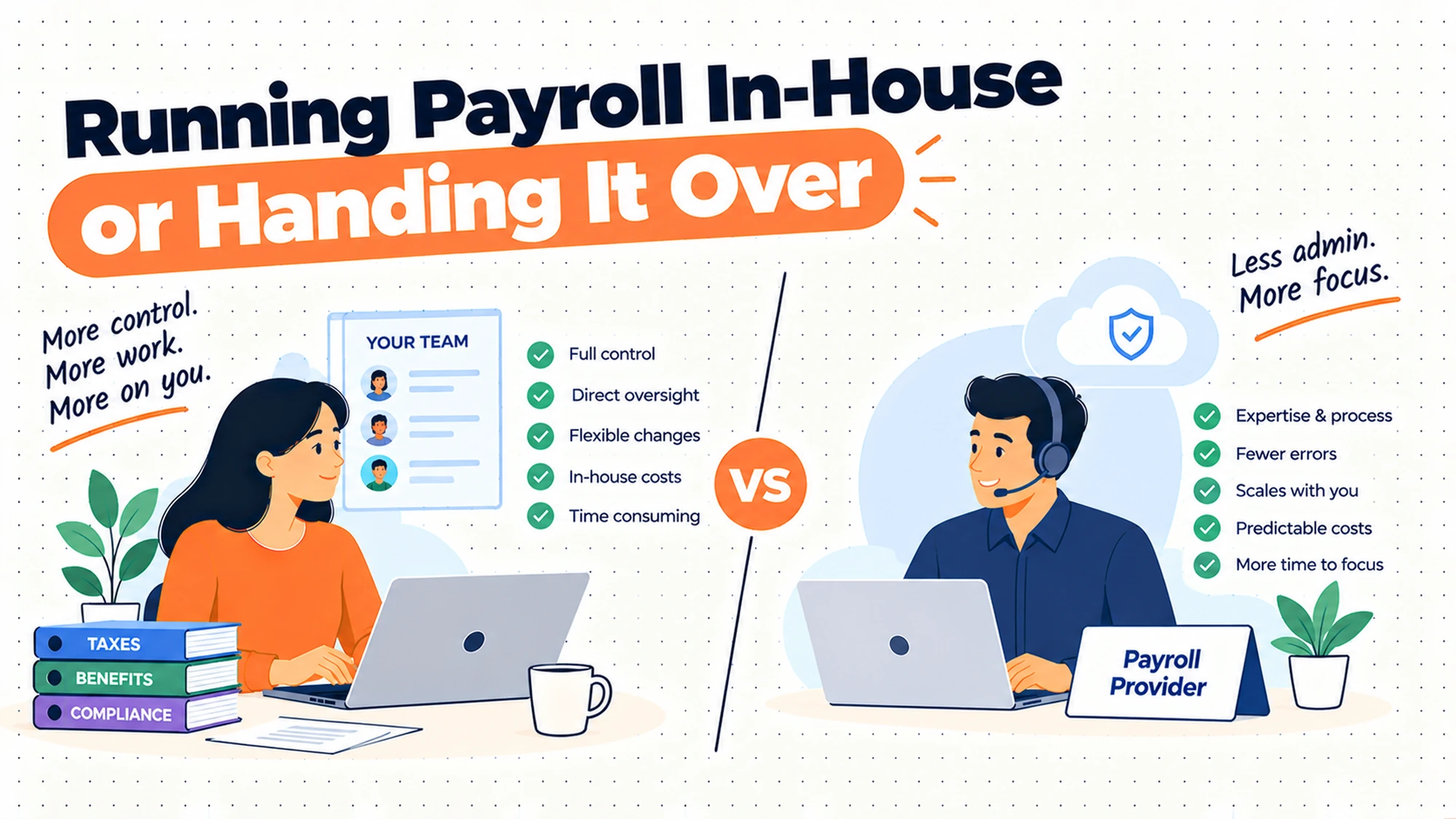
TL;DR
- The core decision: which tasks move, because the consequence of a wrong payment generally does not move with them.
- When doing nothing is right: when the current arrangement is correct, resilient and nobody is stretched by it.
- What has to be true: somebody internal can still tell whether a run is right before it goes.
- How the options split: by how much work transfers, not by how much responsibility does.
- Decision rule: if nobody inside could spot a wrong result, you have outsourced the checking as well as the work.
- Outcome to expect: less of the process on your desk, and the same phone call when something is wrong.
The Question After the Wrong Payment
Somebody is paid the wrong amount. They notice the same day, because people always do, and they ask their manager, who asks HR.
Payroll is run by an external arrangement, so the query goes out and comes back a day later with an explanation: a value was supplied incorrectly, or an element was configured a certain way, or a change arrived after the deadline. The explanation may well be right.
Meanwhile the employee is still short, still waiting, and increasingly clear that nobody they can actually reach is able to tell them what happened or when it will be fixed. They don't care about the arrangement. From where they stand, their employer got their pay wrong.
Best tools for Payroll Software
That's the thing worth understanding before comparing any of these options. The work can move. The relationship with the person being paid doesn't, and in most arrangements neither does the responsibility for the payment being correct. What you're buying is capacity and specialist knowledge of rules that change, not the removal of the consequence.
This gets obscured by how the market describes itself. Words like managed, full-service and end-to-end suggest that something has been taken off you entirely. Some genuinely has. But the question an employee asks, and the question that matters when something goes wrong, is who is accountable, and the answer is frequently still you.
Where legal responsibility actually sits differs by jurisdiction and by the specific arrangement, sometimes considerably. Nothing here tells you what applies to you. Establish it with local advice for each place you pay people, before signing rather than after, because it's the single most consequential thing about this decision and it's the thing least clearly stated in any proposal.
When You Genuinely Do Not Need to Act Yet
Your current setup is genuinely fine. Payroll runs correctly, somebody other than one person could do it, and nobody is working late to make it happen. Changing arrangements is disruptive and the disruption lands on a process where errors are felt personally.
Friction is starting to show. One person holds the whole thing, a rule change was noticed late, or the run consumes more of the week than it should. Worth examining, because the fix might be a system, a documented process or a different arrangement, and those are very different purchases.
It has become a real cost. Payroll is limiting what the team can do, a mistake reached employees, or you can't take on a new population because nobody knows how to pay them. At that point buying capacity or knowledge is a reasonable response.
The edge case that forces it. You start paying people somewhere you have no expertise, or you take on a worker category with treatment nobody internally understands. Buying knowledge is the honest reason to outsource, and it's a better reason than cost. Establish what you're obliged to do in that place first, with local advice, so you can tell whether an arrangement actually covers it.
Five Questions This Reader Asks at 11pm
What's the difference between a bureau and a managed service? Broadly, how much you still do. A bureau typically takes data you prepare, runs the calculation, and returns the output for you to check and act on. A managed service typically also handles more of what surrounds it: queries, filings, changes. The labels aren't standardised, which is why the useful question is never which category something is but which specific tasks it includes.
Does outsourcing remove our responsibility? Usually not, and this is the most important thing to establish rather than assume. Who carries the obligation for correct payment, for filings, and for records differs by jurisdiction and by arrangement. A contract can allocate commercial risk between two parties and that's a different matter from where an obligation sits. Get this checked locally before signing.
Is it cheaper than doing it in-house? Sometimes, and cost is the weakest reason to decide. External arrangements tend to beat internal headcount at small scale, where a full payroll person isn't justified, and the comparison narrows as volume grows. The stronger reasons are resilience, meaning it doesn't depend on one person, and knowledge, meaning somebody else tracks rules that change.
What should we keep in-house regardless? The ability to tell whether a run is right. That's the capability people give up accidentally, and once it's gone, every output has to be taken on trust. Also anything requiring judgement about your own organisation: whether a payment is appropriate, how to handle an unusual case, what to tell an employee.
Can our accountant just do it? Frequently they can, and it's worth understanding the trade. An accountant running payroll alongside other work is convenient and joins up nicely with the wider financial picture. The risks are capacity at period ends, whether payroll is a specialism or a sideline for them, and what happens when they're unavailable in your pay week.
What Moves and What Stays
This table is the substance of the decision. Work through it for any arrangement you're considering, because the marketing language rarely maps onto it cleanly.
| Activity | Does it transfer | What remains with you |
|---|---|---|
| Preparing and supplying the inputs | Rarely | Almost all of it, whatever the arrangement |
| Running the calculation | Yes, readily | Nothing, this is genuinely mechanical |
| Keeping statutory elements current | Yes, and this is the main thing worth buying | Knowing whether coverage matches your obligations |
| Checking the output before it goes | Partly at best | The judgement about whether it looks right |
| Approving the run | No | The decision to release money |
| Moving the money | Varies considerably by arrangement | Depends entirely, establish it explicitly |
| Answering an employee's question | Sometimes | The relationship, and the trust |
| Filings and onward reporting | Often | Responsibility, in most cases |
| Being accountable for correctness | Generally not | Establish this locally, do not assume |
The first row is the one that surprises people and it's the reason outsourcing saves less time than expected. Getting the inputs right is most of the work in payroll, and it stays with you in every arrangement, because only you know who joined, who left, who changed and what happened. An arrangement that removes the calculation has removed the easy part.
The fourth row is where quiet damage happens. Checking transfers poorly because an outside party can spot an internal inconsistency in the data and can't know that a particular person's figure looks wrong for reasons specific to your organisation. Teams that hand over checking along with processing lose the ability to detect anything.
The last row is not a design choice and it's frequently misunderstood. Contractual allocation of commercial risk is not the same thing as where an obligation sits, and both differ by jurisdiction. Establish your actual position with local advice.
Five Diagnostic Questions You Can Self-Assess Against
Could somebody inside spot a wrong run? Not audit it in detail, just notice that something looks off. If the answer is no, you've outsourced the detection along with the processing, and the first indication of a problem will be an employee.
What does your arrangement actually include? Write the task list and mark each one. Most people discover they're less clear than they thought, particularly around queries, changes and filings, which are where the differences between arrangements really sit.
Who does an employee contact? Trace it for a real query. If the path runs through your team to an external party and back, budget for the delay and decide whether that's acceptable for something somebody is worried about.
What happens in your pay week if they're unavailable? Every arrangement has a pinch point. For an accountant it might be their own busy period; for a bureau it might be a support queue at month end. Ask what their peak looks like and whether it coincides with yours.
Where does responsibility sit, in writing, in each place you pay people? If you can't answer, that's the first thing to establish with local advice. It differs by jurisdiction and by arrangement and it's the question that matters most when something goes wrong.
Work through all five with whoever actually runs payroll rather than whoever owns the relationship. The two are frequently different people, and the person doing the work usually has a more accurate picture of what is covered and what quietly is not.
Six Arrangements for Getting Payroll Run, Reviewed
Software operated entirely in-house
You hold the system, do the work, and handle everything around it. It earns its place on control and immediacy: you can see everything, correct things quickly, and answer an employee the same hour rather than the next day.
Where it falls short is resilience and knowledge. It usually depends on one or two people who accumulate the understanding, and if nobody is actively tracking rule changes, the arrangement is quietly relying on the software to do it. Capability also has to be rebuilt every time that person leaves.
Right where you have genuine internal expertise and enough volume to justify it. Write down how the run works regardless, because that document is the difference between a process and a person.
The honest test is what happens when the person who runs it is unavailable in your pay week. If the answer involves phoning them, the arrangement is a single point of failure that has simply not been triggered yet. Organisations discover this at the worst possible moment, because absence is rarely scheduled around a pay date.
The second test is how rule changes reach you. If nobody can name where they would hear about a change that affects a deduction or a submission, then the arrangement is relying on the software vendor to notice, which may be reasonable and is worth establishing rather than assuming. Ask your vendor directly what they maintain and what they expect you to track.
Software with the provider handling filings
You run the calculation; the provider handles what has to be submitted onward. It earns its place because filings are the part with external deadlines and unfamiliar formats, and getting them wrong has consequences that arrive later and are harder to fix.
Where it falls short is the boundary. Filings are produced from your data, so an error upstream becomes a filing error, and who notices and who corrects it needs stating explicitly. Coverage also varies: a provider may handle one obligation and not another, and the gap is easy to miss.
Confirm precisely which submissions are included and in which places. Then establish independently what you're obliged to file, because the two lists need comparing rather than assuming.
The gap that catches people is a change in their own shape rather than a change in the rules. A new office, a new category of worker, a person who moves: each can bring an obligation that was outside the original scope, and the arrangement will not flag it because it was never asked to.
Also settle who corrects a submission that turns out to be wrong. Filings are produced downstream of your data, so an error you introduced becomes an error in something submitted in your name, and the correction path is usually less obvious than the submission path. Ask what it looks like before you need it.
A bureau running the calculation from data you send
You prepare and send the inputs; they calculate and return the output. It earns its place as the cleanest division of labour available: you keep everything requiring knowledge of your organisation, and buy the calculation plus rule maintenance.
Where it falls short is turnaround and the shape of your week. The bureau's deadline becomes your cut-off, which compresses everything before it, and a correction after submission usually means a cycle rather than a fix. Data has to reach them in their format, which is real work.
Good where your inputs are reliable and your calendar has room. Understand their deadline properly before agreeing to it, because it sets your entire cycle.
The second thing to establish is what a correction actually costs, in time rather than money. Some arrangements will rerun; some will handle it in the following cycle; some treat it as a new submission. Each of those implies a very different answer to an employee asking when they will be paid properly, and that answer is the one you will be giving.
Data format is the underestimated part. Getting your information into their structure, every cycle, reliably, is ongoing work that does not appear in any proposal. Whoever does it needs to be named, and the process needs to survive their absence.
A fully managed service including queries and filings
The external party handles processing, submissions, and frequently employee queries too. It earns its place where payroll knowledge genuinely doesn't exist internally and building it isn't sensible.
Where it falls short is distance. An employee with a worried question reaches somebody with no relationship to them and no context about their situation, and response times are contractual rather than human. You also lose most internal ability to detect a problem, which means you learn about errors from the people affected.
Viable where the alternative is nobody competent. Keep somebody internal who can read the output and answer a person, because that capability is what you're most likely to lose without noticing.
The distance shows up most clearly in unusual cases. A standard run handled externally is usually fine. The situations that need judgement, somebody leaving mid cycle with something owing, an unusual payment, a person whose circumstances changed, are exactly the ones where an outside party has no context and will ask you anyway.
Watch what happens to your own knowledge over a couple of years. Teams that hand everything over frequently find that nobody remaining can explain how a figure is reached, which makes the arrangement much harder to leave than it was to enter. That is worth knowing at the point of signing rather than at renewal.
An arrangement bundled with employment through a third party
Payroll comes as part of a wider arrangement where another organisation is involved in employing people. It earns its place in specific situations, typically where you're paying people somewhere you have no entity.
Where it falls short is that the payroll question is the smallest part of what you're deciding. These arrangements carry implications for the employment relationship that go well beyond how somebody gets paid, and those differ substantially by jurisdiction. Evaluating on the payroll experience alone means deciding a large question on a small criterion.
Where this is under consideration, take proper local advice on the whole arrangement rather than assessing the payroll mechanics. The payroll part is rarely the part that matters.
The practical warning is scope creep by convenience. An arrangement set up for one situation, typically a single person somewhere you have no presence, gets extended because it is already there, and the wider implications are never re-examined against the larger population it now covers.
Also think about what happens when somebody in that arrangement becomes a direct employee, or moves, or the relationship ends. Those transitions are the part least described in any proposal and the part most likely to need advice you did not budget for.
An accountant or bookkeeper running it alongside other work
Somebody who already handles your finances also runs payroll. It earns its place at small scale on convenience and joined-up thinking: they already know the numbers, one relationship covers several needs, and they're usually responsive.
Where it falls short is specialism and capacity. Payroll may be a sideline rather than a focus, which matters when something unusual arises or when rules move. Their busy periods may collide with your pay week, and a single person being unavailable is a real risk.
Ask directly how many payrolls they run, who covers when they're away, and how they keep current. Those three answers separate an accountant who does payroll properly from one who accommodates it.
The fourth question is about growth. An arrangement that works comfortably at your current size may not survive doubling, or adding a second location, or taking on a worker type with different treatment. Asking what their largest client looks like tells you where the ceiling probably sits.
Be realistic about the relationship too. Because it is usually informal and long standing, problems tend to go unraised for longer than they would with a contracted provider. That informality is genuinely valuable and it makes it harder to say that something is not working.
The Decision Table
| Situation | Scale | Setup | Primary Pain | Recommended Starting Point |
|---|---|---|---|---|
| Correct, resilient, nobody stretched | Any | Any | None | Change nothing |
| One person holds the whole process | Any | In-house | Continuity, not capability | Document it before changing anything |
| Nobody tracking rule changes | Any | In-house or software only | Silent exposure | An arrangement that maintains elements |
| Paying somewhere with no expertise | Any | New jurisdiction | Knowledge you do not have | Establish obligations, then buy knowledge |
| Compressed cycle, external deadline | Any | Bureau | Their cut-off drives your week | Confirm the deadline before agreeing |
| Employees waiting a day for answers | Any | Managed service | Distance from the relationship | Keep somebody internal who can answer |
| Nobody can tell if a run is wrong | Any | Any outsourced form | Detection was outsourced too | Rebuild the internal check |
| Accountant unavailable in pay week | Any | Accountant-run | Capacity collision | Ask who covers, before it happens |
| Unclear where responsibility sits | Any | Any | The question that matters most | Local advice, per jurisdiction, in writing |
The seventh row is the failure worth designing against from the start, because it happens gradually and nobody decides on it. Processing moves out, checking follows because the external party is doing it anyway, and within a year nobody inside can look at a run and tell whether it's sensible. The first sign is an employee query about something that should have been caught.
The fourth row is the strongest reason to outsource and it's rarely the one in the business case. Buying knowledge of rules you don't have is a genuine, durable value. Buying capacity to do work you could do is a weaker argument that gets re-examined at every renewal.
What You Still Have to Be Able to Do
Whatever the arrangement, a small set of capabilities has to stay inside, and losing them is how outsourcing goes wrong in a way nobody planned.
Recognise a wrong result. Not audit in detail. Look at a run and notice that a total moved unexpectedly, or that somebody's figure looks implausible. This is the check that catches errors before money moves, and it requires somebody who understands your population well enough to know what normal looks like. No external party can do this, because the knowledge is about your organisation.
Answer a worried person. Somebody whose pay is wrong needs to speak to a person who can explain what happened. A contractual response time is a poor substitute for a colleague who can look at it now. Where queries are handled externally, keep somebody internal who can at least understand the answer and relay it with context.
Own the inputs. Every arrangement returns a result calculated from what you supplied. If nobody internally is accountable for those being right and complete by the cut-off, no arrangement will produce correct payroll, and each error will be attributed to whoever processed it.
Explain a payslip. Somebody has to be able to walk through how a figure was reached in terms an employee understands. That's a knowledge requirement that persists through every arrangement, and it's the one most likely to atrophy quietly.
Know your own obligations. What has to be deducted, produced, filed and kept is yours to establish, and it differs by jurisdiction and changes. A provider tells you what they do. That's not the same as what you're required to do, and comparing the two lists is work only you can do, with proper local advice.
The pattern across all five is that they're the parts requiring knowledge of your specific organisation or your specific obligations. Everything mechanical transfers well. Everything contextual transfers badly, and the mistake is assuming the contextual parts went with the mechanical ones because they were bundled in the same proposal.
Keeping them does not take a payroll specialist. It takes somebody who knows the population, looks at each run, and is willing to ask why a figure changed. That is a smaller commitment than most organisations assume, and it is the difference between finding problems yourself and hearing about them from the people they affected.
Where These Arrangements Go Wrong
| The failure | How it shows up | What would have to change |
|---|---|---|
| Responsibility assumed to have transferred | A formal question with no good answer | Establish it locally, in writing, before signing |
| Checking outsourced along with processing | Errors found by employees | Keep an internal reviewer |
| Input ownership left unclear | Every error blamed on the processor | Name who owns each input |
| Coverage narrower than obligations | A filing or element nobody handled | Compare their list against yours |
| Their deadline sets your whole cycle | A compressed week you did not choose | Confirm the deadline before agreeing |
| Employee queries routed through two parties | A worried person waiting a day | Somebody internal who can answer |
The first row is the one with genuine exposure and it's the most commonly assumed. Language in a proposal about handling something is a description of work, not a statement about where an obligation sits, and the two differ by jurisdiction. This needs establishing with local advice rather than inferring from a contract summary.
The fourth row catches organisations that changed something after signing. An arrangement scoped against your situation at the time doesn't automatically extend to a new population, a new place or a new worker category. Each change is worth re-checking against the coverage you actually bought.
What to Put in Writing
| Artefact | Who owns it | When it is written | What it prevents |
|---|---|---|---|
| What you are obliged to do, per jurisdiction | You, with local advice | Before any conversation | Obligations defined by a proposal |
| The task list, marked included or not | Whoever runs payroll | Before signing | Assumptions about what is covered |
| Where responsibility sits | You, with local advice | Before signing | Discovering it during an incident |
| Who owns each input, and by when | Whoever runs payroll | Before go-live | Errors attributed to the processor |
| Who internally can review a run | Whoever runs payroll | Before go-live | Detection leaving with the processing |
| What an employee query path looks like | Whoever runs payroll | Before go-live | A worried person waiting a day |
The second row is the exercise that makes every proposal comparable. Write your own list of tasks, then mark each one as included, partly included or yours. Proposals are structured to present well rather than to map onto a common list, and forcing them onto yours is the only way to see what actually differs.
Questions to Ask Before You Commit
On responsibility. Where does the obligation sit, in each place? A bad answer is that they handle it.
On scope. Which of these specific tasks are included? A bad answer is full service.
On inputs. Who is accountable for the data being right? A bad answer is that it's a shared process.
On detection. Who inside could spot a wrong run? A bad answer is that they check it.
On capacity. When is your busy period? A bad answer is that it's always manageable.
On coverage. What happens when we add a new place or worker type? A bad answer is that it's covered.
What Getting This Wrong Costs
The first cost is the responsibility you believed had moved. An organisation that assumed an arrangement carried an obligation, and discovers otherwise when a formal question arrives, is in a poor position that a contract may not improve, because commercial allocation between two parties is a different thing from where an obligation sits. This is the failure with consequences beyond inconvenience and it's entirely avoidable by establishing the position locally before signing.
The second cost is detection, lost quietly. When checking moves out along with processing, nobody internal retains a sense of what a normal run looks like, so errors are found by the people they affect. That's the worst possible detection mechanism: it's slow, it's public, and it damages trust with exactly the people you most need to keep.
The third cost is the saving that didn't materialise. Because input preparation stays with you in every arrangement, and input preparation is most of the work, outsourcing the calculation removes less effort than the proposal implies. Organisations that moved for cost reasons frequently find the internal load largely unchanged, with a new coordination overhead on top.
The fourth cost is the one nobody counts, which is how hard it becomes to change again. Once a process has been shaped around somebody else's deadlines, formats and calendar, and once internal knowledge has thinned, moving to a different arrangement is a much larger undertaking than the first move was. That is not an argument against outsourcing. It is an argument for keeping enough internal capability that the next decision is still genuinely yours to make.
So before comparing anything, do two things. Establish what you're actually obliged to do, per jurisdiction, from somebody accountable for that answer. And write your own task list, then force each proposal onto it. Those two convert a set of incomparable pitches into a decision you can defend.
When You Are Ready to Go Further
None of this needs a provider conversation to begin. Write down how payroll is performed today, who owns each input, and what you're obliged to do where you pay people. Those three are useful whatever you decide and they're what any arrangement will ask you for anyway.
Then, whichever direction you go, protect the internal review. Somebody who understands your population, looks at each run before it's approved, and would notice something implausible is the control that catches errors while they're still fixable. It's cheap, it doesn't require payroll expertise so much as familiarity, and it's the first thing lost when processing moves out.
Finally, revisit the arrangement whenever you change shape. A new population, a new place, a new category of worker: each one can fall outside coverage that was scoped against a different organisation, and the gap surfaces as an obligation nobody handled rather than as an error anybody sees.
HROpsLab publishes independent comparison work across HR tooling, applicant tracking and payroll. We sell nothing, we take no vendor money, and we publish no paid placements. If the next step is looking at what your current tooling actually supports here, our comparison work is one place to start.
Frequently Asked Questions
What does payroll outsourcing actually mean?
It covers a wide range of arrangements that differ mainly in how much work moves. At one end, a bureau takes data you prepare, runs the calculation and returns the output for you to check and act on. At the other, a managed service handles processing, submissions and sometimes employee queries too. The labels aren't standardised across the market, which is why the only reliable approach is to write your own list of tasks and mark which ones each arrangement includes, rather than comparing categories.
What is the difference between a payroll bureau and a managed service?
Broadly, how much remains with you, though the terms are used loosely enough that you shouldn't rely on them. A bureau arrangement typically means you prepare the inputs in their format, they calculate, and you check, approve and handle everything around it. A managed arrangement typically extends further into filings, changes and queries. Because the boundary moves between providers, the useful question in any conversation is which specific activities are included, not which word describes the service.
Does outsourcing payroll remove your responsibility?
Generally not, and this is the most important thing to establish rather than assume. Who carries the obligation for correct payment, for onward filings and for records differs by jurisdiction and by the specific arrangement, sometimes considerably. A contract can allocate commercial risk between two parties, which is a different matter from where an obligation legally sits. Get your own position checked with local advice for each place you pay people, before signing, because a proposal's language about handling something describes work rather than liability.
Is outsourcing payroll cheaper than running it in-house?
Sometimes, and cost is the weakest basis for the decision. External arrangements tend to compare well at small scale, where a dedicated payroll person isn't justified, and the gap narrows as volume grows. The bigger problem with a cost-led comparison is that input preparation stays with you in every arrangement, and that's most of the work, so the internal load falls less than expected. Resilience and access to knowledge of changing rules are stronger and more durable reasons.
What should always stay in-house?
The ability to look at a run and notice something wrong, ownership of the inputs, and somebody who can explain a payslip to a worried person. Those three depend on knowing your organisation rather than knowing payroll, which is why no external party can do them. The failure to avoid is letting checking drift outward along with processing: within a year nobody inside can tell whether a run is sensible, and errors are then found by the employees they affect.
Can your accountant run payroll?
Frequently, and it works well at small scale because they already know your numbers and one relationship covers several needs. The questions worth asking are how many payrolls they actually run, who covers when they're away, and how they keep up with rule changes. Those three separate an accountant who treats payroll as a specialism from one who accommodates it alongside other work. The risk to watch is capacity: their busiest periods may coincide with your pay week.
What happens when an outsourced payroll gets something wrong?
Practically, an employee notices the same day, the query goes out, and an answer comes back later, during which somebody is short of money and increasingly aware that nobody they can reach can explain it. That delay is the real cost of distance, and it's worth designing around by keeping somebody internal who can at least understand and relay the explanation with context. Separately, who is responsible for putting it right, and for any consequence, is a question to settle with local advice before it arises.
How do you compare payroll providers fairly?
Write your own task list first, then force every proposal onto it, marking each item as included, partly included or remaining with you. Proposals are structured to present well rather than to map onto a shared format, so comparing them as written compares marketing. Do the same for obligations: establish independently what you're required to do in each place you pay people, then compare that against what each arrangement covers. The difference between those two lists is the work that stays with you.
The work moves. The phone call when somebody is paid wrongly does not.