
TL;DR
- The decision: You’re weighing whether to keep your massive iCIMS instance or migrate to a referral-focused system like Jobvite.
- When to stay put: If your only real complaint is a dated interface but your recruiters still hit their hiring targets, do not move.
- Core functions: Any system you buy must manage requisition approvals while keeping a unified candidate record.
- Market categories: The options split into high-volume enterprise clouds, proactive CRM platforms, or structured evaluation engines.
- The rule: If your hiring strategy relies heavily on employee referral networks, Jobvite is a better fit than iCIMS.
- Expected outcome: Moving systems will cost you six months of political capital but can fix fundamental pipeline visibility gaps.
Why We Are Having This Conversation
You are sitting in a pipeline review meeting on a Tuesday afternoon. Your recruiters complain that it takes twelve clicks just to update a candidate status from screening to interview. Your engineering hiring managers are ignoring the system entirely. They track their feedback in a private Google Doc. You know perfectly well that iCIMS can handle your complex OFCCP compliance needs. But the daily user experience is driving your entire talent acquisition team crazy. They want something new, and they’re vocal about it.
But pulling out an enterprise applicant tracking system is a massive undertaking that carries enormous political risk when you already have integrations holding your data together. You know a migration means mapping tens of thousands of historical candidate records. It means retraining every single hiring manager in the building. It means walking into your CFO’s office and asking for fresh budget to fix a problem they think you already solved three years ago.
You might be looking at Jobvite because someone on your recruiting team used it at their last job. Or maybe you’re just tired of waiting for long implementation cycles every time you need a new module configured. The real issue isn’t whether a modern interface looks prettier on a monitor. It is whether a new tool will actually change how your hiring managers behave.
Best tools for Applicant Tracking (ATS)
When Staying Put Makes Sense
Your current setup is genuinely fine if recruiters complain but still get the job done every week. Every applicant tracking system requires clicks. Every enterprise platform feels clunky eventually. If your team is hitting their time to fill targets, the friction they feel is just the cost of doing business at scale. Don’t spend six months of political capital just to make software look slightly nicer.
Then comes the friction stage. This is when hiring managers actively avoid logging into the platform. They email candidate feedback directly to the recruiter. They skip mandatory steps in the requisition approval workflow. That’s intensely annoying, but it’s a process problem. You can often fix this by enforcing your existing governance rules rather than buying new software.
Real liability happens when candidate data gets lost or corrupted. If a recruiter makes an offer that violates your compensation bands because the system lacked rigid approval controls, you have a massive problem. If your reports for US compliance are consistently inaccurate, your software is failing you. At this point, the risk of staying put outweighs the pain of moving.
The edge case is when your company fundamentally changes its entire hiring model. If you drop a massive hourly hiring strategy to focus entirely on headhunting senior executives, your high-volume talent cloud will feel completely wrong. You are driving a bus on a track meant for race cars.
The Midnight Questions
Here’s what keeps you up at night when you consider tearing out your existing system.
Will my historical candidate data actually transfer? Probably not all of it. This matters because you’ll lose a percentage of your passive talent pool when parsing engines fail to map custom fields correctly during the migration.
Can I prove ROI to the finance team? Yes, if you focus heavily on time-to-fill improvements or agency spend reduction. You need to show that better internal pipeline tools will reduce your reliance on expensive external recruiters.
Will hiring managers actually adopt the new tool? Only if it makes their daily jobs significantly easier. It matters because poor adoption breaks your compliance trail and ruins your data quality immediately.
How long will we be in implementation hell? At least six to eight weeks for a mid-tier tool. It takes even longer for enterprise systems. You must plan for a full quarter of dual-system chaos.
Will the Workday integration break? It will definitely require extensive testing. A broken HRIS sync means manual data entry for every single new hire. This defeats the entire purpose of buying enterprise software.
The Three Kinds of Tools on the Market
The High-Volume Enterprise Cloud These systems are built specifically to process massive applicant numbers without breaking. They are right for companies hiring thousands of hourly workers across multiple geographies. They fail spectacularly when a small startup tries to use them, as the heavy configuration weight crushes a lean talent team.
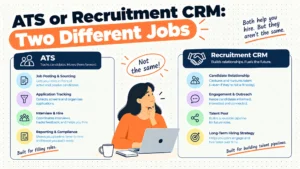
The Proactive CRM Hybrid These platforms treat every person as a passive candidate for future roles. They are perfect for teams doing aggressive outbound sourcing for hard-to-fill technical positions. They fail when a company just needs to post a standard job and screen the inbound applicants efficiently.
The Structured Interview Engine These tools force hiring managers to use strict scorecards or calibrated feedback forms. They are ideal for midsize companies prioritizing fair, bias-reduced hiring processes. They struggle in highly decentralized organizations where no one agrees on a single evaluation standard.
Assess Your Own Situation
Are your hiring managers currently using scorecards? If they can’t agree on basic competencies during an interview panel, new software won’t fix their calibration problems. You must fix the human behavior before you try to automate it with a new tool.
How much of your pipeline comes from employee referrals? If your staff is constantly referring former colleagues but HR is losing track of the emails, you have a very specific workflow gap. You need a dedicated branded portal for this.
Do you regularly hire past applicants? If your database is full of silver medalists but your team never contacts them, your CRM features are completely useless. You need to know if the system can surface passive talent automatically.
What happens when an offer requires executive approval? If your current ATS can’t handle conditional approval chains based on compensation bands, you’re exposed to real financial risk. This is a non-negotiable requirement for scale.
How many hires do you actually make a year? A company making forty hires a year has wildly different needs than a business processing two thousand hourly workers. Be brutally honest about your actual hiring volume.
Reviewing the Options
iCIMS iCIMS is rated 4.3/5 on HROpsLab. It ranks number six out of ten platforms. This system is best for large enterprises with over 2,000 employees handling high-volume recruiting. It earns its place because it processes more enterprise hiring volume than almost anyone else in the market. In our testing, the ability to set up completely different hiring workflows for different business units was genuinely impressive. The modular talent cloud lets you start with a core ATS. You can then add modules for CRM or video interviewing. The TextRecruit SMS engagement module dramatically improves response rates for hourly workers. The offer module handles digital offer letters alongside e-signature collection. But it genuinely struggles with user experience. The interface feels dated compared to newer competitors. Implementation cycles are painfully long. Pricing is available on request.
Jobvite Jobvite is rated 4/5 on HROpsLab. It holds the number nine rank. The system works best for companies between 500 and 5,000 employees that prioritize referral programs alongside traditional workflows. It earns a spot because it built referral management into its core years ago. Employees can search open roles. They can generate trackable links without bothering HR. The Jobvite platform is now part of Employ Inc. It features an employer brand content management layer that few other platforms match. Predictive AI candidate sourcing surfaces candidates from internal pipelines or external job boards. It ranks applicants by fit score to help recruiters prioritize. It struggles with complexity for smaller teams. The UI is less modern than newer options. Configuration can be overwhelming if you lack a dedicated administrator. Pricing is available on request.
Greenhouse Greenhouse is rated 4.7/5 on HROpsLab. It is our number one ranked system. It is ideal for midsize companies that want structured, bias-reduced hiring. It earns its reputation through an incredible interview kit builder. You can ensure every interviewer assesses candidates consistently using predefined scorecards. Calibration tools help teams align on standards before extending offers. Requisition approval workflows manage headcount sign-off alongside compensation banding confirmation. Hiring quality scores reported by Greenhouse customers consistently outperform industry benchmarks. You also get pipeline diversity reporting at every stage. It struggles with price and speed. Implementation can take six to eight weeks. The high cost puts it out of reach for smaller teams. Pricing is available on request.
Lever Lever is rated 4.6/5 on HROpsLab. It ranks number two out of ten. It is the right choice for talent teams of 100 to 2,000 employees needing a CRM-first approach. It earns its place with a visual drag-and-drop kanban pipeline. It also features excellent two-way email sync. All recruiter email conversations sync automatically into profiles without copy-paste. The nurture campaign feature lets recruiters stay warm with passive candidates effortlessly. Interview scheduling automation lets candidates book slots directly from their calendar availability. You can also pull source attribution analytics to measure hiring equity. But it struggles with structured evaluation. It is less focused on detailed interview kits. Getting the reporting you need requires manual configuration. Pricing is available on request.
JazzHR JazzHR is rated 4.2/5 on HROpsLab. It holds the number seven rank. It is the best affordable option for small businesses making fewer than 50 hires a year. It earns its spot by offering core ATS workflows starting from $75/month with no hidden fees. You can sign up for a 21-day free trial. The job posting flow gets roles live on major boards within minutes. The collaborative evaluation tools let team members leave per-candidate comments. Automated rejection emails are highly customizable. You can schedule interviews directly from candidate profiles. But it struggles significantly as you grow. The reporting features are severely limited. It is poorly suited for companies scaling past 200 employees.
Recruitee Recruitee is rated 4.1/5 on HROpsLab. It ranks number eight out of ten platforms. It is best for collaborative hiring in companies with 50 to 500 employees. It earns praise because hiring managers find the candidate card view incredibly intuitive. This was a consistent finding across our user testing sessions. Teams can build a branded careers page without needing a developer. The job board multiposting tool distributes roles to aggregators or social channels from one interface. You can organize passive candidates into talent pools by role type. Pricing starts from $224/month. You can test it with an 18-day free trial. It struggles with advanced metrics. The analytics features are basic. This makes it less suited for enterprise scale where complex compliance reporting is mandatory.
Making the Call
| Situation | Scale | Setup | Primary Pain | Recommended Starting Point |
|---|---|---|---|---|
| Heavy reliance on internal networks | 500 – 5000 employees | Dedicated TA team | Losing track of candidate referrals | Jobvite |
| Massive hourly hiring volume | 2000+ employees | Multiple business units | Candidates ignore emails | iCIMS |
| Proactive outbound sourcing | 100 – 2000 employees | Sourcing specialists | Manual data entry for candidate emails | Lever |
| Strict fairness and DEI focus | 200 – 5000 employees | Trained interview panels | Inconsistent hiring manager feedback | Greenhouse |
| Lean startup making few hires | 5 – 100 employees | No dedicated recruiter | Budget constraints for software | JazzHR |
| Heavy hiring manager involvement | 50 – 500 employees | Collaborative teams | Managers refuse to use complex tools | Recruitee |
| Focus on employer branding | 500 – 5000 employees | Marketing-led recruiting | Poor career site conversion | Jobvite |
The Hidden Costs of a Bad Migration
The real price of a failed software rollout doesn’t stem from the initial license fee. It is the political capital you burn with your hiring managers. When you force a busy engineering director to learn a new tool that actively slows them down, they simply stop using it. They revert to private spreadsheets. They complain to the executive team.
Once that happens, your data integrity collapses entirely. Your source attribution reports become worthless overnight. You cannot track your time to fill metrics accurately. Your diversity metrics become a complete guessing game. The finance team stops trusting your capacity models. This creates a massive headache for the talent acquisition lead.
Is the marginal improvement in recruiter user experience actually worth gambling the trust of your entire organization?
Finding the Right Path Forward
We know that evaluating HR software is an exhausting process. We’ve seen vendor sales decks, and they all look identical. Every representative promises their tool will fix your pipeline visibility issues automatically. The reality of implementing an enterprise system is always significantly more complicated than the demo suggests.
HROpsLab operates as an independent review publication. We do not sell applicant tracking systems. We do not sell implementation services. We spend our time testing these platforms with actual talent acquisition practitioners. This ensures you have honest data to take to your CFO.
If you’re building a business case to replace iCIMS, you need objective evidence. Read our detailed platform breakdowns. Compare the features side by side. Make your decision based on how the software actually behaves in production environments.
Frequently Asked Questions
What is the main difference between iCIMS and Jobvite?
iCIMS focuses heavily on massive enterprise scale. It handles high-volume hourly hiring exceptionally well. Jobvite places its emphasis on employee referral programs. It targets midsize companies wanting strong employer branding tools.
Why would a company leave iCIMS?
Many teams find the iCIMS interface feels dated compared to newer competitors. If a company shifts from high-volume hourly hiring to specialized professional recruiting, they often want a more modern user experience.
Does Jobvite handle structured interviews well?
Jobvite has structured feedback forms. It offers skills assessment tools. But if bias-reduced hiring is your absolute highest priority, Greenhouse is superior. Greenhouse has the best-in-class interview kit tooling.
Is a data migration from iCIMS to a new system difficult?
Yes. Moving candidate records requires significant planning. Moving compliance audit trails takes time. An implementation for a replacement often takes six to eight weeks.
Can small businesses use iCIMS or Jobvite?
They’re generally not recommended for small teams. iCIMS targets companies with over 2,000 employees. Jobvite is complex for smaller teams to configure. A small business making 40 hires a year should look at JazzHR starting from $75/month.
Will changing my software automatically improve my referral volume?
No. Software alone won’t generate referrals if your company culture is poor. But Jobvite does offer a dedicated branded portal. Employees can generate trackable links without HR coordination.
What happens if our hiring managers refuse to use the new system?
Your data integrity collapses immediately. If managers track feedback in private spreadsheets, your compliance reports become worthless. You must prioritize user experience during your evaluation process.
Independent software reviews for the people who actually run HR.