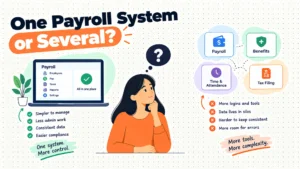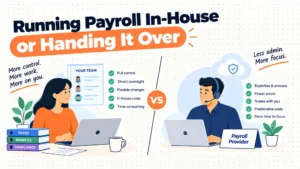

Evaluating gusto vs paychex flex requires looking past standard feature lists to examine how your internal operations team actually works. Choosing between these platforms is fundamentally a choice between adopting an intuitive, self-service software platform with published pricing or partnering with an established payroll provider built around a named specialist service relationship.
TL;DR
- Choose Gusto Simple if you operate strictly within a single state, have 10 to 20 employees, and want a transparent $49/month plus $6 per person fee with full self-service administration.
- Choose Gusto Plus if you manage remote employees across multiple states, require built-in time tracking, and need next-day pay functionality at a clear $80/month plus $12 per person price point.
- Choose Gusto Premium if you require dedicated HR support, certified expert advice, custom reporting, and performance and compensation management at $180/month plus $22 per person.
- Choose Paychex Flex Essentials if your business prioritizes running payroll in as few as two clicks with an estimated starting entry cost around $39/month plus $5 per employee.
- Choose Paychex Flex if you want a dedicated, named payroll specialist to handle operational complexities and demand seamless native 401(k) administration.
- Choose Paychex Flex if you prefer working with a massive enterprise provider—now serving over 790,000 clients following its $4.1 billion acquisition of Paycor—that offers a simpler setup process than ADP Workforce Now.
Pricing at a glance
When evaluating software costs, the structural difference between Gusto's published subscription model and Paychex Flex's quote-driven model directly shapes your long-term operational budget. Gusto publishes every tier openly, whereas Paychex Flex provides baseline starting estimates while customizing final software quotes based on administrative options.
| Pricing Metric / Feature | Gusto Simple | Gusto Plus | Gusto Premium | Paychex Flex Essentials |
|---|---|---|---|---|
| Base Monthly Fee | $49 / month | $80 / month | $180 / month | Starts around $39 / month (Estimate) |
| Per-Employee Fee | $6 / person | $12 / person | $22 / person | Starts around $5 / employee (Estimate) |
| Multi-State Payroll | Not included (Single-state only) | Included | Included | Quoted per account configuration |
| Time Tracking | Basic / Add-on dependent | Included native | Included native | Optional module / Quoted |
| Support Model | Standard web / phone support | Standard support + next-day pay | Dedicated advisor & certified HR experts | Named payroll specialist |
| Pricing Transparency | 100% Published online | 100% Published online | 100% Published online | Quote-based / Custom pricing |
Understanding the foundational cost mechanics helps prevent financial surprises as headcount grows. Gusto’s pricing structure remains fully transparent across all tiers, including its Contractor-only plan ($35/month base plus $6 per contractor). On the other hand, Paychex Flex Essentials starts around $39 per month plus $5 per employee for basic needs, but detailed custom feature packages require direct sales quotes.
Best tools for Payroll Software
Beyond the baseline fees, growing organizations must evaluate how administrative support, state tax filings, and specialized integrations affect the total cost of ownership. While Gusto includes its core operational capabilities inside published monthly tiers, Paychex Flex builds custom agreements that bundle services such as 401(k) integration directly into your client plan. When comparing these systems against other market solutions like Patriot, OnPay, or QuickBooks Payroll, calculating total software expenditures requires looking closely at per-employee fees across every state where your workforce resides.
What is Gusto? Modern self-service software built for visibility
Gusto is a modern, cloud-native payroll, benefits, and human resources platform engineered specifically for small to mid-sized businesses that value employee self-service and modern user interface design. Rather than delegating routine administrative tasks to an external account manager, Gusto provides an intuitive platform where business owners, operations managers, and employees handle data entry, onboarding, and payroll processing independently.
The platform is organized into three distinct operational tiers to support companies at various stages of growth:
- Simple Tier ($49/month base + $6 per person): Designed for single-state businesses running straightforward payroll operations. It provides automated tax filings, direct deposit, and essential employee self-service portals.
- Plus Tier ($80/month base + $12 per person): Built for scaling teams that operate across multiple states. It introduces integrated time tracking, next-day pay processing, workforce management features, and expanded hiring tools.
- Premium Tier ($180/month base + $22 per person): Geared toward mid-sized operations requiring elevated compliance and administrative support. It adds a dedicated phone support advisor, direct access to certified HR experts, custom operational reporting, and integrated performance and compensation management tools.
- Contractor-Only Tier ($35/month base + $6 per contractor): Formulated specifically for firms operating without traditional W-2 headcount.
Gusto emphasizes automated compliance, user-friendly digital onboarding, and automated federal, state, and local payroll tax administration. For growing companies navigating modern remote hiring, Gusto automatically handles state tax registration workflows and multi-state withholdings within its Plus and Premium tiers. Its overall product philosophy centers on software autonomy: giving internal HR administrators direct control over payroll workflows without forcing them to communicate through an assigned service intermediary.
However, operational leaders should evaluate user feedback alongside platform features. Gusto maintains a 3.5 Trustpilot rating, reflecting a mix of client experiences regarding customer support responsiveness during complex tax resolution scenarios. While the platform offers powerful tools for independent administrators, organizations shifting away from basic entry-level options like Wave Payroll or standard accounting add-ons must recognize that Gusto's model relies heavily on self-directed troubleshooting unless you upgrade to the Premium tier.
What is Paychex Flex? Dedicated service backed by a payroll powerhouse
Paychex Flex is an enterprise-grade payroll and human capital management platform designed to serve businesses ranging from small early-stage companies to large organizations. Unlike modern self-service software applications that rely solely on automated help centers, Paychex Flex builds its service model around personal account management. Every client receives access to a named payroll specialist who serves as a direct operational point of contact for processing, compliance updates, and platform adjustments.
The platform’s entry-level package, Paychex Flex Essentials, starts around $39 per month plus $5 per employee. It allows administrators to run accurate payrolls in as few as two clicks once recurring pay schedules and employee profiles are configured. This extreme efficiency makes Paychex Flex popular among busy office managers who want to process payroll rapidly without navigating complex software menus.
Key operational characteristics of Paychex Flex include:
- Massive Corporate Reach: Paychex expanded its operational scale by completing a $4.1 billion acquisition of Paycor in April 2025. The combined enterprise now serves over 790,000 clients across North America, giving it extensive regulatory resources and corporate stability.
- Dedicated Account Expertise: Client operations are supported by an assigned, named payroll specialist who understands your company's account structure and historical payroll runs.
- Seamless 401(k) Integration: The system offers native retirement plan administration, automatically syncing employee deferrals and employer matching contributions directly with investment repositories.
- Streamlined Platform Setup: Designed to offer a significantly simpler setup process than legacy enterprise competitors such as ADP Workforce Now.
Paychex Flex bridges the gap between traditional outsourced payroll bureau services and modern software. While the application provides robust online portals for desktop and mobile devices, the underlying operational philosophy acknowledges that busy founders and HR directors often prefer talking directly to a dedicated professional. By combining a named payroll specialist with enterprise-grade infrastructure, Paychex Flex appeals to organizations that prioritize high-touch service support over purely self-directed software tools.
Gusto vs Paychex Flex: How their pricing models really work
Analyzing the financial reality of gusto vs paychex flex requires looking beyond published entry prices. Payroll vendor costs typically fall into two categories: standard transparent SaaS pricing models and tailored sales-driven quotation models. Choosing between them determines whether your payroll expense remains fixed and predictable or requires periodic manual contract reviews.
+———————————————————————–+
| GUSTO PRICING MODEL |
| [Published Base Rate] + [Published Per-Person Fee] = Predictable |
| Simple: $49 + $6/person | Plus: $80 + $12/person | Premium: $180 + $22|
+———————————————————————–+
+———————————————————————–+
| PAYCHEX FLEX PRICING MODEL |
| [Custom Quote Base] + [Quoted Per-Employee Fee] + [Add-On Modules] |
| Essentials Baseline: Starts around $39 + $5/employee (Customized) |
+———————————————————————–+
Gusto operates on a fully transparent, published pricing model. If your organization operates in a single state with 15 W-2 employees on the Simple plan, your monthly software expense is calculated directly: $49 base plus 15 multiplied by $6 ($90), totaling $139 per month. If you expand into multi-state hiring or require time tracking, upgrading to the Plus tier adjusts your cost to $80 base plus 15 multiplied by $12 ($180), totaling $260 per month. Every fee is visible on their public website, allowing finance teams to model future headcount expansion accurately without scheduling sales calls.
Conversely, Paychex Flex utilizes a custom quotation pricing structure. While Paychex Flex Essentials offers a published starting baseline around $39 per month plus $5 per employee, this starting price represents the entry point for basic payroll processing. As your business scales and demands additional HR infrastructure—such as multi-state tax management, time tracking, custom GL reporting, or advanced onboarding—Paychex constructs a custom service tier.
This custom model creates distinct budget considerations:
- Cost Predictability: Gusto’s flat per-employee rates allow finance managers to project software costs across future headcount thresholds easily.
- Negotiation Opportunities: Paychex Flex’s quoted structure gives larger teams flexibility to negotiate custom pricing bundles based on service usage, payroll frequency, and selected software modules.
- Service Bundling: Paychex Flex often combines service costs (like dedicated specialist support and 401(k) management) into standard account invoices, whereas software-first platforms charge extra for elevated support tiers.
When evaluating overall value against other industry options—such as Patriot, OnPay, or enterprise platforms like Rippling and ADP Workforce Now—you must balance software transparency against high-touch service. Gusto guarantees total pricing clarity, while Paychex Flex offers custom contract packaging tailored to your operational complexity.
Total cost analysis: Modeling 10, 50, and 150 employee scenarios
To evaluate the long-term financial impact of each platform, we modeled annual operational costs across three realistic business scenarios. When reviewing these calculations, remember that Gusto’s rates reflect published monthly fees, while Paychex Flex figures utilize the published Essentials starting baseline ($39/month base + $5/employee) to establish standard cost benchmarks.
Scenario A: 10 Employees (Single-State Business)
- Gusto Simple Plan: $49 base + (10 employees × $6 = $60) = $109 per month. Annual cost: $1,308.
- Gusto Plus Plan: $80 base + (10 employees × $12 = $120) = $200 per month. Annual cost: $2,400.
- Gusto Premium Plan: $180 base + (10 employees × $22 = $220) = $400 per month. Annual cost: $4,800.
- Paychex Flex Essentials Baseline (Estimate): $39 base + (10 employees × $5 = $50) = $89 per month. Annual cost: $1,068.
Scenario B: 50 Employees (Multi-State Team with Time Tracking)
- Gusto Plus Plan (Required for multi-state): $80 base + (50 employees × $12 = $600) = $680 per month. Annual cost: $8,160.
- Gusto Premium Plan: $180 base + (50 employees × $22 = $1,100) = $1,280 per month. Annual cost: $15,360.
- Paychex Flex Essentials Baseline (Estimate): $39 base + (50 employees × $5 = $250) = $289 per month base. Annual cost baseline: $3,468. (Note: Multi-state handling and specialized modules require custom sales quotes for mid-market teams).
Scenario C: 150 Employees (Mid-Market Organization Needing HR Infrastructure)
- Gusto Plus Plan: $80 base + (150 employees × $12 = $1,800) = $1,880 per month. Annual cost: $22,560.
- Gusto Premium Plan: $180 base + (150 employees × $22 = $3,300) = $3,480 per month. Annual cost: $41,760.
- Paychex Flex Essentials Baseline (Estimate): $39 base + (150 employees × $5 = $750) = $789 per month baseline. Annual cost baseline: $9,468. (Note: At 150 employees, Paychex transitions clients into custom mid-market software packages).
| Headcount & Operational Scope | Gusto Plus Tier | Gusto Premium Tier | Paychex Flex Essentials (Baseline Estimate) |
|---|---|---|---|
| 10 Employees (Single-State) | $2,400 / year ($200/mo) | $4,800 / year ($400/mo) | $1,068 / year ($89/mo) |
| 50 Employees (Multi-State + Time) | $8,160 / year ($680/mo) | $15,360 / year ($1,280/mo) | $3,468 / year ($289/mo baseline) |
| 150 Employees (Expanded HR Support) | $22,560 / year ($1,880/mo) | $41,760 / year ($3,480/mo) | $9,468 / year ($789/mo baseline) |
These cost models demonstrate how software choices scale alongside company size. While Gusto Premium provides dedicated advisor access and certified HR expert support, its $22 per-employee fee increases total operational expenditure significantly as headcount grows. Conversely, Paychex Flex Essentials offers a low baseline entry price, but total cost shifts as custom sales quotes incorporate advanced modules for larger teams. To explore broader platform comparisons across the marketplace, visit our guide to the best payroll software.
Where Gusto wins: Published rates, intuitive UI, and clear scaling
Gusto excels in providing a streamlined, self-service software environment designed specifically for modern business teams. Its key advantage lies in operational autonomy: platform features are designed so administrators and employees can handle tasks independently without needing step-by-step guidance from account support representatives.
+———————————————————————–+
| GUSTO CORE ADVANTAGES |
|---|
| 1. Transparent Pricing -> 100% published online across all tiers. |
| 2. Self-Service UI -> Modern employee onboarding portals. |
| 3. Automated Scaling -> Effortless transition from Simple to Plus. |
| 4. Integrated HR Tools -> Performance & comp management on Premium. |
+———————————————————————–+
Key operational areas where Gusto leads include:
- Transparent Pricing Clear-Cut Tiers: Gusto eliminates sales negotiation friction by publishing all plan rates online. Operations managers can quickly calculate monthly software costs for single-state teams ($49 base + $6/person), multi-state teams ($80 base + $12/person), or premium accounts ($180 base + $22/person).
- Intuitive Employee Self-Service: Employees can manage direct deposit details, view pay stubs, update withholding forms, and access annual tax documents through a clear user interface. This reduces routine administrative requests sent to your HR team.
- Seamless Multi-State Support: Upgrading to Gusto Plus provides built-in multi-state payroll capabilities, integrated time tracking, and next-day pay processing, ensuring smooth compliance as your business hires remote employees nationwide.
- Modern HR Infrastructure: The Premium plan integrates certified HR expert consultations, dedicated support, custom reporting, and built-in performance and compensation management tools directly into the payroll workflow.
- Contractor Management: Fulfills contractor-only operational needs through a dedicated $35/month base plus $6 per contractor pricing model.
For teams moving away from basic tools like Wave Payroll or manual spreadsheets, Gusto delivers a modern payroll experience. The application automates complex tax calculations and multi-state withholdings, giving small business owners complete financial clarity without requiring dedicated payroll specialists.
Where Paychex Flex wins: Named payroll specialists and enterprise reach
Paychex Flex excels by providing dedicated expert support alongside enterprise-grade infrastructure. While modern software platforms push users toward digital help centers and automated ticket queues, Paychex Flex grounds its customer experience in personal service.
+———————————————————————–+
| PAYCHEX FLEX CORE ADVANTAGES |
|---|
| 1. Named Specialist -> Dedicated point of contact for payroll. |
| 2. 2-Click Processing -> Rapid, streamlined payroll execution. |
| 3. Massive Market Scale -> $4.1B Paycor deal; 790,000+ clients. |
| 4. Native 401(k) Sync -> Fully integrated retirement management. |
+———————————————————————–+
Key operational advantages of Paychex Flex include:
- Dedicated Named Payroll Specialist: Rather than submitting online support tickets, your team works directly with an assigned payroll professional who knows your account setup, payroll history, and business structure.
- Fast Two-Click Payroll Run: Paychex Flex allows administrators to process routine payroll in as few as two clicks, minimizing administrative tasks for office managers handling recurring payrolls.
- Built-in 401(k) Integration: Paychex administers retirement plans natively. Employee contributions and employer matching logic sync automatically with payroll runs without needing external third-party API connectors.
- Enterprise Stability and Reach: Following its $4.1 billion acquisition of Paycor in April 2025, the combined company serves over 790,000 clients. This immense reach gives business leaders peace of mind regarding long-term service stability and regulatory resources.
- Simpler Setup Than ADP: Designed to offer a quicker implementation process than ADP Workforce Now, allowing growing companies to deploy advanced payroll features without multi-month delays.
For growing businesses that handle complex payroll needs, Paychex Flex offers a powerful combination of service and scale. Having an assigned expert to handle adjustments, processing issues, or multi-state filings gives busy leadership teams confidence that payroll execution remains compliant and accurate.
Where Gusto struggles: Premium tier barriers and platform limitations
Despite its user-friendly interface, Gusto presents operational challenges that business leaders must consider during platform evaluations.
Escalating Premium Tier Costs
While Gusto's entry-level Simple tier ($49 base + $6/person) is cost-effective for local teams, pricing increases quickly as your company expands. Once your organization needs multi-state capabilities, integrated time tracking, or next-day pay, you must upgrade to Gusto Plus ($80 base + $12/person).
If your team requires high-touch operational support—such as a dedicated advisor, certified HR experts, or performance management tools—you must move to Gusto Premium ($180 base + $22/person). For a business with 100 employees, the Premium tier costs $2,380 per month ($28,560 annually), creating a significant software investment for mid-sized teams.
+———————————————————————–+
| GUSTO COST ESCALATION AT 100 EMPLOYEES |
|---|
| Simple Plan: $49 + (100 x $6) = $649/mo ($7,788/yr) |
| Plus Plan: $80 + (100 x $12) = $1,280/mo ($15,360/yr) |
| Premium Plan: $180 + (100 x $22) = $2,380/mo ($28,560/yr) |
+———————————————————————–+
Self-Service Support Dependencies
Gusto holds a 3.5 Trustpilot rating, reflecting mixed user feedback regarding customer service response times. On the Simple and Plus plans, users rely on standard online support channels. When complex payroll discrepancies or state tax authority notices arise, resolving issues through general support queues can be frustrating for busy office managers.
Software Platform Boundaries
Gusto is designed primarily as a modern self-service platform. Organizations with complex workforce needs—such as job costing, union payroll rules, or complex labor tracking—may find Gusto’s native feature set limiting compared to enterprise platforms like Paychex Flex or ADP Workforce Now. When analyzing comprehensive solutions across our guide to the best payroll software, business leaders should evaluate whether Gusto's self-directed software tools meet their operational requirements.
Where Paychex Flex struggles: Custom quotes and fee opacity
While Paychex Flex offers personal specialist support and robust software, its service-oriented model presents specific challenges for growing companies.
Quote-Based Pricing Structure
Unlike Gusto’s published rates, Paychex Flex relies on custom sales quotations. Although Paychex Flex Essentials provides a starting baseline around $39 per month plus $5 per employee, determining the total cost for advanced account options requires direct sales discussions. Operations managers must review sales proposals carefully to confirm which features are included in baseline fees versus optional add-ons.
+———————————————————————–+
| PAYCHEX FLEX CUSTOM QUOTATION MATRIX |
|---|
| [Essentials Base Estimate: $39/mo + $5/emp] |
| │ |
| ├── Multi-State Tax Filing Fees? ──> (Quoted Per Account) |
| ├── Advanced Time & Attendance? ──> (Custom Module Fee) |
| ├── Custom GL Integration? ──> (Custom Setup / Mo) |
| └── Year-End Tax Document Prep? ──> (Quoted Processing Fee) |
+———————————————————————–+
Potential Add-On Charges
Because Paychex offers wide customization, additional fees can appear as your account configuration evolves. Common items that may adjust your final billing include:
- Year-end tax document processing and distribution fees.
- Specialized general ledger reporting integrations.
- Multi-state tax setup and compliance management modules.
- Advanced time and attendance management software.
Contract Commitment Requirements
Paychex Flex operates using traditional business software contracts. While self-service SaaS applications allow month-to-month changes, Paychex client agreements often include standard term commitments. Terminating contracts early or scaling down unused features requires advance planning and administrative coordination.
For business owners who want complete pricing clarity and self-service software control, Paychex's quote-driven model can feel overly complex. Organizations evaluating vendors like Patriot, OnPay, or QuickBooks Payroll must balance the high-touch benefits of a named specialist against the simplicity of all-inclusive software pricing.
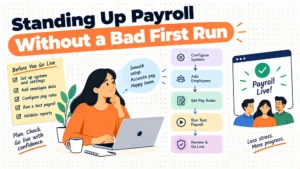
Implementation, migration, and switching between platforms
Transitioning your organization between payroll applications requires careful operational planning. Moving payroll data involves transferring sensitive employee information, historical tax records, and complex compliance details.
+———————————————————————–+
| MIGRATION ROADMAP |
|---|
| [Step 1: Data Extraction] -> YTD Payroll, W-4s, Direct Deposit Info |
| [Step 2: Platform Setup] -> Tax Accounts, GL Mapping, Schedules |
| [Step 3: Data Validation] -> Parallel Run / Math Balance Reconciliation |
| [Step 4: Live Cutover] -> Direct Deposit Verification & Launch |
+———————————————————————–+
The Migration Checklist
- Historical Data Extraction: Export year-to-date (YTD) wage registers, tax withholding histories, employee benefit choices, and bank routing details from your legacy platform.
- Tax Account Verification: Reconcile active tax registration numbers across federal, state, and local jurisdictions to prevent tax filing discrepancies.
- General Ledger Mapping: Align chart-of-accounts settings with your accounting platform (e.g., QuickBooks Payroll integrations) to ensure accurate journal entries.
- Parallel Payroll Testing: Run a side-by-side test calculation to verify gross-to-net math, benefit deductions, and tax withholdings match your original records.
| Migration Vector | Gusto Migration Process | Paychex Flex Migration Process |
|---|---|---|
| Data Onboarding Method | Automated digital import tools & self-directed employee portals | Assisted onboarding coordinated by implementation team |
| Setup Timeline | Fast, self-paced execution (typically 1 to 2 weeks) | Structured onboarding guided by specialist (typically 2 to 4 weeks) |
| Historical Tax Uploads | Self-service YTD entry with digital verification | Implementation team handles YTD entry and account setup |
| Employee Account Setup | Self-service invitations sent to employees | Specialist-guided setup or employee portal invitations |
Transitioning to Gusto is generally fast and self-directed. The platform provides automated import tools that guide administrators through data uploading, while employees complete their own profiles through self-service portals.
Switching to Paychex Flex involves a structured, hands-on onboarding process. Your assigned account implementation specialist coordinates data migration, sets up custom pay rules, and configures native 401(k) integrations. While setup takes slightly longer than self-service software, having an assigned specialist minimizes internal administrative workload during the transition.
Contract structure and negotiation playbook for growing teams
Understanding payroll vendor contracts is essential for managing software expenditures effectively. Gusto and Paychex Flex approach service agreements differently, requiring distinct purchasing strategies.
+———————————————————————–+
| CONTRACT NEGOTIATION STRATEGIES |
|---|
| Gusto Approach: |
| – Select the optimal plan tier (Simple vs. Plus vs. Premium). |
| – Utilize monthly flexibility; adjust tiers based on seasonal needs. |
| Paychex Flex Approach: |
| – Request transparent, bundled quote proposals upfront. |
| – Negotiate year-end W-2 processing and setup fee waivers. |
| – Lock in per-employee rates across multi-year terms. |
+———————————————————————–+
Navigating Gusto's Fixed SaaS Terms
Gusto operates on standard, pay-as-you-go subscription terms without mandatory long-term contracts. Negotiation centers on choosing the right tier for your operational needs:
- Tier Selection Strategy: If operating in a single state, start on the Simple tier ($49 base + $6/person). Upgrade to Plus ($80 base + $12/person) only when multi-state hiring or native time tracking becomes necessary.
- Support Evaluation: Upgrade to Premium ($180 base + $22/person) only if your team requires dedicated advisor support and built-in performance and compensation tools.
- Contractor Management: Utilize the Contractor-only plan ($35 base + $6/contractor) for non-W-2 workforces to avoid paying base employee tier rates.
Negotiation Playbook for Paychex Flex
Because Paychex Flex uses customized sales quotes, business leaders have opportunities to negotiate pricing during sales discussions:
- Request Bundled Quotes: Ensure your initial proposal covers all operational requirements—including multi-state tax handling, GL integrations, and 401(k) admin—to avoid unexpected add-on costs later.
- Negotiate Fee Waivers: Ask your sales representative to discount or waive upfront setup fees, historical data migration costs, or year-end W-2/1099 processing charges.
- Establish Fee Guarantees: Request multi-year price locks on per-employee base rates to protect your budget against annual price increases.
- Compare Market Alternatives: Leverage quotes from alternative providers (such as ADP Workforce Now or Rippling) during contract discussions to secure competitive pricing options.
By understanding these structural contract differences, finance managers can structure vendor agreements that provide long-term operational flexibility and clear cost predictability.
Decision framework: Choosing between Gusto vs Paychex Flex
Selecting the right payroll software depends on your company's operational model, internal HR expertise, and overall support preferences.
+——————————–+
| WHICH PAYROLL SYSTEM FITS? |
+—————+—————-+
|
+———————–+———————–+
| |
[SELF-SERVICE / PUBLISHED] [NAMED SPECIALIST / QUOTED]
| |
v v
+———————–+ +———————–+
| GUSTO PLATFORM | PAYCHEX FLEX SYSTEM | |
|---|---|---|
| • Published pricing | • Named specialist | |
| • Modern employee UI | • 2-click payroll run | |
| • Multi-state Plus | • Native 401(k) sync | |
| • Self-directed setup | • 790k+ client base |
+———————–+ +———————–+
Choose Gusto if your organization:
- Values Total Pricing Transparency: You want clear, published pricing ($49/mo + $6/person for Simple; $80/mo + $12/person for Plus; $180/mo + $22/person for Premium) without entering sales negotiations.
- Prefers Employee Self-Service: You want modern onboarding portals where employees update direct deposit information, tax forms, and personal data independently.
- Operates a Self-Directed HR Team: Your internal team feels confident navigating software tools, running reports, and managing payroll without needing a dedicated service manager.
- Needs Flexible Contractor Management: You manage an active flexible workforce using a dedicated contractor plan ($35/mo + $6/contractor).
Choose Paychex Flex if your organization:
- Wants a Dedicated Named Specialist: You prefer working directly with an assigned payroll professional who manages your account setup and processes adjustments.
- Prioritizes Quick Payroll Processing: You want administrators to review and execute recurring payroll runs in as few as two clicks.
- Requires Native 401(k) Integration: You want integrated retirement plan management that automatically syncs employee contributions with payroll runs.
- Prefers an Enterprise Partner: You value the scale and stability of a combined business entity that serves over 790,000 clients following a $4.1 billion Paycor acquisition, offering a simpler setup process than ADP Workforce Now.
Ultimately, choosing between gusto vs paychex flex comes down to whether your team wants intuitive self-service software or a dedicated professional service relationship. Business leaders should assess their internal HR capacity, growth plans, and service expectations before making a final decision. For a broader look at top market solutions, review our comprehensive analysis of the best payroll software.
Related reading
Frequently asked questions
Does Gusto or Paychex Flex offer better multi-state payroll support?
Gusto supports multi-state payroll on its Plus tier ($80/month base + $12 per person) and Premium tier ($180/month base + $22 per person), providing automated tax registration tools. Paychex Flex manages multi-state tax filings through customized account configurations supported directly by your assigned named payroll specialist.
How do Gusto and Paychex Flex pricing structures compare?
Gusto uses transparent, published pricing across all tiers (Simple: $49+$6/person; Plus: $80+$12/person; Premium: $180+$22/person). Paychex Flex utilizes custom pricing quotes, though its entry-level Essentials package provides a published starting baseline around $39 per month plus $5 per employee for basic needs.
Which platform is easier to set up for a small business?
Gusto offers a fast, self-directed setup that allows small teams to launch within days using digital onboarding tools. Paychex Flex provides guided implementation managed by support specialists, offering a significantly simpler setup process than legacy systems like ADP Workforce Now.
Can both platforms handle 401(k) retirement plan integration?
Yes. Gusto offers 401(k) integrations through select third-party retirement plan partners. Paychex Flex provides native, fully integrated 401(k) administration, automatically syncing employee deferrals and employer match contributions directly with investment repositories during every payroll run.
What customer support models do these platforms provide?
Gusto relies primarily on digital help centers, email, and phone support, reserving dedicated advisors for its Premium tier. Paychex Flex builds its core model around a named payroll specialist who serves as your assigned personal account contact.
How big are these companies in the payroll industry?
Gusto serves hundreds of thousands of small-to-midsize businesses via its modern cloud platform. Paychex completed a $4.1 billion acquisition of Paycor in April 2025; the combined business now serves over 790,000 corporate clients across North America.