

Hiring your first employee outside your home country is a legal decision disguised as an HR task, and getting it wrong exposes your company to misclassification fines, tax withholding failures, and benefits gaps before your Series A even closes. Choosing the best EOR for first international hire means finding a provider that combines transparent per-employee pricing, in-country legal entities (not just partner networks), and a support team that will actually pick up the phone during your first payroll run. Deel and Remote lead this list for founders who need speed and coverage across 100+ countries; Rippling wins if you're already inside its HR/IT stack; Papaya Global and Multiplier fit narrower geographic or pricing needs. If you're hiring one contractor who might convert to an employee in six months, skip the EOR entirely and use a contractor-of-record product instead — paying $500-$700/month for full EOR compliance on a $2,000/month contractor is a bad trade.
TL;DR
- Pick Deel if you need coverage in 100+ countries and want a single platform for contractors and EOR employees as you scale past hire #1.
- Pick Remote if data privacy, worker-friendly benefits, and owned (not partnered) legal entities matter more to you than raw country count.
- Pick Rippling if you already run US payroll and HRIS through Rippling and want the international hire in the same system of record.
- Pick Multiplier or Papaya Global if your first hire is in a lower-cost EOR market (India, Philippines, Latin America) and you're price-sensitive on the monthly fee.
- Walk away from EOR entirely if your "hire" is actually a short-term contractor engagement under 15 hours a week — use a contractor management tool instead.
- Never sign a 12-month EOR contract for a single hire before confirming exit terms and data portability in writing.
- Compare full vendor shortlists on HR Ops Lab's best EOR services guide before you request a quote, not after.
Quick comparison table
| Vendor | Countries covered | Owned entities vs. partner network | Starting EOR price/employee/mo | Best for |
|---|---|---|---|---|
| Deel | 150+ | Mostly owned, some partner | ~$599 | Founders scaling past 1-2 hires quickly |
| Remote | 60-70+ | Owned entities in most markets | ~$599 | Data privacy, benefits quality |
| Rippling | 50+ | Mix of owned/partner | ~$500+ | Teams already on Rippling HRIS/IT |
| Multiplier | 150+ | Mostly partner network | ~$400 | Budget-conscious first hire |
| Papaya Global | 160+ | Partner network | ~$599+ | Payroll-heavy, multi-country finance teams |
| Velocity Global | 185+ | Mix, strong in complex markets | Custom quote | Complex/regulated markets, larger contracts |
Pricing varies by country, currency, and contract length — treat these as directional, not final quotes.
What Is the Best EOR for First International Hire?
There isn't one universal answer, but for a founder hiring one person abroad for the first time, the best EOR for a first international hire is the one with a legal entity (owned or reliably partnered) in that specific country, transparent monthly pricing with no long-term lock-in, and a self-serve platform you can run without a dedicated HR hire.
Best tools for Employer of Record (EOR) Tools
Why "best" depends on the country, not just the vendor
The mistake most founders make is picking a vendor based on brand recognition rather than geographic fit. Deel and Remote both claim broad country coverage, but coverage quality differs by region — Remote tends to own its entities more directly in Latin America and Europe, while Deel has historically leaned on a mix of owned entities and local partners depending on the market. If your first hire is in Portugal, ask specifically whether the vendor has an owned entity there or is using a third-party partner, because that changes who's legally liable if something goes wrong with payroll tax filings.
The three things that actually separate vendors for a single hire
Price matters less than founders think at this stage — the difference between $500 and $650 a month is $1,800 a year, not a rounding error but not the deciding factor either. What matters more:
- Time to first payroll run. Some vendors quote 2-3 weeks to get a first employee live in a new country; others quote 5-10 business days if the country is already "pre-provisioned" in their system.
- Contract statutory compliance. The EOR should draft the employment contract in the local language, with local statutory benefits (leave, notice period, severance formulas) baked in automatically — not bolted on after you ask.
- Support model. A dedicated onboarding specialist versus a shared support queue matters enormously when you're doing this for the first time and don't know what a "13th month payment" or "aguinaldo" obligation even is.
A worked example
A 12-person SaaS startup based in Austin wants to hire a senior engineer in Warsaw. The founder gets quotes from Deel ($599/month, 10 business day setup, owned entity in Poland), Multiplier ($400/month, partner-network entity, 15 business day setup), and Remote ($599/month, owned entity, 8 business day setup, stronger benefits admin for EU statutory pension contributions). Because Poland has specific rules around B2B contractor conversion scrutiny from tax authorities, the founder picks Remote for the owned entity and faster setup, accepting the higher price to reduce legal exposure on a hire making a six-figure salary.
What to do:
- Ask each vendor for their entity status (owned vs. partner) in the exact country of your hire, in writing.
- Request a sample employment contract template for that country before signing.
- Confirm turnaround time with a specific start date, not a general SLA.
Why do startups use an EOR instead of opening a foreign entity?
Startups use an employer of record instead of a foreign legal entity because entity setup costs $10,000-$30,000+ per country and takes 2-6 months, while an EOR gets a compliant hire live in 1-3 weeks for a few hundred dollars a month. For a single hire, the math almost always favors the EOR.
The real cost of a foreign entity
Opening a subsidiary in most countries requires local legal counsel, a registered address, a local bank account, tax registration, and often a local director or statutory representative. In markets like Brazil or India, this can take four to six months and cost well over $20,000 in legal and accounting fees before you've paid a single employee. You'd also need ongoing local accounting and tax filing support, which runs $500-$2,000/month indefinitely — a fixed cost that doesn't scale down if the hire doesn't work out.
When the entity math flips
The breakeven point is usually somewhere between 5 and 15 employees in a single country, depending on local costs and how expensive the EOR markup is relative to salary. A $600/month EOR fee on a $150,000/year hire is under 5% overhead. The same fee on a $35,000/year hire in the Philippines is closer to 20% overhead — still often cheaper than entity setup, but worth recalculating as headcount in that country grows. Companies like Deel, Remote, and Velocity Global all offer "entity setup" services as a parallel product specifically because they know clients eventually outgrow the EOR model in high-headcount countries.
What founders underestimate
It's not just the setup cost — it's the ongoing compliance burden. Labor law changes (minimum wage increases, new leave mandates, changes to termination notice requirements) happen regularly in every country, and an entity means your own legal/HR team has to track them. An EOR absorbs that risk contractually. For a founder with no in-house international HR expertise, that risk transfer is often worth more than the monthly fee itself.
What to do:
- Model entity cost vs. EOR cost over a 24-month horizon, not just month one.
- Ask your EOR vendor at what headcount they'd recommend you transition to your own entity.
- Keep the EOR relationship even after entity setup for any single-digit-headcount countries where volume never justifies a subsidiary.
How much does an EOR cost for one employee?
Expect to pay $400-$700 per employee per month in base EOR fees as of 2026, on top of the employee's gross salary, statutory employer contributions, and any local benefits top-ups. Total employer cost for one international hire typically runs 20-40% above base salary once you add EOR fees, payroll taxes, and benefits.
Breaking down the real bill
The EOR fee itself is only one line item. You're also responsible for:
- Gross salary (obviously), paid in local currency or the currency agreed in the contract.
- Employer payroll taxes and social contributions — these vary wildly, from around 13% of salary in some Eastern European markets to 30%+ in parts of Latin America and Southern Europe.
- Mandatory benefits like health insurance top-ups, pension contributions, or 13th/14th month pay in countries where that's statutory.
- The EOR platform fee itself, usually flat per employee per month regardless of salary level.
A real-world total cost example
Say you hire a marketing manager in Mexico at a $60,000/year equivalent salary through Deel. Add Mexico's employer social security contributions (roughly 25-30% depending on salary bracket and risk classification), mandatory profit-sharing (PTU) obligations, and the EOR platform fee of around $599/month ($7,188/year). Your all-in employer cost lands somewhere between $80,000-$85,000/year for that $60,000 salary — a fully loaded cost ratio you need in your budget model before you make an offer, not after.
Hidden fees to ask about upfront
Some vendors charge separately for: contract amendments, offboarding/termination processing, background checks, equipment procurement and shipping, and currency conversion spreads on payroll disbursement. Multiplier and Papaya Global have historically been more transparent about all-in pricing upfront; others quote the base fee and itemize add-ons during onboarding, which can catch a first-time buyer off guard.
Checklist:
- Request a full cost breakdown including employer taxes for the specific country before you make the offer.
- Ask explicitly whether termination/offboarding is billed separately.
- Confirm the currency conversion method and any spread the vendor takes on FX.
What's the difference between an EOR and a PEO?
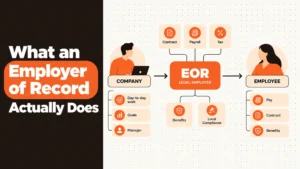
An EOR (Employer of Record) becomes the legal employer of your international hire in a country where you have no entity; a PEO (Professional Employer Organization) co-employs workers alongside you, typically within a country where you already have a registered entity — most commonly used for US domestic hiring.
Why this distinction trips up first-time buyers
Founders often search for "PEO" when they mean "EOR" because PEOs like Insperity and TriNet are more familiar names in US HR circles. But a PEO can't legally employ someone in Vietnam on your behalf if you have no Vietnamese entity — that's specifically the EOR's job. Some vendors, like Rippling and Justworks, offer PEO services domestically and EOR services internationally under one brand, which adds to the confusion when comparing quotes.
Where the lines blur
A handful of providers market themselves as doing both, and functionally the contract terms can look similar from the employee's side — same payroll cadence, same benefits enrollment flow. The legal liability structure is where they diverge: in a PEO relationship, you and the PEO share employer responsibilities and you generally retain more control over hiring/firing decisions; in an EOR relationship, the EOR holds full legal employer status, which is exactly why it can operate somewhere you have no local footprint.
Which one you need for a first international hire
If this is genuinely your first hire outside your home country and you have no local entity there, you need an EOR — not a PEO. If you're hiring your first employee in a US state where you don't have a physical presence but you're already a US entity, that's a different problem (state-level payroll registration or a domestic PEO), not an international EOR question at all. Getting these mixed up in a vendor conversation wastes both parties' time and can lead to a signed contract that doesn't actually solve your compliance problem.
What to do:
- Confirm you have zero registered entity in the target country before requesting EOR quotes.
- If the hire is domestic but cross-state, ask vendors specifically about PEO or payroll-tax-registration products instead.
- Read the liability clause in any EOR/PEO contract to see who's named as legal employer of record.
Which EOR is best for hiring in Europe vs. Latin America vs. Asia?
No single EOR dominates every region — Remote and Deel are consistently strong in Europe and Latin America, while Multiplier and Papaya Global often quote more competitively for South and Southeast Asian markets. Regional strength usually tracks with where a vendor has owned legal entities versus where it relies on local partners.
Europe: compliance density favors owned entities
European labor law is dense — works councils, strong notice periods, statutory redundancy pay, and strict data privacy rules under GDPR. Remote has invested heavily in owned entities across the EU and markets this as a differentiator for data handling and contract accuracy. Deel covers most EU countries as well, with strong self-serve tooling for contract generation. For a founder hiring their first employee in Germany or France specifically, ask about notice period defaults and probation period handling — these differ meaningfully by country and a generic template contract can create obligations you didn't intend.
Latin America: currency and termination cost matter most
Brazil, Mexico, and Argentina all have complex severance and termination cost structures — Brazil's FGTS system and 13th salary requirements, for example, aren't optional add-ons. Deel and Remote both have solid Latin America coverage; Oyster HR is also frequently cited for LatAm strength given its founding focus on distributed, remote-first hiring in the region. Ask any vendor for a termination cost estimate upfront in Brazil specifically — severance costs there can be substantially higher than the salary itself in year one if termination happens without cause.
Asia: pricing and speed vary more by country than by vendor brand
India and the Philippines are common first hires for startups building offshore engineering or support teams, and pricing here tends to be more competitive across vendors because of scale and lower statutory contribution burdens compared to Europe or Latin America. Multiplier and Papaya Global frequently quote lower base fees in these markets. Singapore and Japan, by contrast, carry higher statutory costs and stricter termination protections, and vendor coverage quality varies — always confirm owned-entity status specifically for Japan, where partner-network EOR arrangements have historically been more common and slower to execute.
Checklist:
- Get country-specific termination cost estimates before finalizing an offer in Brazil, France, or Japan.
- Confirm GDPR-compliant data handling in writing for any EU hire.
- Compare at least two vendors' quotes for the exact country — regional "leaders" aren't uniform country by country.
How long does it take to onboard your first international hire through an EOR?
Most EOR providers quote 5-15 business days from signed offer to first payroll run, though pre-provisioned "fast lane" countries can be faster and complex or less common markets can take 3-4 weeks. Background checks, local ID verification, and benefits enrollment are usually the longest steps.
What actually happens during onboarding
Once you select a candidate, the EOR drafts a locally compliant employment contract, collects the employee's tax and banking information, registers them for local social security/tax withholding, and often runs a background check depending on role and country. Benefits enrollment (health insurance, pension) happens in parallel but can lag behind the contract signing by a week or two in some markets, which matters if your new hire is expecting coverage from day one.
Where delays actually happen
Delays rarely come from the EOR platform itself — they come from document collection. Employees who don't promptly provide tax ID numbers, bank details, or required government ID scans can add a week or more to the timeline. Countries requiring notarized documents or government registry lookups (common in parts of Latin America) add friction that no vendor can fully engineer around. First-time founders should build a two-week buffer into their offer letter's stated start date rather than promising a start date the day after signing.
A realistic timeline example
A founder extends an offer to a candidate in Colombia on a Monday. Deel confirms contract generation within 48 hours, but the candidate takes four days to submit banking and tax documents. Colombian social security registration adds another 3-4 business days. Total elapsed time: roughly 12 business days from offer acceptance to first payroll-eligible day — within the vendor's quoted range but longer than a domestic US hire, where you might run payroll within days.
What to do:
- Build a 2-3 week buffer between offer acceptance and stated start date for any first international hire.
- Ask the candidate to submit required documents within 48 hours of signing to avoid self-inflicted delays.
- Confirm with the vendor exactly when benefits coverage becomes active relative to the contract start date.
What compliance risks does an EOR actually cover — and what's still on you?
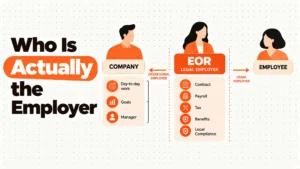
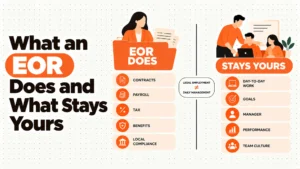
An EOR covers local employment law compliance, payroll tax withholding, statutory benefits administration, and termination process compliance in the country of hire. It does not cover your hiring decisions, performance management judgment calls, or compliance with your own home-country laws (like equity plan regulations or export control rules).
What the EOR is legally responsible for
Because the EOR is the named legal employer, it's on the hook for correctly calculating and remitting payroll taxes, filing required local employment paperwork, administering statutory leave entitlements, and following legally mandated termination procedures (notice periods, severance calculations, required documentation). If the EOR gets a termination process wrong in a market like France or Brazil — where wrongful termination claims are common and expensive — that liability sits substantially with them, not you, assuming you followed their guidance on process.
What's still your responsibility
Performance management, day-to-day work direction, and the decision to terminate are still yours — the EOR executes the process, but you decide who to hire, promote, or let go. You're also still responsible for your own company's obligations: if you're granting stock options to an international hire, securities and tax treatment in that employee's country is a separate legal question the EOR typically won't fully solve, and you may need a specialized equity compliance partner. Misclassification risk on the contractor side (if you're using contractor-of-record instead of EOR) is a different and often underestimated risk category entirely.
A cautionary scenario
A startup terminates its first EOR-employed hire in Spain without cause, six months into the role, believing the EOR will "handle everything." Spain requires specific notice periods and severance calculations based on tenure and salary; if the founder pushes for an immediate exit without following the EOR's guidance on notice, the company can still be exposed to a wrongful termination claim, because the underlying decision and communication were the company's, even though the EOR processes the paperwork. The lesson: an EOR reduces compliance risk, it doesn't eliminate the need to follow their process precisely.
What to do:
- Ask your EOR for a written termination process guide for the specific country before you need it.
- Route all termination decisions through the EOR's HR/legal team before communicating anything to the employee.
- Get separate legal guidance on equity grants to international hires — don't assume the EOR covers this.
Can you switch EOR providers later without disrupting your employee?
Yes, but it requires advance planning — most EOR transitions take 30-60 days and involve re-signing employment contracts, transferring benefits enrollment, and coordinating payroll cutover dates to avoid a missed pay cycle. It's manageable, but not instant.
Why founders end up switching
Common reasons include pricing (a vendor raises fees or a competitor undercuts significantly at renewal), service quality (slow support, payroll errors), geographic expansion (moving to a vendor with better coverage as you add countries), or consolidation (moving everyone onto one platform like Rippling or Deel as headcount grows past a handful of scattered EOR relationships).
What the transition actually involves
The new EOR has to draft a new employment contract for the employee — legally, this is often treated as a change of employer even though the day-to-day job doesn't change, so the employee needs to sign new paperwork. Benefits (health insurance, pension enrollment) need to be transferred or re-enrolled, which can create a coverage gap if timed poorly. Payroll cutover needs a clean date — most founders coordinate the switch to align with a pay period boundary to avoid a split or delayed paycheck, which is the fastest way to lose employee trust in the process.
Data portability matters more than people expect
Before signing with any EOR, check what happens to your employment records, contract history, and payroll history if you leave. Some vendors make this straightforward with exportable records; others make it more painful, which is a real switching cost you should price in at the start, not discover at renewal. This is also a good moment to plug into a broader comparison — a resource like HR Ops Lab's EOR services breakdown walks through what "good" data portability and contract terms look like across the major vendors.
Checklist:
- Ask about data export and contract portability before you sign with any EOR, not when you're trying to leave one.
- Time any provider switch to a pay period boundary to avoid payroll disruption.
- Communicate the switch to the employee directly and early — don't let them find out via a new contract email from an unfamiliar company.
What should you check in an EOR contract before signing?
Check termination/exit terms, liability and indemnification clauses, pricing lock-in period, data ownership, and country-specific coverage confirmation before signing any EOR agreement. These five items cause the most disputes and surprise costs down the line.
Termination and exit terms
Understand what happens if you want to end the relationship with the EOR itself (not the employee) — notice period required, any early termination fees, and how quickly employee data and contract records are handed back. Some vendors lock you into annual contracts with penalties for early exit; others operate month-to-month, which is generally safer for a first hire where you're still validating the relationship.
Liability and indemnification
Read who's liable if the EOR makes a payroll tax error or misses a filing deadline. Reasonable contracts indemnify you against the EOR's own compliance failures; less favorable ones push liability back to you as the "client" in ways that undercut the entire point of using an EOR. This clause is worth having actual legal eyes on, even for a single hire — a $500/month vendor relationship shouldn't come with unlimited liability exposure.
Pricing lock-in and renewal terms
Ask whether the quoted price is locked for 12 months or subject to change at renewal, and get the renewal notice period in writing. Vendors sometimes quote aggressive first-year pricing that increases meaningfully at renewal — not unreasonable, but you want to know it's coming rather than discover it on an invoice.
Country coverage confirmation in writing
Get written confirmation, not just a verbal sales assurance, that the vendor has active, compliant entity coverage in your specific target country as of the contract date — entity status can change, and a country that was "covered" a year ago in a case study might now run through a different partner arrangement.
What to do:
- Have a lawyer review the indemnification and liability clauses, even for a single-employee contract.
- Get country coverage and entity status confirmed in writing, dated to your signing date.
- Confirm renewal pricing terms and notice periods before, not after, signing.
Do EOR providers handle equity and benefits for international hires?
Most EOR providers handle statutory and supplemental benefits (health insurance, pension, leave) reasonably well, but equity compensation for international hires is a separate and more complicated problem that most EORs only partially solve.
Benefits administration is the easier half
Health insurance, retirement/pension contributions, and statutory leave entitlements are core to what an EOR does — this is table stakes, and vendors like Deel, Remote, and Rippling all offer benefits packages that meet or exceed local statutory minimums in most covered countries. Some also offer supplemental benefits (private health top-ups, life insurance) as add-ons, which can help you compete for talent against local employers offering more generous packages than the legal minimum.
Equity is where it gets complicated
Granting stock options to an employee legally employed by a third-party EOR raises real questions: securities law compliance in the employee's country, tax treatment of option exercises, and whether the EOR's employment relationship structure even permits equity grants cleanly under your cap table software. Some countries have favorable option tax treatment (the UK's EMI scheme, for example) that requires specific structuring; others make equity grants to non-resident, EOR-employed workers legally awkward or tax-inefficient. Deel and Remote have both built equity-adjacent tooling or partnerships to help here, but neither fully replaces the need for specialized equity/legal counsel when the grant size is meaningful.
A practical approach for a first hire
For a founder's very first international hire, many startups solve this by offering a cash equivalent or a smaller token grant with a side letter, rather than attempting a fully compliant options grant in an unfamiliar jurisdiction on day one. As the company scales and adds more hires in that country, it becomes worth the legal spend to structure equity properly — often coinciding with the same headcount threshold where you'd consider opening a local entity anyway.
Checklist:
- Confirm which statutory benefits are included by default vs. billed as add-ons in your target country.
- Ask your EOR directly whether they support equity grants to their employees, and how.
- For meaningful equity grants, get country-specific legal advice rather than relying on the EOR's general guidance.
Pricing breakdown
Pricing for EOR services as of 2026 generally runs in three tiers: budget providers around $400-$500/employee/month, mid-market providers at $500-$650, and premium/enterprise-focused providers that quote custom pricing, often $700+ or bundled into larger contracts. These figures are base platform fees only — they exclude salary, statutory employer taxes, and benefits costs, which vary by country.
| Vendor | Base EOR fee (per employee/month) | Setup fee | Contract minimum | Notes |
|---|---|---|---|---|
| Deel | ~$599 | Often waived for annual plans | Typically month-to-month available | Broadest self-serve platform |
| Remote | ~$599 | Usually none | Month-to-month common | Strong owned-entity coverage |
| Rippling | ~$500-$600+ | Varies | Often annual for bundled HRIS | Best if already on Rippling |
| Multiplier | ~$400 | Usually none | Month-to-month common | Competitive in Asia/LatAm |
| Papaya Global | ~$599+ | Varies by scope | Often annual for volume | Strong on payroll/finance reporting |
| Velocity Global | Custom quote | Custom | Often annual | Better fit for complex/regulated hires |
Always request a quote for your exact country and salary band — these numbers shift with local statutory obligations and can differ by hundreds of dollars a month between countries even within the same vendor.
Related reading
Frequently asked questions
What is the cheapest EOR for a single international hire?
Multiplier and similar budget-focused providers often quote the lowest base fees, around $400/month, particularly in Asian and Latin American markets. But cheapest base fee doesn't always mean lowest total cost — factor in statutory employer taxes and any add-on fees before comparing across vendors.
Do I need an EOR if I'm only hiring a contractor abroad?
No — if the role is genuinely a contractor engagement (project-based, limited hours, no direct supervision), a contractor management or contractor-of-record product is more appropriate and cheaper than a full EOR. Misclassifying a contractor role as an EOR employee wastes money; misclassifying an employee as a contractor creates legal risk.
Can an EOR sponsor a work visa for my first international hire?
Some EORs, including Deel and Remote, offer visa sponsorship support in select countries, but coverage varies significantly by destination country and visa type. Confirm this specifically before assuming it's included — it's often a separate service with its own fee and timeline.
How fast can I hire someone through an EOR compared to opening my own entity?
An EOR can typically have an employee live within 1-3 weeks, compared to 2-6 months to establish a foreign legal entity. This speed advantage is the primary reason startups choose EOR for their first international hire rather than entity setup.
What happens to my employee's benefits if I switch EOR providers?
Benefits typically need to be re-enrolled with the new provider, which can create a short coverage gap if the transition isn't timed carefully. Coordinate the switch with your outgoing and incoming EOR to align cutover dates and avoid any lapse in health insurance or pension contributions.
Is Deel or Remote better for a first international hire in Europe?
Both cover most EU countries well; Remote is often cited for owned-entity strength and data handling, while Deel offers a broader self-serve platform that's useful if you expect to add more countries quickly. The better fit depends on your specific target country's entity status with each vendor.
Do EOR fees increase as my international headcount grows?
Per-employee fees usually stay flat or decrease slightly with volume discounts, but total spend obviously scales with headcount. Most vendors offer tiered pricing or negotiated rates once you cross 5-10 employees in a single country, which is also the point to reconsider entity setup.
Final verdict
- Best overall for a first international hire: Deel or Remote — both offer broad country coverage, transparent monthly pricing, and self-serve platforms suited to founders without a dedicated international HR team.
- Best for startups already on Rippling: Rippling, to keep US and international headcount in one system of record.
- Best for price-sensitive hires in Asia or Latin America: Multiplier, given consistently competitive base fees in those regions.
- Best for finance teams needing detailed payroll reporting across countries: Papaya Global.
- Best for complex or highly regulated markets: Velocity Global, particularly once you're hiring beyond one or two straightforward countries.
- Skip EOR entirely if: your hire is a genuine part-time or project-based contractor — use a contractor-of-record tool instead and save the monthly EOR fee.
Choosing the wrong EOR for your first international hire is expensive to unwind later — new contracts, benefits re-enrollment, and a nervous employee wondering why their employer changed twice in a year. Compare the full shortlist, including pricing structures and country-specific entity coverage, on HR Ops Lab's best EOR services page before you request your first quote, so the vendor you pick for hire #1 is still the right one at hire #10.