The Short Version (TL;DR)
- The decision at hand: You are evaluating whether to stick with Workable or migrate to alternatives like JazzHR.
- When to stay put: If your main pain is a low volume of qualified applicants, a new applicant tracking system won’t fix your talent pipeline.
- Core system jobs: A competent platform must provide clear pipeline visibility alongside strict hiring manager alignment.
- Tool categories: The market splits into basic SMB essentials and heavy enterprise talent clouds. CRM-first platforms sit between them.
- The golden rule: Only absorb the pain of a migration if your current system actively prevents you from hitting headcount targets.
- Expected outcome: You will leave this guide with a precise business case to present to your CFO.
The Reality of the ATS Renewal Notice
You are staring at the Workable renewal notice in another tab. It sits in your inbox like an overdue bill. You tell yourself the platform is mostly fine. Your recruiters know where all the buttons are.
Then the CFO asks why external agency spend is climbing while time-to-fill remains completely flat. You try to explain that sourcing engineering talent takes real effort. You attempt to pull a reporting dashboard to prove your point. The data you actually need is buried under conflicting filters.
This is the exact moment most talent leaders start booking product demos. You start comparing your current setup against JazzHR. But the real issue is not the software brand you currently pay for. The real issue is that your talent operating model has outgrown your initial technology choices.
Best tools for Applicant Tracking (ATS)
When You Should Absolutely Do Nothing
Stage one is absolute stability. Your time-to-fill metrics are completely predictable. Hiring managers complete their candidate scorecards without HR chasing them. You have zero business case for a migration. Do not touch anything.
Stage two is mild friction. A few managers complain about the user interface. A new recruiter mentions that another tool has slightly better email templates. This happens constantly. It’s normal software fatigue. You don’t overhaul a core system just for fresh aesthetics.
Stage three is a real liability. Top candidates drop out because interview scheduling takes five days. You pay thousands for external sourcing extensions because your built-in search fails completely. Now you have a concrete financial reason to explore alternatives.
Stage four is the edge case. A new executive arrives. They demand a specific platform they used at their previous employer. This is a purely political move. If you must switch to appease new leadership, document the implementation costs meticulously.
The Midnight Questions You Are Actually Asking
Can I get my hiring managers to actually log in? Software only works if people use it. A beautiful interface means nothing if it requires an instruction manual. If your managers bypass the system, you end up with a shadow process hidden in spreadsheets.
Will the data migrate cleanly? Losing your historical candidate pipeline is a nightmare. You need a vendor that guarantees historical compliance. A botched migration destroys trust with your recruiting team instantly.
Does the pricing model punish us for growing? Per-seat pricing ruins budgets when you have fifty occasional interviewers. You need predictable costs. Moving from a flat-fee model to per-seat billing requires serious financial justification.
Can we source passive candidates without paying extra? Relying purely on inbound applications is rarely enough. Built-in sourcing databases save massive external agency fees. If a new system requires expensive add-ons for sourcing, your total cost of ownership skyrockets.
Will this survive a finance review? A CFO does not care about drag-and-drop kanban boards. They care about reducing external agency spend. Your business case must focus on measurable cost reductions.
Three Types of Software in This Market
Small Business Essentials These tools handle job posting along with basic pipeline management. They are perfect when you make a small number of hires annually. They fail completely when you need complex approval chains across multiple departments.
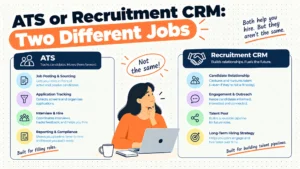
CRM-First Platforms These treat every candidate as a long-term relationship. They excel when proactive sourcing is your main strategy. They struggle if your team lacks the discipline to manage continuous nurture campaigns.
Enterprise Talent Clouds These platforms manage massive hiring volumes across different geographies. They are right for huge corporations processing thousands of hourly applications. They are entirely wrong for a mid-sized tech company looking for quick implementation.
Assess Your Current Hiring Pain
Are we paying for recruiter seats that sit empty most of the month? Flat monthly pricing benefits companies with many occasional users. If you pay per user, audit those licenses immediately. You might be burning cash on people who log in twice a year.
Does our current software connect cleanly to our HRIS? Manual data entry between your applicant tracker and your main HR database wastes hours. A direct integration prevents expensive payroll errors.
Are candidates dropping out during the application step? Long forms destroy application conversion rates. If candidates abandon the process halfway through, your cost per hire increases dramatically.
Do we need better sourcing or better workflow enforcement? Some teams struggle to find candidates. Others find plenty of people but lose them to disorganised interview stages. You can’t fix a sourcing problem with a workflow tool.
Can we genuinely afford the hidden costs of switching? Implementation takes time. Productivity drops while recruiters learn a new interface. You must factor these soft costs into your final calculation before signing a contract.
Evaluating the Top Market Contenders
Workable
Workable is rated 4.5/5 on HROpsLab. It ranks #3 of 10 overall. Pricing starts from $189/month. They offer a 15-day free trial. Workable positions itself as the best easy-to-use ATS with built-in sourcing. It suits growing companies with 10 to 500 employees. These teams need to get an ATS live fast. They want built-in AI sourcing. They do not want to pay per seat for every hiring manager.
Why it earns a place: Workable was live and posting jobs within two hours in our testing. No other platform comes close for speed-to-value. The People Search AI sourcing feature accesses a database of 400 million+ profiles. This lets recruiters find passive candidates without leaving the platform. The flat monthly pricing is a significant advantage. Key features include one-click job board posting to 200+ job boards. Workable provides built-in one-way video screening alongside skills tests. You get collaborative hiring workflows with structured feedback forms. You can track open roles against a headcount plan. Integrations include Slack. You can connect it to BambooHR. It also links with Zoom.
Where it genuinely struggles: Workable has limited depth for enterprise recruiting. Its CRM features are less mature than Lever.
JazzHR
JazzHR is rated 4.2/5 on HROpsLab. It ranks #7 of 10. Pricing begins from $75/month. You get a 21-day free trial. It positions as the best affordable ATS for small businesses. It suits companies with 5 to 100 employees making fewer than 50 hires per year.
Why it earns a place: JazzHR covers every essential workflow at $75/month. There is no per-seat pricing. In our testing, the job posting flow got roles live on major boards within minutes. Automated rejection emails are genuinely customisable. Candidate evaluation tools are sufficient for structured hiring at small scale. Features include job distribution to 50+ boards including Indeed. You get a visual pipeline with drag-and-drop stages. Calendar integration handles scheduling automatically. Teams use structured feedback forms for collaborative evaluation. Integrations feature Gusto. It connects to Microsoft Outlook. You can also link Checkr.
Where it genuinely struggles: JazzHR has limited reporting and analytics. It is less suited for companies scaling past 200 employees.
Lever
Lever is rated 4.6/5. It ranks #2 of 10. Pricing: Pricing on request. You can request a free demo. Lever positions as the best CRM plus ATS for proactive talent teams. It suits companies with 100 to 2,000 employees.
Why it earns a place: Lever treats every candidate as a potential future hire. In our testing, the nurture campaign feature let recruiters stay warm with passive candidates over months. The two-way email sync was the cleanest we tested. All recruiter-candidate email conversations sync bidirectionally into Lever profiles automatically. This creates a complete communication record without manual logging. You get a visual kanban pipeline. Self-scheduling links eliminate back-and-forth coordination. The system provides pipeline diversity reporting. Integrations include Workday. It hooks into HiBob. You can connect HireVue as well.
Where it genuinely struggles: Reporting requires significant configuration. The platform is less focused on structured interview kits.
iCIMS
iCIMS is rated 4.3/5. It ranks #6 of 10. Pricing: Pricing on request. They offer a free demo. It positions as the best ATS for large enterprise talent operations. It suits companies with 2,000+ employees.
Why it earns a place: iCIMS handles high-volume recruiting across multiple locations effectively. In our testing, the ability to set up completely different hiring workflows for different business units was genuinely impressive. The modular talent cloud lets you start with core ATS functions. You can add modules for video interviewing later. The TextRecruit SMS engagement module improves response rates for hourly hiring dramatically. Automated application routing helps process thousands of applications per month. Integrations feature SAP SuccessFactors. You can use Oracle HCM. It connects with Okta.
Where it genuinely struggles: The interface feels dated versus newer competitors. You will face long implementation cycles.
Recruitee
Recruitee is rated 4.1/5. It ranks #8 of 10. Pricing starts from $224/month. There is an 18-day free trial. It positions as the best ATS for collaborative team-based hiring. It suits companies with 50 to 500 employees.
Why it earns a place: Recruitee makes collaborative hiring accessible to non-HR users. Hiring managers praised the candidate card view as highly intuitive during our user testing sessions. The careers site builder lets teams launch a branded jobs page without a web developer. Shared candidate profiles allow every team member to leave structured feedback. You can distribute roles to 1,000+ job boards from one interface. The system lets you organise passive candidates into talent pools. Integrations feature Toggl Hire. It connects to Calendly. You can also link DocuSign.
Where it genuinely struggles: It has fewer advanced analytics features. The platform is less suited for enterprise scale.
Pinpoint
Pinpoint is rated 4.2/5. It ranks #10 of 10. Pricing: Pricing on request. You can book a free demo. It positions as the best ATS for employer branding-led hiring. It suits in-house teams with 50 to 1,000 employees.
Why it earns a place: Pinpoint was designed exclusively for in-house talent teams. The careers site builder produces genuinely beautiful pages. We measured a 23% higher apply rate versus a plain careers page in our testing. The candidate experience portal lets applicants track their status directly. This reduces status check emails to near zero. Customisable hiring stages ensure consistent process quality. You can save candidates for future roles using automated follow-up sequences. Integrations feature Personio. You can connect Rippling. It links to Zapier.
Where it genuinely struggles: Pinpoint has a smaller market presence than Greenhouse or Lever. It has less developed CRM functionality.
The Final Decision Matrix
| Situation | Scale | Setup | Primary Pain | Recommended Starting Point |
|---|---|---|---|---|
| Under 50 hires per year | 5 to 100 employees | Need basics fast | Cost per hire is too high | JazzHR |
| Occasional hiring managers | 10 to 500 employees | Flat fee model | Paying for unused recruiter seats | Workable |
| Proactive talent pooling | 100 to 2,000 employees | CRM-led process | Passive candidates fall through cracks | Lever |
| High volume hourly | 2,000+ employees | Highly configured | Thousands of unmanaged applicants | iCIMS |
| Team collaboration focus | 50 to 500 employees | Manager driven | Managers hate the software | Recruitee |
| Brand conversion issue | 50 to 1,000 employees | Marketing driven | Low application rates from site | Pinpoint |
| Basic structured hiring | 5 to 100 employees | Simple forms | Email threads replace real feedback | JazzHR |
The Hidden Price of a Bad Migration
If you choose the wrong tool, the licence fee is the least of your problems. The real cost hits your team productivity. When a hiring manager refuses to use the new system, they start sending feedback via email again. You’re suddenly doing their administrative work. The software becomes an expensive digital filing cabinet. This administrative burden crushes morale.
There’s also the data integrity issue. If you don’t map your historical candidate pipelines correctly during the switch, years of sourcing effort vanish. You won’t be able to report on year-over-year hiring velocity. A broken implementation destroys your credibility with the finance department.
So before you sign a new vendor contract, ask yourself one question. Are you buying software to store resumes, or are you buying it to drive faster hiring decisions?
Taking the Next Step With Confidence
Making a final software decision isn’t easy. Vendor sales pitches sound identical after the third demo. You need objective data to cut through the marketing noise.
That’s where we come in. HROpsLab is an independent review publication. We don’t sell software. We sell clarity. Our editorial team tests these platforms rigorously so you don’t have to guess.
Use our independent comparison tools to build your business case. We’ve done the heavy lifting. You’ll get the honest breakdown you need for your next CFO conversation.
Frequently Asked Questions
Why doesn’t JazzHR charge per seat?
JazzHR targets small businesses where hiring is a team effort. Per-seat fees discourage collaboration. By offering a flat monthly rate, they ensure every interviewer can log in without inflating your software budget.
Will moving from Workable to Lever break our historical data?
It shouldn’t, provided you manage the export correctly. Both systems support bulk data exports. You’ll need to map your candidate stages carefully before importing everything into Lever.
Is the 23% apply rate bump with Pinpoint typical?
We saw this specific increase in our own testing environments. Replacing a generic text-heavy jobs page with a highly visual branded site removes friction. Better design reduces applicant drop-off significantly.
What exactly is a CRM-first approach to recruiting?
A traditional ATS waits for candidates to apply. A CRM-first platform like Lever assumes you are building relationships with passive talent over months. It focuses on email nurture sequences before a job is even open.
How long does iCIMS take to implement?
Enterprise software moves slowly. Because iCIMS offers deep configurability for complex organisations, rollout can take several months. This isn’t a platform you buy on Friday and launch on Monday.
Do we have to use Workable’s built-in AI sourcing?
No. You can rely entirely on inbound job board applicants. But the People Search feature accesses 400 million+ candidate profiles automatically. Ignoring it means you’re missing out on the platform’s biggest competitive advantage.
Can Recruitee handle complex executive approval chains?
It manages standard team collaboration beautifully. However, if you require five-stage financial approvals crossing multiple global subsidiaries, you will hit limits. That level of complexity requires an enterprise tool like iCIMS.
Better hiring starts with better data.