
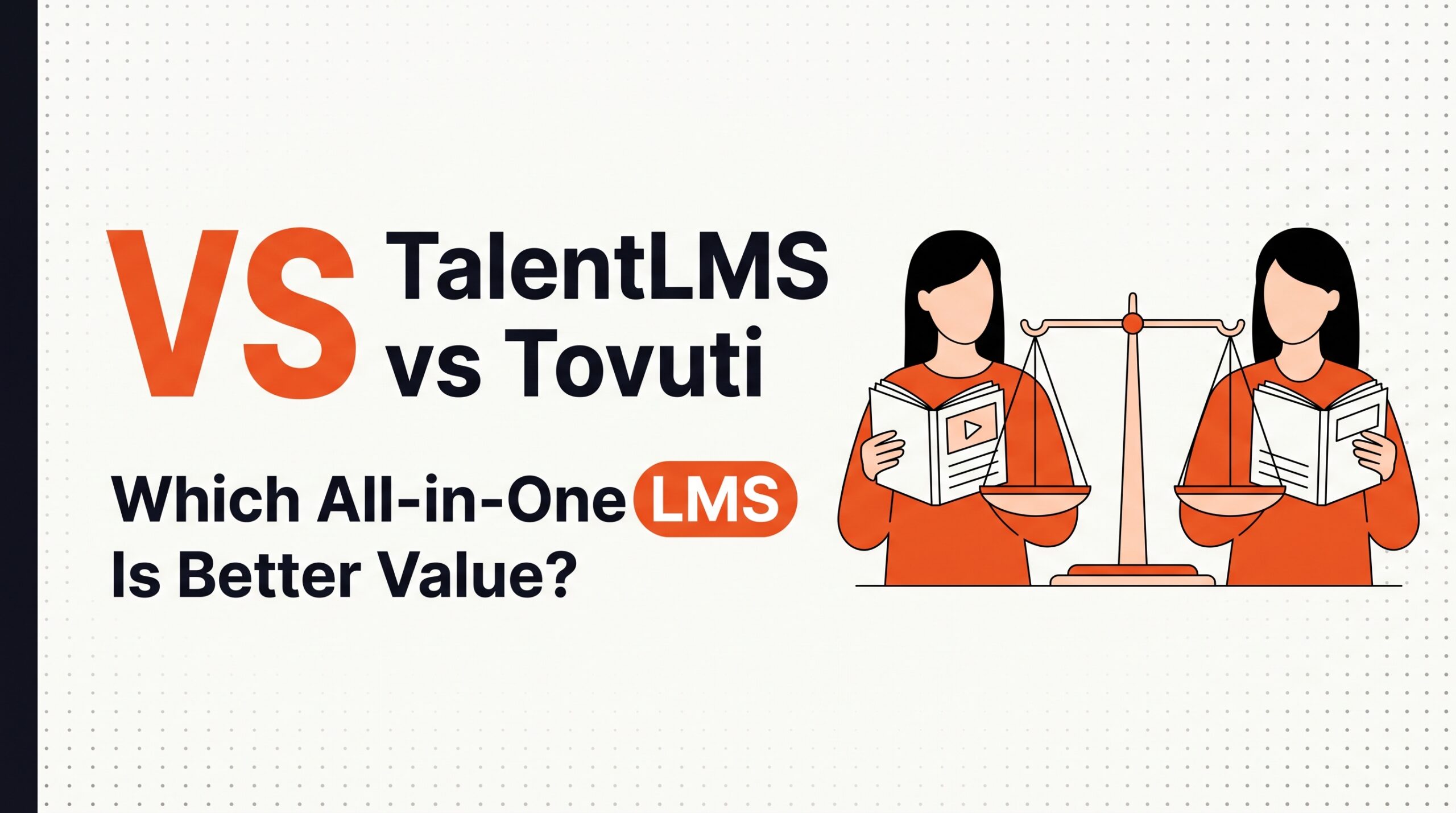
When evaluating talentlms vs tovuti, HR and training leads at growing 25 to 250-employee companies face a choice between two distinct commercial structures and deployment philosophies. Selecting the right platform depends on whether your organization benefits more from flexible, low-commitment user-bracket pricing or an all-inclusive managed platform package.
TL;DR
- Free entry vs bundled onboarding: TalentLMS offers a Free Forever plan covering 5 users and 10 courses, whereas Tovuti LMS requires a commercial commitment starting at $199 per month for its Starter plan or $10,000 annually for fully managed setups.
- Reconciling Tovuti pricing: Tovuti exists in two pricing realities: self-serve monthly tiers ($199/month Starter, $299/month Growth, $399/month Business) and a bundled annual contract reported at $10,000 per year (approximately $833 per month) covering up to 100 users along with dedicated onboarding, account management, and support.
- TalentLMS entry points: TalentLMS publishes standard tiers starting at $69 per month for Core (1–40 users), $109 per month for Grow (1–70 users), and $179 per month for Pro (1–100 users), with an available 10 percent discount on annual billing.
- Alternative reporting models: Separate industry reporting lists TalentLMS annual billing starting at higher baseline tiers ($119 per month for Core, $229 per month for Grow, and $449 per month for Pro), underscoring the need to verify current baseline quotes before committing.
- Overage dynamics: Beyond base user brackets, TalentLMS charges approximately $6 per additional active user per month, making it crucial to calculate growth thresholds accurately before scaling.
- Market position: Across the 2026 market landscape—where LMS costs range from $0 to over $120,000 per year—both vendors fit squarely within standard SMB budgets, which typically fall between flat monthly rates of $150–$500 or per-user costs of $3–$10 per user per month.
Pricing at a glance
Understanding the baseline costs of TalentLMS and Tovuti LMS requires analyzing published tier schedules alongside industry-reported package structures. The table below outlines the core pricing models, tier levels, included user allocations, and public cost benchmarks for both platforms.
| Feature / Tier | TalentLMS | Tovuti LMS |
|---|---|---|
| Free Tier | Free Forever (5 users, 10 courses) | None published |
| Entry Monthly Tier | Core: $69 / month ($62.10/mo billed annually) | Starter: $199 / month |
| Mid-level Monthly Tier | Grow: $109 / month ($98.10/mo billed annually) | Growth: $299 / month |
| Upper Monthly Tier | Pro: $179 / month ($161.10/mo billed annually) | Business: $399 / month |
| Base User Allocations | Core: 1–40 users; Grow: 1–70 users; Pro: 1–100 users | Customisable / Tier-defined |
| Additional User Fee | ~$6 per additional active user / month | Customisable / Tier-defined |
| Alternative Reported Model | Core: $119/mo, Grow: $229/mo, Pro: $449/mo (Annual) | $10,000 / year (up to 100 users; ~$833/month) |
| Included Services in Enterprise/Annual | Custom tier available; standard support tiers | Platform access, onboarding, account management, support |
When evaluating these published metrics against the broader learning management ecosystem, both systems reflect typical SMB pricing models. In 2026, an LMS across the wider market costs anywhere from $0 to $120,000+ per year. However, most small-to-midmarket and mid-market organizations pay either a flat monthly plan of roughly $150 to $500 or a per-user rate of approximately $3 to $10 per user per month. TalentLMS aligns closely with per-user and bracketed monthly pricing, whereas Tovuti bridges flat-rate tiers and high-touch annual enterprise contracts.
Best tools for Onboarding & LMS
To properly situate these tools within your broader HR stack, evaluate how training delivery connects with employee milestone programs by reading our deep dive into the best onboarding software platforms available today.
TalentLMS vs Tovuti: The core decision for growing SMBs
When comparing talentlms vs tovuti, the fundamental choice for HR and L&D leaders at companies with 25 to 250 employees revolves around platform flexibility, billing predictability, and administrative support. Small and mid-sized businesses buying their first dedicated learning management system often lack full-time instructional designers or dedicated HRIS system administrators. Consequently, the commercial model and onboarding structure offered by the vendor frequently dictate project success just as much as technical features do.
TalentLMS provides a low-barrier, highly scalable framework designed for rapid self-service deployment. Companies can launch training initiatives without upfront capital expenditure using the Free Forever tier (supporting 5 active users and 10 courses). As operational demands expand, organizations can seamlessly transition into paid brackets—Core ($69/month), Grow ($109/month), or Pro ($179/month)—paying incrementally as their active user base increases. This structure appeals strongly to budget-conscious teams seeking absolute flexibility and direct control over software spend.
Tovuti LMS, by contrast, targets organizations looking for an all-in-one learning environment that combines course delivery with structured implementation support. While Tovuti publishes entry-level monthly options—Starter ($199/month), Growth ($299/month), and Business ($399/month)—it also maintains a fully managed annual deployment package reported at $10,000 per year for up to 100 users. This translates to roughly $833 per month and includes complete platform access, dedicated onboarding, account management, ongoing technical support, and core LMS functionality.
Selecting between these platforms requires balancing internal administrative bandwidth against total financial outlays. If your team possesses the bandwidth to build courses independently and prefers paying strictly for active participants, TalentLMS offers an adaptable, incremental growth path. If your team requires hands-on implementation guidance, white-glove setup, and bundled account management wrapped into a predictable annual contract, Tovuti LMS delivers a comprehensive solution that reduces internal deployment burden.
What is TalentLMS? Core capabilities and positioning
TalentLMS is designed as an accessible, highly adaptable learning management system aimed at small-to-midmarket businesses seeking to centralize employee, partner, or customer training. Its architectural focus prioritizes rapid content deployment, simple navigation, and modular scaling. Rather than forcing organizations into rigid annual commitments from day one, TalentLMS enables internal L&D teams to configure environments, upload materials, and enroll users with minimal setup friction.
The platform's functional core centers around straightforward course creation, user management, and active-user tracking. Administrators can build learning tracks using native authoring tools, upload multimedia files, assign compliance modules, and monitor user progress through built-in analytics dashboards. TalentLMS sits alongside mid-market training platforms like Absorb LMS, Docebo, 360Learning, SAP Litmos, Trainual, Tovuti, and Seismic Learning (formerly Lessonly), catering primarily to teams that prioritize ease of use and immediate time-to-value over complex enterprise configurations.
A defining characteristic of TalentLMS is its transparent active-user commercial framework. By charging based on active monthly participants within predefined user brackets, the platform allows businesses to manage fluctuating training volumes without paying for inactive user seats. Furthermore, the availability of a functional Free Forever tier (5 users, 10 courses) offers risk-free pilot testing for early-stage organizations establishing formal training frameworks.
For organizations integrating formal learning modules into broader employee lifecycle workflows, pairing a flexible LMS with specialized HR tools is critical. You can explore how learning systems pair with new-hire workflows in our guide to the best onboarding software.
What is Tovuti LMS? Platform mechanics and feature scope
Tovuti LMS is an all-in-one learning management platform engineered to combine content delivery, interactive learning, user management, and administrative support into a single ecosystem. Designed to accommodate both internal workforce training and external extended-enterprise use cases, Tovuti positions itself as a comprehensive learning solution that eliminates the need for third-party add-ons or separate implementation consultants.
The mechanics of Tovuti LMS center around providing robust course authoring, audience segmentation, gamification, and automated compliance tracking. The software enables administrators to construct multi-stage learning pathways, track learner engagement, and deliver branded portals tailored to different business units or external client groups. In the broader marketplace, Tovuti competes directly with enterprise and mid-market learning management platforms such as Cornerstone OnDemand, Docebo, Absorb LMS, SAP Litmos, 360Learning, and TalentLMS, while competing for corporate training budgets alongside content providers like LinkedIn Learning.
Where Tovuti distinguishes itself commercially is in its dual-model market posture. For smaller teams seeking standard monthly software access, Tovuti offers self-serve tiers starting with Starter at $199 per month, Growth at $299 per month, and Business at $399 per month, alongside customisable Professional plans. For mid-sized teams needing end-to-end guidance, Tovuti offers a bundled annual model reported at $10,000 per year for up to 100 users. This annual structure integrates account management, implementation assistance, and dedicated technical support directly into the license cost, shielding HR teams from unexpected service fees during software rollout.
How pricing really works: Reconciling public tiers and enterprise quotes
Evaluating LMS software pricing often presents challenges due to divergent public tiers, annual enterprise quotes, and active-user overage metrics. To make an accurate value assessment when comparing talentlms vs tovuti, buyers must examine how published baseline tiers align with real-world quotes reported across the HR technology industry.
TalentLMS operates primarily on an active-user model billed monthly or annually. Billed monthly, standard tiers are priced at $69 per month for Core (1–40 base users), $109 per month for Grow (1–70 base users), and $179 per month for Pro (1–100 base users). Opting for annual billing applies a 10 percent discount, lowering effective costs to $62.10 per month ($745.20 per year) for Core, $98.10 per month ($1,177.20 per year) for Grow, and $161.10 per month ($1,933.20 per year) for Pro. Beyond base allocations, additional users incur a fee of approximately $6 per additional active user per month.
However, secondary industry reporting lists an alternative pricing structure for TalentLMS on annual plans: Core starting at $119 per month ($1,428 per year), Grow starting at $229 per month ($2,748 per year), and Pro starting at $449 per month ($5,388 per year). Buyers should verify whether baseline quotes reflect standard published rates or specialized feature-gated tiers during contract discussions.
Tovuti LMS exhibits a similar dual pricing model. On one hand, Tovuti publishes structured monthly plans: Starter at $199 per month ($2,388 per year), Growth at $299 per month ($3,588 per year), and Business at $399 per month ($4,788 per year), alongside customisable Professional tiers. On the other hand, separate enterprise sources report Tovuti starting at $10,000 annually for up to 100 users—representing an effective rate of approximately $833 per month. Rather than reflecting an unexplained markup, this $10,000 baseline represents an all-inclusive managed package bundling software access, formal onboarding, dedicated account management, ongoing support, and core LMS capabilities into a single contract.
| Pricing Element | TalentLMS (Standard Published) | TalentLMS (Alt. Reported Annual) | Tovuti LMS (Published Tiers) | Tovuti LMS (Bundled Annual Quote) |
|---|---|---|---|---|
| Entry Point | $69 / month | $119 / month | $199 / month | $10,000 / year (~$833/month) |
| Mid Tier | $109 / month | $229 / month | $299 / month | Professional (Custom) |
| Upper Tier | $179 / month | $449 / month | $399 / month | Custom / Enterprise |
| Annual Discount | 10% standard discount | Included in baseline quote | Varies by contract | Bundled services included |
| Included Capacity | 40 (Core), 70 (Grow), 100 (Pro) | 40 (Core), 70 (Grow), 100 (Pro) | Tier-specific | Up to 100 users |
| Additional User Fee | ~$6 / active user / month | ~$6 / active user / month | Custom tier adjustment | Custom tier adjustment |
| Included Services | Standard web support | Standard web support | Standard online support | Onboarding, Account Mgr, Support |
Reconciling these pricing structures depends on your team's operational readiness. A team with limited internal technical resources may find that Tovuti's $10,000 managed package provides greater overall financial predictability than paying lower software license fees and managing setup independently. Conversely, self-sufficient teams can maximize cost efficiency using TalentLMS's core monthly plans.
Total cost of ownership: 25, 100, and 250 active users compared
To understand total cost of ownership (TCO) across both platforms, HR buyers must model expenses across realistic organizational headcount milestones: 25, 100, and 250 active users. The arithmetic below shows exact baseline expenditures, user bracket overage calculations, and annual totals across standard and reported pricing models.
Scenario A: 25 Active Users (Small Business Launch)
For an organization with 25 active users, training demands fit comfortably within baseline entry tiers for both platforms.
- TalentLMS (Standard Published Core Plan):
- Monthly billing rate: $69 per month.
- Base capacity: Covers up to 40 users (25 users requires no additional overage).
- Monthly cost: $69.
- Annual cost (Monthly billing): $69 x 12 = $828 per year.
- Annual cost (With 10% annual discount): $69 x 0.90 = $62.10 per month; $62.10 x 12 = $745.20 per year.
- TalentLMS (Alternative Reported Annual Core Plan):
- Monthly rate: $119 per month.
- Annual total: $119 x 12 = $1,428 per year.
- Tovuti LMS (Published Starter Plan):
- Monthly billing rate: $199 per month.
- Annual cost: $199 x 12 = $2,388 per year.
- Tovuti LMS (Bundled Annual Model):
- Flat annual fee: $10,000 per year (covers up to 100 users, including onboarding and account management). Effective monthly cost: $10,000 / 12 = $833.33 per month.
Scenario B: 100 Active Users (Mid-Sized Growth)
At 100 active users, companies hit the upper threshold of standard SMB plans, making overage rules and tier limits central to total spend.
- TalentLMS (Standard Published Pro Plan):
- Monthly billing rate: $179 per month.
- Base capacity: Covers up to 100 users exactly.
- Annual cost (Monthly billing): $179 x 12 = $2,148 per year.
- Annual cost (With 10% annual discount): $179 x 0.90 = $161.10 per month; $161.10 x 12 = $1,933.20 per year.
- TalentLMS (Alternative Standard Core Plan + Overage):
- Core Base Plan: $69 per month (covers 40 users).
- Overage calculation: 100 users – 40 base users = 60 additional users.
- Overage charge: 60 users x $6 per user = $360 per month.
- Total monthly cost: $69 + $360 = $429 per month.
- Total annual cost: $429 x 12 = $5,148 per year.
- TalentLMS (Alternative Reported Annual Pro Plan):
- Monthly rate: $449 per month.
- Annual total: $449 x 12 = $5,388 per year.
- Tovuti LMS (Published Business Plan):
- Monthly billing rate: $399 per month.
- Annual cost: $399 x 12 = $4,788 per year.
- Tovuti LMS (Bundled Annual Package):
- Flat annual contract: $10,000 per year for up to 100 users ($833.33 per month equivalent), including account management and implementation.
Scenario C: 250 Active Users (Scaling Mid-Market Enterprise)
At 250 active users, organizations exceed standard tier limits, requiring per-user overage additions or custom enterprise plans.
- TalentLMS (Pro Base Plan + Overage):
- Pro Base Plan: $179 per month (covers 100 users).
- Overage calculation: 250 users – 100 base users = 150 additional users.
- Overage charge: 150 users x $6 per user = $900 per month.
- Total monthly cost: $179 + $900 = $1,079 per month.
- Annual cost (Monthly billing): $1,079 x 12 = $12,948 per year.
- Annual cost (Pro base with 10% discount + overage): ($179 x 0.90) + $900 = $161.10 + $900 = $1,061.10 per month; $1,061.10 x 12 = $12,733.20 per year.
- TalentLMS (Core Base Plan + Overage):
- Core Base Plan: $69 per month (covers 40 users).
- Overage calculation: 250 users – 40 base users = 210 additional users.
- Overage charge: 210 users x $6 per user = $1,260 per month.
- Total monthly cost: $69 + $1,260 = $1,329 per month.
- Total annual cost: $1,329 x 12 = $15,948 per year.
- TalentLMS (Grow Base Plan + Overage):
- Grow Base Plan: $109 per month (covers 70 users).
- Overage calculation: 250 users – 70 base users = 180 additional users.
- Overage charge: 180 users x $6 per user = $1,080 per month.
- Total monthly cost: $109 + $1,080 = $1,189 per month.
- Total annual cost: $1,189 x 12 = $14,268 per year.
- Tovuti LMS (Custom Professional / Enterprise Tier):
- Scaled beyond the standard 100-user $10,000 package or $399/month Business plan; custom enterprise quote required.
| User Count | TalentLMS (Std. Billed Annually) | TalentLMS (Alt. Reported Annual) | Tovuti LMS (Published Tier) | Tovuti LMS (Bundled Annual Quote) |
|---|---|---|---|---|
| 25 Active Users | $745.20 / year ($62.10/mo) | $1,428 / year ($119/mo) | $2,388 / year ($199/mo) | $10,000 / year (~$833/mo) |
| 100 Active Users | $1,933.20 / year ($161.10/mo) | $5,388 / year ($449/mo) | $4,788 / year ($399/mo) | $10,000 / year (~$833/mo) |
| 250 Active Users | $12,733.20 / year ($1,061.10/mo) | Custom / Enterprise | Custom / Enterprise | Custom / Enterprise |
These calculations demonstrate how platform selection directly impacts total software outlay depending on user volume and internal support requirements.
Where TalentLMS wins: Agility, tiered scaling, and low entry friction
TalentLMS holds a clear operational advantage for organizations prioritizing quick deployment, flexible billing, and scalable entry points. For small-to-midmarket companies launching a formal corporate learning program for the first time, TalentLMS minimizes upfront financial commitments and administrative overhead.
Key areas where TalentLMS excels include:
- Zero-cost evaluation and entry: The Free Forever plan (5 users, 10 courses) allows L&D teams to build prototype courses, test administrator workflows, and assess learner interfaces without spending budget or submitting credit card details.
- Granular user-bracket flexibility: With standard plans starting at $69 per month for Core (1–40 users), $109 per month for Grow (1–70 users), and $179 per month for Pro (1–100 users), smaller teams pay only for the capacity tier they require.
- Transparent overage structure: Rather than requiring an immediate enterprise tier upgrade when user limits are exceeded, TalentLMS charges approximately $6 per additional active user per month. This allows companies experiencing seasonal hiring spikes or fluctuating user activity to scale access predictably.
- Immediate time-to-value: The self-service nature of TalentLMS enables non-technical HR administrators to create portals, upload SCORM packages, assign learning paths, and launch training within hours, eliminating lengthy sales cycles and mandatory implementation periods.
These attributes make TalentLMS an exceptional choice for agile businesses seeking a straightforward learning management platform that scales directly alongside headcount growth.
Where Tovuti wins: All-inclusive support, enterprise onboarding, and flat tiers
Tovuti LMS stands out for companies seeking a fully supported, end-to-end learning environment that combines course management with comprehensive implementation services. While smaller organizations might find a higher entry bar in its bundled options, mid-sized companies often find significant value in Tovuti's managed support structure.
Key areas where Tovuti LMS excels include:
- Comprehensive onboarding and account support: Tovuti's reported $10,000 annual package for up to 100 users includes dedicated account management, structured platform onboarding, and technical setup guidance. This hands-on support is invaluable for HR teams lacking in-house L&D specialists or technical administrators.
- Predictable budgeting for mid-market cohorts: For organizations with around 100 users, Tovuti's $399 per month Business tier ($4,788 annually) or its $10,000 bundled package provides clear, predictable budgeting without per-user overage surprises.
- All-in-one platform environment: Tovuti integrates custom branding, interactive course authoring, user management, and compliance automation into a unified system designed to operate without reliance on external add-ons or third-party plug-ins.
- Dedicated support partnership: By bundling strategic platform consulting alongside technical support, Tovuti functions as an extension of an organization's HR department, guiding administrators through structural configuration, user adoption, and reporting setups.
For mid-sized companies seeking a long-term technology partner that manages implementation complexity, Tovuti delivers a robust, hands-on solution.
Where both platforms struggle: Common SMB pain points and limitations
While both TalentLMS and Tovuti LMS rank among the top learning management systems for small and mid-sized businesses, each platform presents structural trade-offs that can create friction for buyers. Understanding these operational limitations helps HR teams set realistic expectations before executing contracts.
Common pain points across both systems include:
- Pricing ambiguity and tier variance: Both platforms display price variance across standard public channels and custom sales quotes. TalentLMS presents standard tiers ($69, $109, $179 per month) alongside alternative reported annual baselines ($119, $229, $449 per month). Similarly, Tovuti presents flat monthly tiers ($199, $299, $399 per month) alongside an all-inclusive $10,000 annual package (~$833/month). Evaluating real software value requires requesting clear, written proposals directly from each vendor.
- Scaling overage penalties: Under TalentLMS, expanding beyond base user allocations incurs an additional charge of approximately $6 per active user per month. For fast-growing companies reaching 250 active users, overage fees can push annual spend to $12,733.20 on Pro or $15,948 on Core—potentially exceeding flat-rate enterprise tiers offered by competing mid-market platforms like Absorb LMS or Docebo.
- Resource-intensive self-implementation: While TalentLMS offers low entry costs, lower tiers do not include dedicated account management. HR teams must handle portal configuration, course authoring, domain setup, and user enrollment independently, which can strain internal HR bandwidth.
- Higher commitment barrier for managed tiers: Organizations considering Tovuti's comprehensive $10,000 annual option must commit significant capital upfront. Small businesses with under 30 users may find it difficult to justify an effective cost of ~$833 per month ($10,000 annually) when standard market per-user rates range between $3 and $10 per user per month.
Identifying these operational considerations early allows buying committees to select the system that best matches their internal bandwidth and financial strategy.
Implementation, content migration, and user onboarding reality
Deploying a new learning management system involves content authoring, user directory synchronization, compliance tracking setup, and administrator training. The operational reality of launching TalentLMS versus Tovuti LMS differs significantly based on service delivery models and resource requirements.
TalentLMS follows a self-service implementation framework. Admins can sign up for a free account, select a pricing tier, configure custom domains, and begin building courses immediately. Content migration is handled directly by internal staff using native course builders or SCORM/xAPI package uploads. User onboarding relies on CSV file imports, automated registration emails, or native single sign-on (SSO) integrations. While this self-directed setup enables high agility, it requires internal team members to oversee system setup and troubleshooting.
Tovuti LMS offers two distinct deployment models depending on the selected plan. On standard monthly tiers ($199 Starter, $299 Growth, $399 Business), implementation follows a self-guided structure using online documentation and support channels. Under the $10,000 annual package, implementation transforms into a vendor-led project. Tovuti assigns a dedicated implementation manager who guides administrative setup, assists with content organization, establishes branding, and conducts admin training. This managed approach accelerates deployment for teams lacking dedicated L&D staff.
To ensure seamless integration across your company's technology stack, align your LMS implementation plan with your organization's core HR infrastructure and onboarding processes. Review our comparative analysis of the best onboarding software solutions to learn how top-performing HR teams align learning systems with HRIS workflows.
Contract negotiation advice: Eliminating hidden fees and locking in rates
Negotiating software contracts requires HR leads to look beyond surface-level pricing to secure long-term price predictability and clear service level agreements. Both TalentLMS and Tovuti offer opportunities for strategic contract optimization.
Key negotiation strategies for HR buyers include:
- Clarify baseline tiers vs. custom quotes: When negotiating with TalentLMS, confirm whether your initial proposal reflects published rates ($69 Core, $109 Grow, $179 Pro) or alternative reported enterprise pricing ($119 Core, $229 Grow, $449 Pro). Request written confirmation that standard active-user overage rates remain fixed at approximately $6 per user per month throughout the initial contract term.
- Itemize bundled services: When reviewing Tovuti's $10,000 annual model (~$833 per month), ask for a line-item breakdown covering software licensing, onboarding hours, technical support tiers, and dedicated account management. If your team does not require managed onboarding, negotiate to license the platform under published monthly tiers ($199 Starter, $299 Growth, $399 Business) to reduce upfront annual outlays.
- Lock in renewal rate caps: Demand a renewal price increase cap—ideally between 3 percent and 5 percent annually—to prevent unexpected rate hikes at the end of your contract term.
- Request active-user pooling and true-up terms: For organizations with seasonal active user counts, request quarterly or annual true-up reviews rather than immediate monthly overage billing. This prevents temporary user spikes from triggering unexpected monthly charges.
Leveraging these strategies helps organizations secure stable commercial terms while avoiding common post-implementation pricing surprises.
Final verdict: Who should choose TalentLMS vs Tovuti?
Deciding between talentlms vs tovuti comes down to your company's internal administrative capacity, onboarding timeline, and preferred financial structure. Both platforms deliver robust LMS functionality within standard SMB budget parameters, where market costs typically fall between flat rates of $150–$500 per month or per-user costs of $3–$10 per month.
Choose TalentLMS if:
- You require a flexible, low-cost platform with a Free Forever option (5 users, 10 courses) to test learning workflows before committing budget.
- You prefer paying incrementally for active users across structured capacity tiers ($69 Core, $109 Grow, $179 Pro) with a clear 10 percent annual discount.
- Your internal team has the technical comfort to manage setup, course uploads, and platform administration independently without needing paid vendor onboarding.
- You need an agile learning system that can be deployed in days without formal sales interactions or lengthy onboarding contracts.
Choose Tovuti LMS if:
- You want a fully managed, hands-on implementation experience that includes dedicated account management, setup support, and administrative guidance under an all-inclusive package (such as the reported $10,000 annual contract for up to 100 users).
- Your organization prefers flat-rate monthly budgeting ($199 Starter, $299 Growth, $399 Business) that provides cost stability for defined user cohorts.
- You lack full-time in-house L&D specialists and require an enterprise software partner to guide platform configuration, instructional strategy, and technical rollout.
- You want an all-in-one platform built to scale seamlessly from core workforce onboarding to extended enterprise training without relying on third-party integrations.
By carefully matching your organization's user volumes, internal technical resources, and training goals against these structured pricing models, you can select the learning management platform that offers the strongest long-term value for your business.
Related reading
Frequently asked questions
What is the main commercial difference between TalentLMS and Tovuti LMS?
TalentLMS centers on flexible, active-user tiered pricing ($69 Core, $109 Grow, $179 Pro monthly) with a Free Forever plan covering 5 users and 10 courses. Tovuti LMS offers flat monthly plans ($199 Starter, $299 Growth, $399 Business) alongside an all-inclusive annual managed package reported at $10,000 for up to 100 users (~$833/month), which bundles dedicated onboarding and account management.
How does TalentLMS handle user overages as an organization grows?
TalentLMS provides clear user brackets (Core covers 1–40, Grow covers 1–70, Pro covers 1–100). When an organization exceeds its base bracket capacity, TalentLMS charges approximately $6 per additional active user per month. Alternatively, companies can upgrade to a higher tier or transition to custom enterprise plans as their active learner volume scales.
Why is Tovuti LMS reported at both $199/month and $10,000/year?
Tovuti offers two operational pricing pathways. Published self-service tiers ($199 Starter, $299 Growth, $399 Business) provide baseline platform access with standard online support. The reported $10,000 annual package represents a fully managed enterprise offering for up to 100 users, bundling platform licensing with structured onboarding, dedicated account management, and hands-on technical support.
Does TalentLMS offer a free tier for testing?
Yes. TalentLMS provides a Free Forever plan that supports up to 5 active users and 10 courses. This plan includes core learning management features, enabling HR and L&D leads to test portal creation, course authoring, user enrollment, and reporting tools before committing financial resources to paid tiers.
Which platform is better for an HR team with no dedicated L&D staff?
Tovuti LMS is often better suited for teams lacking dedicated L&D staff when adopting its managed $10,000 annual package, as it includes dedicated account management and structured implementation guidance. However, self-sufficient HR teams can successfully deploy TalentLMS independently using its intuitive setup tools and published self-service support documentation.
How do these systems fit within standard 2026 market pricing for SMBs?
In 2026, LMS pricing spans from $0 to over $120,000 per year. Most SMBs pay either flat monthly fees of $150–$500 or per-user rates of $3–$10 per user per month. Both TalentLMS and Tovuti align squarely with these industry benchmarks through their respective tiered monthly plans and structured user allocations.