
Evaluating mid-market payroll platforms requires looking past standard marketing claims to examine long-term total cost of ownership and administrative workflows. When evaluating paychex flex vs adp workforce now, HR and finance leaders must balance upfront setup simplicity against global scaling capacity and reporting sophistication. This technical analysis breaks down pricing tiers, service delivery models, and structural capabilities to help your executive team select the optimal platform for your workforce size.
TL;DR
- Choose Paychex Flex for Domestic Simplicity: Paychex Flex provides a faster, simpler setup than ADP Workforce Now, featuring payroll execution in as few as two clicks, direct 401(k) integration, and access to a dedicated named payroll specialist.
- Choose ADP Workforce Now for Complex Scaling: ADP Workforce Now leads in analytics and global capability, offering payroll processing across over 140 countries and serving over 1 million employers on ADP infrastructure.
- Understand the Pricing Reality: Both platforms operate on quote-only pricing for mid-market tiers. Paychex Essentials starts at about $39/month plus $5 per employee, whereas ADP RUN starts at about $59/month plus $4 per employee, and ADP Workforce Now ranges from $23–$30 per employee per month (PEPM) for its base platform down to $15–$25 PEPM at 250–1,000 employees.
- Factor in Upfront Implementation: ADP Workforce Now charges an implementation fee equal to 10% to 20% of first-year software costs, representing a significant capital expense during initial deployment.
- Service Model Differentiation: Paychex Flex assigns a named payroll specialist to support your account, whereas ADP’s elevated support model requires moving to ADP Comprehensive Services ($30–$50 PEPM total).
- Strategic Acquisition Scale: Paychex’s $4.1 billion acquisition of Paycor in April 2025 created a combined entity serving over 790,000 clients, expanding its competitive footprint against ADP’s enterprise ecosystem.
Pricing at a glance
Understanding mid-market payroll costs requires breaking down entry-level packages, mid-market base platforms, full software suites, and managed service tiers. The table below outlines published and estimated pricing frameworks based on platform data.
| Platform / Plan Tier | Base Monthly Fee | Per-Employee Per-Month (PEPM) | Setup / Implementation Overhead | Target Headcount / Key Detail |
|---|---|---|---|---|
| Paychex Flex (Essentials) | About $39/mo | $5 per employee | Simpler setup than ADP | Entry tier; fast 2-click payroll |
| ADP RUN | About $59/mo | $4 per employee | Standard setup fee | Small business tier (1–49 employees) |
| ADP Workforce Now (Base Platform) | Quote-only | $23–$30 PEPM (Base) | 10%–20% of first-year software cost | Mid-market core platform |
| ADP Workforce Now (250–1,000 Employees) | Quote-only | $15–$25 PEPM | 10%–20% of first-year software cost | Volume-discounted mid-market tier |
| ADP Workforce Now (1,000–5,000 Employees) | Quote-only | $20–$30 PEPM | 10%–20% of first-year software cost | Upper mid-market / enterprise scale |
| ADP Workforce Now (Core HR + Payroll) | Quote-only | $25–$35 PEPM | 10%–20% of first-year software cost | Integrated HR and payroll bundling |
| ADP Workforce Now (Full Suite) | Quote-only | $50–$100+ PEPM | 10%–20% of first-year software cost | Complete HR, benefits, and talent suite |
| ADP Comprehensive Services | Quote-only | $30–$50 PEPM (Total) | Custom implementation scope | Fully managed HR & payroll service |
Paychex Flex vs ADP Workforce Now: Architecture and Market Positioning
When evaluating best payroll software platforms for mid-sized operations, understanding vendor scale and infrastructure trajectory is essential. ADP is an industry titan, with over 1 million employers utilizing ADP infrastructure globally. Its flagship mid-market platform, ADP Workforce Now, is engineered as an end-to-end Human Capital Management (HCM) engine capable of handling complex organizational structures, multi-entity operations, and international workforces.
Best tools for Payroll Software
Paychex Flex historically operated as a domestic payroll powerhouse focused on small-to-mid-sized businesses. However, its market positioning expanded dramatically following its $4.1 billion acquisition of Paycor in April 2025. This strategic combination established an entity serving over 790,000 clients, creating a consolidated HCM provider capable of challenging ADP’s dominance in the 100-to-1,000 employee space.
+——————————————————————-+
| MID-MARKET HCM LANDSCAPE |
+——————————————————————-+
| ADP WORKFORCE NOW PAYCHEX FLEX |
| – Over 1M employers on ADP – 790,000+ clients (post-Paycor)|
| – 140+ countries global scale – $4.1B Paycor acquisition |
| – Enterprise reporting depth – Named payroll specialist |
| – 10-20% implementation fee – Fast 2-click payroll execution|
+——————————————————————-+
Architecturally, the platforms reflect distinct design philosophies. ADP Workforce Now is built around an enterprise database model optimized for deep compliance reporting, multi-state tax management, and cross-border payroll processing across more than 140 countries. This architecture caters to organizations with dedicated HR departments, internal analytics requirements, and complex organizational hierarchies.
Conversely, Paychex Flex prioritizes user interface accessibility and rapid operational execution. The platform allows administrators to run payroll in as few as two clicks, minimizing administrative overhead for lean HR teams. Its system architecture connects directly with 401(k) retirement frameworks and employee benefits systems without requiring the heavy middleware or extensive custom configuration often associated with ADP deployments.
For HR and finance leaders comparing these solutions against options like Gusto or Patriot at the smaller end, or software compensation tools like Pave and Payscale on the enterprise end, the choice between Paychex Flex and ADP Workforce Now represents a decision between operational simplicity and enterprise depth. Paychex Flex emphasizes quick deployment and dedicated direct support, while ADP Workforce Now delivers granular custom reporting, extensive third-party integrations, and international scalability.
Paychex Flex Architecture: Core Modules, Capabilities, and Operations
Paychex Flex is designed around operational efficiency and administrative ease. For organizations navigating fast-paced payroll cycles, the platform's core payroll engine allows administrators to calculate taxes, process deductions, and complete payroll runs in as few as two clicks. This streamlined workflow reduces time spent on routine data entry, allowing HR teams to shift focus toward workforce strategy.
+——————————————————————-+
| PAYCHEX FLEX CORE ENGINE |
+——————————————————————-+
| [2-Click Payroll Engine] —> Automated Tax Calculation |
| —> Direct Deposit Disbursement |
| [Built-In 401(k) Module] —> Real-Time Deferral Updates |
| —> Automatic Compliance Filing |
| [Named Service Specialist]—> Direct Account Support |
+——————————————————————-+
A major structural advantage of Paychex Flex is its integrated 401(k) recordkeeping and administration. Rather than relying on third-party middleware or delayed file uploads, Paychex Flex connects payroll deductions directly to 401(k) retirement accounts. This native integration ensures real-time updates for employee deferrals, employer matching contributions, and non-discrimination compliance testing, mitigating regulatory penalties associated with late contribution remittances.
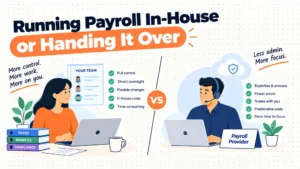
Setup efficiency is another area where Paychex Flex distinguishes itself. Compared to ADP Workforce Now, Paychex Flex offers a significantly simpler initial setup process. Implementation timelines are streamlined, reducing the administrative burden on internal HR and payroll teams during platform onboarding. Mid-sized companies transitioning off basic systems often find Paychex Flex's onboarding framework less disruptive to business routines.
The service architecture of Paychex Flex is anchored by a named payroll specialist model. Rather than routing client inquiries through generic call centers or tiered ticketing queues, Paychex assigns a dedicated payroll contact to each client account. This service model provides administrators with a direct point of contact who understands their company's tax setup, organizational hierarchy, and historical processing nuances.
Beyond core payroll and retirement services, Paychex Flex includes modules for time and attendance tracking, benefits administration, onboarding, and basic HR compliance. While these tools may not offer the granular customizability of enterprise HCM systems, their unified design guarantees consistent user experiences across employee self-service portals and managerial dashboards.
ADP Workforce Now Architecture: Enterprise Features and Global Scalability
ADP Workforce Now is engineered to support complex workforce structures and multi-national operations. At its core, the platform processes payroll in over 140 countries, making it a primary choice for mid-market companies with international entities, remote global workers, or plans for cross-border expansion. This global capability enables organizations to centralize domestic and international payroll operations within a single vendor framework.
+——————————————————————-+
| ADP WORKFORCE NOW HCM SUITE |
+——————————————————————-+
| [Global Engine] —> Payroll Processing in 140+ Countries |
| [Core HR + Payroll] —> Base Platform ($23-$35 PEPM Tiers) |
| [Analytics Suite] —> Industry-Leading HR & Financial BI |
| [Managed Services] —> ADP Comprehensive Services ($30-$50) |
+——————————————————————-+
The platform's reporting and analytics engine is recognized as the strongest in its class. HR leaders can query vast data repositories to generate custom reports on labor cost distributions, overtime trends, turnover drivers, pay equity metrics, and benefit utilization. ADP Workforce Now allows financial analysts to build complex report formulas, schedule automated executive distribution lists, and benchmark internal workforce metrics against ADP's massive dataset representing over 1 million employers.
ADP Workforce Now uses a modular software architecture divided into functional product tiers:
- Base Platform ($23–$30 PEPM): Core payroll processing, basic employee recordkeeping, and standard compliance tools.
- Core HR plus Payroll ($25–$35 PEPM): Advanced workforce management, custom HR workflows, and enhanced reporting capabilities.
- Full Suite ($50–$100+ PEPM): Comprehensive talent acquisition, performance management, advanced compensation planning, and learning management system (LMS) modules.
- ADP Comprehensive Services ($30–$50 PEPM total): Co-managed or fully managed HR, payroll, and benefits services pairing platform software with dedicated ADP operational staff.
This modular structure allows organizations to scale software adoption as operational complexity increases. However, implementing ADP Workforce Now requires substantial investment. Platform setup costs typically range from 10% to 20% of first-year software costs, reflecting the extensive configuration, database mapping, and custom integration work required during deployment.
For organizations leveraging dedicated compensation intelligence platforms like Pave or Payscale, ADP Workforce Now provides robust API frameworks that enable seamless data synchronization between systems.
Mid-Market Payroll Pricing Mechanics: Uncovering Quote-Only Structures
Navigating software pricing for mid-market platforms requires evaluating custom quotes rather than fixed published list prices. While entry-level platforms display fixed monthly fees online, both Paychex Flex and ADP Workforce Now transition to quote-only models once a company exceeds lower headcount thresholds or requires mid-market feature sets.
Understanding entry-level baselines helps establish financial benchmarks. Paychex Flex Essentials starts at approximately $39 per month plus a $5 per-employee fee. ADP RUN, designed for smaller businesses (1–49 employees), begins at roughly $59 per month plus $4 per employee. However, when moving into mid-market evaluation territory (100 to 1,000 employees), pricing transitions entirely to custom per-employee-per-month (PEPM) structures.
+——————————————————————-+
| QUOTE-ONLY PRICING MECHANICS |
+——————————————————————-+
| Paychex Flex Essentials: $39/mo + $5 per employee (Entry point) |
| ADP RUN: $59/mo + $4 per employee (Small business entry point) |
| ADP Workforce Now Base: $23 – $30 PEPM |
| ADP Workforce Now (250-1k scale): $15 – $25 PEPM |
| ADP Implementation Fee: 10% – 20% of first-year software cost |
+——————————————————————-+
For ADP Workforce Now, software pricing varies based on total headcount and selected product modules:
- The base platform ranges between $23 and $30 PEPM for standard deployments.
- Scaling to headcounts between 250 and 1,000 employees drops base pricing to roughly $15 to $25 PEPM due to volume discounting.
- Upper mid-market organizations (1,000 to 5,000 employees) typically see base platform rates settle between $20 and $30 PEPM, depending on multi-year contract commitments and selected module bundles.
- Bundling Core HR with Payroll moves pricing to $25–$35 PEPM, while deploying the Full Suite pushes software costs to $50–$100+ PEPM.
- Companies opting for ADP Comprehensive Services pay a combined software and service rate of $30–$50 PEPM.
A critical, often overlooked cost component is ADP’s implementation charge, which adds 10% to 20% of first-year software fees as an upfront expense. This fee covers database migration, custom integration setup, workflow design, and administrative training.
By contrast, Paychex Flex enters mid-market contract discussions with a lower overall price baseline. However, exact mid-market pricing remains quote-only and depends on year-end tax processing add-ons, time-tracking integrations, and custom HR management tools. When reviewing payroll solutions on our best payroll software guide, finance leaders must account for both annual recurring software costs and one-time implementation expenses.
Total Cost Analysis at 100, 250, and 500 Headcounts
To evaluate the financial impact of selecting Paychex Flex versus ADP Workforce Now, finance teams must review detailed mathematical cost projections across realistic mid-market headcounts. Below are calculated cost scenarios for headcounts of 100, 250, and 500 employees based on published baseline rates and quote-only pricing frameworks.
+——————————————————————-+
| ANNUAL SOFTWARE COST COMPARISON |
+——————————————————————-+
| 100 Employees: |
| – Paychex Flex Essentials: $6,468/yr |
| – ADP WFN Core HR + Payroll: $30,000 – $42,000/yr |
|---|
| 250 Employees: |
| – Paychex Flex Essentials: $15,468/yr |
| – ADP WFN (Volume Rate): $45,000 – $75,000/yr |
| 500 Employees: |
| – Paychex Flex Essentials: $30,468/yr |
| – ADP WFN (Volume Rate): $90,000 – $150,000/yr |
+——————————————————————-+
Scenario A: 100 Employees
Paychex Flex (Essentials Baseline Calculation):
- Base platform fee: $39 per month = $468 annually.
- Employee per-capita fee: 100 employees × $5 per month = $500 per month ($6,000 annually).
- Total Paychex Flex Essentials Annual Software Cost: $468 + $6,000 = $6,468 per year ($539 per month).
ADP Workforce Now (Core HR + Payroll Calculation):
- Low-end rate: 100 employees × $25 PEPM = $2,500 per month ($30,000 annually).
- High-end rate: 100 employees × $35 PEPM = $3,500 per month ($42,000 annually).
- Upfront implementation fee (10% to 20% of first-year software cost):
- At 10% on low-end software cost: $30,000 × 0.10 = $3,000.
- At 20% on high-end software cost: $42,000 × 0.20 = $8,400.
- Total First-Year ADP Expense (Software + Implementation): $33,000 to $50,400.
Scenario B: 250 Employees
Paychex Flex (Essentials Baseline Calculation):
- Base platform fee: $39 per month = $468 annually.
- Employee per-capita fee: 250 employees × $5 per month = $1,250 per month ($15,000 annually).
- Total Paychex Flex Essentials Annual Software Cost: $468 + $15,000 = $15,468 per year ($1,289 per month).
ADP Workforce Now (Mid-Market Volume Rate: $15–$25 PEPM):
- Low-end volume rate: 250 employees × $15 PEPM = $3,750 per month ($45,000 annually).
- High-end volume rate: 250 employees × $25 PEPM = $6,250 per month ($75,000 annually).
- Upfront implementation fee (10% to 20%):
- At 10% on low-end software cost: $45,000 × 0.10 = $4,500.
- At 20% on high-end software cost: $75,000 × 0.20 = $15,000.
- Total First-Year ADP Expense (Software + Implementation): $49,500 to $90,000.
Scenario C: 500 Employees
Paychex Flex (Essentials Baseline Calculation):
- Base platform fee: $39 per month = $468 annually.
- Employee per-capita fee: 500 employees × $5 per month = $2,500 per month ($30,000 annually).
- Total Paychex Flex Essentials Annual Software Cost: $468 + $30,000 = $30,468 per year ($2,539 per month).
ADP Workforce Now (Mid-Market Volume Rate: $15–$25 PEPM):
- Low-end volume rate: 500 employees × $15 PEPM = $7,500 per month ($90,000 annually).
- High-end volume rate: 500 employees × $25 PEPM = $12,500 per month ($150,000 annually).
- Upfront implementation fee (10% to 20%):
- At 10% on low-end software cost: $90,000 × 0.10 = $9,000.
- At 20% on high-end software cost: $150,000 × 0.20 = $30,000.
- Total First-Year ADP Expense (Software + Implementation): $99,000 to $180,000.
| Headcount | Paychex Flex Essentials (Annual Software) | ADP Workforce Now (Annual Software Range) | ADP Upfront Implementation Fee (10%–20%) | ADP First-Year Total Cost Range |
|---|---|---|---|---|
| 100 Employees | $6,468 | $30,000 – $42,000 | $3,000 – $8,400 | $33,000 – $50,400 |
| 250 Employees | $15,468 | $45,000 – $75,000 | $4,500 – $15,000 | $49,500 – $90,000 |
| 500 Employees | $30,468 | $90,000 – $150,000 | $9,000 – $30,000 | $99,000 – $180,000 |
Note: Paychex Flex calculations represent the Essentials baseline package ($39/mo + $5/ee). Custom mid-market quotes for Paychex Flex will increase based on added modules, but typically maintain a lower entry price than ADP Workforce Now.
Where Paychex Flex Dominates: Implementation Speed and Dedicated Specialists
Paychex Flex excels in delivery speed, service consistency, and core payroll efficiency for domestic operations. For mid-sized organizations with lean HR teams, implementation velocity can make or break a payroll platform migration. Paychex Flex offers a significantly simpler setup process than ADP Workforce Now, allowing businesses to transition off legacy systems without multi-month implementation delays.
+——————————————————————-+
| PAYCHEX FLEX ADVANTAGE AREAS |
+——————————————————————-+
| 1. Implementation Speed: Rapid onboarding vs multi-month setup |
| 2. Account Support: Dedicated named payroll specialist model |
| 3. Processing Speed: Execution in as few as 2 clicks |
| 4. Retirement Operations: Native 401(k) auto-sync integration |
+——————————————————————-+
Operational simplicity is embedded in the platform's execution engine. Paychex Flex enables administrators to run payroll in as few as two clicks once time cards and earnings adjustments are finalized. This straightforward approach reduces administrative time spent on routine pay runs, preventing operational bottlenecks during short payroll windows.
The centerpiece of Paychex’s client retention strategy is its account management structure. Paychex Flex provides clients with access to a named payroll specialist. Rather than submitting generic tickets or waiting on phone queues, clients communicate directly with an assigned professional who understands their payroll history, organizational structure, and tax setup. This service model stands in contrast to standard tier-one software support queues.
Retirement plan management is another operational strength. Paychex Flex features built-in 401(k) integration that connects payroll processing directly with retirement asset accounts. This Native integration automates employee deferral adjustments, employer match calculations, and end-of-year regulatory reporting. Finance teams avoid manual file conversions or third-party transmission errors, ensuring consistent retirement compliance management.
Additionally, following Paychex’s $4.1 billion acquisition of Paycor in April 2025, the combined entity serving over 790,000 clients is positioning itself as a dominant force in mid-market software. This expanded operational footprint brings enhanced product investment while preserving the fast setup and dedicated specialist support model that mid-sized HR teams rely on.
Where ADP Workforce Now Dominates: Global Payroll and Advanced Analytics
While Paychex Flex wins on setup simplicity and domestic administrative efficiency, ADP Workforce Now leads in analytics depth, international expansion capacity, and complex organizational management. For growing businesses with multi-state operations or international workforces, ADP Workforce Now provides enterprise-level tools built for complex scale.
+——————————————————————-+
| ADP WORKFORCE NOW ADVANTAGE AREAS |
+——————————————————————-+
| 1. International Scale: Payroll processing in 140+ countries |
| 2. Analytics Engine: Industry-leading BI and workforce metrics |
| 3. Scale & Stability: Proven infrastructure for 1M+ employers |
| 4. Managed Services: ADP Comprehensive Services ($30-$50 PEPM) |
+——————————————————————-+
International capabilities are a key differentiator. ADP Workforce Now processes payroll across over 140 countries, enabling mid-market companies to manage global teams within a single software ecosystem. Rather than patching together local payroll providers in each international jurisdiction, HR teams can centralize international tax compliance, currency conversions, and employee records inside ADP’s infrastructure.
Analytics and reporting capabilities are equally advanced. ADP Workforce Now features the strongest reporting engine in its class, allowing HR and finance executives to build granular dashboards and custom data views. Users can analyze labor overhead, track turn-over dynamics, model future compensation scenarios, and benchmark workforce metrics against anonymized data from more than 1 million employers using ADP systems.
+——————————————————————-+
| ADP ANALYTICS & REPORTING CAPABILITIES |
+——————————————————————-+
| [Custom Query Engine] —> Multi-Variable Financial Modeling |
| [ADP Data Cloud] —> Benchmarking Across 1M+ Employers |
| [Executive BI] —> Automated Scheduled C-Suite Dashboards |
+——————————————————————-+
ADP Workforce Now also scales effectively for organizations seeking outsourced administrative management. Through ADP Comprehensive Services, companies can combine software access with managed HR, payroll, and benefits support for a total cost of $30 to $50 PEPM. This model appeals to mid-sized businesses that want to outsource administrative payroll tasks while retaining executive oversight.
For companies that utilize dedicated compensation benchmarking platforms like Pave or Payscale, ADP Workforce Now offers pre-built API connectors that ensure consistent syncs across job architectures, pay bands, and employee records.
Where Both Platforms Struggle: Common Mid-Market Friction Points
Despite their market leadership, both Paychex Flex and ADP Workforce Now present operational friction points that mid-market HR and finance teams must navigate. Understanding these limitations prevents unexpected software bottlenecks after contract sign-off.
+——————————————————————-+
| PLATFORM LIMITATIONS MATRIX |
+——————————————————————-+
| PAYCHEX FLEX FRICTION: |
| – Less flexible analytics for complex, multi-entity modeling |
| – Global expansion requires third-party integrations |
| – Higher tier costs for advanced talent management tools |
|---|
| ADP WORKFORCE NOW FRICTION: |
| – Significant setup fees (10-20% of first-year software cost) |
| – Opaque quote-only pricing tiers ($23-$30 base PEPM) |
| – Multi-month implementation complexity |
+——————————————————————-+
Paychex Flex struggles when organizations require ultra-complex, multi-entity financial modeling or deep global expansion. While its 2-click payroll engine and direct 401(k) integration excel in domestic environments, business structures with complex international subsidiaries may outgrow its primary domestic framework. Additionally, while custom reporting in Paychex Flex handles standard HR requirements, it lacks the multi-variable data visualization and deep workforce benchmarking analytics found in ADP Workforce Now.
ADP Workforce Now struggles with pricing transparency, administrative complexity, and upfront implementation burdens. Operating on a strict quote-only structure, base platform rates run between $23 and $30 PEPM, with full software suites reaching $50 to $100+ PEPM. Combined with mandatory implementation fees ranging from 10% to 20% of first-year software costs, ADP Workforce Now demands substantial capital commitment before processing its first payroll run.
| Feature / Capability Area | Paychex Flex | ADP Workforce Now | Operational Impact |
|---|---|---|---|
| Global Processing | Domestic core focus | 140+ countries | ADP handles cross-border scale without add-ons |
| Analytics & Reporting | Core HR reports | Class-leading analytics | ADP provides deeper business intelligence |
| Implementation Scope | Streamlined setup | 10%–20% fee; complex deployment | Paychex reduces initial time-to-value |
| Support Architecture | Named payroll specialist | Standard queues or Comprehensive | Paychex offers direct named contact |
| Base Pricing Entry | Essentials ~$39/mo + $5/ee | RUN ~$59/mo + $4/ee; WFN Quote-Only | Paychex enters at lower baseline costs |
Furthermore, ADP’s support framework can feel transactional unless organizations upgrade to ADP Comprehensive Services ($30–$50 PEPM total). Mid-sized HR teams without dedicated system administrators may find configuring custom workflows in ADP Workforce Now overly complex compared to Paychex Flex’s accessible user interface.
System Migration and Implementation Strategy
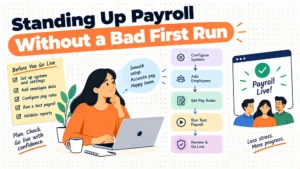
Migrating to a new mid-market payroll engine requires deliberate planning to prevent operational disruptions, tax miscalculations, or delayed employee compensation. Whether implementing Paychex Flex or ADP Workforce Now, HR and finance leaders must manage data migration, system parallel runs, and administrative integration carefully.
+——————————————————————-+
| IMPLEMENTATION TIMELINE STAGES |
+——————————————————————-+
| STAGE 1: Data Audit & Extraction (Years-to-date pay records) |
| STAGE 2: System Configuration & Tax Mapping |
| STAGE 3: Benefit & 401(k) API Connector Configuration |
| STAGE 4: Parallel Payroll Run (Verification phase) |
| STAGE 5: Go-Live & Specialist Handoff |
+——————————————————————-+
First, timing the transition around calendar quarter ends—or the start of a new tax year—minimizes the burden of converting Year-to-Date (YTD) wage and tax balance data. Transitioning mid-quarter requires manual entry of individual pay stubs, quarterly tax filings, and subject wage totals, increasing the risk of tax balancing errors.
Second, account for setup costs and project timelines early in the budgeting process. When choosing ADP Workforce Now, finance leaders must allocate an extra 10% to 20% of first-year software costs for implementation services. This budget allocation covers database configuration, custom security profile mapping, and core workflow design. For Paychex Flex, while implementation costs are typically lower and setup is simpler, internal teams must still commit resources to audit legacy employee records, setup benefit plans, and verify 401(k) deduction schedules.
Key implementation milestones must include:
- Data Validation: Audit employee personal details, active tax withholdings, direct deposit routing, and cumulative YTD tax figures before importing data into the target platform.
- Integration Verification: Test automated benefit deduction feeds and 401(k) retirement system links to verify accurate deferral transmissions.
- Parallel Payroll Processing: Run at least one parallel payroll on both the legacy software and the new engine (Paychex Flex or ADP Workforce Now) to verify net pay calculations, tax withholding formulas, and general ledger journal entries.
- Administrative Training: Ensure HR managers understand platform navigation, custom reporting, and support escalation protocols—such as engaging your assigned named payroll specialist in Paychex Flex or utilizing account resources in ADP.
Organizations evaluating software choices should review our analysis of best payroll software options to ensure selected tools integrate smoothly into existing HR technology ecosystems.
Executive Contract Negotiation Blueprint
Because mid-market payroll platforms rely heavily on quote-only pricing models, finance and HR executives hold significant leverage during contract negotiations. Vendor sales representatives operate with discretionary discounting authority, especially when competing against opposing mid-market vendors or modern software alternatives.
+——————————————————————-+
| CONTRACT NEGOTIATION STRATEGIES |
+——————————————————————-+
| 1. Implementation Fee Waivers: Target the 10-20% upfront cost |
| 2. Year-End Processing Capping: Bound form W-2 / 1099 fees |
| 3. Multi-Year Rate Locks: Cap annual price adjustments at < 3-5% |
| 4. Module Unbundling: Strip inactive HCM modules from base PEPM |
+——————————————————————-+
When negotiating with ADP Workforce Now, the first priority should be waiving or discounting the implementation fee. Since ADP’s standard implementation fee runs between 10% and 20% of first-year software fees, requesting a 50% to 100% credit on implementation costs can immediately save thousands of dollars during initial deployment. Leverage competitive quotes from Paychex Flex—which offers a simpler, less expensive setup process—to incentivize ADP sales representatives to reduce upfront costs.
When negotiating with Paychex Flex, target year-end processing fees, quarterly tax filing add-ons, and per-employee base rates. While Paychex Flex Essentials starts around $39 per month plus $5 per employee, mid-market custom packages scale rapidly when adding advanced time tracking, HR compliance tools, and performance management modules. Insist on bundled module discounts and benchmark pricing against entry-level alternatives like Gusto or Patriot to secure favorable mid-market PEPM rates.
Key contract terms to secure in writing include:
- Multi-Year Rate Locks: Cap annual software price increases at 3% to 5% per year over a 36-month period to protect against sudden post-year-one price hikes.
- Waived Ancillary Charges: Eliminate routine per-item fees for direct deposits, standard tax filings, and digital W-2 delivery.
- Service Level Agreements (SLAs): Ensure dedicated support access terms—such as maintaining an assigned named payroll specialist in Paychex Flex—are explicitly written into the master service agreement.
- Module Unbundling Rights: Retain contractual rights to remove unused software modules (e.g., advanced learning management or onboarding tools) without invalidating base platform discounts.
Final Verdict: Who Should Pick Paychex Flex vs ADP Workforce Now?
Selecting between Paychex Flex and ADP Workforce Now comes down to matching vendor strengths with organizational priorities, international expansion plans, and internal HR resources.
+——————————————————————-+
| FINAL DECISION MATRIX |
+——————————————————————-+
| SELECT PAYCHEX FLEX IF: |
| – You operate primarily within the US. |
| – You prioritize fast 2-click payroll execution. |
| – You want direct access to a named payroll specialist. |
| – You need simple setup and integrated 401(k) options. |
|---|
| SELECT ADP WORKFORCE NOW IF: |
| – You process payroll across international borders (140+ countries). |
| – You require class-leading workforce analytics and BI. |
| – You manage complex, multi-entity organizational hierarchies. |
| – You want fully managed HR options via Comprehensive Services. |
+——————————————————————-+
Choose Paychex Flex If:
- Your Operations are Primarily Domestic: You run a US-focused organization between 100 and 500 employees that values administrative ease over international global software reach.
- You Value Speed and Simplicity: You want an intuitive payroll engine capable of finalizing pay runs in as few as two clicks, backed by simpler setup workflows than ADP.
- You Demand Direct, Named Support: You prefer working with a dedicated named payroll specialist who understands your account history rather than navigating tiered support queues.
- You Seek Low Upfront Expenses: You want to avoid ADP’s 10% to 20% implementation fees while keeping baseline costs manageable ($39/mo + $5/ee entry points).
Choose ADP Workforce Now If:
- You Manage International Workforces: You require native payroll processing across over 140 countries to support cross-border expansion and global teams.
- You Require Advanced Business Intelligence: Your executive team relies on class-leading analytics to query complex workforce data and benchmark metrics against 1 million+ employers.
- You Plan Heavy HCM Scaling: You need a modular software platform that scales from base HR ($23–$30 PEPM) to full talent, compensation, and LMS suites ($50–$100+ PEPM).
- You Want Co-Managed Administrative Options: You prefer combining core software with outsourcing via ADP Comprehensive Services ($30–$50 PEPM total).
For additional comparison frameworks and software analysis across modern HR platforms, explore our complete benchmark guide to the best payroll software products on the market today.
Related reading
Frequently asked questions
How does Paychex Flex pricing compare to ADP Workforce Now?
Paychex Flex Essentials starts at about $39/month plus $5 per employee for entry tiers, offering a lower entry price and simpler setup than ADP. ADP RUN begins around $59/month plus $4 per employee, while ADP Workforce Now uses quote-only pricing from $23–$30 PEPM for base software, up to $50–$100+ PEPM for full suites, plus a 10%–20% upfront implementation fee.
What is the service support model difference between Paychex Flex and ADP Workforce Now?
Paychex Flex assigns a named payroll specialist to client accounts, providing a dedicated direct contact for payroll and tax questions. ADP Workforce Now utilizes a standard support queue model unless organizations upgrade to ADP Comprehensive Services ($30–$50 PEPM total), which provides co-managed administrative support.
Can both Paychex Flex and ADP Workforce Now handle international payroll?
ADP Workforce Now processes payroll natively across more than 140 countries, making it ideal for multinational businesses. Paychex Flex is primarily designed for US-based domestic payroll operations and relies on third-party integrations or add-on partners for international workforce processing.
What are the standard implementation costs for ADP Workforce Now?
ADP Workforce Now implementation fees typically range from 10% to 20% of first-year software costs. For example, a 250-employee company paying $45,000 annually for software will incur an upfront implementation fee between $4,500 and $9,000 for system configuration and setup.
How quickly can payroll be run on Paychex Flex?
Paychex Flex allows administrators to finalize payroll in as few as two clicks once time tracking and earnings adjustments are approved. Its intuitive interface prioritizes execution speed, minimizing manual administrative tasks during recurring pay cycles compared to more complex enterprise platforms.
How did Paychex’s acquisition of Paycor affect its mid-market position?
Paychex completed a $4.1 billion acquisition of Paycor in April 2025, creating a combined entity serving over 790,000 clients. This expanded scale enhanced Paychex’s mid-market capabilities and competitive reach against ADP's network of over 1 million employers.