

If you're running a 10-30 person creative agency with a mix of full-time staff and freelance contractors, the justworks vs gusto decision comes down to one trade-off: Justworks charges more but bundles a PEO with health benefits and compliance coverage, while Gusto costs less and gives you more control but leaves benefits administration mostly on your plate. Agencies with heavy contractor rosters and no dedicated HR person tend to lean Justworks; agencies with a lean, salaried team and an owner who wants to keep costs tight tend to lean Gusto. Neither is a bad pick, but the wrong one will either overpay for PEO overhead you don't need or leave you exposed on compliance you didn't know you had. If you want a side-by-side against the rest of the market before committing, the best payroll software comparison is worth a read first.
TL;DR
- Pick Justworks if you have no in-house HR person and want a PEO to absorb compliance risk and bundle benefits; pick Gusto if you already manage HR internally and want lower costs.
- Choose Gusto for a 15-person agency if you’re optimizing for per-seat price, since it runs roughly $250-$300/month versus Justworks’ $590-$1,090/month for 10 W-2 employees before benefits.
- Go with Justworks if your team is currently paying small-group health rates through a broker, since its PEO pooling can offset much of that per-employee price gap.
- Select Justworks if your creative team spans three or more states, since its PEO structure absorbs state tax ID registration and unemployment insurance filings that Gusto leaves to you.
- Start with Gusto’s contractor-only plan (around $35/month base) if freelancers outnumber W-2 staff 3:1 or more, since Justworks has no comparable stripped-down contractor tier.
- Choose Gusto’s Simple plan for a bootstrapped startup agency under 5 people with no benefits yet, then revisit Justworks once you hit 10-15 employees and want to add health coverage.
- Before committing to either, map your exact W-2-to-1099 headcount split and get real per-seat quotes rather than relying on marketing-page price ranges.
Quick comparison table
| Vendor | Best for | Starting price (approx.) | PEO option | Contractor payments | Benefits admin |
|---|---|---|---|---|---|
| Justworks | Agencies wanting HR outsourced | $59-$109/employee/month | Yes, built-in | Included | Full-service, PEO-based |
| Gusto | Lean agencies managing HR in-house | $6-$12/mo base + $6-$16/employee | No (Gusto is not a PEO) | Included, no extra fee on most plans | Self-managed via broker integration |
| Rippling | Agencies scaling into tech stack complexity | $8/employee/month + modules | Yes, optional PEO | Included | Available, modular |
| ADP RUN | Agencies wanting brand-name payroll | $79 base + $4-$8/employee | No (separate ADP TotalSource) | Extra module | Add-on, broker-dependent |
| Deel | Agencies with global/remote contractors | $49/contractor/month | No | Core product strength | Limited outside EOR |
| BambooHR | Agencies needing HRIS depth, less payroll focus | $6-$8/employee/month (payroll add-on separate) | No | Not native | Add-on |
Justworks vs Gusto: Which payroll platform fits small creative agencies?
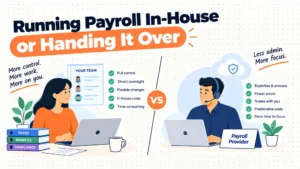
For a small creative agency, Justworks fits better if you have no in-house HR person and want a PEO to absorb compliance risk; Gusto fits better if you already handle HR internally and want lower costs with more direct control over benefits and policy.
Creative agencies have a specific profile that makes this comparison different from a generic small-business payroll decision. You're usually running a mix of full-time designers, copywriters, or account managers alongside a rotating bench of freelance contractors and 1099s for overflow projects. You may operate in one state or scatter employees across three or four as remote work becomes standard. And you almost certainly don't have a full-time HR director — the office manager, a founder, or an ops lead is handling payroll as one of six other jobs.
Best tools for Payroll Software
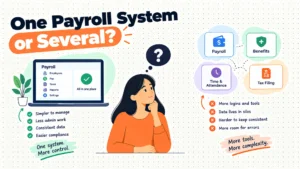
Justworks was built around exactly this pain point. As a PEO (professional employer organization), it co-employs your staff, which means it takes on a chunk of the compliance and benefits administration that would otherwise sit with you. For an agency owner who doesn't want to think about ACA reporting, workers' comp audits, or state-by-state unemployment insurance filings, that's real value. Justworks also handles multi-state payroll cleanly, which matters if your account manager works from Austin while your art director works from Portland.
Gusto takes a different approach. It's payroll and HR software, not a PEO, so you stay the legal employer of record and retain more control over plan design, but you also retain more responsibility. For an agency with a lean team, a straightforward benefits setup, and someone comfortable reading a state notice now and then, Gusto's lower price point and simpler interface often win out.
Where the contractor mix matters most
Both platforms pay 1099 contractors without extra per-contractor fees on most plans, which is good news since agencies routinely pay freelance illustrators, video editors, and specialist copywriters. The difference shows up in reporting: Gusto's contractor-only plan (no W-2 employees) starts around $35/month base plus a small per-contractor fee, and it's a genuinely cheap way to run a freelancer-only shop. Justworks doesn't offer a stripped-down contractor-only tier at a comparable price, since its value proposition is built around the PEO bundle for W-2 staff.
What to do:
- Map your current headcount split between W-2 employees and 1099 contractors before pricing either platform.
- If contractors outnumber employees 3:1 or more, price Gusto's contractor-only plan against Justworks' per-employee minimums.
- Ask each vendor for a multi-state cost breakdown if your team spans more than two states.
Which platform is cheaper for a 15-person agency?
Gusto is almost always cheaper on a per-seat basis for a 15-person agency; Justworks costs more per employee but that premium buys PEO-level benefits and compliance coverage that Gusto doesn't include.
Run the numbers on a hypothetical 15-person agency — say, 10 full-time employees and 5 regular freelance contractors. On Gusto's Plus plan, you're looking at roughly $12/month base plus $12/employee/month for the 10 W-2 staff, plus contractor payments included at no extra per-head charge on most tiers. That lands somewhere around $250-$300/month depending on add-ons like time tracking or PTO policies.
On Justworks, pricing is quoted per active employee per month and typically ranges from $59 to $109 depending on the tier and whether you select the Basic or Plus plan, plus benefits costs which are often bundled into the invoice. For 10 W-2 employees, that's roughly $590-$1,090/month before benefits premiums, though those premiums would otherwise be a separate line item under Gusto too, so the comparison isn't purely apples-to-apples.
Where the "cheaper" answer gets complicated
The catch is that Justworks' higher per-employee fee often includes access to a large-group health insurance pool, meaning your 10-person agency could get benefits pricing closer to what a 500-person company pays. If your agency is currently buying health insurance through a broker at small-group rates, that PEO access can offset a meaningful chunk of the price gap. A 200-person retailer wouldn't need this — they have enough scale to negotiate their own group rates — but a 15-person creative shop usually doesn't have that use.
Gusto does offer benefits administration through broker integrations and, in some states, its own licensed insurance offerings, but it's not pooling your agency with other small businesses to get large-group rates the way a PEO does. So the "cheaper" platform on the invoice isn't always cheaper once you factor in what your team is currently paying for health coverage.
Checklist:
- Get a real quote for both platforms' payroll fees on your actual headcount, not the marketing page range.
- Ask your current benefits broker what your group's small-group rate looks like, then compare it to Justworks' PEO-pooled rate.
- Factor in the cost of the person currently doing HR/compliance work manually — that's a real, if invisible, line item.
Does Justworks include health insurance, and does Gusto?
Justworks includes access to PEO-sponsored health insurance plans as part of its core offering; Gusto offers benefits administration and, in some states, its own insurance brokerage, but it is not a PEO and doesn't pool your company into a larger risk group.
This distinction trips up a lot of first-time buyers because both platforms show "benefits" prominently on their pricing pages, and the word means something different depending on which one you're looking at.
With Justworks, health insurance is baked into the PEO model. Your employees get access to plans from major carriers — often Aetna or UnitedHealthcare depending on region — at rates negotiated across Justworks' entire client base, not just your 15-person agency. That's the "large-group pooling" advantage mentioned earlier. Justworks also handles COBRA administration, FSA/HSA setup, and commuter benefits as part of the same bundle, which reduces the number of separate vendors your ops lead has to manage.
With Gusto, you can administer benefits through the platform, but the underlying insurance is typically purchased through a broker relationship or, in states where Gusto is a licensed agency, directly through Gusto's own brokerage arm. The rates you get depend on your company's own risk pool and group size — Gusto doesn't absorb you into a larger pool the way a PEO does. For a 15-person agency, that usually means small-group-market pricing, which tends to run higher per employee than what a PEO can offer.
The trade-off for creative agencies specifically
Creative agencies often skew younger and healthier as a workforce, which can actually work against them in small-group pricing — insurers price small groups on the group's own claims history and demographics, and a young, healthy team sometimes gets decent small-group rates anyway. So the PEO pooling advantage isn't automatic; it depends on your specific team's risk profile and your state's insurance market.
What to do:
- Request quotes from both Justworks' PEO plans and your current broker for identical coverage tiers (bronze/silver/gold equivalents).
- Ask whether your state allows Gusto's own brokerage services, since availability varies.
- Compare total employee-facing premium costs, not just the employer contribution line, since take-home impact affects retention.
Justworks vs Gusto for multi-state remote creative teams
Justworks generally handles multi-state compliance more comprehensively because it's a PEO with dedicated compliance staff tracking state-by-state requirements; Gusto also supports multi-state payroll but puts more of the ongoing monitoring burden on you.
Remote creative teams are common now — an agency based in Chicago might have a designer in Denver, a copywriter in Raleigh, and a project manager in Brooklyn. Each of those states has its own withholding rules, unemployment insurance rates, paid leave mandates, and in some cases, local tax jurisdictions.
Justworks registers as the employer of record in the co-employment relationship, which means it's the entity responsible for many of these state-level filings. When a new state law passes — say, a paid sick leave mandate in a state where you just hired your first employee — Justworks' compliance team is generally on it, and it flows through to your account without you needing to research it yourself.
Gusto supports multi-state payroll natively too, and it will calculate the right withholdings and file the right forms once you've registered your company in that state. The difference is registration: with Gusto, you as the employer typically need to register for state tax IDs and unemployment insurance accounts in each new state yourself (Gusto can guide you through it, and in some cases assist directly, but the legal registration burden sits with your company). With Justworks' PEO structure, a lot of that registration friction is absorbed into the co-employment relationship.
A worked scenario
Picture a 12-person branding agency headquartered in Texas that just hired a senior motion designer in California. California has some of the more complex state employment requirements in the country — specific meal and rest break rules, paid sick leave, and various notice requirements. On Gusto, the agency's ops lead would need to register the business with California's EDD, understand the state-specific new-hire paperwork, and stay current on California-specific labor law updates. On Justworks, much of that registration and ongoing monitoring is handled as part of the PEO relationship, though the agency still needs to follow California-specific workplace policies day to day.
Checklist:
- Count how many states your current and near-term hires span.
- If you're adding a new state this year, ask both vendors exactly what registration steps fall on you versus them.
- Weigh the cost of outside employment counsel against the PEO premium if you're expanding into 3+ states quickly.
How does Gusto's pricing compare to Justworks for a startup agency?
Gusto's tiered pricing (Simple, Plus, Premium) starts lower and scales with features you actually use; Justworks' per-employee pricing (Basic and Plus) starts higher but includes PEO services from day one, so the comparison depends on how many features a young agency actually needs.
A startup creative agency — three founders, a handful of early hires, no HR headcount — usually cares about two things: keeping monthly software costs predictable, and not getting blindsided by a compliance issue they didn't know existed. Gusto's Simple plan, priced around $6/month base plus roughly $6/employee/month, covers core payroll, basic reporting, and employee self-service. It's inexpensive enough that a bootstrapped agency won't blink at the bill.
Justworks' Basic plan starts around $59/employee/month and its Plus plan (which adds full benefits access) runs closer to $109/employee/month. For a 5-person startup agency, that's a meaningful gap — Gusto might run $60-$100/month total, while Justworks could run $300-$550/month for the same headcount on the Plus tier.
When the math flips
The gap narrows, or even flips, once benefits enter the picture. If your startup agency wants to offer health insurance to attract talent away from bigger shops — a real competitive pressure in creative hiring — sourcing a small-group plan independently and administering it yourself takes time your three founders don't have. Justworks' bundled approach means benefits, payroll, and compliance ride on one platform and one bill, which has real value when nobody on the founding team has bandwidth to manage three vendor relationships.
What to do:
- If you're not offering benefits yet, start with Gusto's lower-tier plan and revisit at 10-15 employees.
- If competitive hiring requires benefits now, price Justworks' Plus plan against a broker-sourced small-group plan plus Gusto Plus.
- Reassess every funding round or headcount doubling — pricing tiers on both platforms shift meaningfully at scale.
Justworks vs Gusto: Which is easier for a non-HR person to run?
Gusto is generally easier for a non-specialist to run day-to-day because its interface is built around simplicity and self-service; Justworks has a comparably clean interface but involves more onboarding steps due to the PEO co-employment setup.
Most small creative agencies don't have an HR person — the person running payroll is often an account director, a studio manager, or one of the founders, doing it between client calls. Ease of use isn't a nice-to-have here; it's the difference between payroll running smoothly and payroll becoming a monthly fire drill.
Gusto's interface has consistently been praised for its clean, guided workflows. Running payroll takes a few clicks once it's set up, employees can self-serve their pay stubs and tax documents, and the onboarding flow for new hires walks a non-specialist through I-9s, W-4s, and direct deposit setup without much hand-holding needed. Gusto also has an "AutoPilot" feature that runs payroll automatically on a set schedule, which matters for a busy ops lead who might otherwise forget a manual run.
Justworks' interface is also well-regarded, but the initial setup is heavier because you're not just standing up payroll — you're entering a co-employment relationship, which involves additional paperwork, master service agreements, and sometimes a longer onboarding timeline with a dedicated Justworks rep. Once running, day-to-day payroll tasks are comparably simple, and Justworks' customer support (often cited as a strength, with live phone and chat support) can offset the complexity for a non-HR operator who'd rather call someone than dig through help docs.
The support factor
This is where the "who's running this" question really matters. If your ops lead is comfortable self-troubleshooting through documentation, Gusto's lighter-weight model works fine. If they'd rather have a human answer questions about a confusing state tax notice, Justworks' PEO support model — where you often get a named contact — can be worth the premium.
Checklist:
- Have your non-HR admin do a live demo of both platforms before deciding — interface comfort is personal.
- Ask each vendor about average support response times and whether phone support is included at your tier.
- Factor in your admin's current bandwidth: heavier onboarding now (Justworks) vs. simpler ongoing management (Gusto).
What happens if a creative agency scales past 25 employees?
Both platforms scale past 25 employees without a hard cutoff, but the cost and complexity trade-offs shift: Justworks' PEO model starts paying for itself with more compliance surface area, while Gusto may require add-ons or a move to its Premium tier to keep pace.
Growth changes the calculus for both platforms. At 25+ employees, an agency typically starts dealing with more states, more nuanced benefits needs (dependents, life events, open enrollment cycles), and potentially its first HR hire.
On the Gusto side, agencies at this size often move to the Premium tier, which adds dedicated support, compliance alerts, and HR resource access — priced higher than Plus but still generally below Justworks' per-employee rates. Gusto Premium also adds features like certified HR pros you can consult, which partially closes the gap with Justworks' built-in compliance support, though it's still advisory rather than the co-employment model Justworks offers.
On the Justworks side, the per-employee cost stays roughly proportional, but the value proposition strengthens: more employees mean more state filings, more benefits enrollments, and more compliance touchpoints, all of which Justworks is already handling. Agencies that hit 30-40 employees and are opening a second office in a new state often find the PEO model earns back more of its premium at this stage than it did at 10 employees.
The HR hire inflection point
A useful marker: once an agency hires its first dedicated HR or People Ops person, the calculus can flip again. That person can now handle a lot of what Justworks' PEO was doing, which sometimes makes a switch to Gusto (or another HRIS) financially sensible — you're paying a person instead of paying a PEO premium for the same coverage. This is a real conversation worth having around the 30-40 employee mark.
What to do:
- Reassess your platform choice at every major headcount milestone (10, 25, 40 employees), not just at initial signup.
- If you're about to hire your first HR/People Ops role, model out whether that hire changes the PEO math.
- Ask both vendors for references from agencies in your size range and industry.
Can Justworks or Gusto handle a creative agency's freelancer-heavy payroll?
Yes, both platforms pay 1099 contractors alongside W-2 employees, but Gusto's contractor-only plan is cheaper for freelancer-heavy shops, while Justworks bundles contractor payments into its standard employee-based pricing without a discounted freelancer-only tier.
Creative agencies lean on freelancers more than most small businesses — a video production project might bring on a freelance colorist for three weeks, or a branding sprint might need a freelance strategist for a single engagement. Managing that flow cleanly, with proper 1099 documentation and on-time payments, is a real operational need.
Gusto's contractor-only plan is priced specifically for businesses with no W-2 employees, running around $35/month base plus roughly $6/contractor/month. For an agency that's essentially a network of freelancers coordinated by one or two full-time principals, this is a lean, purpose-built option. Gusto also auto-generates and files 1099-NEC forms at year-end, which removes a genuinely annoying manual task.
Justworks pays contractors too, and it's included as part of the standard platform rather than a separate fee structure, but Justworks doesn't offer a discounted contractor-only tier the way Gusto does — its pricing model assumes you have W-2 employees as the base. If your agency is 90% freelancers and 10% W-2 staff, Justworks' per-employee pricing model isn't really built for your shape.
Where Deel enters the conversation
Worth a mention here: if your freelancer roster is international — say, a remote illustrator in Portugal or a video editor in the Philippines — neither Gusto nor Justworks is really built for cross-border contractor payments and compliance. That's a scenario where Deel, which specializes in global contractor payments and misclassification risk, becomes worth a look alongside or instead of either platform.
Checklist:
- Total up your freelancer spend and headcount separately from W-2 payroll before pricing any platform.
- If freelancers are the majority of your roster, price Gusto's contractor-only plan specifically, not its bundled tiers.
- If any contractors are international, get a quote from Deel as a comparison point.
What are the biggest complaints about Justworks and Gusto from agency users?
The most common complaint about Justworks is cost relative to smaller headcounts, while the most common complaint about Gusto is the lack of dedicated HR compliance support once things get complex.
No platform is free of trade-offs, and agency operators who've actually run payroll on these systems tend to flag consistent friction points.
For Justworks, the recurring theme is price sensitivity at small scale. A 6-8 person agency paying $60-$100 per employee per month can feel like it's paying PEO-level fees without a PEO-level compliance need yet. Some users also note that switching PEOs later (if you outgrow Justworks or want different benefits options) can involve more friction than switching standard payroll software, since you're unwinding a co-employment relationship, not just exporting a CSV.
For Gusto, the recurring complaint is the ceiling on support once things get genuinely complicated — a multi-state compliance question, a benefits eligibility edge case, or a worker misclassification concern. Gusto's help documentation and support are solid for standard payroll questions, but agencies report needing to bring in outside counsel or a fractional HR consultant when things go sideways, since Gusto isn't positioned to take on employer-of-record liability the way a PEO is.
A balanced read
Neither complaint is disqualifying — they're really just the flip side of each platform's core design. Justworks costs more because it's absorbing risk and administration; Gusto costs less because it isn't. The "complaint" in both cases is really just the trade-off showing up in a review.
What to do:
- Read recent user reviews on G2 or Capterra filtered specifically for company size similar to yours.
- Ask each vendor directly how they handle a specific edge case relevant to you (e.g., a contractor reclassification question).
- Talk to at least one other agency owner in your network who's used either platform for more than a year.
Justworks vs Gusto: Integration with creative agency tools
Justworks and Gusto both integrate with common accounting and time-tracking tools like QuickBooks and Xero, but Gusto's integration library is broader and includes more project-management and agency-specific tools, while Justworks focuses integrations more narrowly around accounting and time-tracking.
Creative agencies typically run on a specific stack: a project management tool (Asana, Monday, or an agency-specific tool like Function Point or Productive), a time-tracking tool tied to client billing (Harvest is common), and an accounting system (QuickBooks Online or Xero). How well payroll software plays with that stack affects daily friction.
Gusto has built out a fairly wide integration marketplace, including direct connections to QuickBooks, Xero, When I Work, Homebase, and several accounting/bookkeeping platforms agencies commonly use for client billing reconciliation. This matters because agency finance often needs payroll data to flow cleanly into project profitability reports — knowing what a designer's fully loaded cost is per billable hour depends on payroll data syncing properly with time tracking.
Justworks integrates with QuickBooks and Xero as well, and supports time-tracking sync, but its integration list is generally narrower than Gusto's. Justworks' PEO focus means its engineering priorities lean toward benefits, compliance, and HR workflows rather than deep integrations with a wide range of third-party project tools.
Why this matters for agency financials
Agencies live and die by utilization rates and project margins — knowing whether a $95/hour billed designer is actually profitable after loaded labor cost is core to agency financial health. If your payroll platform's data doesn't flow cleanly into the tools your finance lead uses to calculate that, someone ends up manually reconciling spreadsheets every month, which defeats the purpose of automation.
What to do:
- List your current tech stack (PM tool, time tracker, accounting software) before evaluating either platform.
- Test the actual integration, not just the marketing claim — ask for a sandbox demo if possible.
- If deep integration matters more than PEO benefits, weigh Rippling as a third option given its broader app marketplace.
Pricing breakdown
Pricing for both platforms is quoted per employee per month, with add-ons for benefits, time tracking, and HR support varying by tier. The numbers below are approximate as of 2026 and should be confirmed directly with each vendor, since promotional pricing and regional variation are common.
| Vendor | Base plan | Mid-tier | Top-tier / Add-ons |
|---|---|---|---|
| Justworks | Basic: ~$59/employee/mo | Plus: ~$109/employee/mo (full benefits access) | Custom pricing for 50+ employees |
| Gusto | Simple: ~$6/mo + $6/employee/mo | Plus: ~$12/mo + $12/employee/mo | Premium: custom pricing, adds HR pros & compliance alerts |
| Gusto (contractor-only) | ~$35/mo + ~$6/contractor/mo | N/A | N/A |
| Rippling | ~$8/employee/mo base | + modules (benefits, IT, PEO) priced separately | Custom, scales with modules selected |
| ADP RUN | ~$79 base + $4-$8/employee/mo | Higher tiers add HR support | TotalSource (PEO) priced separately |
| Deel | ~$49/contractor/mo | EOR services priced per employee, higher | Custom enterprise pricing |
For a 15-person agency (10 W-2, 5 contractors), expect roughly $250-$350/month on Gusto Plus versus $600-$1,100/month on Justworks depending on tier and benefits inclusion. Always request a live quote — published ranges shift and regional benefits costs vary significantly.
Related reading
Frequently asked questions
Is Justworks more expensive than Gusto?
Yes, on a per-employee basis Justworks typically costs more than Gusto because it's a PEO bundling payroll, compliance, and benefits access into one fee. Gusto charges less but requires you to source and administer benefits separately in most cases. The right choice depends on whether you value the bundled compliance coverage enough to pay the premium.
Can a creative agency switch from Gusto to Justworks later?
Yes, but switching to a PEO involves more setup than a typical software migration, since Justworks becomes a co-employer of your staff. Expect a data migration period, new onboarding paperwork for employees, and potential benefits plan transitions. Most agencies plan this switch around a natural milestone like open enrollment or a new fiscal year.
Does Gusto count as a PEO?
No, Gusto is payroll and HR software, not a PEO. Your company remains the sole legal employer of record, meaning you retain full responsibility for compliance filings and benefits sourcing. This is a key structural difference from Justworks, which co-employs your staff under its PEO model.
Which platform is better for a fully remote creative agency?
Justworks generally handles multi-state compliance with less manual work since it operates as a PEO with dedicated state-by-state filing support. Gusto also supports remote, multi-state teams but places more registration responsibility on your company. Agencies spread across many states often lean toward Justworks for this reason.
Do either Justworks or Gusto handle international contractors?
Neither platform is built primarily for international contractor payments or compliance. Both focus on U.S.-based W-2 employees and 1099 contractors. If your agency pays freelancers outside the U.S., a platform like Deel, which specializes in global contractor payments, is worth evaluating alongside either option.
What size agency benefits most from Justworks' PEO model?
Agencies around 15-40 employees with limited or no in-house HR staff tend to see the most value from Justworks' PEO bundling, since compliance complexity often outpaces internal bandwidth at that size. Below 10 employees, the per-seat cost can feel steep relative to actual compliance need. Above 40, an internal HR hire sometimes changes the math.
Is Gusto good enough for an agency planning to offer health benefits soon?
Gusto can administer benefits through broker integrations and, in some states, its own licensed brokerage, but it doesn't pool your company into a larger risk group the way a PEO does. If competitive benefits pricing is a priority, compare Gusto's broker-sourced rates against Justworks' PEO-pooled rates before deciding.
Final verdict
- Best for agencies under 10 employees with no benefits offering yet: Gusto — lower cost, simpler setup, and you're not paying PEO overhead you don't need yet.
- Best for agencies with heavy freelancer rosters and few W-2 staff: Gusto's contractor-only plan, or Deel if freelancers are international.
- Best for agencies 15-40 employees with no dedicated HR person: Justworks — the PEO bundle absorbs compliance and benefits administration that would otherwise fall on an already-stretched ops lead.
- Best for multi-state remote creative teams: Justworks, given its PEO-level handling of state registration and compliance monitoring.
- Best for agencies that just hired their first People Ops or HR person: Reassess — Gusto or another HRIS may now be cost-competitive since the internal hire can absorb work the PEO was doing.
- Best for agencies wanting deep tool integrations with PM/time-tracking software: Gusto, or Rippling if you want a broader app marketplace alongside PEO options.
Both Justworks and Gusto are solid, established platforms — the decision really is about matching the platform's structure (PEO vs. software) to your agency's headcount, state footprint, and internal HR bandwidth. If you're still weighing these two against the wider payroll market before signing anything, the full payroll software comparison breaks down how each stacks up against ADP, Rippling, Deel, and others so you can make the call with your CFO's questions already answered.