
Justworks payroll cost for a 20-person startup runs roughly $1,200–$2,200 per month in 2026, depending on whether you pick the Basic or Plus plan and how many employees opt into health benefits. That works out to $59–$109 per employee per month, all-in for payroll, compliance, and PEO-bundled HR support — not a per-check add-on fee like you'd see with a standalone payroll processor. For most startups this size, Justworks payroll pricing beats piecing together a payroll tool plus a broker plus a compliance consultant, but it can lose to Gusto or Rippling if you don't need PEO-level benefits access. If your team is fully remote across states with no interest in group health plans, keep reading before you sign — there's a cheaper path.
TL;DR
- Budget $1,200–$2,200/month for 20 employees on Justworks, depending on plan tier and benefits enrollment.
- Pick Justworks if you want PEO-sponsored health insurance, workers' comp, and HR compliance bundled into one line item.
- Pick Gusto if you're under 20 people, don't need a PEO relationship, and want the lowest predictable monthly cost.
- Pick Rippling if you're already buying IT/device management and want payroll on the same platform.
- Skip Justworks if your team is fully remote with no group health interest — you're paying PEO overhead for benefits you won't use.
- Watch for co-employment implications — Justworks becomes your employees' employer of record for tax and benefits purposes, which changes your liability profile.
- Run the math against a la carte tools before renewing; PEO pricing rarely drops as you scale past 50 employees.
Quick comparison table
| Vendor | Pricing model | Est. cost for 20 employees/month | PEO or HRIS | Health benefits access | Contract terms |
|---|---|---|---|---|---|
| Justworks | Flat per-employee fee, 2 tiers | $1,200–$2,200 | PEO (co-employment) | Yes, large-group rates | Month-to-month |
| Gusto | Per-employee + base fee | $520–$1,300 | HRIS (payroll only) | Broker-arranged, not PEO-pooled | Month-to-month |
| Rippling | Modular, per-employee add-ons | $700–$1,600 | HRIS with PEO option | Optional PEO module | Annual or monthly |
| ADP TotalSource | Custom quote, per-employee | $1,300–$2,400 | PEO (co-employment) | Yes, large-group rates | Typically annual |
| TriNet | Per-employee, tiered | $1,400–$2,300 | PEO (co-employment) | Yes, large-group rates | Annual, often |
| BambooHR | Per-employee, add-on payroll | $600–$1,100 | HRIS (payroll add-on) | Broker-arranged | Annual |
Prices are approximate for 2026 and will vary based on state mix, benefit enrollment, and negotiated rates. Always get a written quote before comparing line items.
How Much Does Justworks Payroll Cost for a 20-Person Startup?
For a 20-person startup, expect to pay approximately $59 to $109 per employee per month on Justworks, which lands between $1,180 and $2,180 monthly before any per-transaction extras. The spread comes from two plan tiers — Basic and Plus — with Plus adding access to Justworks' large-group health insurance pool and a broader set of HR perks.
Best tools for Payroll Software
Why the range is so wide
The lower end applies if you choose Basic, which covers payroll processing, tax filing, compliance support, and access to a smaller benefits marketplace. The higher end applies once you add Plus-tier benefits, especially if most of your 20 employees enroll in medical, dental, or vision coverage through Justworks' pooled plans. A startup with 20 employees where 15 opt into health coverage will pay meaningfully more than one where employees decline coverage or get it through a spouse's plan.
A worked example
Consider a 20-person Series A SaaS company in Texas and California. If they choose Justworks Plus and 16 employees enroll in health benefits, the monthly PEO fee alone could run $1,900–$2,100, not counting the premiums for whichever health plan tier employees select (Justworks pricing separates the administrative fee from actual premium costs, though the fee is the number most buyers underestimate). If that same company picks Basic and handles benefits through an outside broker, the monthly Justworks fee drops to roughly $1,200–$1,400, but they now need a separate broker relationship and likely a standalone workers' comp policy.
What drives the final number
Three variables matter most: plan tier, state mix (multi-state payroll adds compliance complexity that Justworks bakes into pricing indirectly through support tiers, not a hard surcharge), and benefits participation rate. Justworks doesn't charge more per state the way some competitors do, which is one reason startups with distributed teams often prefer it over doing state-by-state registration themselves.
What to do:
- Get a live quote with your actual headcount and state mix — published ranges are directional, not binding.
- Ask specifically whether the quote is Basic or Plus, and get the per-employee breakdown in writing.
- Model your cost with 0%, 50%, and 100% benefits enrollment to see the real spread before you commit.
What's Actually Included in the Justworks Monthly Fee?
The Justworks monthly fee bundles payroll processing, federal and state tax filing, HR compliance support, and access to PEO-sponsored benefits — it is not just a payroll processing charge. Understanding what's bundled versus what's separately billed is the single biggest factor in deciding whether the price is fair for your startup.
Core inclusions
Every Justworks plan includes payroll runs (unlimited pay cycles at no extra per-run fee, unlike some standalone processors), automated tax filing across all 50 states, W-2 and 1099 handling, and a compliance layer that covers things like new-hire reporting and labor law posting requirements. You also get access to Justworks' HR platform for onboarding, PTO tracking, and basic org management — features that would otherwise require a separate HRIS subscription from a vendor like BambooHR or Gusto's higher tiers.
Where PEO status adds value
Because Justworks operates as a professional employer organization (PEO), it becomes the employer of record for tax and insurance purposes through a co-employment arrangement. That structure is what lets a 20-person startup access group health insurance rates typically reserved for companies with hundreds of employees — this is the actual value proposition, not just payroll processing. It also means workers' compensation insurance is bundled in, which a startup would otherwise have to purchase separately from a carrier.
What's not automatically included
International contractor payments, deep custom reporting, and advanced people-analytics dashboards typically require add-ons or fall outside scope. If your 20-person team includes contractors in other countries, you'll likely need a supplementary tool like Deel or Remote for those payments, since Justworks' core strength is U.S. domestic employment.
A realistic scenario
A 20-person startup with 18 W-2 employees and 2 international contractors would run U.S. payroll and benefits through Justworks, then handle the two contractors through Deel or a similar global payroll tool — a common hybrid setup that keeps compliance clean without forcing everyone onto one platform that doesn't do international well.
Checklist:
- Confirm whether workers' comp and unemployment insurance are bundled or billed separately in your quote.
- Ask if there's a per-run fee for off-cycle payroll (bonuses, corrections) — Justworks generally doesn't charge one, but confirm.
- Identify contractor and international headcount now, since that changes your tooling stack regardless of plan tier.
Justworks vs Gusto: Which Costs Less for a 20-Person Team?
For a straightforward 20-person startup without PEO ambitions, Gusto is typically cheaper, running $520–$1,300 a month versus Justworks' $1,200–$2,200. The gap closes fast, though, once you factor in what a PEO gives you that Gusto doesn't.
Where the price difference comes from
Gusto charges a base fee (commonly $40–$80/month) plus a per-employee fee (roughly $6–$12/month depending on tier), which for 20 employees lands well under $1,000 for its core Simple or Plus plans. Gusto doesn't operate as a PEO in its standard plans, meaning your startup remains the legal employer of record, responsible for your own workers' comp policy and state tax registrations. Justworks absorbs more of that administrative and legal burden, which is reflected in the higher per-employee price.
The benefits access gap
This is where the comparison gets nuanced. Gusto can connect you to health insurance brokers and offers its own benefits administration, but you're buying insurance as a 20-person company, subject to small-group underwriting and rates. Justworks pools you with its broader client base for large-group pricing, which can offset — or even beat — the higher administrative fee if your team is young and healthy, or wipe out the savings if you have a few high-cost claimants (large-group pooling somewhat protects against this, which is part of the appeal).
A worked scenario
A 20-person startup that's bootstrapped and cost-sensitive, with most employees on a spouse's health plan or opting out of coverage, will almost always save money on Gusto — there's little PEO value to capture if nobody needs the benefits pool. A venture-backed startup trying to offer competitive health plans to recruit senior engineers, on the other hand, may find Justworks' bundled large-group rates worth the premium, especially if it avoids hiring an in-house HR generalist to manage compliance.
The decision test
Ask: would you need to hire a broker, set up your own workers' comp policy, and manage multi-state compliance yourself on Gusto? If yes, add that cost (often $300–$800/month in broker fees and admin time) before declaring Gusto the winner. For a full side-by-side of payroll platforms beyond just these two, the best payroll software for small teams comparison breaks down feature parity in more depth.
What to do:
- Price out Gusto's Plus plan with your exact headcount, then add estimated broker and workers' comp costs separately.
- Compare that total to a live Justworks quote before deciding based on sticker price alone.
- Factor in your team's likely benefits enrollment rate, not just the base plan fee.
Justworks vs Rippling: PEO Pricing vs Modular HRIS Pricing
Rippling generally costs less than Justworks for a lean 20-person startup because its pricing is modular — you pay only for the modules you turn on, whereas Justworks bundles PEO services as one package. Rippling can run $700–$1,600/month for 20 employees depending on which modules (payroll, benefits, IT device management) are active.
How the pricing philosophies differ
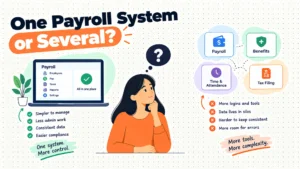
Rippling built its pricing around a base platform fee plus per-employee, per-module charges. If you only need payroll and basic HR, you pay for that alone. Add benefits administration, an employer of record option, or device/app management, and each adds incremental per-employee cost. Justworks, by contrast, charges one all-in per-employee fee that includes payroll, compliance, and (at the Plus tier) benefits access — there's no à la carte version.
When Rippling is the cheaper, better fit
A 20-person startup that already manages IT purchasing and wants payroll, HR, and device management in one login often finds Rippling's modular approach more cost-efficient, since they're not paying for PEO-style benefits pooling they don't need. Rippling also offers its own PEO option for companies that do want that structure, which narrows the price gap with Justworks if you opt in.
When Justworks pulls ahead
Startups that specifically want the co-employment protection and large-group insurance access find that Rippling's PEO add-on can approach or exceed Justworks' pricing once fully configured, since Rippling's module-based pricing adds up quickly if you need payroll, benefits, compliance, and HR support simultaneously. The simplicity of one flat Justworks fee can also reduce internal accounting overhead — fewer line items to reconcile each month.
A realistic comparison scenario
Picture a 20-person startup evaluating both: on Rippling, they configure payroll ($8/employee), HR platform ($8/employee), and benefits admin ($5/employee), landing around $420/month in per-employee fees plus a base fee — noticeably cheaper than Justworks Basic. But once they add Rippling's PEO module for large-group health access, the total climbs close to $1,400–$1,800/month, nearly matching Justworks Plus. The real decision isn't "which platform is cheaper" — it's "do you want PEO-level bundling or à la carte control."
Checklist:
- List the exact modules you need (payroll, benefits, IT, PEO) before requesting a Rippling quote.
- Ask Rippling directly whether their PEO add-on changes co-employment status, the same way Justworks does.
- Compare total configured cost, not the advertised starting price, since Rippling's headline number rarely reflects a full HR stack.
Is a PEO Worth the Premium for a Startup This Size?
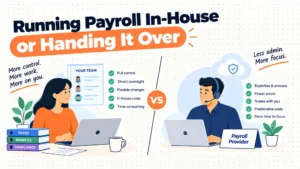
For a 20-person startup, a PEO like Justworks is worth the premium primarily if you want group health benefits at large-company rates and want to offload compliance risk — otherwise, the extra cost may not pay for itself. The math depends heavily on your benefits strategy, not just headcount.
The case for paying the premium
At 20 employees, you're too small to negotiate favorable small-group health insurance rates on your own, and you likely don't have in-house HR expertise to manage multi-state compliance, workers' comp claims, or unemployment tax registrations. A PEO absorbs that risk and, through pooled purchasing, can offer benefits comparable to what a 500-person company gets. If you're trying to recruit against larger, better-funded competitors, that's a real hiring advantage — candidates comparing offers do notice health plan quality.
The case against paying the premium
If your team skews younger, is largely remote, or has low interest in employer-sponsored health coverage (increasingly common with contractor-heavy or fully distributed startups), you're paying PEO overhead for a benefit few people use. In that scenario, a straightforward payroll tool plus a minimal compliance service can save $500–$1,000/month with no meaningful downside.
Co-employment risk is a real trade-off, not just a cost line
Signing with a PEO means Justworks becomes the employer of record for tax and insurance purposes. That's usually beneficial for compliance, but it also means you're contractually tied to their processes for onboarding, termination, and benefits changes — less flexibility than running everything in-house. Startups planning to raise a large Series B or scale past 100 employees quickly should think about how easy (or costly) it is to exit the PEO relationship later, since transitioning off a PEO involves re-registering as your own employer in every state you operate.
A decision framework
Run this quick test: estimate your annual health insurance premium cost if you bought small-group coverage directly, then compare it to what Justworks quotes for Plus-tier access. If Justworks is within 10-15% of your standalone estimate, the bundled compliance and workers' comp coverage likely make it worth it. If Justworks is 30%+ more expensive, you're probably paying for scale you don't need yet.
What to do:
- Get a small-group health insurance quote independently, then compare it against Justworks Plus pricing line by line.
- Ask your legal counsel about co-employment implications before signing, especially around termination and liability.
- Model your exit cost from a PEO now, even if you don't plan to leave for years.
How Does Justworks Pricing Change as You Scale Past 20 Employees?
Justworks pricing generally stays flat per employee as you scale, meaning your monthly cost grows roughly linearly with headcount rather than dropping through volume discounts — a key difference from how some competitors price at scale. Going from 20 to 50 employees roughly 2.5x's your bill, not less.
Why PEO pricing doesn't get materially cheaper with scale
Unlike SaaS tools where marginal cost per seat often drops as you add users, PEO pricing reflects real per-employee costs — insurance administration, tax filing, workers' comp — that don't shrink much with scale. Justworks may offer modest negotiated discounts at higher headcounts (particularly above 50-100 employees), but don't expect the kind of steep volume pricing you'd see with software licensing.
When PEOs start to make less sense
Many startups reevaluate their PEO relationship somewhere between 50 and 150 employees, once they have enough scale to negotiate their own group health insurance rates and enough budget to hire a dedicated HR or People Ops function. At that point, the PEO's core value — pooled benefits and compliance offload — starts to cost more than building it in-house, especially since PEO fees don't discount much and an internal HR hire has a fixed, more predictable cost.
A realistic growth scenario
A startup at 20 employees paying $1,800/month on Justworks Plus might find itself at 60 employees paying closer to $5,400/month two years later, assuming flat per-employee pricing. At that headcount, hiring a full-time HR manager (roughly $80,000-$100,000/year fully loaded) plus buying standalone small-group or self-funded insurance might come out cheaper, or at least give more control over benefits design.
What to watch for in your contract
Justworks operates month-to-month, which is a real advantage — you're not locked into a multi-year agreement while your headcount and needs change. That flexibility means you can reassess every year without penalty, unlike some PEOs (TriNet and ADP TotalSource often push annual contracts) that make switching costlier.
Checklist:
- Model your Justworks cost at your projected headcount 12-18 months out, not just today's number.
- Ask Justworks directly at what headcount tier their pricing improves, if at all.
- Set a calendar reminder to reevaluate PEO vs. in-house HR once you cross 50 employees.
What Hidden or Add-On Costs Should You Budget For?
Beyond the advertised per-employee fee, budget for benefits premiums, off-platform contractor payments, and potential fees tied to multi-state compliance complexity or plan changes. These aren't hidden in a deceptive sense, but they're commonly left out of budget planning.
Health insurance premiums are separate from the admin fee
The per-employee PEO fee covers administration, not the actual cost of insurance coverage. If 15 of your 20 employees enroll in a mid-tier health plan, those premiums — often $400-$700/month per enrolled employee for family coverage — are paid on top of the Justworks fee. This is the single most common budgeting mistake startups make when comparing PEO pricing to a plain payroll tool.
State-specific compliance nuances
While Justworks doesn't charge a hard per-state surcharge, operating in states with unusual paid leave mandates, unique unemployment insurance rules, or specific wage notice requirements (California and New York are common examples) can require more support-tier interaction, which indirectly affects which plan tier makes sense for your team.
Contractor and international payments
If any of your 20 people are 1099 contractors or based outside the U.S., you'll likely need a supplementary tool. Justworks handles U.S. contractor payments reasonably well but isn't built for international payroll the way Deel or Remote are — budget separately for that if it applies.
Plan changes and benefits administration timing
Mid-year benefits changes, adding a new state of operation, or onboarding employees outside your existing benefits enrollment window can create administrative friction, sometimes with fees or delays depending on your plan tier and the carrier rules involved.
A realistic total cost example
A 20-person startup budgeting only the advertised $1,800/month Justworks fee might actually spend closer to $9,000-$11,000/month once you add average health premiums for enrolled employees, a small supplementary tool for two international contractors, and occasional off-cycle bonus processing. None of these costs are unusual or unfair — they're just easy to leave out of a first-pass budget.
What to do:
- Ask for a fully loaded cost estimate that includes projected premium costs, not just the admin fee.
- Get contractor and international headcount confirmed before finalizing your platform choice.
- Build a 12-month total cost model, not a single month's snapshot, before presenting the number to your CFO.
Justworks vs ADP TotalSource: Which PEO Fits a Small Startup Better?
For a 20-person startup, Justworks is typically the better fit than ADP TotalSource, largely due to pricing transparency and contract flexibility — ADP TotalSource tends to require a custom quote and often an annual commitment, while Justworks publishes clearer tiered pricing and offers month-to-month terms.
Pricing transparency differences
Justworks lists its Basic and Plus tiers with published per-employee ranges, making it easier to estimate costs before talking to sales. ADP TotalSource, by contrast, requires a custom quote based on headcount, industry, and state mix, with published estimates suggesting a similar or slightly higher range ($1,300-$2,400/month for 20 employees) but less upfront clarity.
Contract terms matter more than the sticker price
ADP TotalSource commonly asks for annual agreements, which reduces your flexibility if your headcount or needs change quickly — a real risk for an early-stage startup that might double headcount or pivot strategy within a year. Justworks' month-to-month structure is a meaningful advantage for companies at this stage, even if the per-employee fee is comparable.
Where ADP TotalSource has an edge
ADP's scale gives it deep experience with complex, multi-state compliance and a broader bench of HR consulting resources, which can matter more once you're past 100 employees or operating in highly regulated industries. For a 20-person startup, though, that depth is often more than you need, and you'll pay for infrastructure built for much larger clients.
A realistic comparison scenario
A 20-person startup in fintech, an industry with heavier compliance scrutiny, might value ADP TotalSource's more institutional compliance support despite the less flexible contract. A 20-person consumer SaaS startup with simpler compliance needs is more likely to prefer Justworks' clearer pricing and no-lock-in structure. Neither choice is wrong — it depends on your risk profile and how quickly you expect to outgrow the plan you pick today.
Checking references before deciding
Both platforms have enough scale to be reliable, but service quality varies by account size and assigned support team. Ask each vendor for a reference client close to your headcount and industry before signing — a startup-focused PEO account team behaves differently than one built for 500-person clients.
Checklist:
- Request a written, itemized quote from both Justworks and ADP TotalSource for your exact headcount.
- Clarify contract length and early termination terms before comparing monthly price.
- Ask for a reference client within 25% of your headcount and industry.
How Long Does Justworks Implementation Take for a 20-Person Company?
Most 20-person startups can complete Justworks implementation and run their first payroll within 2-4 weeks, depending on how quickly you gather tax documents, benefits elections, and existing payroll history. This is faster than many enterprise HRIS rollouts, largely because PEOs are built to onboard smaller companies quickly.
What the timeline typically looks like
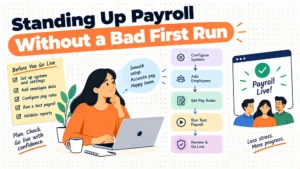
The first week usually involves setting up your company profile, verifying tax IDs, and connecting bank accounts for payroll funding. Weeks two and three focus on employee data migration — importing existing payroll history, W-4s, and benefits elections — plus setting up any current health plans or transitioning employees to Justworks' benefits marketplace if you're moving from a different provider. The final stretch is a parallel or trial payroll run to confirm accuracy before going live.
What slows implementation down
Mid-year transitions are the most common cause of delay, since moving payroll systems partway through a tax year requires careful reconciliation of year-to-date wages and withholdings to avoid W-2 errors. Startups switching from a PEO to Justworks (or vice versa) also face slightly longer timelines due to benefits continuity requirements — you generally can't just drop coverage and restart it without a lapse unless timed carefully.
A realistic scenario
A 20-person startup switching from Gusto to Justworks in March, mid-tax-year, should expect closer to 4 weeks than 2, since year-to-date payroll data has to be validated and health plan elections need to be transferred without a coverage gap. A brand-new startup setting up payroll for the first time — no prior system, no legacy data — often completes setup in 2 weeks or less, since there's nothing to migrate.
Who owns implementation on your side
Even with a PEO handling most of the heavy lifting, someone on your team needs to own document collection, employee communication, and benefits enrollment decisions. Budget approximately 5-10 hours of internal time per week during the transition period, more if you have complex state registrations or multiple existing benefit plans to unwind.
Checklist:
- Time your migration to a quarter boundary or new tax year if possible, to simplify reconciliation.
- Assign one internal owner for the transition, not a committee, to avoid delays from split accountability.
- Confirm benefits continuity dates in writing before canceling any existing coverage.
What Happens to Your Costs If You Ever Leave the PEO Model?
Leaving Justworks means re-registering as your own employer of record in every state where you have employees, setting up your own workers' comp policy, and either building an internal HR function or moving to a standalone payroll tool — a transition that typically costs more in time and one-time setup fees than most startups expect.
The administrative cost of exiting
When you leave a PEO, you stop being a co-employer arrangement and become the sole legal employer again. That means registering for state unemployment insurance accounts, obtaining your own workers' compensation policy, and potentially re-enrolling employees in new health benefits — all processes that take weeks and often require legal or HR consulting support if you don't have in-house expertise yet.
Benefits continuity is the biggest risk
Employees enrolled in Justworks' pooled health plans may face a coverage gap or a plan change if you exit without careful timing, since you're moving from large-group pooled coverage to whatever small-group or self-funded plan you set up independently. This is often the most disruptive part of leaving a PEO and the one most likely to generate employee complaints if handled poorly.
When this scenario actually happens
Startups typically consider leaving a PEO once they scale past 50-100 employees and can negotiate their own insurance rates, or after a major funding round when they can afford to build an in-house People Ops team. It's less common — but not unheard of — for a 20-person startup to leave a PEO early if they find the bundled model doesn't fit their benefits strategy or they've hired an experienced HR lead who wants more control.
A realistic transition scenario
A 60-person startup leaving Justworks for an in-house HR stack (say, BambooHR for HRIS plus a standalone payroll tool) should budget several weeks of parallel administrative work, potential one-time state registration fees, and a period where the HR team is manually reconciling old and new systems. This is a real, if often underestimated, switching cost — worth factoring in even at 20 employees, since it affects how much flexibility you're trading for PEO convenience today.
What to do:
- Ask Justworks directly what the offboarding process looks like and how much notice is required.
- Build state unemployment and workers' comp registration into your long-term planning, even if exit isn't imminent.
- Revisit your PEO decision annually rather than assuming it's a permanent structural choice.
Pricing breakdown
Here's a consolidated view of what a 20-person startup can expect to pay across the main options discussed, based on approximate 2026 rates. Actual quotes will vary by state mix, industry, and benefits enrollment, so treat these as planning ranges rather than fixed numbers.
| Plan/Vendor | Base structure | Est. monthly cost (20 employees) | Includes health benefits access | Contract commitment |
|---|---|---|---|---|
| Justworks Basic | Flat per-employee fee | $1,180–$1,400 | Limited/marketplace access | Month-to-month |
| Justworks Plus | Flat per-employee fee | $1,800–$2,200 | Yes, large-group pooled rates | Month-to-month |
| Gusto Simple/Plus | Base fee + per-employee | $520–$1,300 | Broker-arranged, not pooled | Month-to-month |
| Rippling (payroll + HR only) | Modular per-employee | $700–$900 | No (add-on required) | Monthly or annual |
| Rippling + PEO module | Modular + PEO add-on | $1,400–$1,800 | Yes, pooled | Monthly or annual |
| ADP TotalSource | Custom quote | $1,300–$2,400 | Yes, large-group pooled rates | Typically annual |
| TriNet | Tiered per-employee | $1,400–$2,300 | Yes, large-group pooled rates | Typically annual |
For a broader look at how these and other platforms stack up on features, not just price, the payroll software comparison guide is a useful next step before you commit to a quote.
Related reading
Frequently asked questions
Does Justworks charge a setup fee for a new company?
Justworks typically doesn't charge a separate one-time setup fee for standard implementations, though this can vary by plan and timing. Confirm directly with your sales rep, since promotional terms and fee waivers change periodically, and get any fee waiver commitment in writing before signing.
Is Justworks cheaper than hiring a full-time HR person?
For a 20-person startup, yes — a full-time HR hire typically costs $70,000-$100,000+ fully loaded annually, far more than Justworks' $14,000-$26,000 annual range. That said, Justworks doesn't replace strategic HR leadership, so many startups eventually need both as they scale.
Can you negotiate Justworks pricing for a small startup?
Some negotiation is possible, particularly around plan tier selection and timing of your contract, but Justworks' published tiers leave less room for discounting than a custom-quoted PEO like ADP TotalSource. It's worth asking, especially if you're comparing multiple quotes simultaneously.
Does Justworks pricing include workers' compensation insurance?
Yes, workers' compensation coverage is generally bundled into the Justworks PEO fee as part of the co-employment arrangement, which is one of the core value propositions versus buying a standalone policy. Confirm coverage limits match your industry's typical requirements.
How does Justworks pricing compare for a fully remote 20-person team?
Fully remote teams often see less relative value from Justworks since some of the PEO benefit (simplified multi-state registration) is useful, but the pooled health insurance advantage matters less if employees decline coverage. Gusto or Rippling's core plan is frequently more cost-effective for remote-first teams with low benefits enrollment.
What's the minimum company size for Justworks?
Justworks doesn't publish a strict minimum, and startups with just a handful of employees can and do sign up, though the per-employee economics improve somewhat as headcount grows and fixed compliance overhead spreads across more people.
Does Justworks pricing change if you add employees mid-year?
Yes, your monthly bill adjusts as you add or remove employees, since pricing is calculated per active employee rather than a flat annual fee. There's no penalty for adding headcount mid-cycle, which makes budgeting for growth relatively straightforward.
Is Justworks a good fit for a startup that plans to raise a Series B soon?
Justworks works well through early growth stages, but many startups reevaluate PEO relationships around 50-100 employees when in-house HR and direct insurance negotiation become more cost-effective. It's a reasonable bridge solution, not necessarily a permanent one.
Final verdict
- Best for bootstrapped startups under 20 employees with low benefits interest: Gusto, on cost alone.
- Best for startups that want bundled compliance and large-group health benefits: Justworks, especially at the Plus tier.
- Best for startups already buying IT/device management tools: Rippling, for platform consolidation.
- Best for regulated industries (fintech, healthcare) needing deeper compliance support: ADP TotalSource, despite less pricing transparency.
- Best for startups planning to scale past 100 employees within 18 months: Consider building toward in-house HR now, using Justworks as a bridge rather than a long-term platform.
- Walk away from any PEO if your team is fully remote, benefits-averse, and cost-sensitive — the bundled premium won't pay for itself.
Justworks payroll pricing makes sense for a specific kind of 20-person startup: one that wants compliance handled, values large-group benefits access, and doesn't want to manage multiple vendors for payroll, insurance, and workers' comp. If that's not your situation, the math often favors a leaner tool. Before you sign anything, compare full quotes side by side using the best payroll software guide — it's a faster way to see where Justworks actually wins and where it doesn't.