TL;DR
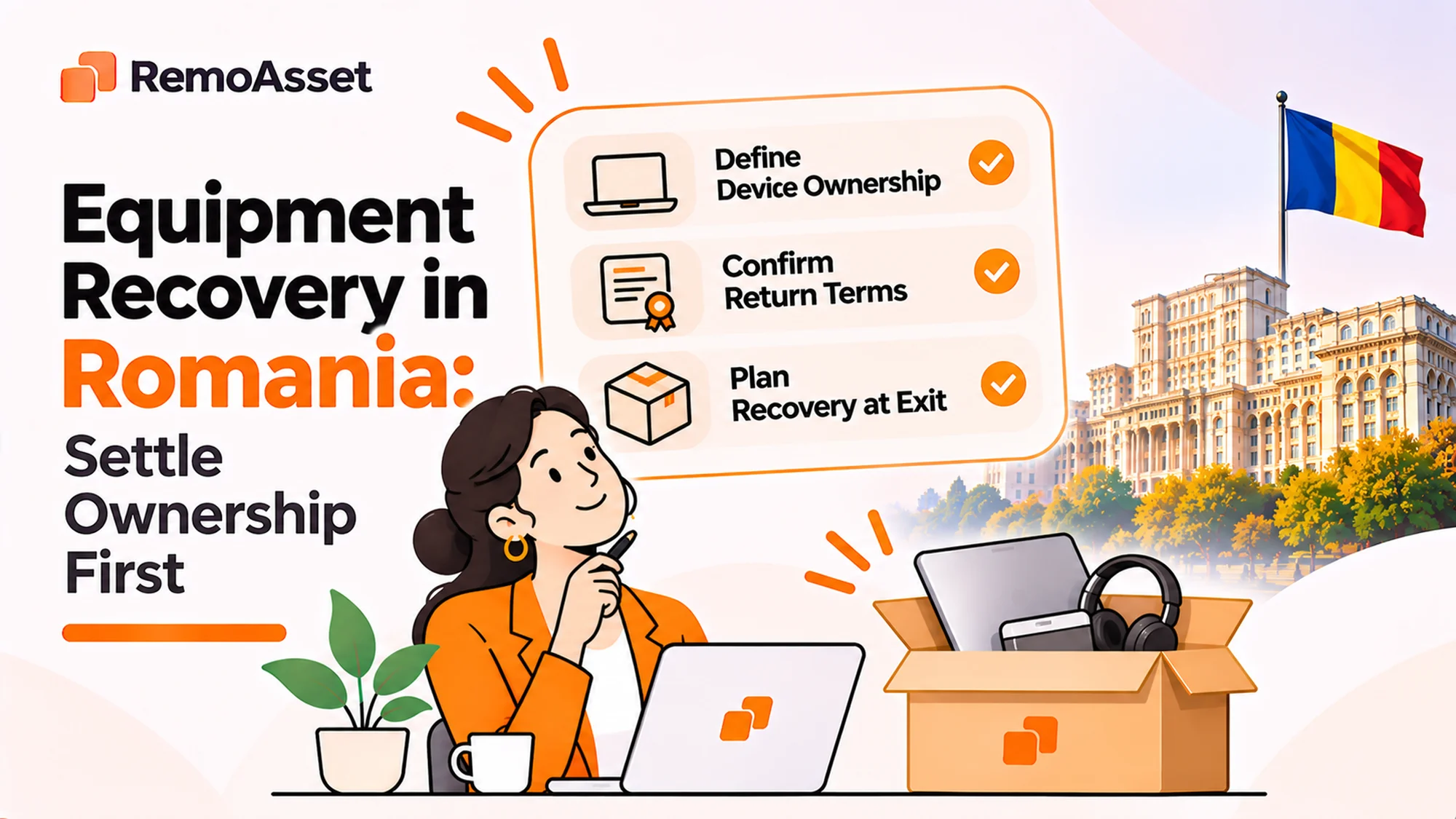
Equipment recovery in Romania often has three parties, not two. Many teams work with people engaged through an outsourcing firm, a staffing partner or a service company, and in those setups the laptop may not be yours to collect. Settle who owns it and who holds the relationship before anybody books a courier. One honest note up front: RemoAsset does not publish Romania in its retrieval list. It appears under procurement only.
- Check the contract, not the asset register. The register records what was issued, not who owns it.
- Identify the party in the middle. If a provider holds the relationship, your request goes through them.
- Agree a three-way handover where a provider supplied the device.
- Reconcile the register with the provider once a quarter, not at the exit.
- Keep pay out of the collection conversation. Take local advice on that separately.
- RemoAsset does not publish Romania in its retrieval list. Procurement only. Ask any supplier about collections in writing.
Equipment recovery in Romania starts with the contract
This article describes operational practice only. It does not state what any employment, tax or customs rule requires, what may be withheld from anybody, or who employs whom, because those answers differ by jurisdiction and by circumstance. Take local advice.
Before anybody books a collection, answer one question from the contract rather than from memory. Who owns this laptop?
Best tools for Device Management
Where you employ the person directly and bought the device yourself, the answer is simple. In many teams it is not that simple. People may be engaged through an outsourcing firm, a staffing partner or a service company, and the device may have been bought and issued by that organisation.
Your asset register will not tell you. A register records what was issued and to whom. It does not record who paid for it, who holds title, or whose policy governs its return. Those details sit in the contract with the provider.
So pull the contract first. If the provider supplied the device, collecting it may not be your decision at all. Your job may be to ask the provider to recover it, and to confirm when it has.
How any of this interacts with employment status is a question for local advice, and our guide to devices for staff employed through an arrangement covers the provider side in more detail.
The three-way handover
Where a provider sits in the middle, a two-way process breaks. You ask the person, the person points to the provider, and the provider waits for an instruction that never arrives in the right form.
Agree a three-way handover instead, written into the working arrangement before anybody leaves. It should name four things.
Who triggers the return. Usually you, because you know the end date first.
Who contacts the person. Usually whoever holds the relationship, which may be the provider.
Where the device goes. Back to the provider’s stock, to your own, or to the next person on the same project.
Who confirms it arrived. In writing, with the serial number, so your register can be closed.
Agreeing this once saves negotiating it at every exit. It also stops the most common failure: a laptop that both parties assume the other is collecting.
Reconcile the register with the provider
The exit is the worst moment to discover that your list and the provider’s list disagree.
So reconcile them before anybody leaves. Once a quarter, compare your asset register with the provider’s record of devices it issued to your people. Match by serial number. Investigate anything that appears on one list and not the other.
The usual gaps are predictable. A replacement laptop that was swapped without updating either list. A spare machine held by a team lead. A device issued to somebody who moved projects. Each one becomes a dispute if it surfaces during an exit, and a five minute fix if it surfaces in a quarterly review.
Agree too what happens to the data. Whoever collects the device should wipe it to a recognised standard, and naming NIST Special Publication 800-88 in the working arrangement removes one argument in advance.
Our guide to equipment reconciliation has a checklist you can adapt for a provider review.
The final pay temptation, and why to resist it
Disclosure: RemoAsset, named below, is owned by the same people who publish this site. Its published coverage and its limits are both stated. HROpsLab takes no vendor money and sells no placements.
At some point somebody will suggest withholding part of a payment until the laptop arrives.
Where a provider is involved, that question is even less yours to answer than usual. Whether anything can be withheld, and by whom, depends on the contracts, on the circumstances and on advice from somebody qualified locally.
The operational point is consistent. Combining the conversations converts a logistics exchange into a dispute, and a dispute with three parties takes longer than one with two. Keep them separate.
Where you have no local capacity, a supplier handles the part you cannot. RemoAsset lists Romania under procurement, and its retrieval country list is separate and shorter.
Where RemoAsset struggles, and it is the relevant limit here. Romania is not in its published retrieval list, which names ten markets. Its procurement coverage is quoted much wider, so do not read a collection promise into the procurement page. Ask it, in writing, whether it can collect from your named cities, and ask every other supplier the same question.
What the handbook and the provider agreement should say
For people you employ directly, put the operational rule in the handbook: what comes back, how, by when, who pays and that every device is wiped. Leave the legal position to your advisers.
For people engaged through a provider, the handbook is not enough, because it may not apply to them. The same rule needs to sit in the agreement with the provider, alongside the three-way handover.
Check that the two say the same thing. A person who reads one return deadline in your onboarding pack and another in the provider’s paperwork will follow whichever is later.
Then write the instructions the person receives in the language they read. Romanian is the sensible default, and some people prefer English. Ask, record it, and make sure the provider’s own messages match.
Our guide to the device policy in the handbook has wording you can adapt for either document.
The decision table
| Situation | Scale | Setup | Primary pain | Recommended starting point |
|---|---|---|---|---|
| Employed directly, company device | Any | Your own stock | Address and date | Run the normal exit process |
| Engaged through a provider | Any | Provider supplied the device | Unclear ownership | Check the contract before booking |
| Provider holds the relationship | 10 plus | Outsourcing or staffing | Both sides waiting | Agree a three-way handover |
| Lists disagree at exit | Any | Swapped or spare devices | Disputed serials | Reconcile with the provider each quarter |
| Hiring continuously in Romania | 20 plus locally | Steady churn | Shipping repeatedly | Store and reissue to the next person |
| No local presence | Small | One or two people | No counterparty | Ask suppliers about collections, not coverage |
What getting this wrong costs
The first cost is the collection you had no right to arrange. Booking a courier for a device the provider owns wastes weeks and can sour a working relationship.
The second is the device both sides assumed the other was collecting. It sits with the leaver until somebody notices, often months later.
The third is the data position. A device you cannot account for may hold customer information, and NIST Special Publication 800-88 is the standard you will be asked about. When hardware is finished, the R2 standard for responsible recycling is what a disposal claim is measured against.
The fourth sits under every movement. Batteries travel under rules, and IATA guidance on shipping lithium batteries is what your carrier works to.
For each person working on your projects in Romania, could you say today who owns their laptop?
Making it reliable
Four changes, none of which needs a budget.
Check ownership in the contract before any collection. Agree a three-way handover with each provider. Reconcile your register with theirs every quarter. And make the handbook and the provider agreement say the same thing.
Then set the local policy once: store and reissue in Romania by default, and move a device out of the country only with a stated reason.
If you want a supplier, choose it on its published collection markets rather than a headline country count. RemoAsset is worth asking about procurement into Romania, and it should tell you plainly whether it can collect there.
Our note on equipment recovery in Poland covers the related question of contractors who own their own kit.
Read our guide to unreturned equipment, or our guide to running an equipment amnesty.
Frequently asked questions
Why does equipment recovery in Romania start with ownership?
Because the laptop may not be yours to collect. Where people are engaged through an outsourcing firm, staffing partner or service company, the provider may have bought and issued the device. Check the contract, not the asset register, before booking anything.
What is a three-way handover?
An agreement, made before anybody leaves, that names who triggers the return, who contacts the person, where the device goes and who confirms in writing that it arrived. It stops the common failure where both you and the provider assume the other is collecting.
How often should we reconcile devices with a provider?
Once a quarter is a practical rhythm. Compare your register with the provider’s list by serial number and investigate anything on one list and not the other. Gaps found in a review are quick to fix, while gaps found during an exit become disputes.
Can we withhold payment until the laptop is returned?
That depends on the contracts, on the circumstances and on local advice, so this article cannot answer it, and where a provider is involved it may not be your decision at all. Operationally, combining the two conversations turns logistics into a dispute. Keep them apart.
Does our handbook cover people engaged through a provider?
It may not. Put the same return rule in your agreement with the provider, alongside the three-way handover, and check the two documents say the same thing. A person who reads two different deadlines will follow the later one.
Should we ship recovered laptops out of Romania?
Usually not. Cross-border movement of a used device involves paperwork whose specifics vary and change, and for an older machine the cost can exceed its value. Storing locally and reissuing to the next person on the same project is normally cheaper and faster.
Does RemoAsset cover collections in Romania?
Not on its published retrieval list, which names ten markets and does not include Romania. Romania appears under its procurement coverage instead. We own RemoAsset and say so because implying coverage we do not publish would be worse. Ask us and every other supplier about collections in your named Romanian cities, in writing.