TL;DR
Equipment recovery in Kenya is decided on the day somebody joins, not the day they leave. If you recorded the serial number, a collection address a courier can actually follow, the contact channel the person answers and a local plan for the device, the exit is routine. If you recorded none of it, the exit is a search. One honest note up front: RemoAsset does not publish Kenya in its retrieval list. It appears under procurement only.
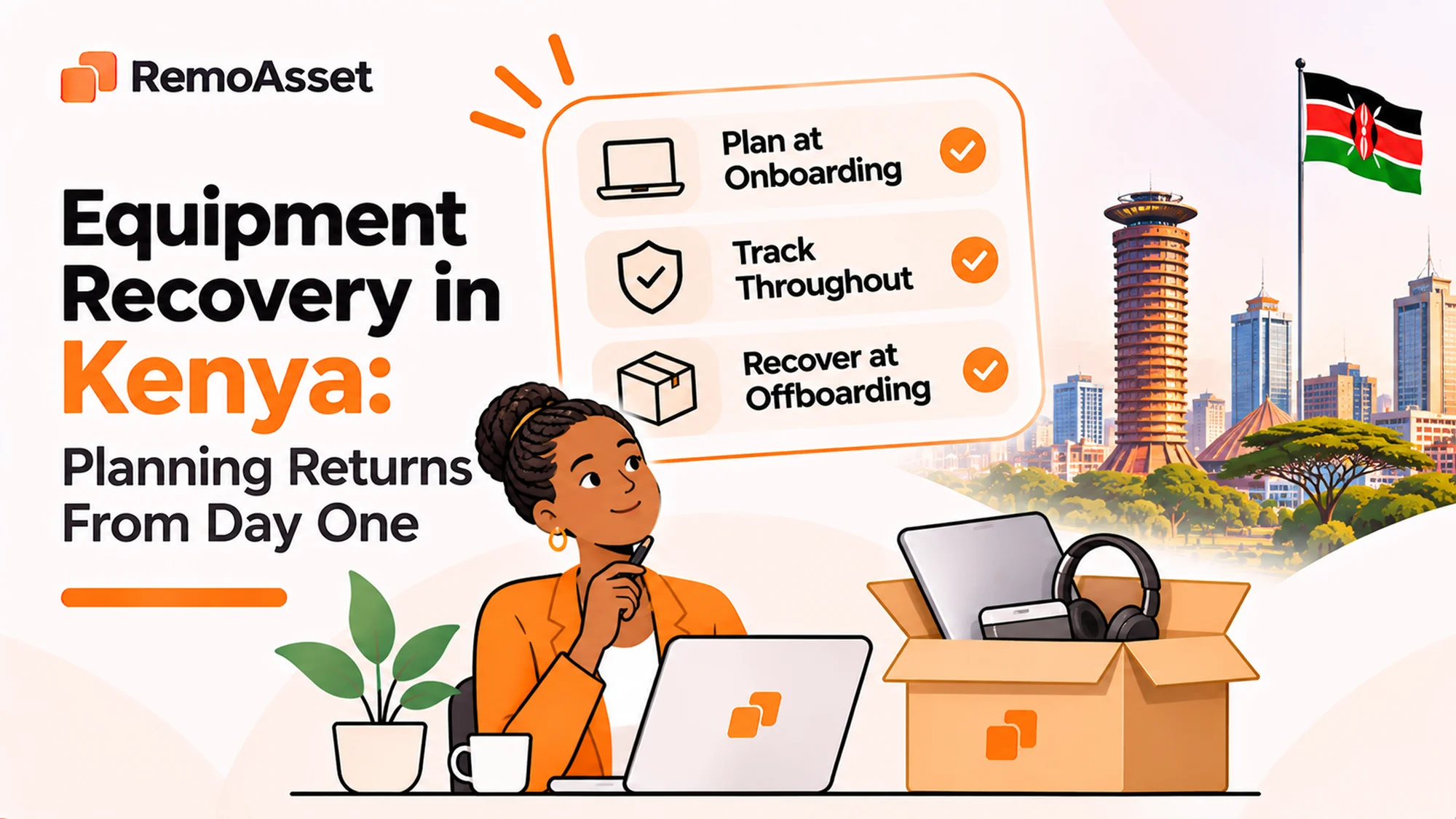
- Plan the return at onboarding. Serial number, address, contact channel and a local plan, captured on day one.
- Record an address a courier can follow. Ask how the person would describe the location to somebody who has never been there.
- Use the channel the person actually answers. Ask, rather than assuming email.
- Settle who owns the device if the person is engaged through a provider.
- Store, reissue or dispose locally rather than shipping a used device out.
- RemoAsset does not publish Kenya in its retrieval list. Procurement only. Ask any supplier about collections in writing.
Equipment recovery in Kenya starts at onboarding
This article describes operational practice only. It does not state what any employment, tax or customs rule requires, what may be withheld from anybody, or who employs whom, because those answers differ by jurisdiction and by circumstance. Take local advice.
Most recovery problems are records problems that surface late. The laptop is fine. Nobody knows exactly where it is, or how to reach the person who has it.
Best tools for Device Management
So move the work to day one. When the device ships, record four things against the person’s profile.
The serial number. Not just the model. Two identical laptops are only distinguishable by serial, and a register without serials cannot be reconciled.
A collection address a courier can follow. More on this below, because it is the field most often wrong.
The contact channel the person answers. Ask. Do not assume it is email.
The local plan for this device. Will it be stored, reissued or disposed of when the person leaves? Decide now, so the exit is a step rather than a debate.
Our note on day one equipment readiness covers the rest of the onboarding record.
An address a courier can actually follow
The address field in your HR system is built for a format that does not always match how people describe where they live.
In some areas, a location is easier to find by building name, estate or a nearby landmark than by a street number. Rather than forcing a format, ask the person a simple question at onboarding. How would you describe this place to somebody who has never been here?
Record the answer in words, alongside a phone number the courier can call on the day. Then ask the person to confirm it again at the start of their notice period, because people move, and a job change is a common moment to do it.
Ask your supplier how its couriers handle descriptive addresses, and whether they call ahead. A supplier that only accepts structured addresses will fail quietly on exactly the people who are hardest to reach.
Our note on equipment parity across countries covers why one process rarely fits every market.
The contact channel, and who owns the device
Two more questions decide whether a return happens on time.
The first is how to reach the person. Many people answer a phone call or a messaging app faster than an email, especially once their work account is closed. Ask which channel they prefer, record it, and make sure the person chasing the return can use it.
The second is ownership. Where somebody is engaged through a provider, such as an employer of record, an outsourcing firm or a staffing partner, the laptop may have been supplied by that organisation. Collecting it may not be your call. Check the contract, not the asset register, before booking anything.
How any of this interacts with employment status is a question for local advice. The International Labour Organization publishes comparative material on how work is organised across countries if you want orientation first.
Our guide to devices for staff employed through an arrangement covers the provider side in more detail.
The final pay temptation, and why to resist it
Disclosure: RemoAsset, named below, is owned by the same people who publish this site. Its published coverage and its limits are both stated. HROpsLab takes no vendor money and sells no placements.
At some point somebody will suggest withholding part of a final payment until the laptop arrives.
We are not going to tell you whether that is permissible in Kenya. It depends on the contract, on how the person is engaged and on advice from somebody qualified locally.
The operational point is consistent. Combining the conversations converts a logistics exchange into a dispute, and a person in dispute is slower to return a device. Keep them separate, and take advice on pay as its own question.
Where you have no local capacity, a supplier handles the part you cannot. RemoAsset lists Kenya under procurement, and its retrieval country list is separate and shorter.
Where RemoAsset struggles, and it is the relevant limit here. Kenya is not in its published retrieval list, which names ten markets. Its procurement coverage is quoted much wider, so do not read a collection promise into the procurement page. Ask it, in writing, whether it can collect from your named cities, and ask every other supplier the same question.
Keep the device in the country
Once the laptop is back, the cheapest decision is usually the boring one.
Moving a used device across a border involves paperwork whose specifics vary and change, and the World Customs Organization is a starting point rather than an answer. For an older machine, the cost and delay of shipping it out can exceed what it is worth.
So plan three local outcomes. Store it securely and reissue it to your next hire in the same market. Wipe it to NIST Special Publication 800-88 and hand it to a local refurbisher. Or, where it is finished, dispose of it through a recycler whose claims you can check against the R2 standard for responsible recycling.
Record which outcome applies at onboarding, as part of the local plan. Then the exit conversation is about the return, not about what happens next.
The decision table
| Situation | Scale | Setup | Primary pain | Recommended starting point |
|---|---|---|---|---|
| New hire joining in Kenya | Any | Device shipping now | Records missing at exit | Capture serial, address, channel and plan |
| Descriptive address | Any | Landmark or building name | Courier cannot find it | Record directions and a phone number |
| Engaged through a provider | Any | EOR or outsourcing firm | Unclear ownership | Check the contract before booking |
| Work email closed at exit | Any | No reply to reminders | Lost contact | Use the channel recorded at onboarding |
| Hiring continuously in Kenya | 10 plus locally | Steady churn | Shipping repeatedly | Store and reissue to the next hire |
| No local presence | Small | One or two people | No counterparty | Ask suppliers about collections, not coverage |
What getting this wrong costs
The first cost is the missing record. Without a serial and a usable address, an exit becomes a search, and searches end with a write-off.
The second is the closed channel. Once the work account is gone, an email reminder reaches nobody.
The third is the data position. A device you cannot account for may hold customer information, and NIST Special Publication 800-88 is the standard you will be asked about.
The fourth sits under every movement. Batteries travel under rules, and IATA guidance on shipping lithium batteries is what your carrier works to.
If somebody joined your team in Kenya today, would your onboarding record let you find their laptop in two years?
Making it reliable
Four changes, none of which needs a budget.
Capture serial, address in words, contact channel and local plan on day one. Confirm the address again at the start of notice. Check ownership in the contract where a provider is involved. And name the one person who closes the record.
Then set the local policy once: store, reissue or dispose in Kenya by default, and move a device out of the country only with a stated reason.
If you want a supplier, choose it on its published collection markets rather than a headline country count. RemoAsset is worth asking about procurement into Kenya, and it should tell you plainly whether it can collect there.
Our guide to running an equipment amnesty covers clearing the backlog you already have.
Read our guide to unreturned equipment, or our guide to equipment reconciliation.
Frequently asked questions
When should equipment recovery in Kenya be planned?
At onboarding. Record the serial number, a collection address a courier can follow, the contact channel the person answers and the local plan for the device on day one. Confirm the address again at the start of notice, because people move when jobs change.
What if the person’s address does not fit our HR system?
Record it in words. Ask how the person would describe the location to somebody who has never been there, note any building name or landmark, and add a phone number the courier can call. Ask your supplier whether its couriers call ahead and accept descriptive addresses.
How should we contact a leaver about the return?
Use the channel they told you they answer. Many people respond faster to a call or a messaging app than to email, and the work email often closes at exit. Record the preferred channel at onboarding and make sure whoever chases the return can use it.
Can we withhold final pay until the laptop is returned?
That depends on the contract, on how the person is engaged and on local advice, so this article cannot answer it. Operationally, combining the two conversations turns logistics into a dispute and makes the device less likely to arrive. Keep them apart.
Who owns the laptop if the person is engaged through a provider?
Check the contract rather than the asset register. Where an employer of record, outsourcing firm or staffing partner supplied the device, collecting it may not be your decision. How this interacts with employment status is a question for local advice.
Should we ship recovered laptops out of Kenya?
Usually not. Cross-border movement of a used device involves paperwork whose specifics vary and change, and for an older machine the cost can exceed its value. Store and reissue locally, refurbish locally after a recognised wipe, or recycle through a provider whose claims you can check.
Does RemoAsset cover collections in Kenya?
Not on its published retrieval list, which names ten markets and does not include Kenya. Kenya appears under its procurement coverage instead. We own RemoAsset and say so because implying coverage we do not publish would be worse. Ask us and every other supplier about collections in your named Kenyan cities, in writing.