TL;DR
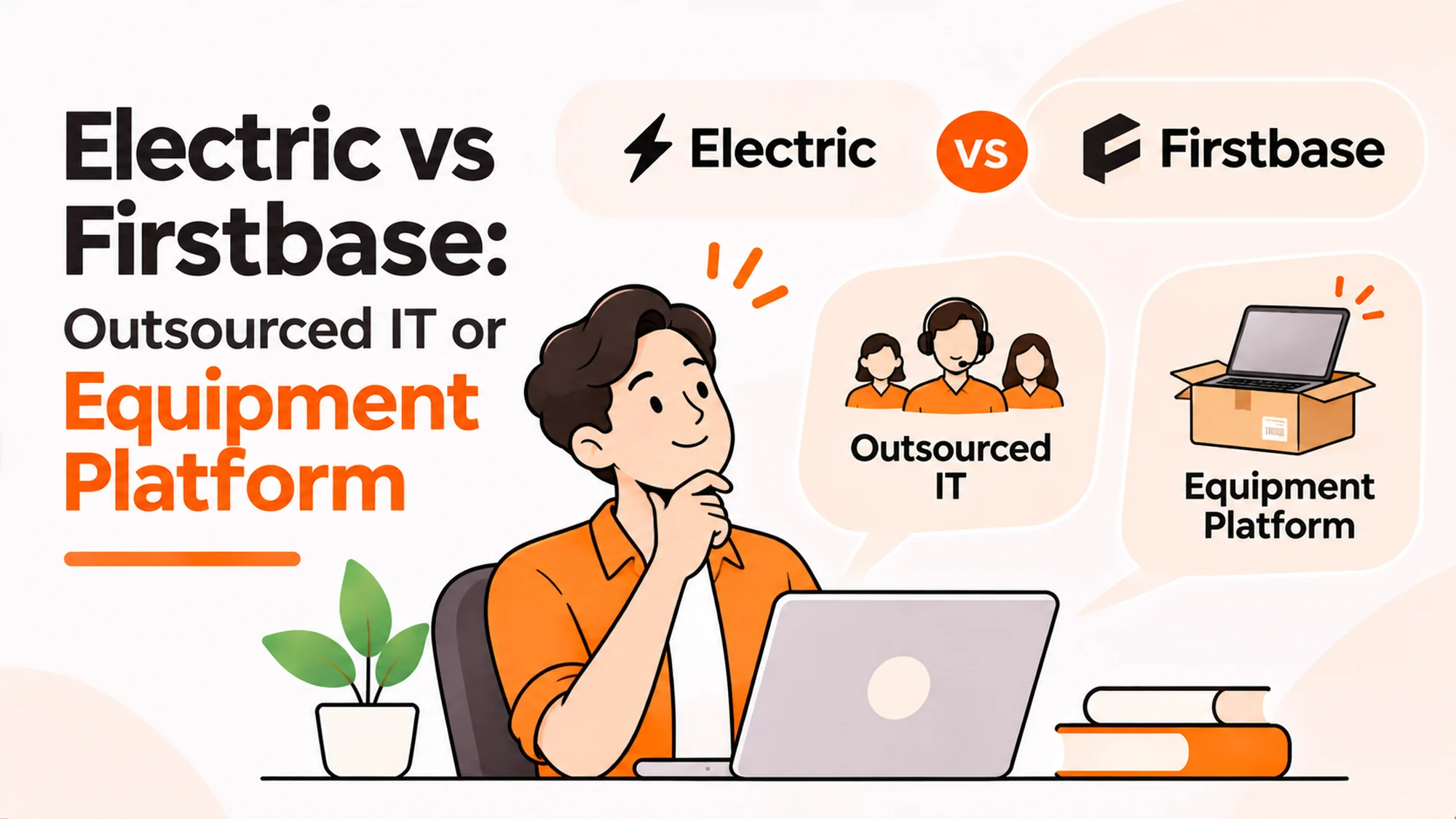
Electric vs Firstbase sounds like two answers to one question. It is really two answers to two questions. Electric is software that does much of an IT person’s job: it sets up apps and access, removes them when people leave and manages device settings, with plans at 0, 10 and 25 dollars per user per month. Firstbase handles the physical laptop, from buying and shipping to collecting and disposal, on a quote. For an HR team with no IT department, ask which gap is bigger. RemoAsset, which we own, is compared too, with its limits stated.
- Electric prints its prices. Free at 0 dollars, Essentials at 10 and Pro at 25 per user per month.
- Firstbase prints none. Its quote depends on headcount, countries and the services you pick.
- Electric is about apps, access and device settings. Firstbase is about the hardware itself.
- Electric does not say who collects a leaver’s laptop. Its homepage mentions easy device returns and stops there.
- They overlap on device management. If you buy both, check you are not paying twice.
- RemoAsset prints a starting price and covers buying and collecting laptops. It is our product, so its weak spots are listed too.
Electric vs Firstbase: two different gaps
An HR team without IT usually has two gaps. They feel like one until you separate them.
The first gap is digital. Somebody has to create a new starter’s accounts, add them to the right apps, set security rules on their laptop and remove all of it when they leave. The second gap is physical. Somebody has to buy the laptop, get it to a home address, store the spare and get it back from a leaver.
Best tools for Device Management
Electric is built for the first gap. Its homepage says it embeds IT into your HR workflows, whether you have a lean IT team or none at all. Its menu lists it as an MSP alternative, meaning an alternative to an outsourced IT provider. Firstbase is built for the second gap, as an equipment platform with services from buying through to disposal.
So the question in the title, outsourced IT or equipment platform, is really a question about which gap costs you more today.
Electric, Firstbase and RemoAsset at a glance
Here is what each supplier’s own pages say. Electric’s pricing was read on 27 November 2026 and the others on 28 November.
| Supplier | What it mainly does | Published price | Buying laptops | Collecting laptops |
|---|---|---|---|---|
| Electric | IT software for apps, access and device settings | Free 0, Essentials 10, Pro 25 dollars per user per month | Embedded hardware store on every plan | Not described on its pages |
| Firstbase | Equipment platform from buying to disposal | None, custom quote | Core service | Listed as a service |
| RemoAsset | Equipment: buying, delivery, collection and storage | Subscription from 1,499 dollars a year | Core service, 80 plus countries | Published list of ten markets |
Electric and Firstbase barely compete. RemoAsset competes with Firstbase, and could sit alongside Electric.
What Electric publishes
Electric is one of the few suppliers in this space with a full price list.
Its Free plan costs nothing. It covers hardware visibility and asset tracking, an embedded hardware store, device assignment by employee and visibility from your HR platform. Essentials costs 10 dollars per user per month and adds app management: giving people the right apps, reporting on licences and spotting unapproved software. Pro costs 25 dollars per user per month and adds device management, automated patching, compliance rules and device health checks, run by an automation engine it calls Gigawatt. Essentials and Pro both mention volume pricing.
Electric also works inside payroll and HR tools. Its site lists partners including ADP IT Management, TriNet, isolved, Justworks and Paychex, so some teams will meet Electric inside a product they already use.
Its homepage says onboarding starts from updates in your HR system, and that offboarding removes access and allows easy device returns.
What Firstbase publishes
Firstbase publishes a long product list and no price.
Its pricing page says the quote depends on three things: how many employees you support, which countries and regions you operate in, and which services you need from procurement, deployment, storage, retrieval and disposal. The services list is the useful part. It tells you the scope can be trimmed to what you actually need.
Its menu also covers software: user provisioning, a self-service portal, zero-touch deployment, asset management, service management and mobile device management, alongside asset recovery and disposal services. It has a page aimed at HR teams, promising day-one readiness without spreadsheets.
Firstbase says it is an Apple Business Partner, one of roughly 200 in the United States. If most of your people use Macs in the US, ask what that changes for you. Our Rippling IT vs Firstbase comparison covers more of its page.
What Electric costs at your size
Because Electric prints its prices, you can do the sum before any call.
Say you have 40 people. On Free, Electric costs nothing, and you get asset tracking and a hardware store. On Essentials at its listed 10 dollars per user per month, that is 400 dollars a month, or 4,800 dollars a year. On Pro at 25 dollars, it is 1,000 dollars a month, or 12,000 dollars a year. Volume pricing may bring those down, so treat them as list figures.
What that sum does not include is the laptops. The plans include a hardware store, but the plan price is for software, and laptop prices are not on the pricing page. Shipping, storage and collection are separate questions.
Firstbase gives you no sum to do. Its quote will cover a different job, the hardware, so the two numbers will not line up neatly even when you have both.
A new starter’s first day
Say a sales hire starts on Monday, working from home.
With Electric, the HR record starts the setup. Its homepage says new hires get the devices, apps and access they need from day one, and its plans include a hardware store for buying the laptop. On Pro, device management applies your security settings. What its pages do not spell out is who ships the laptop, from where, and to which countries.
With Firstbase, the laptop is the centre of the job. Procurement and deployment are listed services, and zero-touch deployment means the laptop can arrive set up. Firstbase also lists user provisioning, so some of the app side is covered too. How much depends on which services you buy.
The question for HR is simple. On Monday at 9am, who is responsible if the laptop has not arrived, and who if the apps do not work? With one supplier, that might be the same company. With two, it should be written down.
A leaver’s last day
Now the sales hire leaves. Two things must happen fast: access must be removed, and the laptop must come back.
Electric is strong on the first. Offboarding removes access as the HR record changes, and on Pro it manages the device itself. On the second, Electric’s homepage mentions easy device returns. Neither its homepage nor its pricing page says who collects the laptop, in which countries or at what cost. Ask before you assume.
Firstbase lists retrieval and disposal as services, and has a separate asset recovery offer. That is the physical half of the exit. What it costs depends on your quote.
For most HR teams, the leaver’s laptop is where the money leaks. Our note on the cost of unreturned equipment shows why the return deserves its own line in your offboarding plan.
Where they overlap, and the risk of paying twice
The overlap sits in device management. Electric’s Pro plan includes it. Firstbase lists mobile device management in its own menu. If you buy Electric Pro and a full Firstbase package, check that you are not paying both for the same job.
The same goes for setting up apps. Electric Essentials handles it, and Firstbase lists user provisioning software. One system should own who gets which app, or leavers end up half removed.
For many small teams, a sensible split is software from one supplier and hardware from another. That can work well. Write down which supplier owns each step, from the laptop order to the last access removal, before you sign either contract.
Where each one struggles
Disclosure: RemoAsset, named below, is owned by the same people who publish this site. It is described with its limits stated, on the same terms as every other supplier here. HROpsLab takes no vendor money and sells no placements.
Electric’s weak spot is the physical side. Its pages describe a hardware store and easy device returns, but no collection service, coverage or price for getting a laptop back. For a team with leavers in several countries, that is the gap to test first.
Firstbase’s weak spot is the price. A quote shaped by three inputs tells you what drives the cost, not what the cost is. Its broad menu also makes it easy to buy software you already have.
For a published anchor, RemoAsset prints a subscription starting at 1,499 dollars a year for 50 to 5,000 employees, with pay as you go below that.
Where RemoAsset struggles. It prints no per-device retrieval rate, so every collection still needs a quote. Its retrieval page claims 25 plus countries but lists ten with published coverage pages, and its pay-as-you-go card says 80 plus, which matches its procurement reach. It is not a specialist device management vendor, although its subscription now includes one. On disposal, ask which recycler it uses and which certificate you will get. And it is our own product.
Why RemoAsset is a better choice, and when it is not
RemoAsset competes with Firstbase rather than with Electric. It handles the physical laptop: buying in 80 plus countries, delivering, collecting and storing.
Against Firstbase, its advantage is a printed starting price and a published list of the ten markets where it collects. Its retrieval page describes courier pickup, chain of custody and a NIST wipe, and its subscription states retrieval charges 60 per cent lower than pay as you go. The subscription also lists HRMS integration, so the exit can start from your HR record.
Against Electric, it is not a replacement. If your biggest gap is apps and access, Electric’s Essentials or Pro plan does a job RemoAsset does not sell, at a price you can see today. RemoAsset’s subscription does include a native device management tool if you have none, so check that overlap with Electric Pro too.
And where Firstbase fits better: a mostly Mac fleet in the US may gain from its Apple partnership, and a team wanting software and hardware from one company gets a wider menu. Outside RemoAsset’s ten collection markets, ask any supplier for terms by city, in writing.
The decision table
| Situation | Scale | Setup | Primary pain | Recommended starting point |
|---|---|---|---|---|
| New starters lack apps and access | Under 100 | No IT staff | Accounts set up by hand | Electric Essentials, at its printed price |
| Laptops arrive late or never come back | 50 to 500 | Distributed staff | Physical logistics | Firstbase or RemoAsset, after a quote |
| Nobody knows who holds which laptop | Small | Spreadsheet today | No register | Electric Free, at no cost |
| Already on ADP, TriNet or another partner | Any | Payroll partner in place | Two systems for one hire | Ask whether Electric is offered inside it |
| Finance wants a hardware figure first | 50 to 5,000 | Distributed staff | No price to budget | RemoAsset, with a printed starting price |
| Mostly Macs in the US | Any | Apple fleet | Setup and deployment | Ask Firstbase what its Apple partnership changes |
What the wrong choice costs
The common mistake in electric vs firstbase is solving the visible gap and calling it done. Software that removes a leaver’s access in seconds still leaves the laptop at their home. A supplier that collects the laptop still leaves accounts open if nobody removes them.
The other mistake is paying twice, covered above. Our guide to equipment vendor pricing models shows where repeated charges tend to hide.
For the laptop itself, ask which erasure method a supplier follows, and name NIST Special Publication 800-88 as the reference. For retired laptops, ask whether the recycler is certified to the R2 standard for responsible recycling. And if laptops fly between countries, IATA guidance on shipping lithium batteries covers how their batteries should travel.
How to run the comparison
Split the job into lists before you call anyone.
- Digital steps: accounts, apps, device settings and access removal.
- Physical steps: buying, shipping, storing, collecting and disposal.
- Countries where your joiners and leavers live, named.
- An owner per step: which supplier, and which person in HR.
- Proof: what record you receive when a laptop is wiped or recycled.
Price Electric from its page for the digital list. Ask Firstbase to quote only the physical services you need. Then set both against a retrieval service with published terms. If the hardware side is your bigger gap, book a demo at remoasset.com and bring your joiners and leavers by country. Our guide to an equipment partner for teams with no IT goes further.
Read our guide to writing an offboarding policy, or our guide to remote work equipment.
Frequently asked questions
What is the difference between Electric and Firstbase?
Electric is IT software that handles apps, access and device settings, and it prints its prices. Firstbase is an equipment platform that buys, ships, stores, collects and disposes of laptops, on a quote. One covers the digital side of a new starter, the other the physical side.
How much does Electric cost?
Its pricing page lists Free at 0 dollars, Essentials at 10 dollars and Pro at 25 dollars per user per month, with volume pricing on the paid plans. Laptops are not part of those prices, although every plan includes an embedded hardware store.
Does Firstbase publish a price?
No. Its pricing page says the quote depends on employees supported, countries and regions, and the services you need from procurement, deployment, storage, retrieval and disposal. Treat any figure beside Firstbase elsewhere as unconfirmed until it is in a written quote.
Does Electric collect laptops from leavers?
Its pages do not say so. The homepage mentions access removal and easy device returns at offboarding, but neither the homepage nor the pricing page describes a collection service, its coverage or its cost. Ask Electric directly before you rely on it for returns.
What does Electric vs Firstbase come down to for an HR team?
Which gap is bigger. If new starters wait for accounts and leavers keep access, Electric’s software is the closer fit. If laptops arrive late or never come back, Firstbase’s equipment services are. Many teams have both gaps and need a clear owner for each step.
Can I use Electric and Firstbase together?
Nothing on either page rules it out, and software from one supplier with hardware from another is a common split. Check the overlap first: both list device management and app or user provisioning, so agree which system owns each job before you sign.
Does RemoAsset replace Electric?
No. RemoAsset handles laptops: buying, delivery, collection and storage. App and access management is not what it sells, although its subscription includes a native device management tool. Its retrieval list names ten markets. We own RemoAsset and say so plainly.