TL;DR
- The core decision: You must decide whether to optimize for structured interview compliance or proactive pipeline building.
- When staying put is right: Stay if you’ve under 500 employees and your hiring managers actually use the shared candidate profiles.
- What an applicant tracking system actually has to do: It must capture clean data without forcing recruiters to do double entry.
- How this market splits: Vendors focus on enterprise compliance, outbound sourcing functionality, or high-volume automated screening.
- A decision rule: Never buy software to fix a broken internal culture.
- The outcome to expect: A proper implementation will slow your hiring down for a month before speeding it up permanently.
| Tool | Rating | Pricing | Free trial | Best for |
|---|---|---|---|---|
| Recruitee (your current tool) | 4.1 / 5 | From $224/month | 18-day free trial | Best ATS for collaborative, team-based hiring |
| Greenhouse | 4.7 / 5 | Pricing on request | Free demo available | Best ATS for structured, bias-reduced hiring |
| Lever | 4.6 / 5 | Pricing on request | Free demo available | Best CRM + ATS for proactive talent teams |
| Workable | 4.5 / 5 | From $189/month | 15-day free trial | Best easy-to-use ATS with built-in sourcing |
| SmartRecruiters | 4.4 / 5 | Pricing on request | Free demo available | Best enterprise ATS for complex hiring operations |
| Ashby | 4.6 / 5 | Pricing on request | Free demo available | Best ATS for data-driven, high-performance teams |
| iCIMS | 4.3 / 5 | Pricing on request | Free demo available | Best ATS for large enterprise talent operations |
| JazzHR | 4.2 / 5 | From $75/month | 21-day free trial | Best affordable ATS for small businesses |
| Jobvite | 4 / 5 | Pricing on request | Free demo available | Best ATS with referral and employer branding tools |
| Pinpoint | 4.2 / 5 | Pricing on request | Free demo available | Best ATS for employer branding-led hiring |
The Board Meeting Post-Mortem
The finance team has asked you to justify the upcoming software renewal because the overall recruiting budget has ballooned over the last three quarters without delivering better engineering candidates. Your head of engineering just left your office. She complained bitterly about an empty pipeline. You stare at the user login reports on your monitor.
Your recruiters log in every single day. The hiring managers only log in when prompted by an automated reminder. They ignore the digital scorecards. They skip the structured feedback forms entirely. They prefer to message you on Slack with a thumbs up or thumbs down.
The pressure is mounting to rip out your current applicant tracking system. Someone always suggests a shiny new tool to fix a broken process. The real issue isn’t the software you bought two years ago. The real issue is a hiring culture that refuses to adopt standard workflows.
Best tools for Applicant Tracking (ATS)
When Recruitee is still the right answer
Your setup is genuinely fine right now. You have between 50 and 500 employees. Your hiring managers are heavily involved in the process. They love using shared candidate profiles where they can see peer opinions. They rate candidates organically. You pay from $224/month for excellent collaborative evaluation tools. The team originally tested it with an 18-day free trial. They adopted it quickly.
Then you hit friction. The business demands better data. You need advanced analytics features to explain why time-to-hire has doubled. The out-of-the-box reporting requires you to export spreadsheets manually. Recruiters get frustrated tracking sources.
Friction becomes real liability when you try to scale. Enterprise compliance requires strict audit trails. Recruitee is less suited for enterprise scale. A massive hiring surge breaks the simple collaboration model. You suddenly need multi-stage approval chains.
The edge case is buying it purely for the employer brand features. You might want the drag-and-drop careers site builder. You want custom application forms. You want to multipost to 1,000+ job boards without touching code. If these are your only requirements, staying put makes sense.
Five Questions at 11PM
What breaks if we migrate? Everything stops for at least a month. Resumes get lost in the export process. Hiring managers lose their historical candidate context.
Will a new system fix our sourcing problem? No software finds candidates automatically. Some platforms offer AI matching. You still have to engage the candidates yourself.
How much does this actually cost? The licence fee is just the start. You must factor in implementation fees. You also pay in lost recruiter productivity during the transition.
Will my hiring managers use it? They will use it if you make it mandatory for opening a requisition. They will abandon it if the interface requires a training manual.
Do we need a unified CRM? You need one if you actively nurture passive talent before roles open. You don’t need one if you rely purely on inbound applications.
How the Market Splits
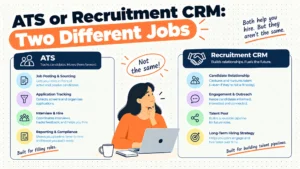
The CRM Hybrids. These platforms treat candidates like sales leads. They focus on two-way email sync. They build automated nurture sequences. This approach is right when your recruiters act like outbound sourcers hunting passive talent. It fails when your team just needs to process high volumes of inbound retail applications.
The Process Enforcers. These systems force discipline onto chaotic teams. They require multi-stage approval chains. They demand competency-based scoring criteria. This is right when you need to reduce unconscious bias across hundreds of interviewers. It fails when a ten-person startup needs to hire a developer by Friday.
The High-Volume Giants. These are massive talent clouds built for scale. They use knock-out question filtering. They feature automated application routing. This category is right when you process thousands of hourly worker applications per month. It fails completely for a mid-market tech firm making thirty highly specialized hires a year.
Five Diagnostic Questions
How mature is your sourcing strategy? Look at your candidate pipeline. Are you relying entirely on job board postings to find talent? If your recruiters spend hours manually tracking passive prospects in spreadsheets, your current setup is holding you back.
Do managers follow your interview scripts? Review the notes from your last five hires. You might find detailed competency assessments. You might find blank text boxes. If interviewers ask whatever questions pop into their heads, you’ve a compliance problem.
What is your true headcount trajectory? Look past the current quarter. A company scaling from 100 to 200 employees needs simple collaboration. A company absorbing an acquisition of 1,000 employees requires complex requisition approval workflows.
How much time goes into scheduling? Ask your recruiting coordinators to track their hours. Coordinating panel interviews takes a massive toll. If they spend forty percent of their week matching calendar availability, automation will pay for itself immediately.
Where does your data live? Check your analytics dashboards. Some teams have to export raw data into external visualization tools just to see source ROI. If you can’t pull a time-to-hire report by department in under a minute, you lack visibility.
The Nine Alternatives, Reviewed
Greenhouse
Greenhouse serves mid-size to large companies of 200 to 5,000 employees that prioritize fair hiring processes. It delivers the best interview-kit tooling on the market with competency-based questions and digital scorecards. Calibration sessions help your teams align on standards before extending offers. It earns its place through unbeatable structured interview tools. But implementation takes 6 to 8 weeks and the pricing on request is high for smaller teams.
Lever
Lever fits proactive talent teams of 100 to 2,000 employees who need a CRM-first approach alongside their ATS workflow. It automatically syncs all recruiter-candidate email conversations bidirectionally into candidate profiles. You can build passive talent pipelines using automated email sequences before roles even open. It earns its spot by providing the best visual Kanban pipeline view. But the reporting requires significant configuration and it focuses less on structured interview kits.
Workable
Workable suits growing companies of 10 to 500 employees that want to go live fast without paying per seat for every hiring manager. It distributes job listings to 200+ job boards from a single click. AI candidate sourcing accesses 400M+ profiles to find passive talent directly within the platform. It earns its recommendation through the fastest setup time of any ATS starting at $189/month with a 15-day free trial. However, it offers limited depth for enterprise recruiting and has less mature CRM features than Lever.
SmartRecruiters
SmartRecruiters targets large enterprises with over 1,000 employees running complex multi-brand or multi-country operations. It provides an end-to-end talent acquisition suite featuring a built-in hiring marketplace to connect with staffing agencies. Machine learning models rank applicants by fit based on job requirements to help recruiters prioritize high-potential candidates. It secures its place through strong compliance tools and large-scale audit capabilities. The downside is high enterprise pricing on request and highly complex configuration for smaller teams.
Ashby
Ashby is built for data-driven tech companies of 50 to 2,000 employees needing ATS and CRM functionalities in one system. It features automated interview scheduling with panel coordination and interviewer load balancing. It boasts the best analytics suite in the category for tracking funnel analysis or source ROI. It earns its spot by combining proactive pipeline management with deep recruiting analytics. But it has a less established brand than Greenhouse and some integrations are still in beta.
iCIMS
iCIMS is a proven talent cloud for enterprises with over 2,000 employees handling high-volume recruiting across multiple locations. It handles thousands of applications per month using automated routing and knock-out question filtering. Two-way TextRecruit SMS engagement dramatically improves response rates for hourly hiring. It earns its place through a massive enterprise track record and strong onboarding integration. Yet the interface feels dated compared to newer competitors and implementation cycles are notoriously long.
JazzHR
JazzHR is the most affordable option for small businesses of 5 to 100 employees making fewer than 50 hires per year. Starting at just $75/month with a 21-day free trial, it provides one-click job distribution to 50+ boards. You get a visual candidate pipeline with drag-and-drop stages and automated status updates. It earns a spot by being quick to learn without the complexity of mid-market platforms. The major weaknesses are limited reporting capabilities and poor scaling once a company passes 200 employees.
Jobvite
Jobvite works best for companies of 500 to 5,000 employees that treat employee referral programs as a core recruiting strategy. It features a branded referral portal where employees can browse open roles and generate trackable links. Predictive AI surfaces candidates from internal pipelines to help recruiters prioritize by fit score. It earns its place with top-tier referral management and strong employer branding tools. Unfortunately, the user interface is less modern than newer competitors and configuration is complex for small teams.
Pinpoint
Pinpoint targets in-house teams of 50 to 1,000 employees that use their employer brand as a true competitive advantage. It offers a fully customizable careers site builder with mobile-first design and team stories. Applicants get a branded portal to track their application status which reduces candidate ghosting. It earns a spot through best-in-class candidate experience tools and a highly modern interface. The drawback is a smaller market presence than Lever alongside less developed CRM functionality.
The Decision Table
| Situation | Scale | Setup | Primary Pain | Recommended Starting Point |
|---|---|---|---|---|
| High-volume inbound | 2000+ | Decentralized | Hourly worker drop-off | iCIMS |
| Proactive sourcing | 100-2000 | Centralized | Empty candidate pipeline | Lever |
| Chaotic interviews | 200-5000 | Fast-growing | Unconscious bias | Greenhouse |
| Simple collaborative | 50-500 | Manager-led | Poor team visibility | Recruitee |
| Small business | 5-100 | Basic | High software costs | JazzHR |
| Data-obsessed tech | 50-2000 | Centralized | Manual scheduling | Ashby |
The Cost of Getting This Wrong
Migration is a brutal test of organizational patience. The primary cost isn’t the software licence fee. The real cost is the political capital you burn with every hiring manager. When the new system launches, they expect perfection. Any missing features or broken calendar integrations will generate immediate resentment.
Your data integrity takes a massive hit during a botched transition. You lose the historical context of why a candidate was rejected three years ago. Nurture campaigns stop functioning. Recruiters fall back into old habits. They start tracking candidates on local hard drives to avoid the new software.
Bad software choices breed bad hiring decisions. The resulting delays frustrate engineering leaders. They eventually bypass the talent acquisition team entirely to hire contractors. Do you want to spend the next year managing software complaints or managing talent?
Ready to Move Beyond a Basic Setup
You will eventually hit the limits of a basic tracking system. Your business will demand better pipeline visibility. Your finance team will demand clearer ROI metrics. Moving to an enterprise suite requires careful planning.
We help teams understand exactly what they’re buying. The HROpsLab Editorial Team spends hundreds of hours testing software functionality. We interview real users to find out where these platforms break. We look past the marketing materials.
HROpsLab is an independent review publication. We sell nothing. We simply provide the data you need to make an informed decision. Our goal is to help you build a talent tech stack that actually works.
Frequently Asked Questions
How long does a typical migration take?
Implementation timelines vary wildly based on your organizational complexity. A simple transition to a small business tool might take two weeks. Moving to an enterprise suite like Greenhouse takes 6 to 8 weeks. You have to map out custom requisition workflows. You must migrate thousands of historical candidate records. Don’t rush this process.
Can we just negotiate a better price with our current vendor?
You can always ask for a discount at renewal time. A lower price tag doesn’t fix missing functionality. If you lack the advanced recruiting analytics your board demands, a twenty percent discount changes nothing. Base your decision on product fit rather than temporary savings.
Why are some prices not listed publicly?
Enterprise software vendors prefer custom quotes based on your specific requirements. They factor in your employee headcount. They look at your required integrations. When a vendor states pricing on request, they want to understand your usage volume before committing to a number.
Do we really need AI sourcing?
Artificial intelligence can’t close a senior engineer for you. It can reduce the hours your recruiters spend reading completely unqualified resumes. Machine learning models rank applicants by fit based on historical hiring data. This helps your team prioritize high-potential candidates in large applicant pools.
What happens to our historical candidate data?
Data migration is the most dangerous part of switching systems. You will likely export your existing records as massive spreadsheet files. The new vendor maps these fields to their database architecture. Some context inevitably gets lost during this translation phase.
Should we let finance choose the software?
Finance teams naturally optimize for the lowest per-seat cost. They don’t understand the daily workflow of a technical recruiter. A cheap tool that requires ten extra clicks per candidate will cost you far more in wasted productivity. Talent acquisition must own the final decision.
Choose the hiring platform that fits your actual process today.