

TL;DR
- The core decision: You’re weighing whether to migrate from a system built for employer branding to one focused strictly on structured interviews or advanced talent pipelining.
- When staying put is right: Stick with your current setup if your company has between 50 and 1,000 employees and you treat your employer brand as a competitive advantage.
- What an applicant tracking system actually has to do: It must enforce a consistent hiring workflow across every recruiter and department.
- How this market splits: The alternatives fall into heavy enterprise suites, CRM-first sourcing tools, or quick-setup platforms for smaller businesses.
- A decision rule: Change your software only if your current technical pain points cost more time than a six-month data migration.
- The outcome to expect: You will see a temporary drop in hiring manager compliance followed by better reporting and specialized sourcing workflows.
| Tool | Rating | Pricing | Free trial | Best for |
|---|---|---|---|---|
| Pinpoint (your current tool) | 4.2 / 5 | Pricing on request | Free demo available | Best ATS for employer branding-led hiring |
| Greenhouse | 4.7 / 5 | Pricing on request | Free demo available | Best ATS for structured, bias-reduced hiring |
| Lever | 4.6 / 5 | Pricing on request | Free demo available | Best CRM + ATS for proactive talent teams |
| Workable | 4.5 / 5 | From $189/month | 15-day free trial | Best easy-to-use ATS with built-in sourcing |
| SmartRecruiters | 4.4 / 5 | Pricing on request | Free demo available | Best enterprise ATS for complex hiring operations |
| Ashby | 4.6 / 5 | Pricing on request | Free demo available | Best ATS for data-driven, high-performance teams |
| iCIMS | 4.3 / 5 | Pricing on request | Free demo available | Best ATS for large enterprise talent operations |
| JazzHR | 4.2 / 5 | From $75/month | 21-day free trial | Best affordable ATS for small businesses |
| Recruitee | 4.1 / 5 | From $224/month | 18-day free trial | Best ATS for collaborative, team-based hiring |
| Jobvite | 4 / 5 | Pricing on request | Free demo available | Best ATS with referral and employer branding tools |
The Tuesday Morning Interrogation
It’s Tuesday morning. Your CFO has just noticed the annual software renewal for Pinpoint and called a quick sync. They want to know why the talent team needs this specific tool when a cheaper vendor just emailed them a highly compelling pitch. You’re sitting there with a coffee that went cold an hour ago. You know exactly what a platform migration actually means in practice.
You’ve lived through an applicant tracking system rollout before. You remember the endless data mapping and the angry hiring managers. The thought of ripping out a perfectly functional careers site builder to save a few dollars fills you with absolute dread. Your hiring managers finally know how to use the candidate experience portal. Candidates are actually tracking their application status instead of flooding your team’s inbox with check-in emails.
But finance is pressing for answers. And deep down, you know your recruiters are complaining loudly about the lack of CRM functionality. They want to build passive talent pools before roles even open. The real issue isn’t the renewal cost. The real issue is whether your current talent strategy has simply outgrown a brand-first platform.
Best tools for Applicant Tracking (ATS)
When to Stay Put
Sometimes your setup is genuinely fine. Pinpoint currently holds a 4.2 out of 5 rating and ranks tenth overall for very good reasons. It works beautifully for in-house teams of 50 to 1,000 employees who rely heavily on a strong employer brand. If your modern careers site is converting candidates and your team loves the customisable hiring stages, don’t touch a thing. You already have the specific tools needed to stop candidate ghosting.
Then you hit the friction stage. Your recruiters start asking for two-way email sync. Your sourcing team wants automated nurture sequences. They start tracking passive candidates in external spreadsheets because the primary ATS can’t handle complex pipeline building. This is annoying. It isn’t yet fatal. You can usually patch this gap with a standalone sourcing tool.
Real liability hits when your hiring managers actively stop trusting the system. If they’re bypassing the structured feedback forms to send you Slack messages, you’ve a massive process failure. When your leadership team demands cross-department interview calibration and your current scorecards can’t deliver it, you’re actively losing quality hires to faster companies.
The edge case is explosive growth. If you suddenly need to hire across multiple countries with vastly different compliance rules, your basic needs change. A mid-market tool will buckle under that immense pressure. But unless you’re hitting that specific wall, an ATS migration will burn goodwill you can’t easily buy back.
Midnight Doubts
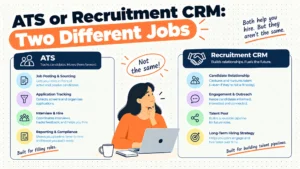
Can we just build a CRM process in our current system? No. An applicant tracking system assumes a candidate applied for a specific job. A CRM assumes you’re talking to someone who might be ready in six months. Forcing one to do the job of the other ruins your reporting data completely.
Will a new tool magically fix our interviewing culture? It won’t. Software simply enforces rules. If your managers refuse to submit structured feedback today, buying a tool with better scorecards just gives them a fancier digital form to ignore.
How much downtime are we actually looking at? Expect four to eight weeks of dual-system chaos. You’ll pay for both licences simultaneously. Your recruiters will hate the transition period as they manually move active pipelines.
Should we buy an enterprise suite just in case we grow? Absolutely not. Buying for five years in the future means you pay premium enterprise prices for features your 200-person team can’t use today.
Is our careers site really that important? Yes. If you switch to a system with a generic job board look, your application conversion rate will drop noticeably. You will likely need to hire a web developer to rebuild what you currently have out of the box.
How the Market Actually Splits
The Interview and CRM Heavyweights These platforms focus strictly on proactive sourcing and rigorous interview structuring. Tools in this bracket assume your recruiters hunt for passive talent. They force your hiring managers into strict competency-based scoring. This category is right when your primary goal is reducing bias or building long-term talent pipelines. It fails entirely if your company makes fewer than fifty hires a year. The high cost will simply crush a smaller talent budget.
The Enterprise Talent Suites This category handles immense scale. These systems manage multi-brand careers sites and vendor marketplaces in one place. They’re right when you’ve well over a thousand employees and complex compliance requirements across different global business units. They fail miserably for agile mid-market companies. The implementation cycles drag on for months. The interfaces often feel visibly dated compared to newer tools.
The Agile and Sourcing-Led Systems These tools prioritise speed above all else. They offer one-click job board posting and flat pricing structures. They’re right when you need to get an ATS live fast without paying per seat for every hiring manager. They fail when your recruiting operations mature. If you need advanced source ROI analytics or complex requisition approval workflows, these platforms will frustrate your talent operations team.
Evaluate Your Current Reality
Are your recruiters spending more time formatting interview scorecards than talking to candidates? If your current structured hiring workflows require manual enforcement, you’ve a severe process bottleneck. Tools with pre-built interview kits solve this problem immediately.
Do you currently pay extra for LinkedIn Recruiter? Some alternatives include AI candidate sourcing that accesses millions of profiles directly. If your team relies heavily on expensive external sourcing licences, bringing that capability inside the ATS offsets the migration cost entirely.
Are your hiring managers complaining about the scheduling burden? When coordinators spend hours playing calendar Tetris for panel interviews, you lose candidates to faster competitors. Automated scheduling with capacity load balancing is a feature truly worth paying for.
How many hires do you actually make a year? A company making twenty hires doesn’t need multi-stage requisition approval workflows. Buying a system designed for high-volume screening tools will just add admin overhead to a highly simple process.
Does your leadership demand custom reporting? If your executives want time-to-hire breakdowns by department and interviewer calibration scores, a basic visual pipeline won’t cut it. You need a platform built around advanced recruiting analytics.
The Nine Alternatives, Reviewed
Greenhouse
Greenhouse positions itself as the best ATS for structured, bias-reduced hiring. Ranked #1 of 10 with a 4.7/5 rating, it earns its place by offering the best interview-kit tooling on the market for companies of 200 to 5,000 employees. You get custom interview guides with competency-based questions and digital scorecards that capture structured feedback. Pricing is on request, and they offer a free demo. The weakness is the exceptionally high cost for smaller teams. Implementation can easily take six to eight weeks before you see any real value.
Lever
Lever is the best CRM and ATS combination for proactive talent teams. Ranked #2 of 10 with a 4.6/5 rating, it fits companies of 100 to 2,000 employees that need to build passive pipelines before roles open. The two-way email sync automatically pulls all recruiter conversations into candidate profiles without manual logging. Pricing is on request, with a free demo available. However, the reporting features require significant configuration out of the box. It’s also distinctly less focused on structured interview kits.
Workable
Workable stands as the best easy-to-use ATS with built-in sourcing capabilities. Ranked #3 of 10 with a 4.5/5 rating, it suits growing companies of 10 to 500 employees that want fast setup and no per-seat fees. The People Search feature gives you AI matching across over 400 million candidate profiles without leaving the platform. Pricing starts from $189/month, and they offer a 15-day free trial. Its weakness lies in limited depth for heavy enterprise recruiting operations. The CRM features are distinctly less mature than Lever.
SmartRecruiters
SmartRecruiters serves as the best enterprise ATS for complex hiring operations. Ranked #4 of 10 with a 4.4/5 rating, it handles attraction and screening across multiple brands for companies with over 1,000 employees. The built-in hiring marketplace lets you connect to staffing agencies and sourcing vendors without managing separate contracts. Pricing is on request, with a free demo available. But it requires highly complex configuration for smaller teams. The high cost at enterprise scale will shock a finance leader used to mid-market pricing.
Ashby
Ashby is the best ATS for data-driven, high-performance talent teams. Ranked #5 of 10 with a 4.6/5 rating, it combines candidate tracking and deep recruiting analytics in a single platform for companies of 50 to 2,000 employees. The funnel analysis and time-to-hire breakdowns represent the best analytics suite in the ATS category. Pricing is on request, with a free demo available. Yet it has a far less established brand presence than Greenhouse or Lever. Some integrations are still in beta, which might frustrate a highly connected tech stack.
iCIMS
iCIMS acts as the best ATS for large enterprise talent operations. Ranked #6 of 10 with a 4.3/5 rating, it supports high-volume recruiting needs across multiple locations with automated application routing and AI candidate ranking. The TextRecruit SMS feature dramatically improves response rates for hourly hiring through two-way text messaging. Pricing is on request, with a free demo available. Its interface feels visibly dated compared to newer competitors. You also have to survive incredibly long implementation cycles to get the modular talent cloud working.
JazzHR
JazzHR is the best affordable ATS for small businesses making fewer than fifty hires a year. Ranked #7 of 10 with a 4.2/5 rating, it offers a very affordable entry point for companies of 5 to 100 employees. You get one-click job board distribution to over 50 boards including Indeed, LinkedIn, and Glassdoor. Pricing starts from $75/month, and they offer a 21-day free trial. It falls down completely on reporting and analytics. It’s genuinely less suited for companies scaling past 200 employees.
Recruitee
Recruitee is the best ATS for collaborative, team-based hiring. Ranked #8 of 10 with a 4.1/5 rating, it works well for companies up to 500 employees where hiring managers need a clean interface to leave structured feedback and see peer opinions. The drag-and-drop careers page builder lets you launch an employer brand presence without a web developer. Pricing starts from $224/month, and they offer an 18-day free trial. It struggles heavily with advanced analytics features. It simply isn’t built for enterprise scale or complex multi-national compliance.
Jobvite
Jobvite is the best ATS for teams heavily invested in referral and employer branding tools. Ranked #9 of 10 with a 4/5 rating, it gives companies of 500 to 5,000 employees a branded referral portal where employees generate trackable links without HR coordination. The predictive AI surfaces candidates from internal pipelines and external job boards to help recruiters prioritize. Pricing is on request, with a free demo available. The user interface is much less modern than newer competitors. Smaller teams will find it too complex to configure effectively.
The Decision Table
| Situation | Scale | Setup | Primary Pain | Recommended Starting Point |
|---|---|---|---|---|
| Need to eliminate bias | 200 – 5,000 employees | In-house TA | Inconsistent interviewer feedback | Greenhouse |
| Proactive talent sourcing | 100 – 2,000 employees | Heavy outbound | Candidates ghosting emails | Lever |
| Need fast deployment | 10 – 500 employees | Lean HR | Paying extra for LinkedIn | Workable |
| Focus on employer brand | 50 – 1,000 employees | Brand-led TA | Generic job board look | Pinpoint |
| High-growth tech hiring | 50 – 2,000 employees | Data-focused | Coordinator scheduling overload | Ashby |
| Multi-brand complexity | 1,000+ employees | Enterprise | Managing vendor contracts | SmartRecruiters |
| High-volume hourly hiring | 2,000+ employees | Multi-location | Slow response times | iCIMS |
| Small business hiring | 5 – 100 employees | Hiring managers | Expensive ATS licences | JazzHR |
The True Cost of Migration Failure
When an applicant tracking system migration fails, the initial licence fee is the smallest part of the financial damage. The real cost hides in the second-order effects. Your talent acquisition team spends three months manually moving candidate data instead of closing open requisitions. Time-to-hire balloons. Agency spend spikes dramatically because your internal recruiters are too busy troubleshooting software to actually source talent. The business misses its quarterly headcount targets completely.
You also burn massive political capital with your hiring managers. When you ask a sales director to learn a new tool, they expect it to save them time immediately. If the new system requires more clicks to approve a job description or submit a scorecard, they will simply refuse to log in. You end up chasing feedback via email, destroying the structured hiring data you bought the system to capture in the first place.
So before you sign a new software contract, look at your existing setup closely. Are you actually outgrowing your current ATS, or are your hiring managers just refusing to use the tools they already have?
Moving Beyond the Basics
Making the right choice requires seeing past the slick sales presentations. Every vendor will show you a perfectly configured dashboard loaded with dummy data. They will all promise high adoption rates and easy integrations. But the reality of running talent operations is always messier than a software demo. You need to know how these systems behave when a hiring manager enters conflicting feedback or an integration suddenly breaks.
This is where independent analysis changes the game completely. HROpsLab provides deep, vendor-neutral reviews of human resources technology. We dig into the reality of implementation timelines and reporting capabilities. We talk to the talent leaders who actually use these platforms every day to find out where the software shines and where it creates massive bottlenecks.
Our team spends hundreds of hours evaluating ATS platforms so you don’t have to. We test the built-in sourcing tools. We evaluate the true complexity of the approval workflows. We map out exactly which systems fit specific company sizes and hiring strategies. HROpsLab sells nothing. We just give you the raw data you need to make a defensible decision for your talent team.
Frequently Asked Questions
How long does it take to migrate from Pinpoint?
You should plan for four to eight weeks of transition time depending on the size of your active candidate database. Your IT team needs to map historical candidate records to the new system architecture carefully. You will run both systems simultaneously during this period. Training your hiring managers on the new interface adds at least two weeks to the rollout schedule.
Do we need a separate CRM if we buy a mid-market ATS?
It depends entirely on your new vendor. Platforms like Lever and Ashby include highly capable talent CRM features natively in their software. If you choose a system heavily indexed on structured interviewing like Greenhouse, you might eventually need a dedicated sourcing tool. Always assess your team’s outbound volume before assuming an ATS can handle complex nurture campaigns natively.
Why do enterprise systems cost so much more?
Enterprise platforms like SmartRecruiters and iCIMS price for extreme complexity and massive scale. They include advanced compliance features, multi-brand careers site management, and server allocation for high-volume screening. You’re paying for the ability to manage thousands of applications per month across dozens of global legal entities. A 200-person company simply doesn’t need that level of architectural overhead.
Can we keep our current careers site if we switch ATS?
You can keep your external website, but you’ll lose Pinpoint’s specific careers site builder functionality. If your marketing team built your current careers page using standard web tools, you just point the apply buttons to your new ATS. If you rely entirely on your current vendor for team stories and department pages, you must rebuild those assets from scratch. This almost always requires hiring a web developer.
Will a new system stop candidates from ghosting us?
Software can’t fix a broken communication process. An ATS with automated status updates helps keep candidates informed, but it can’t write a compelling offer letter or conduct a respectful interview. If your interview process drags on for six weeks, candidates will drop out regardless of which platform tracks their application. Fix your internal process speed first.
How do we get hiring managers to adopt the new tool?
You involve them in the buying process early. Show a skeptical hiring manager the automated interview scheduling or the digital scorecards during the trial phase. If you choose a system that objectively reduces their administrative burden, they will use it. If you choose a tool that only benefits the HR reporting function, you’ll fight an uphill battle for adoption forever.
We give you the unvarnished truth about HR software so you can build teams that win.