TL;DR
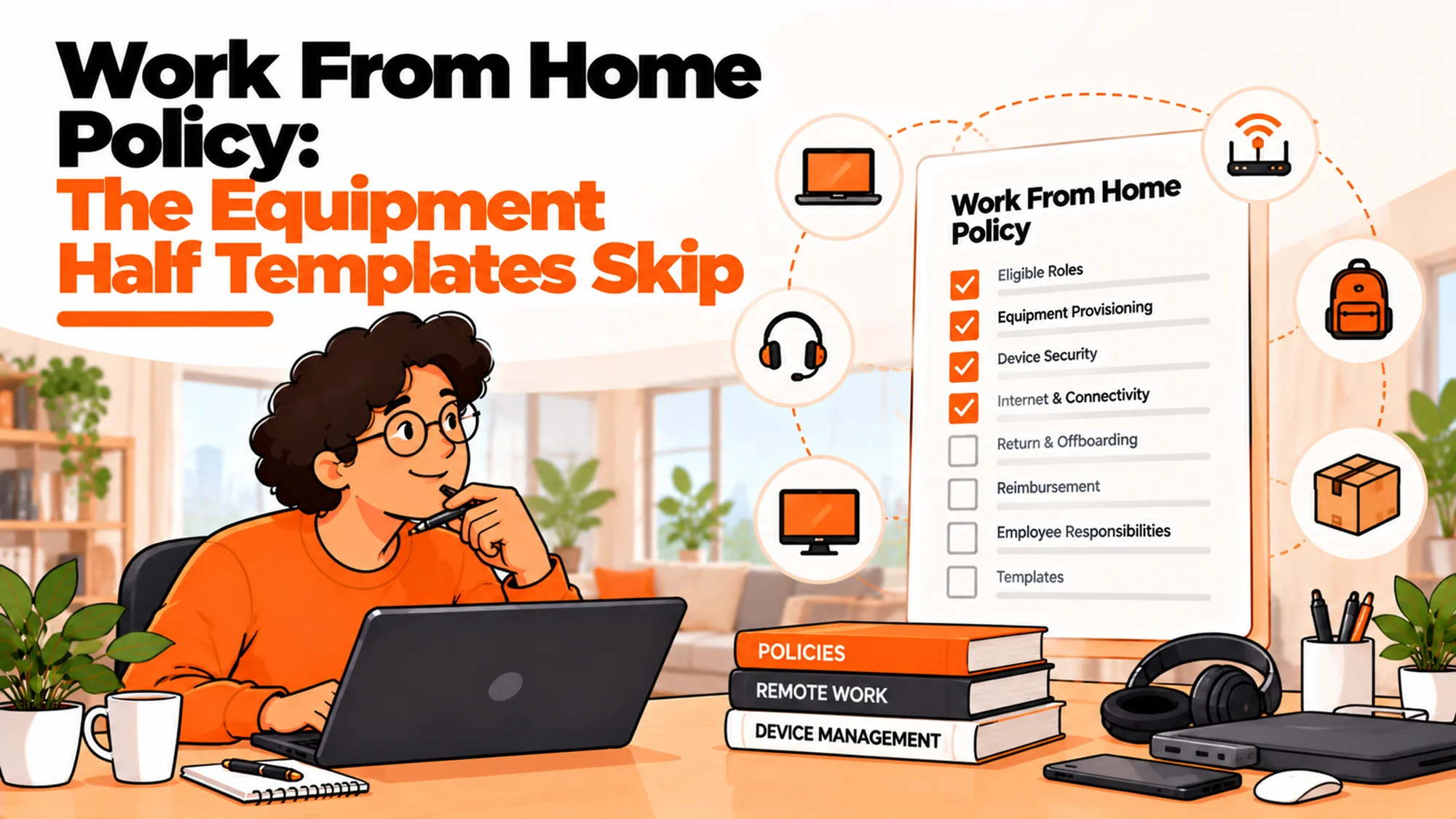
A work from home policy usually covers hours, communication, health and safety and expenses well, then handles equipment in a single vague sentence. That sentence is where the disputes come from. Six clauses close it: ownership, provision, allowance, damage, loss and return.
- Equipment disputes come from ambiguity, not from the money involved.
- Say whether an allowance buys company property or personal property.
- Decide the damage position before an incident, never during one.
- A return clause should name the process, not only the obligation.
- Scope health and safety honestly. You cannot inspect a home.
- Review the equipment clauses first, because they drift furthest from practice.
When a short version is enough
Four stages, and the first two do not need much.
Occasional home working. People are mostly in an office and sometimes at home. A paragraph in the handbook is proportionate, because the equipment question barely arises.
Best tools for HR Operations
Hybrid by default. Equipment now moves between two places and gets damaged in transit. Worth stating who provides what and what happens when something breaks.
Remote by default. The home is the primary workplace. Everything in this article applies, and the equipment section stops being an afterthought.
Remote across countries. Allowances, tax treatment and return logistics all differ by market. The core policy needs local annexes rather than one wording stretched across everywhere.
Why the work from home policy equipment section is thin
Templates are written by people who think about employment terms, and equipment sits awkwardly between HR, IT and finance. It ends up in whichever document somebody remembered, which is often none of them.
There is a second reason. The other sections describe behaviour, which is easy to write about in general terms. Equipment describes property, and property questions have answers that cost money, so they get deferred.
The cost of deferring is predictable. Every unanswered question becomes a case somebody handles individually, inconsistently, under time pressure. Two people leave the same month and get different treatment on a damaged laptop, and now you have a fairness problem on top of an asset problem.
It is worth noting these clauses interact with other documents. Asset handling expectations under ISO/IEC 27001 assume an organisation can account for equipment and recover it, and guidance for home and remote working published by the National Institute of Standards and Technology covers the security side of the same ground. If your work from home policy contradicts either, the contradiction will be found eventually.
The six equipment clauses worth writing
- Ownership. State that company-provided equipment remains company property during and after employment. One sentence, and the foundation for the other five.
- Provision. What the company supplies as standard. A list prevents the negotiation that otherwise happens with every hire.
- Allowance. If you pay a stipend, say what it covers and who owns what it buys. This is the single most common gap.
- Damage. What to report, how quickly, and whether cost is ever recovered from the employee. Decide the principle now.
- Loss and theft. Separate from damage, because the data question is different and the reporting urgency is higher.
- Return. Who initiates, by when, through what process, and what follows if the device does not come back.
Six short paragraphs. The test for each is whether a manager could apply it without asking HR, because clauses that always need interpretation are not really policy.
Five questions to settle before drafting
Allowance or provision? Pick one as the default. Mixing both without rules creates most of the confusion.
Who owns stipend-bought equipment? Answer this explicitly, in writing, before anybody asks.
Will you ever recover damage costs? If the honest answer is no, say nothing about recovery rather than implying it.
Who initiates a return? A named role, triggered by the exit, not whoever notices.
Can you actually collect from every country you employ in? If not, the return clause is aspirational and you should know that before writing it.
How teams handle equipment, and the trade-offs
Company provides everything. Best for consistency, security and recovery, because ownership is never in doubt. It struggles on cash and on choice, since people get a standard machine rather than a preferred one.
A one-off setup allowance. Best for flexibility and simplicity to administer. It struggles badly on ownership and return, because people reasonably treat what they bought as theirs.
Allowance with ownership retained. Best on paper, worst in practice unless written very clearly, since you are asking somebody to buy something they do not own.
Bring your own device. Best for cost and for people who prefer their own setup. It struggles on security and on separation of personal and company data, which needs its own policy.
Company provision through a lifecycle service. Disclosure: RemoAsset is owned by the same people who publish this site. It handles procurement, delivery, retrieval and wiping across 80 or more countries, which matters to this policy because the return clause only works where collection is possible. Where it struggles: it is a logistics service, so it has nothing to say about allowances, tax treatment or employment terms, which remain yours. The narrow thing it changes is whether the return clause is deliverable in every market you hire in.
The decision table
| Situation | Scale | Setup | Primary pain | Recommended starting point |
|---|---|---|---|---|
| Occasional home working | Any | Office based | Barely arises | One paragraph in the handbook |
| Hybrid by default | 50 plus | One HR owner | Kit moving and breaking | Provision and damage clauses |
| Remote by default | Any | No office | Ownership unclear | All six clauses, provision model |
| Stipend already in place | Any | Any | Nobody knows who owns what | Write ownership retrospectively, tell people |
| Several countries | 100 plus | HR team | Tax and return differ | Core policy plus local annexes |
| Equipment rarely returned | Any | Any | Return clause is aspirational | Fix collection before rewording |
What the missing clauses cost
The first cost is individual negotiation. Without a written position, every damaged laptop and every exit becomes a conversation, and conversations take manager time and produce inconsistent outcomes.
The second is the stipend problem, which is the most common and most avoidable. A company pays an allowance, somebody buys a laptop, and two years later nobody can say whose it is. The employee believes it is theirs, which is a reasonable reading of what happened, and the company believes otherwise. Neither party is being unreasonable and the document should have settled it.
The stipend problem has a second edge that shows up at scale. If people buy their own machines, you end up with a fleet of twenty different models on twelve different operating system versions, bought in nine countries, with warranties held by the individual rather than the company. Nobody decided that. It is the accumulated result of a sentence that was never written, and it surfaces the first time you need to patch everything quickly or prove what you hold.
The third is unequal treatment. Two people in similar situations handled differently by different managers is a fairness issue that outlasts the equipment question, and it is harder to defend than any policy would have been.
The fourth is quiet and cumulative: machines that never come back because nothing obliged them to. Each is small. The list is not.
So the question is not whether your policy covers working from home. It is whether somebody reading it could tell you who owns the laptop they are typing on.
When the policy needs an operational route
A return clause is a commitment that equipment comes back. That commitment is only credible where collection is actually possible.
Three signals say it is currently not. You cannot list which device is with which person. The last few returns from outside your main market were difficult or did not happen. And the return process depends on somebody remembering rather than on the exit itself.
A fourth signal is quieter and easier to miss. Returns happen, but they take weeks, and nobody can say what the expected timeframe should be, so nobody can say whether three weeks is normal or bad. A clause with no stated timeframe cannot be measured against, which means it cannot be improved either.
Those are operational rather than drafting problems, and rewording will not touch them. What closes them is an accurate record and one route that works wherever you employ people.
It is worth checking before the next policy revision, because a clause you cannot deliver is worse than one you never wrote: it creates an expectation you then fail. Seeing how provision and return work as one process answers whether the gap is in the wording or underneath it.
See how equipment return works across markets
Read our guide to equipment stipends
Related reading
- Equipment stipends, and what they buy
- Writing an employee equipment policy
- Remote work equipment, practically
- What to do about unreturned equipment
- Device allowances and tax
Frequently Asked Questions
What should a work from home policy cover?
Hours and availability, communication expectations, health and safety, expenses, and equipment. The first four are well served by templates. The fifth is usually one vague sentence, which is why equipment generates most of the disputes that reach HR.
Who should pay for home equipment?
Decide and write it down, because the dispute comes from ambiguity rather than from the amount. The two workable models are company-provided equipment that stays company property, or a stated allowance with clear ownership. Mixing them without saying which applies to what causes the trouble.
Does a stipend change who owns the laptop?
It can, and that is exactly why it must be stated. If the company pays, the default assumption of many employees is that the item is theirs. Say explicitly whether an allowance buys company property or personal property, because retrieval later depends entirely on that sentence.
What about damage at home?
Write the position before an incident. State what should be reported, how quickly, and whether any cost falls to the employee. Deciding during a dispute looks punitive whatever you choose, and inconsistent handling across managers is worse than a slightly strict rule applied evenly.
Do we need a return clause?
Yes, and it should name the process rather than just the obligation. A clause saying equipment must be returned is weak if nobody can arrange a collection. State who initiates it, the expected timeframe and what happens if the device is not returned.
Should the policy mention health and safety?
Include it, scoped honestly. You cannot inspect somebody’s home, so the realistic version is guidance on setting up safely, a route to request adjustments, and a record that this was offered. Overclaiming supervision you do not perform helps nobody.
How often should it be reviewed?
Annually, and whenever your working pattern shifts materially. Policies written during a sudden move to remote work often describe a temporary arrangement that became permanent, and they age badly. Check the equipment clauses first, since those drift furthest from practice.