TL;DR
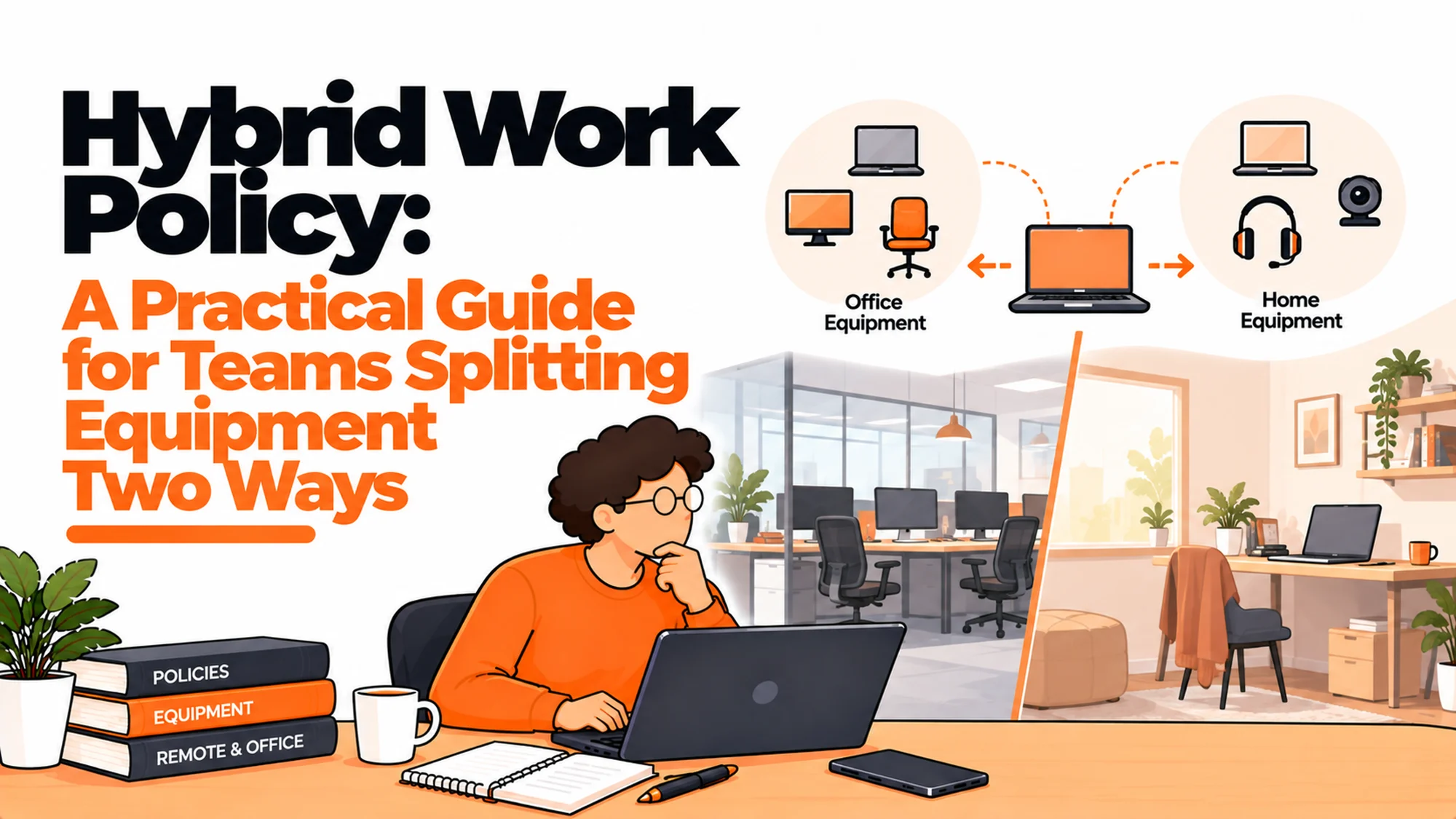
A hybrid work policy usually settles which days people come in and then goes quiet on the thing that generates the most tickets: equipment in two places. Five clauses close it, and the expensive decision is whether peripherals get duplicated.
- Decide the peripheral principle once, not per request.
- Separate assigned equipment from shared desk equipment in the register.
- Transit damage is a real category. Record it as one.
- Say explicitly how fully remote staff differ.
- Track attendance only if you will act on it.
- Review the equipment clauses first. They age fastest.
When a short version is enough
Four stages, and only the last two need detail.
Everyone in most days. People occasionally work from home and nothing about equipment changes. A paragraph is proportionate.
Best tools for HR Operations
Split roughly evenly. Now people carry hardware twice a week, desks are shared, and the questions start. This is where the gap first shows up.
Mostly remote with office days. The home setup is primary and the office is the exception, which inverts the usual assumption in templates and needs saying.
Mixed arrangements across countries. Office access, equipment norms and costs all differ by market, so one wording stretched everywhere produces unequal outcomes nobody intended.
Why the hybrid work policy equipment clause is missing
Hybrid policies are written to answer a question about presence: how often people are expected in. That question is contested and emotive, so it absorbs all the attention, and the document ships once it is settled.
Equipment then arrives as a stream of individual requests. Somebody wants a second monitor at home. Somebody else carries a laptop in every day and wants a bag. A third person finds the office dock does not fit their machine. Each is handled on its own, by whoever is asked, and the outcomes differ for no principled reason.
There is a structural reason too. Presence costs nothing to write about. Peripherals cost money per person, and duplicating them across two locations is the single largest line item hybrid working adds. Deferring that decision is rational in the moment and expensive across a year.
Health and safety guidance for display screen equipment, such as the material published by the Health and Safety Executive, assumes a workstation somebody can actually set up properly. Under hybrid working there are two, and only one is within your sight. That does not change the duty; it changes how you discharge it, which is worth a sentence rather than silence.
It also helps to be clear about what kind of document this is. Guidance on hybrid arrangements from Acas distinguishes between an informal expectation and a contractual change, and the distinction matters here: a policy that describes equipment provision as a standard is easier to adjust later than one written into individual terms. Keep the logistics in the policy and out of the contract unless you intend them to be permanent.
The five clauses that close it
- The peripheral principle. One standard: duplicated, shared in the office, or an allowance. Pick it and apply it evenly.
- The carry arrangement. Whether a bag is provided, and how transit damage is reported and treated.
- Office desk standard. What a shared desk has, and that the docks match the laptops you issue. This one is checked least and breaks most.
- Home setup support. What is provided, how adjustments are requested, and who decides. Scope it honestly, since you cannot inspect a home.
- Return and change. What happens to equipment at both locations when somebody moves role, moves country or leaves.
Each is short. The test for each is whether a manager could answer a request without escalating, because the clauses exist to stop the stream of individual decisions.
Five questions to settle first
Duplicate, share or allowance? This is the cost decision and everything else follows from it.
Do your docks fit your laptops? Check before writing a desk standard, not after buying forty docks.
Who owns the shared equipment in the office? A named role, or it degrades until somebody complains.
How will accessibility adjustments be routed? Not through the same queue as a monitor upgrade. That conflation is the most damaging design error here.
Can you recover equipment from both locations? If the home half is uncertain, the return clause is only half true.
Equipment models, and the trade-offs
Duplicate everything. Best for the experience and for people who move between locations daily. It struggles on cost, which is roughly double on peripherals, and on the register, since every person now holds two sets.
Shared desks with docks. Best for cost control and for a tidy office. It struggles when the standard is not enforced, because one incompatible laptop model turns a hot desk into a useless desk.
Laptop only, carried both ways. Best for simplicity and for the register. It struggles on ergonomics and on transit damage, which rises with the number of journeys.
An allowance for the home end. Best for flexibility and for avoiding procurement work. It struggles on ownership, since people reasonably treat what they bought as theirs, which matters at the return clause.
A lifecycle service handling both ends. Disclosure: RemoAsset is owned by the same people who publish this site. It handles procurement, delivery, retrieval and certified wiping across 80 or more countries, which touches this policy where the return clause meets the home location. Where it struggles: it will not manage your office desk standard, your lease or your attendance expectations, which are the parts most hybrid debates are actually about. The narrow thing it changes is whether equipment reaches people and comes back without somebody coordinating couriers by hand.
The decision table
| Situation | Scale | Setup | Primary pain | Recommended starting point |
|---|---|---|---|---|
| Mostly in the office | Any | One site | Barely arises | One paragraph on equipment |
| Even split | 50 plus | Shared desks | Individual requests pile up | Write the peripheral principle |
| Mostly remote, office days | Any | Small office | Templates assume the reverse | Home is primary, office is the exception |
| Docks and laptops mismatched | Any | Hot desks | Desks unusable for some | Fix the standard before the wording |
| Several countries | 100 plus | HR team | Unequal outcomes | Core policy plus local annexes |
| Equipment rarely returned | Any | Any | Return clause half true | Fix recovery, then reword |
What the gap costs
The first cost is manager time, spent repeatedly on the same decision. Without a principle, every monitor request is a small negotiation, and the people who ask most confidently get the most equipment. That is not a defensible basis for allocation.
The second is duplicated spend you never approved. Peripherals bought one at a time, from different places, at different prices, do not look like a budget line until somebody adds them up at the end of the year. By then the money is gone and the inventory is unrecorded.
The third is the register problem. Hybrid working roughly doubles the number of items in play while leaving the record designed for one set per person. A docking station on a shared desk, a monitor at somebody’s home and a laptop that moves between both are three different things, and most registers treat them as one or omit two.
The fourth is the accessibility failure, which is the most serious and the least visible. If an adjustment request routes through the same queue as a general upgrade request, it waits behind preferences. That is a bad outcome produced by a process choice rather than by anybody’s intent.
So the test is not whether your policy explains how many days people come in. It is whether somebody asking for a second monitor gets the same answer whoever they ask.
When the policy needs a working process
A return clause commits you to recovering equipment from two places. The office half is easy. The home half is where it quietly fails.
Three signals say the process is weaker than the wording. You cannot list what is at somebody’s home as distinct from what is at their desk. Returns from outside your main market took weeks or did not happen. And equipment recovery starts when somebody notices rather than when the exit is recorded.
Those are operational rather than drafting problems. More precise wording does not reach them, and a stricter clause you cannot deliver creates an expectation you then fail to meet.
Worth checking before the next policy review, because the home half of a hybrid fleet is the half nobody can see. Looking at how collection from home addresses actually works settles whether the gap is in the policy or underneath it.
See how equipment is collected from home addresses
Read our guide to hybrid equipment returns
Related reading
- Hybrid equipment returns
- The employee equipment policy
- Remote work equipment, practically
- Handling accessibility requests
- Device policy in the handbook
Frequently Asked Questions
What does a hybrid work policy need to cover?
Which days are expected in the office, how that is agreed, what happens when plans change, and the equipment arrangement at both locations. The first three are usually written well. The fourth is where the open questions pile up, because it costs money to answer properly.
Should people get two monitors?
Decide the principle rather than approving case by case. Duplicating peripherals at both locations is the most expensive option and also the one people prefer. Shared desks with docking stations in the office is the usual compromise, and it works if the standard laptop port selection actually matches the docks you buy.
Who carries the laptop?
The employee, which sounds obvious until you consider damage in transit and bags. A carrying case is a small cost that prevents a recurring one. Say whether a bag is provided, and record transit damage as its own category so you can see whether the pattern is a real problem.
How do hot desks and asset records interact?
Badly, unless you separate assigned and shared equipment in the register. A docking station on a hot desk belongs to the desk; the laptop belongs to the person. Recording both the same way means nobody can answer who is responsible when something stops working.
What about people who are fully remote?
Say so explicitly in the same document, with a different equipment arrangement. A policy that treats everyone as hybrid leaves fully remote staff reading rules that do not apply to them, and the gaps are filled by whoever asks loudest rather than by a decision.
Does office attendance need to be tracked?
Only if you will act on it, otherwise collecting the data creates an expectation you then ignore. If attendance matters, say what happens when it is not met. If it does not matter enough to act on, write a looser expectation and save the monitoring effort.
How often should it be reviewed?
Annually at least, and whenever the office footprint changes. Most hybrid policies were written when a lease assumed one headcount and now describe a building that holds a different number of desks. The equipment clauses age fastest, so check those first.