TL;DR
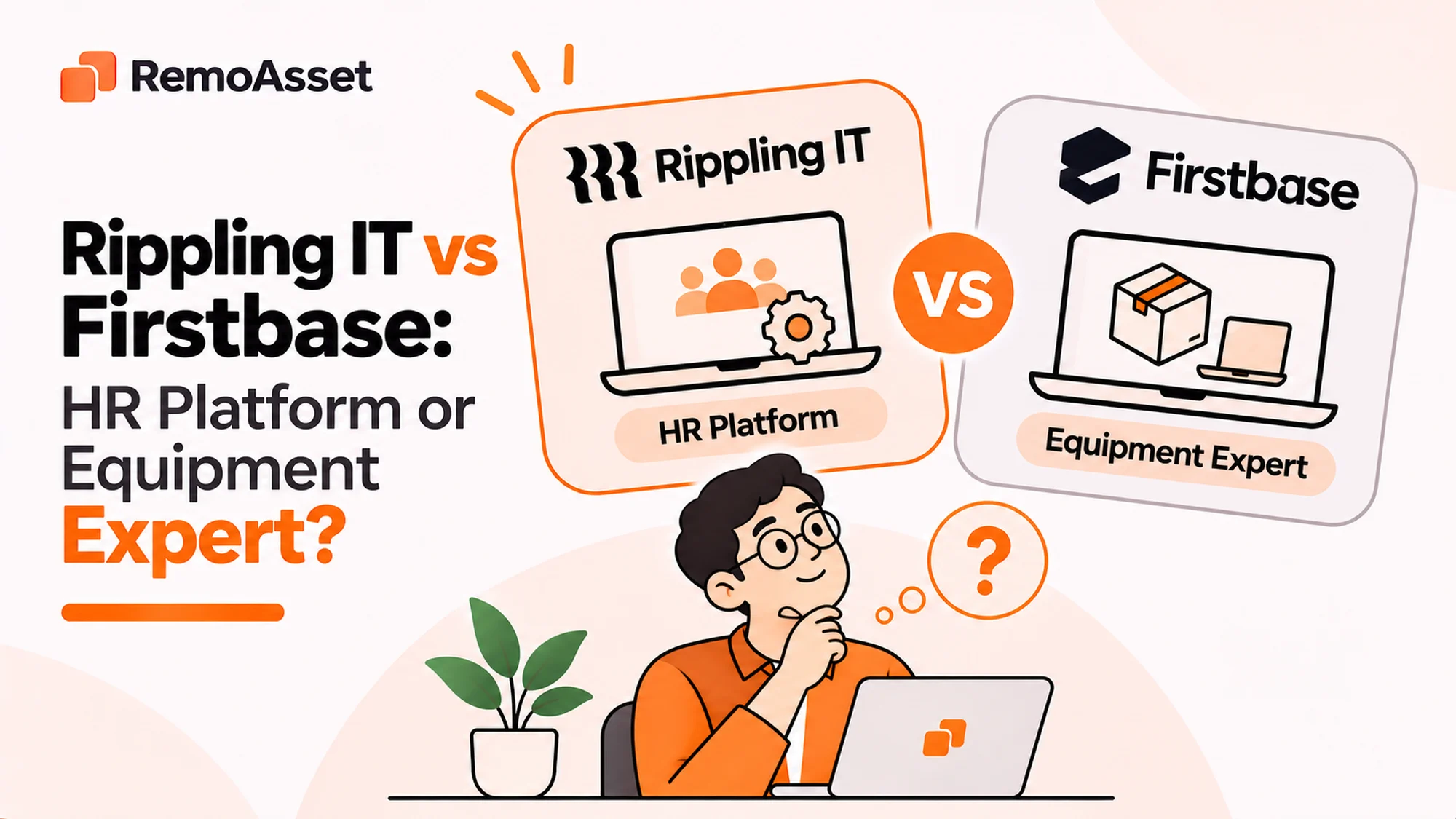
Rippling IT vs Firstbase is a platform against a specialist. Rippling runs devices as one module of an HR system, starting each order and return from the employee record. Firstbase is a standalone equipment supplier that quotes on employees, countries and the services you pick. Rippling prints a starting price with an unstated base fee. Firstbase prints none. For an HR team the deciding question is whether your HR platform should also be your equipment supplier. RemoAsset, which we own, is compared too, with its limits stated.
- Rippling IT is a module, Firstbase is a supplier. That shapes everything else.
- Rippling’s price has a gap. Plans start at 8 dollars per employee per month, plus a monthly base fee it does not state.
- Firstbase quotes on three inputs: employees, countries and which services you take.
- Rippling names its warehousing reach: the US and 26 plus other countries.
- Firstbase is an Apple Business Partner, one of roughly 200 in the United States by its own account.
- RemoAsset prints a starting price and collects in ten named countries. It is our product, so its limits are stated.
Rippling IT vs Firstbase: a module or a supplier
The first question is not which product is better. It is where the equipment work should live.
Rippling puts it inside the HR platform. A hire orders the laptop, an exit starts the return, and the whole history sits next to the employee record. There is no second vendor to manage.
Best tools for Device Management
Firstbase keeps it outside. It is a company whose whole business is equipment, with its own platform and a quote shaped around your headcount, your countries and the services you want.
Both models work. The module wins on convenience when everyone is on Rippling. The supplier wins on independence when your HR stack is mixed, or likely to change.
The rest of this article reads what each one publishes and turns it into questions you can put to both.
What Rippling IT publishes
Rippling’s device page is specific about the lifecycle.
A single hire event triggers purchase, configuration, app installs, security policies and shipment. On exit, it sends the employee a device return box automatically, and you can schedule the lock and wipe in step with HR’s offboarding. Its page says it automatically handles retrievals.
Unused devices can be stored. Rippling says it inspects them on 10 points, wipes and cleans them, and warehouses them in the US and 26 plus other countries before reassigning them.
Its pricing FAQ says plans start at 8 dollars per employee per month, with a monthly base fee, and that the total depends on the products you choose. The base fee is not stated, so the 8 dollars is a floor, not a price for device management.
What Firstbase publishes
No price, and a clear statement of what the price depends on.
Firstbase quotes on three inputs: how many employees you support, which countries and regions you operate in, and which services you want from procurement, deployment, storage, retrieval and disposal.
That third input is useful to an HR team. It is the published signal that scope can be cut. A company that already buys laptops well can ask for collections and storage alone.
Firstbase also says it is an Apple Business Partner, one of roughly 200 in the United States. If your people are mostly on Mac and mostly American, ask what that changes. Its platform list includes service management and device management next to asset recovery. We looked at it more closely in Deel IT vs Firstbase.
Who starts the return
For HR, this is the most important difference in practice.
With Rippling the trigger is native. The exit is entered once and the return box, the lock and the wipe follow from it. That is hard to beat when every leaver is in Rippling.
With Firstbase the trigger is a request or an integration. Its page lists user provisioning, so there is a route in, but whether it reads your HR system directly is a question for a call.
The native trigger loses its advantage quickly when your people are spread across systems. Contractors, agency staff and anybody paid through another provider fire no event in Rippling. A standalone supplier takes a list from anywhere.
Count those people before you let the trigger make the decision. If they hold a fifth of your laptops, they are a fifth of your risk.
Where each one struggles
Disclosure: RemoAsset, named below, is owned by the same people who publish this site. It is described with its limits stated, on the same terms as every other supplier here. HROpsLab takes no vendor money and sells no placements.
Rippling’s difficulty is the bundle. Device management is priced inside a wider platform with an unstated base fee, and it is strongest when Rippling already runs HR. Buying Rippling for its device module alone is a large commitment for a narrow need.
Firstbase’s difficulty is the quote. Three inputs describe a quote, not a rate card, so you cannot tell from outside what country eleven costs. Its broad platform also makes it easy to pay for tooling you already have.
For a published anchor, RemoAsset prints a subscription starting at 1,499 dollars a year for 50 to 5,000 employees, and it works with whatever HR system you use.
Where RemoAsset struggles. It prints no per device rate, so a collection still needs a quote. Its published retrieval list names ten markets under a 25 plus claim, and its pricing page also says 80 plus, which is the procurement figure. It is not a device management suite and not a certified disposal vendor. And it is our own product.
Why RemoAsset is a better choice, and when it is not
RemoAsset is the better starting point when you want a standalone supplier with a printed price.
Like Firstbase, it does not tie devices to one HR platform. Unlike Firstbase, it publishes a starting price. Its subscription page lists HRMS and device management integration, so the exit can still start from your HR record. Its retrieval is described as courier pickup, chain of custody and a NIST wipe.
The honest limits are clear. If the whole company already runs on Rippling, its native trigger and published warehousing reach are a strong reason to stay inside it. If your fleet is mostly Mac in the United States, Firstbase’s Apple partnership deserves a proper question.
And outside ten named collection markets, RemoAsset’s coverage is procurement only. Ask for collection terms by city, in writing.
The decision table
| Situation | Scale | Setup | Primary pain | Recommended starting point |
|---|---|---|---|---|
| Whole company on Rippling | Any | Rippling HR and payroll | Devices off the HR record | Rippling IT, after pricing the base fee |
| Mostly Mac, US based | Any | Apple fleet | Deployment and setup | Ask Firstbase what its Apple partnership changes |
| HR stack mixed or changing | 100 to 1,000 | Several providers | Trigger covers only some people | Firstbase or RemoAsset, which stand alone |
| Buying already works, returns do not | Any | Partial stack | Paying for stages you have | Scope the quote to retrieval and storage |
| Finance wants a figure first | 50 to 5,000 | Distributed staff | No price to budget | RemoAsset, with a printed starting price |
| Leavers in Germany, France or Mexico | Any | Distributed staff | Collection outside the US | RemoAsset, which lists those markets |
What getting this wrong costs
The commonest error is letting the device module decide the HR platform.
An HR system is a multi-year decision about payroll, contracts and records. A device workflow is a much smaller one. Choosing the first because of the second is the wrong order.
The second error is double paying. Both options list device management. If you already run it, paying for it again inside an equipment contract goes unnoticed until renewal. Our guide to equipment vendor pricing models shows where that hides.
Then there is the data position. NIST Special Publication 800-88 is the standard you will be asked about when somebody wants to know how a returned laptop was erased. The R2 standard for responsible recycling is what a recycler’s claim is measured against. Batteries also travel under rules, and IATA guidance on shipping lithium batteries is what the courier works to.
Running the evaluation
Ask both for five things in writing.
- Full annual cost at your headcount, including any base fee or minimum.
- Cost per collection from three named leaver cities.
- Storage reach and cost per device per month.
- Coverage for people outside your HR system.
- Wipe evidence, and the standard it meets.
Then compare both against a retrieval service with stated terms so you have at least one published reference point.
If you want a standalone supplier with a printed starting price, book a demo at remoasset.com and bring your list of leavers. Our equipment vendor questions cover the rest.
Read our guide to day one equipment readiness, or our guide to switching equipment vendors.
Frequently asked questions
What is the main difference between Rippling IT and Firstbase?
Rippling IT is a device module inside an HR platform. Firstbase is a standalone equipment supplier. Rippling starts orders and returns from the employee record. Firstbase quotes on employees, countries and the services you choose, and works alongside whatever HR system you run.
How much does Rippling IT cost?
Rippling’s pricing FAQ says plans start at 8 dollars per employee per month, with a monthly base fee, and the total depends on the products you choose. The base fee is not stated, so ask for the full monthly cost at your headcount.
Does Firstbase publish a price?
No. It shows a quote form and says the quote depends on employees supported, countries and the services you want. Treat any figure beside Firstbase elsewhere as unconfirmed until it is in a written quote.
What does Rippling IT vs Firstbase come down to?
Whether your HR platform should also be your equipment supplier. If the whole company is on Rippling, the native trigger is hard to beat. If your HR stack is mixed or may change, a standalone supplier keeps devices independent of it.
Can I buy only retrieval from Firstbase?
Its quote form names the services you want as one of three inputs, listing procurement, deployment, storage, retrieval and disposal separately. Whether it prices retrieval alone is a call question, and worth asking before you accept a bundle.
Does RemoAsset need a particular HR platform?
No. Its subscription page lists HRMS and device management integration, so the exit can start from your HR record whichever system you use. Its retrieval list names ten markets, and its procurement covers far more. We own RemoAsset and say so plainly.
Who should own the device return, HR or IT?
Whoever owns the exit should start it, because that is where the date comes from. The collection can sit with IT or a supplier. One named person should confirm the device arrived and update the register the same day.