TL;DR
Equipment recovery in Belgium is mostly decided before anybody books a courier. HR controls the exit meeting, the language the instructions are written in, and whether every piece of company property comes back in one handover or in three separate chases. Belgium is compact, so distance is rarely the problem. One honest note up front: RemoAsset does not publish Belgium in its retrieval list. It appears under procurement only.
- Settle it in the exit meeting. Items by serial number, the address and a date, all agreed in one conversation.
- Collect everything in one handover. Laptop, phone, badge and charger together, not three chases.
- Ask which language the person reads. Do not assume it from the office location.
- Keep pay out of the collection conversation. Take local advice on that separately.
- Write the process into the handbook so the exit meeting confirms it rather than announces it.
- RemoAsset does not publish Belgium in its retrieval list. Procurement only. Ask any supplier about collections in writing.
Equipment recovery in Belgium starts in the exit meeting
This article describes operational practice only. It does not state what any employment, tax or customs rule requires, what may be withheld from anybody, or who employs whom, because those answers differ by jurisdiction and by circumstance. Take local advice.
In a compact country with dense transport, the courier is almost never the reason a laptop goes missing. The reason is usually a meeting that ended without a decision.
Best tools for Device Management
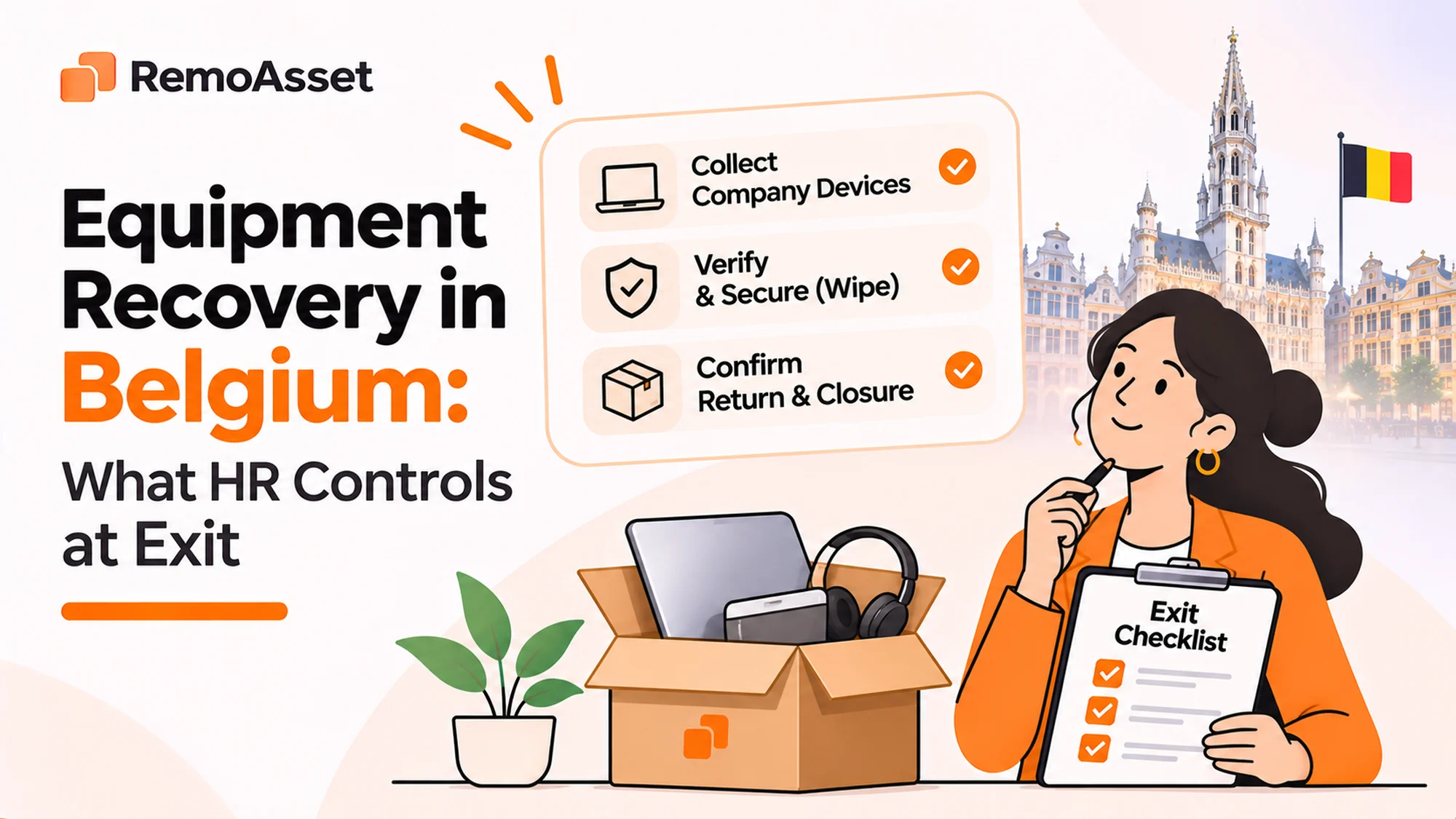
So treat the exit meeting as the moment recovery is agreed, not the moment it is mentioned. Four things should leave that room settled.
What is coming back. Read the list from the asset register, by serial number. People forget what they were issued, and a list read aloud prompts the second laptop or the spare monitor nobody recorded.
Where it is. Ask for the current collection address. The one in the HR system was captured at hiring, and people move.
When. Agree a named day. A date gets done. The word soon does not.
How. Office drop-off or home collection. Pick a default for the company rather than offering a choice to every leaver, because a choice invites delay.
Write all four against the person’s record before the meeting ends. Our note on equipment during the notice period explains why the notice window, rather than the last day, is when this works.
One handover for every piece of company property
Laptops are rarely the only thing a person holds. There is often a phone, a charger, a badge, perhaps a headset or a monitor. If the package includes other company property, the same logic applies to all of it.
The failure pattern is predictable. IT chases the laptop. Facilities chase the badge. Someone else chases the phone. Each chase is polite and separate, and the leaver gets three sets of messages from three people they no longer work with.
Run one handover instead. One list, one date, one box or one appointment, and one person who closes the record. That person can be in HR or in IT, but it has to be one name.
It also matters for the leaver. A single clear request reads as routine. Three requests from three people read as distrust, and people who feel distrusted tend to slow down.
If you are not sure the register is complete, fix that before the next exit rather than during it. Our guide to equipment reconciliation covers the check.
Which language the instructions should be in
Belgium has more than one official language, and teams often mix them with English. The tempting shortcut is to pick the language from the office address. That shortcut is often wrong.
Ask the person, in the exit meeting, which language they want the return instructions in. Record the answer. It takes ten seconds, and it removes the most common reason a return kit sits unopened.
Keep the instruction to one page. Say what is in the box, when the courier comes or where to drop it, what to do with chargers and accessories, and that the machine is wiped to a recognised standard. Naming NIST Special Publication 800-88 helps, because people hold back devices that carry personal photos and logins.
Send it twice. Once at the start of the notice period, and again a few days before the collection. The second message is the one people act on.
Then check whether your supplier can send its own messages in the same language. A carefully translated page from you, followed by courier texts in a language the person does not read, undoes the work.
The final pay temptation, and why to resist it
Disclosure: RemoAsset, named below, is owned by the same people who publish this site. Its published coverage and its limits are both stated. HROpsLab takes no vendor money and sells no placements.
At some point somebody will suggest withholding part of a final payment until the laptop arrives.
We are not going to tell you whether that is permissible in Belgium. It depends on the contract, on the circumstances and on advice from somebody qualified locally.
The operational point is consistent across every market we write about. Combining the two conversations converts a logistics exchange into a dispute, and a person in dispute is slower to return a device, not faster. Keep them separate. Take advice on pay as its own question.
Where you have no local capacity, a supplier handles the part you cannot. RemoAsset lists Belgium under procurement, and its retrieval country list is separate and shorter.
Where RemoAsset struggles, and it is the relevant limit here. Belgium is not in its published retrieval list, which names ten markets. Its procurement coverage is quoted much wider, so do not read a collection promise into the procurement page. Ask it, in writing, whether it can collect from your named cities, and ask every other supplier the same question.
Put the return process in the handbook first
The exit meeting goes better when it confirms something the person already knew.
That means the return process belongs in the handbook, written before anybody leaves. Not the legal position, which is for your advisers, but the operational one. What gets returned, how, by when, and what happens to the data.
Three lines usually cover it. Company equipment comes back within a stated number of working days after the last day. We arrange the collection and pay for it. Every device is wiped before anybody else uses it.
Then the exit meeting is a reminder, not a negotiation. The leaver has seen the rule since their first week, and nobody has to improvise a policy at an awkward moment.
Our guide to the device policy in the handbook has wording you can adapt, and our note on writing an employee equipment policy covers what sits behind it.
The decision table
| Situation | Scale | Setup | Primary pain | Recommended starting point |
|---|---|---|---|---|
| Leaver works from a regional office | Any | Office on site | Nobody owns the handover | Office drop-off with a named receiver |
| Leaver works from home | Any | Normal courier reach | Address accuracy | Confirm the address in the exit meeting |
| Several items issued | Any | Phone, badge, laptop | Three separate chases | One list and one handover |
| Mixed language team | 20 plus | Regional preferences | Instructions ignored | Ask which language each person wants |
| Hiring continuously in Belgium | 20 plus locally | Steady churn | Shipping repeatedly | Store and reissue to the next hire |
| No local presence | Small | One or two people | No counterparty | Ask suppliers about collections, not coverage |
What getting this wrong costs
The first cost is the meeting that ended without a date. It turns a five minute handover into a month of polite reminders.
The second is the second laptop nobody listed. If the register is incomplete, the exit meeting cannot recover what it does not know about, and that machine stays out of reach for good.
The third is the data position. A device you cannot account for may hold customer information, and NIST Special Publication 800-88 is the standard you will be asked about. When hardware reaches the end of its life, the R2 standard for responsible recycling is what a disposal claim is measured against.
The fourth sits under every movement. Batteries travel under rules, and IATA guidance on shipping lithium batteries is what your carrier works to.
If somebody asked how many company devices are in former employees’ homes in Belgium right now, could you answer?
Making it reliable
Four changes, none of which needs a budget.
Agree items, address, date and route in every exit meeting. Collect all company property in one handover. Ask and record the instruction language. And name the one person who closes the record.
Then set the local policy once: store and reissue in Belgium by default, and move a device out of the country only with a stated reason.
If you want a supplier, choose it on its published collection markets rather than a headline country count. RemoAsset is worth asking about procurement and storage, and it should tell you plainly whether it can collect in your Belgian cities.
Our guide to running an equipment amnesty covers clearing the backlog you already have, and our note on equipment recovery in the Netherlands covers the neighbouring market.
Read our guide to unreturned equipment, or our note on day one equipment readiness.
Frequently asked questions
When should equipment recovery in Belgium start?
In the exit meeting, during the notice period. Agree the items by serial number, the current address, a named return date and the route in that one conversation, and write all four against the record before the meeting ends. Starting after the last day means asking a former employee for a favour.
Should we collect the phone and badge at the same time?
Yes, where you can. One list and one handover reads as routine, while three separate chases from three people read as distrust and slow things down. Name one person who closes the record for every item, whether they sit in HR or IT.
Which language should return instructions be in?
Ask the person. Belgium has more than one official language and many teams also use English, so the office address is a poor guide. Record the answer, keep the instruction to one page, and check your supplier can send its own messages in the same language.
Can we withhold final pay until the laptop is returned?
That depends on the contract, on the circumstances and on local advice, so this article cannot answer it. Operationally, combining the two conversations turns logistics into a dispute and makes the device less likely to arrive. Keep them apart and take advice on pay separately.
Office drop-off or home collection?
Pick one default for the company rather than offering a choice to every leaver. Where people work near an office with somebody to receive the kit, drop-off is simple. Where they work from home, a booked collection with a named date is usually faster than waiting for a visit.
What should the handbook say about returning equipment?
The operational rule, in plain words: what comes back, how, by when, who pays for the collection and that every device is wiped. Leave the legal position to your advisers. When the rule is in the handbook from day one, the exit meeting confirms it rather than introducing it.
Does RemoAsset cover collections in Belgium?
Not on its published retrieval list, which names ten markets and does not include Belgium. Belgium appears under its procurement coverage instead. We own RemoAsset and say so because implying coverage we do not publish would be worse. Ask us and every other supplier about collections in your named Belgian cities, in writing.