By [Author Name] · [Date] · [X] min read · [Table of Contents]
TL;DR
- IT equipment leasing is a finance arrangement: a funder buys the hardware, you pay across a term, and at the end you buy out, extend or hand it back.
- If you're buying fewer than about 40 machines a year and cash isn't tight, you don't need this and the admin will cost you more than the interest saves.
- It does three jobs and only three: spread the cost, keep the asset off your balance sheet in some structures, and set a date that forces a refresh.
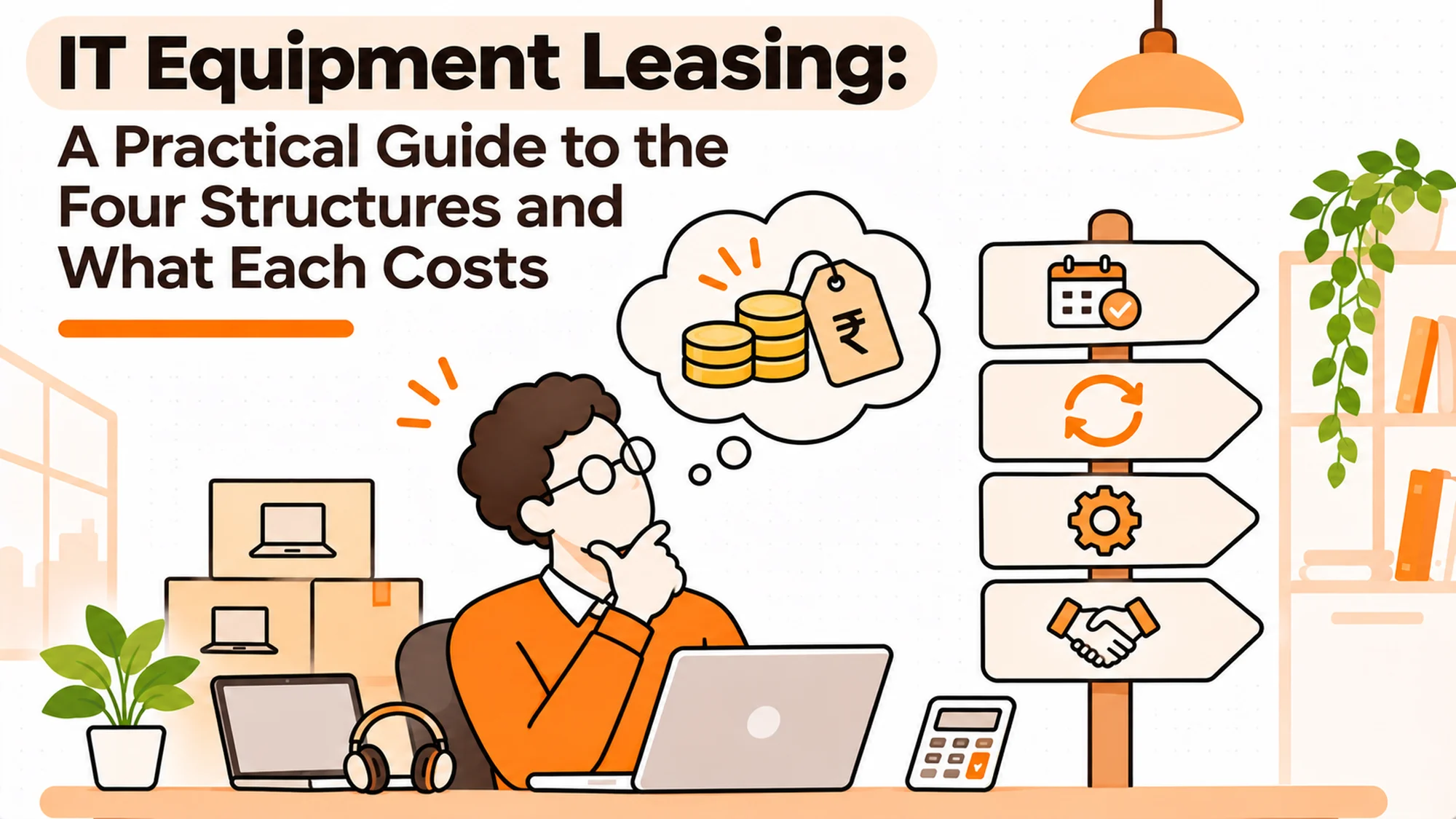
- Three structures dominate: a finance lease you end up owning, an operating lease you hand back, and a bundled service that has a lease inside it.
- Choose on the end-of-term clause first and the monthly figure second, because that's the reverse of how it gets sold.
- Done right, a 300-machine refresh stops being a single bad quarter for finance.
The invoice lands in March and it's for 280 laptops. Somebody in finance asks why the whole fleet is being replaced in one quarter, and the honest answer is that it was all bought in one quarter four years ago, so of course it's all dying in one quarter now. The conversation that follows is not about hardware. It's about why a predictable event wasn't planned for, and you are the person in the room who has to explain it.
That pattern repeats everywhere. Almost every company that grew fast has it. A big hiring year creates a cohort of machines that age together, and the refresh arrives as a lump nobody budgeted. The same shape shows up after an acquisition, after a return-to-office hardware push, or any time a company standardised on one model and bought in bulk because the discount was good.
Best tools for Device Management
The real issue isn't whether leasing is cheaper than buying. In most cases it isn't, once you count the financing cost honestly. The real issue is whether your hardware spend is lumpy in a way that hurts, and whether anybody owns the refresh date. Leasing is one answer to lumpiness. It's a poor answer to almost everything else, which is where most of the disappointment comes from.
When You Don't Actually Need IT Equipment Leasing
When buying outright is genuinely fine. You're adding maybe 20 to 40 machines a year, spread fairly evenly across quarters, and nobody in finance has ever queried the hardware line or asked you to forecast it more precisely. Cash is not the constraint. Buying is simpler, cheaper over the full period and leaves you with no end-of-term exposure. Leasing here adds a funder, a schedule and a return condition in exchange for nothing you needed.
When the friction starts showing. The first sign is a budget conversation that happens twice. Once when you forecast hardware and once when the actual invoice arrives and it's 40 per cent higher because nobody counted the contractors. A second sign: somebody asks for the fleet's book value and the answer takes a week to assemble from purchase invoices. That's not a leasing problem yet. It's a record problem wearing a finance costume.
When it becomes a liability. The point where leasing earns its place is usually a single number: the size of the next refresh relative to a quarter's discretionary spend. If replacing the machines that turn four next year would consume most of a quarter's budget, you have a timing problem that a lease genuinely solves. The other trigger is an auditor or investor asking about capital commitments, where the structure of your hardware funding stops being an internal matter.
The edge case that breaks everything. A contraction during a lease term. You signed for 300 devices on a 36-month schedule, headcount drops by a third in month 14, and you're now paying for a hundred machines sitting in a cupboard. I've seen that bill arrive and there is no good answer in the contract, because the contract was written for the growth case. Ask the downside question before you sign, since it's free then and impossible afterwards.
What Finance and IT Actually Need from an Equipment Lease
> "What does this actually cost over the full term, not per month?" > A total, including the buyout or the return charges, written as one number. > Monthly figures are designed to be compared against each other rather than against a purchase price, which is how the comparison gets lost.
> "What happens on the last day of the term?" > A named option with a price: buy out at a stated residual, extend at a stated rate, or return against a stated condition. > End of term is where lease economics are decided, and it's the part that gets two sentences in the proposal.
> "Who collects the devices if we hand them back?" > A party, a process and a cost, because almost no lease includes retrieval from employees' homes. > This is the single most common gap between what people think they bought and what they actually bought.
> "What if headcount falls?" > An answer in writing, even if the answer is that you keep paying. > A clear no is manageable. A vague yes becomes a dispute in a quarter when you can least afford one.
> "Does this change how we account for the fleet?" > A conversation with your own accountant, because the treatment depends on the structure and on your jurisdiction. > Any vendor telling you confidently how a lease will appear in your accounts is answering a question they aren't qualified to answer.
The Three Structures You'll Be Offered
The finance lease, where you end up owning the hardware. What it is: the funder buys the machines, you pay across a term that covers most of their value, and at the end you buy them for a small sum. Economically it's a purchase with the payments spread out. When it's right: when you want to own the machines and keep them for five or six years, and the only problem is the shape of the cash. This suits desktops and anything that stays useful well past the term. When it fails: when you treat the small buyout as a formality. It isn't. If you forget to exercise it, some agreements roll into an extension at the original rate, and paying the fifth and sixth year of a lease on a machine you could have bought for very little is a genuinely annoying way to lose money.
The operating lease, where you hand the hardware back. What it is: you pay for the use of the machine across a shorter term, and at the end you return it. The funder carries the residual value risk and prices it into your payments. When it's right: three-year refresh cycles on laptops, where you actually want the machines gone at the end and would otherwise be running a disposal process yourself. When it fails: on the return condition. You are now exposed to a judgement about wear, and more importantly to the devices you cannot produce. A machine that was never collected from a leaver is not a tracking problem under an operating lease. It's a charge at the stated replacement value, and that value is rarely sympathetic.
The bundled service with a lease inside it. What it is: a per-device monthly fee that covers the hardware, delivery, support and sometimes retrieval, with a financing arrangement sitting underneath that you may never see. When it's right: when you genuinely want the operational work handled and are willing to pay a margin for it. For a distributed team with no IT function this can be the correct purchase even though it's the most expensive on paper. When it fails: when nobody separates the two halves. You're buying finance and service in one number, and you cannot tell whether you're paying a fair rate for either. Ask the vendor to split the quote. Some will, and the ones who will are easier to trust on everything else.
How to Choose: Five Questions Before You Talk to Any Funder
How lumpy is your hardware spend, really? Pull the last three years of hardware purchases by quarter. Not by year, by quarter. If the chart is flat, leasing solves a problem you don't have and you should stop here. If one or two quarters carry most of the spend, you've found the actual case for a lease, and you now have the chart that will convince your own finance team faster than any vendor deck.
What's your real refresh cycle, measured rather than assumed? Almost every company says three years and almost none does it. Look at the age distribution of machines currently in use. If the median is four and a half years, a 36-month lease forces a refresh a year and a half earlier than your actual practice, and that acceleration is a real cost that the monthly comparison hides. Match the term to what you do rather than to what the policy says.
Can you produce a device when asked? This is the question that decides whether an operating lease is safe for you. Under a return structure, every machine you cannot locate at end of term converts into a charge. So count the devices you've written off in the last two years because nobody could find them. If that number is more than a handful, fix the retrieval problem before you sign anything with a return condition, or choose a structure where you own the hardware and the loss is yours quietly rather than the funder's loudly.
Who owns the end date? Put a name to it now. Lease terms end on a specific day, usually with a notice window before it, and the single most common way companies lose money on leases is by missing that window and rolling into an extension nobody chose. It belongs in a shared calendar with two reminders, owned by somebody who will still be in the job, and if you cannot name that person you've found the first task.
What's the downside case in writing? Ask what happens if you need to reduce the fleet by 25 per cent in month 18. Ask what happens if a device is damaged beyond the fair-wear definition. Ask what the charge is for a device you cannot return. Then ask for all three answers in the agreement rather than in an email, because the email will not be findable when it matters and the person who sent it will have changed jobs.
The Arithmetic, With the Working Shown
Lease proposals are hard to compare because they're quoted monthly while purchases are quoted once, which means the two numbers in front of you are not in the same unit and cannot be read against each other. So do the arithmetic yourself, with your own numbers, and keep it crude. Precision is not the point. The order of magnitude is.
Take a worked example with every input stated, because an example with hidden inputs is just an advertisement. Say 120 laptops at a purchase price of $1,450 each. That's a capital outlay of $174,000. Now compare three paths across four years, using a flat financing assumption you should replace with whatever a funder actually quotes you.
| Path | Up-front | Across the term | At the end | What you carry |
|---|---|---|---|---|
| Buy outright | $174,000 | Nothing | Machines worth something, yours to sell | Disposal, and the fifth-year decision |
| Finance lease, 36 months | Nothing | 36 payments plus financing cost | A small buyout, then you own them | The buyout deadline |
| Operating lease, 36 months | Nothing | 36 payments, usually lower | Return every device, in condition | Missing-device charges |
| Bundled service | Nothing | A per-device fee including service | Depends entirely on the contract | Margin, and a harder comparison |
The two numbers to extract from any proposal are the total cost across the term including the end-of-term event, and the charge for a device you cannot return. Everything else is detail. In my experience the second number is the one that decides whether an operating lease was a good idea, and it is almost never on the first page of the proposal.
One more sum is worth doing. Work out what a single unreturned device costs you under each path. Buying it outright, an unreturned laptop costs you the depreciated value and some embarrassment. Under an operating lease it costs you a contractual replacement charge, which is typically set to protect the funder rather than to reflect a used machine's market value. If your retrieval rate is 90 per cent rather than 99, that gap is the whole economics of the deal, and it is entirely within your control to fix before you sign.
The Decision Table: Where Each Path Actually Fits
| Situation | Scale / Size | Setup | Primary Pain | Recommended Starting Point |
|---|---|---|---|---|
| Steady hiring, flat hardware spend | Under 100 devices a year | Any | None, honestly | Buy outright |
| One big cohort ageing together | 200 to 1,000 devices | Mostly offices | A single brutal quarter | Finance lease, watch the buyout |
| Hard three-year refresh, devices come back | 200+ devices | Offices, low churn | Disposal and resale admin | Operating lease |
| Distributed team, devices rarely come back | 50 to 500 people | Fully distributed | Retrieval, not cash | Fix retrieval first, then decide |
| No IT function, want it handled | 20 to 200 people | Distributed | Nobody owns any of this | Bundled service, split the quote |
| Headcount genuinely uncertain | Any | Any | Commitment risk | Buy in smaller batches, no term |
| Public sector or grant funded | Any | Any | Capital rules, not cash | Ask your own finance team first |
Most companies sit between the second and fourth rows, which is exactly where the decision is hardest. I'd resolve it on evidence rather than on preference. The tiebreaker is honest: if you cannot reliably get devices back from leavers, do not sign anything with a return condition, whatever the monthly figure says.
Leasing Does Not Fix the Operational Half, and That Is the Main Confusion
This is the point the whole article exists to make, so here it is plainly, without the hedging that usually surrounds it in vendor material. A lease is a money instrument. It does not ship anything, chase anybody or keep a record.
Under every structure above except the bundled one, you still own all of the following: specifying and ordering, getting the machine to a person who may be in another country, handling customs where you have no entity, arranging a repair, collecting from a leaver, storing a device between users, wiping it and proving that you did. Leasing touches none of that. The funder's interest begins and ends with the payments and the asset's condition at term.
Which creates a specific trap. A team feels operational pain, goes looking for a solution, and is sold a lease because the lease sales motion is more developed and better funded than the logistics one. Eighteen months later the laptops still arrive late in Portugal, the leaver in Manila still hasn't posted anything back, and now there's a return condition hanging over the fleet as well. The pain is unchanged and the exposure is higher. I have watched this happen twice and both times the original brief said "we need help with equipment", which is ambiguous in exactly the wrong way.
So separate the two questions before you take a single call. Is the problem when the money leaves, or who does the work? If it's the money, talk to funders and your own finance team. If it's the work, talk to logistics vendors, and note that almost none of them publishes a rate card: when I checked on 28 October 2026, Workwize, Firstbase, GroWrk, allwhere and Deel IT all published nothing. RemoAsset is the exception in that group, publishing $1,499 a year for its Subscription tier. Disclosure: RemoAsset is our own product. It does no network discovery, so it will not find machines you've lost track of, it does no software licence management, and only the Subscription tier publishes a figure because the pay-as-you-go side is quoted.
If it's both, you need two conversations rather than one bundled answer, and running them separately is the cheapest way to find out whether the bundle is good value.
What the Funder Is Actually Pricing, and How to Read a Quote
A lease quote looks like one number and is really four decisions somebody else has already made on your behalf. Reading those four back out of the quote is the difference between negotiating and nodding.
The first is the term. Longer terms lower the monthly figure and raise the total, and they also lock your refresh cycle to a date chosen by a funder rather than by you. The second is the assumed residual, which you will rarely see stated but can infer: unusually low payments on a short term mean the funder is confident about resale, and that confidence is why the return condition will be strict. The third is the rate itself, which is the part everyone focuses on and the part that varies least between reputable funders. And the fourth is the end-of-term structure, which is where the quote stops being arithmetic and becomes a contract.
So ask for the quote to be restated in a shape you can use. One total across the term. One figure for the end-of-term event under each option. One charge per device that cannot be returned. Three numbers, on one page, in writing. A funder who provides that without friction is a funder you can work with, and a funder who cannot or will not restate their own quote has told you how the next three years will go.
| What to ask for | Why it matters | What to watch for |
|---|---|---|
| Total cost across the full term | Makes it comparable with a purchase price | A refusal to total it up |
| End-of-term figure under each option | This is where the economics actually land | "Market value at the time" |
| Charge for a device you cannot return | Prices your own retrieval failure rate | A figure set well above used value |
| Notice window and how it is communicated | Missing it is the most common loss | Notice required by post, or not stated |
| Fair wear and tear definition | Decides disputes at the end | A definition with no examples |
| Early termination terms | Your only protection against contraction | Silence, which means no |
One more thing on quotes. It is specific to equipment rather than to finance generally. Hardware quotes often bundle the device price and the financing without separating them, which means you cannot tell whether you're getting a good rate on an overpriced laptop or a poor rate on a well-bought one. Those two situations call for different negotiations, and they are easy to tell apart: ask what the equipment would cost you to buy outright today from the same supplier. If that number is above what you could get elsewhere, the financing conversation is the wrong conversation and you should fix the purchase price first.
The Refresh Cycle Question Nobody Asks First
Leasing forces a refresh date, and that is sold as a benefit. Sometimes it is. But the honest version of that argument depends on a number most companies have never measured, which is how long their machines actually stay useful.
Three years became the default. The reasons for it have mostly stopped applying. Laptops at the specification most knowledge workers get are now commonly serviceable for five years or more, and the thing that retires them is often a battery or a cracked hinge rather than performance. So a 36-month term can mean paying to replace a fleet that had two good years left in it, and across 300 devices that is a real amount of money spent to solve a problem that would have arrived later and smaller.
Measure before you commit. Pull the age of every machine currently in service and look at the distribution rather than the average, because an average hides the shape. If most of your fleet is between two and three years old, a three-year cycle describes your practice and a lease will fit it comfortably. If there is a long tail of five and six-year-old machines doing perfectly good work, your real cycle is longer than your policy and a shorter term will cost you.
There is a counter-argument and it deserves stating fairly. A forced refresh date removes a decision that otherwise never gets made, and plenty of fleets limp along on machines that frustrate the people using them because nobody owns the replacement call. If that describes you, the discipline of a term may be worth more than the efficiency you lose. Just make that trade deliberately rather than inheriting it from a standard proposal, and write down which of the two reasons you chose.
If You Own Them at the End, You Own the Disposal
The article keeps mentioning disposal, so here is what it actually involves, because this is the half of the ownership decision that never appears in a comparison.
A machine you own at end of life has to go somewhere. There are four destinations: resale, trade-in, recycling, or a cupboard. The cupboard is the one most companies pick by accident. Machines accumulate because nobody has been given the job. And three years later there are forty laptops on a shelf with unknown data on them, which is a liability wearing the costume of an asset.
The real work has three parts and only one of them is logistics. First, the data has to be destroyed in a way you can prove, which means a wipe to a recognised standard and a certificate naming the devices by serial number. Second, the asset register has to be updated so the fleet count is right and finance can write the items off. Third, the machines have to physically move to whoever is taking them. Skip the first and you have an unresolved exposure. Skip the second and your register slowly becomes fiction, which is the failure that shows up at the next audit.
The financial side is smaller than people hope. A three-year-old business laptop in good condition has real resale value, but by the time you have paid somebody to collect, test, grade and wipe a batch of them, the net recovery is modest rather than transformative. Treat resale proceeds as a useful offset against the disposal cost rather than as a revenue line, and be suspicious of any model that counts on a specific recovery percentage, since condition varies enormously and nobody inspecting your fleet has seen it yet.
Which is the quiet argument in favour of an operating lease, properly made. Under a return structure the funder takes the resale risk and the disposal work, and you pay for both of those through payments that are higher than the financing alone would justify. That is the deal. That is a legitimate trade, and for a company with no appetite for running a disposal process it can be the right one. The condition it depends on is the one named throughout this piece: you have to be able to produce the devices.
Return Obligations and Distributed Teams Are a Bad Combination
This deserves its own section because it is the single most expensive mismatch in the category and it is almost never flagged at the point of sale.
A return obligation assumes a world where devices come back. That world exists in an office. A leaver hands a laptop to somebody at a desk on their last day, it goes into a cupboard, and the whole transaction takes under a minute and needs no courier at all. It does not exist in a distributed company, where the device is in a flat in a city nobody from your company has visited, and the person holding it stopped being your colleague three weeks ago.
So run the numbers on your own history before you sign anything with a return condition. Take the last two years of leavers. Count how many devices came back, how long each one took, and how many never arrived at all. That gives you a recovery rate, and the recovery rate is the number that prices the lease, whatever the quote says. A fleet at 99 per cent recovery can take a return obligation comfortably. A fleet at 90 per cent cannot, because one device in ten converts into a charge at a figure the funder chose.
There is a sequence that works. Follow it in order rather than in parallel. Fix retrieval first, with a vendor or a process that produces a measured recovery rate. Run it for two quarters so you have real numbers rather than a hope. Then take the lease, with your actual recovery rate in hand, and use it in the negotiation, because a funder pricing a return condition will take evidence of recovery seriously. Doing it the other way round means you discover your recovery rate at the exact moment it becomes a bill.
And one practical note that costs nothing. If you do end up carrying both a return obligation and a distributed fleet, put the end-of-term date into whatever system triggers your offboarding, not just into a calendar. Every leaver in the final year of the term is a device that needs to reach the funder's location rather than your cupboard, and the people doing offboarding will not know that unless the process tells them.
The Cost of Choosing the Wrong Structure
The expensive mistakes in leasing are not interest rates. They're dates and devices.
In my experience the date failure is the more common one by a wide margin. A notice window passes unobserved, the agreement extends, and a company pays twelve or twenty-four additional months on hardware it had already finished paying for. Nobody notices for a while, because the payment was already in the budget and nothing changed in the bank statement. When somebody does notice, the money is gone and the only lesson available is to put the next end date in a calendar. It's a dull failure and it's very widespread.
The device failure is sharper. At end of term under a return structure, you have to produce the machines. The ones in the office are easy. The ones with people who left in the last three years are the problem, and the charge for each one is a contractual figure rather than a market one. A fleet with a 92 per cent retrieval rate and a return obligation on 300 devices means two dozen charges arriving at once, in a quarter when you were expecting a saving. That is how a lease that looked cheaper than buying ends up costing more, and the cause was never the financing.
The third cost is strategic and quieter. A term commits you to a fleet size and often to a device standard for three years. If your working pattern changes inside that window, and over the last few years whose has not, you're carrying a specification somebody chose under different assumptions. Buying in smaller batches is less efficient per unit and much easier to steer. There's a real trade-off there and the right answer depends on how confident you are about the next three years.
So the diagnostic worth sitting with: is your problem the timing of the money, the size of the total, or the work of running a fleet? Leasing answers the first well, the second rarely, and the third not at all.
Three Questions Your Own Finance Team Will Ask, and Good Answers to Them
If you are the operational person bringing this forward, the meeting that decides it will be with finance, and it will turn on three questions. Having the answers ready is worth more than any vendor comparison.
"Why not just buy them?" The honest answer is a chart rather than an argument. Show the last three years of hardware spend broken down by quarter, and show the forecast for the next two, including the cohort that is about to age out. If the chart is lumpy, the case makes itself and you do not need to advocate. If the chart is flat, accept that buying is the right answer and save everybody the exercise. I have seen this meeting go badly in exactly one way, which is the operational person arguing from principle when the data did not support it.
"What are we committed to if things change?" Finance teams are not worried about the rate. They are worried about signing a three-year obligation in a year when headcount might go either way, and that worry is entirely reasonable. So bring the early-termination terms and the reduction terms in writing, state plainly what the exposure is in a downside case, and give the number rather than a reassurance. A commitment that is understood is much easier to approve than one that is minimised.
"What does this do to the accounts?" Hand this one to them rather than answering it. The treatment depends on the structure of the agreement and on the standards your company reports under, and an operational owner guessing at it creates a problem rather than solving one. What you can usefully bring is the agreement itself and a clear description of which of the three structures it is, because that is the input your finance team needs in order to answer their own question properly.
One last piece of preparation that pays for itself. Bring the retrieval number. However this decision goes, somebody will eventually ask what proportion of devices come back from leavers, and the team that already knows that figure looks like a team in control of its fleet. The team that has to go and find out looks like the opposite, and the figure is the same either way.
When You're Ready to Move Beyond Buying Laptops on a Card
The signals are specific. Your hardware spend is concentrated in one or two quarters a year. A refresh is coming that would consume most of a quarter's discretionary budget. Finance has asked for the fleet's book value and the answer took longer than a day. You have a cohort of machines that were all bought within a few months of each other, and they are all about to need replacing within a few months of each other. Any two of those and the card has stopped being adequate.
If the pain turns out to be operational rather than financial, RemoAsset is built for that half: the joiner and leaver cycle across many countries, with procurement and retrieval stated in 80+ countries and a published annual figure you can budget against. It carries the three limits named above, and if your real problem is a lumpy capital spend rather than the weekly work, a funder will serve you better than we will.
If that's roughly where you are, work out which half of the problem is actually hurting before you take any meeting, because the two halves are sold by different people with different incentives.
Frequently Asked Questions
What is IT equipment leasing in plain terms?
Somebody else buys the hardware. You pay for it across an agreed term instead of all at once, which is the entire mechanic. At the end you either buy it for a residual sum, extend the arrangement or hand the equipment back in a defined condition. The key thing to hold onto is that it's a financing product, so it changes when money leaves your account and generally changes nothing about who does the work of running the fleet.
Is leasing cheaper than buying laptops outright?
Usually not. Count the financing cost across the full term and the purchase normally wins on total outlay. What leasing does is move the cost from one quarter into thirty-six smaller pieces, which is valuable when the lump is genuinely painful and worth nothing when it isn't. Run your own total across the term including the end-of-term event, because a monthly figure compared against another monthly figure tells you nothing about whether either beats a purchase.
What is a residual value and why does it matter?
It's a guess about the future resale value. More precisely, it's the funder's estimate of what the equipment will be worth at the end of the term, and it's the lever that sets your monthly payment. A higher assumed residual means lower payments, because the funder expects to recover more at the end. That's why return conditions get strict under operating leases: the funder's pricing depends on getting back a machine it can actually sell.
Who is responsible for collecting devices at end of term?
You are. Under almost every straightforward lease the collection is yours, and this surprises people constantly. The funder wants the equipment returned to a location it specifies, by a date, in a condition. Getting laptops out of employees' homes in six countries and into that location is your operational problem, which is exactly why a distributed team should solve retrieval before taking on a return obligation.
Can we lease equipment for contractors?
Generally yes. The funder cares about your covenant rather than about who uses the machine. The practical difficulty is the same one that makes contractors hard everywhere else: the engagement ends on a date that lives in a statement of work rather than in an HR system, so the device never gets collected. Under a return structure that becomes a charge rather than a shrug, so contractor devices deserve their own collection trigger.
What happens if we need to shrink the fleet mid-term?
Usually you keep paying. Assume that is the answer unless the agreement says otherwise in writing. Some funders will negotiate a reduction in exchange for a longer term or a higher rate on the remainder, and it's worth asking before you sign rather than after. The honest position is that a lease is a commitment, which is the trade you made in exchange for the smoother cash profile.
Does leasing handle shipping, support and wipes?
No. Not unless you've bought a bundled service that happens to have financing inside it, in which case you are paying for two different things through a single monthly figure and should ask for them to be separated. A plain lease covers the funding of the asset and nothing else. If somebody is selling you a lease and describing delivery, retrieval and wipe evidence in the same conversation, ask for the quote to be split into the finance component and the service component, because that's the only way to tell whether either half is priced well.
Decide whether your problem is the cash or the work, and buy the thing that fixes the one you actually have.