By [Author Name] · [Date] · [X] min read · [Table of Contents]
TL;DR
- IT asset management companies sell you a way to know what hardware and software you own, where it is, who has it and what it cost.
- If you have 40 devices in one office and a spreadsheet that has never been wrong, you don't need a vendor and you should spend the money elsewhere.
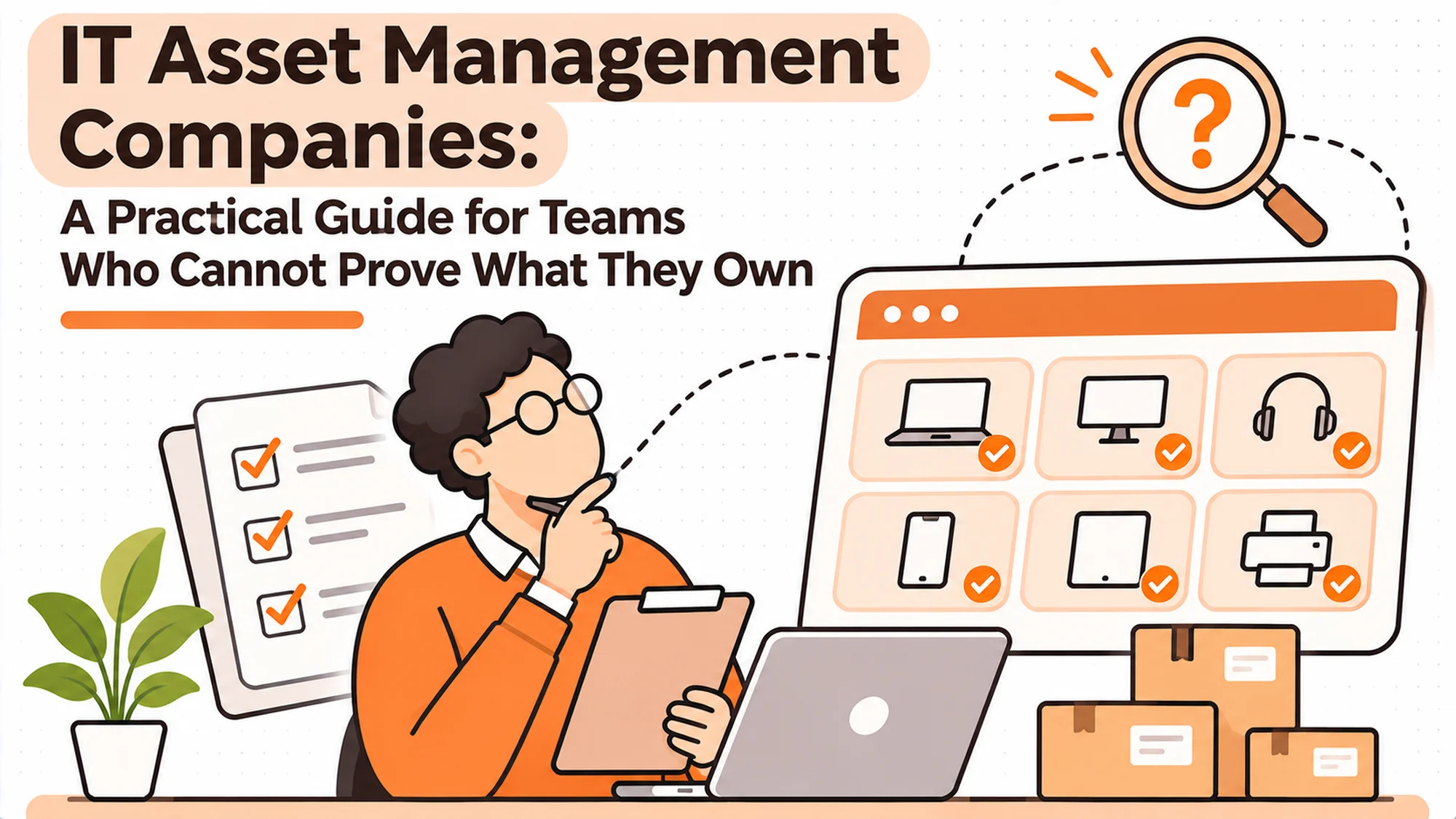
- The category does four jobs: discover what exists, hold the record, track the money, and prove the record to somebody outside.
- It splits three ways: discovery-led platforms, register-led tools, and logistics vendors that produce a record as a by-product of moving things.
- Choose on which of those four jobs is failing, because no vendor is good at all four and the ones who claim to be are selling the discovery and delivering the register.
- Done right, the answer to "what do we own" takes thirty seconds and survives being checked.
The security questionnaire asks for a complete hardware inventory with serial numbers. You open the spreadsheet. It has 312 rows, you have 340 people, and about 60 of the rows have an assignee who left at some point in the last two years. Somebody suggests exporting from the MDM instead, which gives you 287 devices, a different 287, and no way to reconcile the two lists because one is keyed on serial numbers and the other on asset tags that were applied inconsistently in 2024.
That mess is close to universal above about 150 people, and it's got an unglamorous cause. Records get created at three different moments by three different people for three different reasons. Procurement records a purchase, IT records an enrolment, HR records an assignment, and nothing reconciles them because reconciling them was never anybody's job. The result isn't one bad spreadsheet. It's three partly-right systems, none of them wrong enough to discard and none of them right enough to rely on, and no authority between them.
Best tools for Device Management
The real issue isn't that you need an asset management tool. It's that you need to decide which of those three systems is the authority, and most vendor evaluations skip that decision entirely and buy a fourth system instead. The tool matters less than the decision. This is what IT asset management companies are supposed to solve, and the good ones will ask you about the decision in the first call.
When You Don't Actually Need an ITAM Vendor
When the spreadsheet is genuinely fine. Under roughly 50 devices, one location, one person who buys and issues everything. The record is small enough to check by eye and the person maintaining it is the person using it. Buying a platform here replaces a working tool with a system somebody has to feed, and the feeding is the part that fails.
When the friction starts showing. The tell is reconciliation rather than ignorance. You can say roughly what you own, but two sources disagree and nobody can say which is right. Somebody asks how many laptops are unassigned and you give a number with a caveat. The record isn't wrong exactly. It's just no longer trustworthy without a day's work, and a record that needs a day's work is not a record.
When it becomes a liability. Three triggers, usually arriving together: a customer security questionnaire asking for inventory evidence, a finance team wanting the fleet's book value for depreciation, and a renewal where somebody realises you're paying for software seats for people who left. Each of those turns an internal annoyance into something you have to produce for an outsider.
The edge case that breaks everything. An acquisition, or a market exit. You inherit 90 devices with no register, or you close a country and need to account for everything in it. Both cases need a serial-level list with custody history, and both reveal within a day whether your record was ever real. I'd rather find that out on a Tuesday of my choosing than on the day the diligence request lands.
What Teams Actually Need from ITAM
> "How many devices do we own, and can I defend the number?" > One figure from one authoritative source, with a stated method and a known error rate. > A number with no method behind it will be challenged, and a number with a stated five per cent error rate is far more useful than a precise-looking one nobody trusts.
> "Which of these devices still has a person attached?" > A current assignee per asset, reconciled against your HR system rather than typed in once at issue. > Stale assignments are the single most common defect in asset records, and they are the reason exit reports look wrong.
> "What are we paying for that nobody uses?" > Licence and seat data tied to people, which is a genuinely different dataset from hardware. > Most of the recoverable money in this category is software rather than hardware, and most hardware-first tools treat it as an afterthought.
> "Where is the physical thing?" > A location per asset, including the ones in a warehouse, in transit or in somebody's spare room. > Hardware that exists in the record and not in a known place is the category of asset that turns into a write-off.
> "Can I prove the leaver's device was wiped?" > A certificate or an event with a date, a serial number and an accountable party. > This is the question auditors actually ask, and it's answered by evidence rather than by a status field somebody set manually.
The Three Types of ITAM Company
Discovery-led platforms. What it is: software that scans your network and your cloud accounts to find devices and software, then builds the inventory from what it finds rather than from what you tell it. When it's right: when your core problem is not knowing what exists. If you suspect there is hardware and software you have lost track of, this is the only category that can tell you, because it does not depend on somebody having recorded the thing in the first place. When it fails: on anything the scan cannot see. A laptop that was never enrolled, sitting in a drawer, is invisible. So is a device belonging to somebody who has not connected to anything company-owned in four months, which in a distributed company is a meaningful population. Discovery is excellent at finding what is live and poor at finding what is dormant.
Register-led tools. What it is: a database you populate deliberately, with assets, assignees, locations, check-in and check-out events and a history. When it's right: when you know roughly what you own and need the record to be organised, queryable and defensible. Also right when hardware spends long periods off the network, which is the normal state in a distributed fleet. When it fails: when nobody feeds it. A register is exactly as good as the process that writes to it, and the failure mode is quiet. You won't notice. It will confidently report the state as of whenever somebody last updated it, with no indication that the data is nine months old.
Logistics vendors that produce the record as a by-product. What it is: a vendor that buys, ships, stores and retrieves hardware, and whose platform holds the record because every movement is something they performed. When it's right: distributed teams, where the physical work is the real problem and the record is valuable mainly as a consequence of somebody else doing that work. When it fails: on everything outside their own transactions. They know about devices they handled and nothing at all about the three laptops you bought locally in 2023, and essentially none of them does software licence management at all. A logistics vendor is not an ITAM platform and the honest ones say so.
How to Choose: Five Questions Before You Talk to Any Vendor
Which of the four jobs is actually failing? Discovery, record-keeping, cost tracking or proof. Say it out loud. If you cannot say what exists, that's discovery and it rules out most of the market immediately. If you know what exists but cannot prove it to an auditor, that's proof, and it wants evidence generation rather than scanning. Teams that skip this question buy a discovery platform to solve a proof problem and then run it as a register, which is the most expensive way to arrive at the worst of both.
Is your fleet on the network or in people's houses? Answer that first. This single fact decides whether discovery-led tools can work for you at all. A company with 400 devices on corporate networks is a good candidate for scanning. A fully distributed company whose machines connect over home broadband to cloud services is a poor one. And no amount of agent deployment fully fixes it, because the devices you most need to find are the ones with no agent on them.
What is your current error rate, roughly? Sample it rather than guessing. Take 25 rows from whatever record you have, and physically confirm each one: the device exists, the serial matches, the person named still has it. The percentage you get is the most useful number in your entire evaluation, because it tells you whether you have a data problem or a system problem. A record at 95 per cent accuracy needs a better system. A record at 60 per cent needs a clean-up first, and migrating it will carry the errors across.
Who will maintain it in month seven? Every tool in this category degrades without an owner, and the degradation is invisible for a while. Name the person and ask them how much time they have. If the honest answer is an hour a month, choose a tool that requires an hour a month, which means fewer fields, fewer custom workflows and more automation from the systems you already run.
Does the vendor publish a price? Most of them do not, and this changes your project timeline rather than your shortlist. Plan for quoted vendors to take two to four weeks each before you can compare anything. Where a vendor does publish, you can do the arithmetic the same afternoon, which is worth something real when you have a decision date to hit.
Who Publishes a Price, and Who Does Not
I read the pricing pages of the main vendors in this category on 28 October 2026, with scripts and styles stripped out first so that a minified identifier could not be mistaken for a figure. The result is lopsided enough to be the most useful thing in this article.
ManageEngine publishes the most by a wide margin. It publishes three separate ladders, because it sells three separate products into this space and each one is priced on a different unit. ManageEngine AssetExplorer is priced by asset count rather than by seat, starting at $115 a month for 250 IT assets on the cloud edition and rising through the tiers from there. ManageEngine ServiceDesk Plus is priced per technician, with the Professional edition that includes asset management starting from $27 per technician per month. ManageEngine Endpoint Central is priced per endpoint, with the Professional edition starting at $1.32 per endpoint per month.
Those three units are not comparable with each other. That is the trap. A company with 40 technicians and 2,000 assets will get wildly different answers depending on which product it prices, and the cheapest-looking unit is not the cheapest outcome. Work out your own asset count, your own technician count and your own endpoint count before you look at any of those figures.
Snipe-IT publishes too, and it is the honest floor of the category. The self-hosted edition is free and open source. That means that a company whose entire requirement is a queryable register with assignees and a history can have one running this week at no licence cost at all. Snipe-IT hosted tiers start at $399.99 per year if you would rather not run the server yourself.
Then the silence begins. Lansweeper publishes nothing a reader can price a fleet from: its pricing page returned exactly one currency figure when I read it, and that figure was a customer savings claim rather than a rate, so there is nothing to quote. Asset Panda returned zero currency figures at all. Device42 is quote-only, and worth a specific warning: its page yields several apparent figures that are actually minified JavaScript identifiers, so a naive scrape produces prices that were never prices.
Two vendors go further than publishing nothing. Oomnitza has no pricing page at all, with the obvious addresses returning a hard 404 and only a demo request resolving. Ivanti is the same: no pricing page exists, and its homepage carries contact-sales links and a how-to-buy page with no figures on it. For both of those, an article claiming their pricing page shows nothing is describing a page that does not exist.
And CDW could not be read at all. It returned a refusal to a server request and to a real browser, so nothing is quoted from it here. It is a reseller with a catalogue rather than a platform with a rate card, which makes it a different kind of comparison anyway.
| Vendor | Publishes a figure | Unit | Note |
|---|---|---|---|
| ManageEngine AssetExplorer | Yes | Per asset count band | Cloud and on-premises ladders both published |
| ManageEngine ServiceDesk Plus | Yes | Per technician per month | Asset management starts at the Professional edition |
| ManageEngine Endpoint Central | Yes | Per endpoint per month | Volume discount, over 10,000 endpoints is quoted |
| Snipe-IT | Yes | Free self-hosted, or per year hosted | The honest floor for a register |
| RemoAsset | Yes | Per year, Subscription tier | Logistics, not discovery. Our own product |
| Lansweeper | No | Quoted | One savings claim on the page, not a rate |
| Asset Panda | No | Quoted | Zero currency figures found |
| Device42 | No | Quoted | Apparent figures are script identifiers |
| Oomnitza | No pricing page exists | Quoted | Demo request only |
| Ivanti | No pricing page exists | Quoted | Contact sales and a how-to-buy page |
| CDW | Did not return a readable page | Catalogue | Refused a server request and a browser |
The Options: Eight Companies Worth Knowing
ManageEngine Best for: teams who want published pricing and are willing to pick the right product out of a large portfolio. Why companies choose it: the breadth and the transparency. You can price it yourself on a Tuesday afternoon, which almost nothing else in this category allows, and the three products between them cover discovery, service desk and asset records. Where it struggles: the portfolio is the problem as well as the strength. Three products with three pricing units means the evaluation starts with an internal decision about which one you are buying, and getting that wrong is expensive in a way the published figures will not warn you about.
Lansweeper Best for: organisations whose primary question is what exists on the network, including the things nobody recorded. Why companies choose it: discovery depth. If you want to find hardware and software you had forgotten about, this is the category this product defines, and the inventory it builds is not dependent on anybody having typed anything in. Where it struggles: it publishes no price, so every evaluation is a sales cycle. And discovery is weakest precisely where distributed companies hurt most, since a laptop in a drawer or belonging to a leaver who stopped connecting months ago will not appear in a network scan at all.
Asset Panda Best for: teams wanting a flexible register that can track things other than computers. Why companies choose it: the configurability, and the fact that it is not limited to IT. If you need one system covering laptops, tools, vehicles and equipment, a general asset platform is a reasonable answer where an IT-specific one is not. Where it struggles: nothing published on price. And flexibility carries a cost that shows up in month three, because a system that can be configured any way requires somebody to decide how, and that decision is usually made once by whoever set it up and never revisited.
Oomnitza Best for: larger organisations wanting to tie asset data into workflows across several existing systems. Why companies choose it: the integration-first approach. Rather than being the authority itself, it reconciles the systems that already hold fragments of the truth, which matches the three-partly-right-systems problem described at the top of this article. Where it struggles: there is no pricing page at all, so the commercial conversation is the entry point. And an integration-led product inherits the quality of what it integrates, so it will reconcile your three imperfect sources into one well-presented imperfect source unless you also fix the sources.
Ivanti Best for: enterprises that want asset management alongside endpoint security and service management from one supplier. Why companies choose it: consolidation at the enterprise end, and a product set that reaches well beyond asset records into security and patching. Where it struggles: no pricing page exists, and the commercial process is firmly enterprise, which means a long cycle and a bespoke number. It also means that for a 200-person company this is likely to be more product than the problem requires, and scale mismatches in this category show up as unused modules you are still paying for.
Snipe-IT Best for: teams whose problem is the record and who have somebody comfortable running a server. Why companies choose it: it is free, self-hosted and open source, and it does the register job properly. Serial numbers, assignees, check-in and check-out, history. For a great many companies that is the entire requirement. Where it struggles: it does nothing else. No discovery, no shipping, no retrieval, no licence optimisation. And the self-hosted edition needs maintaining, so "free" means free of licence cost rather than free of effort.
Device42 Best for: infrastructure-heavy environments where the estate includes servers and network equipment rather than mostly laptops. Why companies choose it: depth on infrastructure discovery and dependency mapping, which is a genuinely different problem from tracking employee devices and is not well served by people-centric tools. Where it struggles: it publishes nothing, and the apparent figures on its pricing page are script artefacts rather than prices, so be careful what you carry into a comparison table. For a company whose estate is 300 laptops and some cloud accounts, this is aimed somewhere else.
RemoAsset Best for: distributed teams whose asset record keeps breaking because the physical work of moving hardware is unmanaged rather than because the database is wrong. Why companies choose it: the record is a by-product of transactions somebody else performed, which is a different and more durable way of staying accurate than asking people to update a field. RemoAsset publishes $1,499 a year for its Subscription tier, with procurement and retrieval stated across 80+ countries and a 60% reduction on retrieval charges at that tier. Disclosure: RemoAsset is our own product, and it is deliberately not at the top of this list, because the two core jobs of an ITAM platform are not jobs it does. Where it struggles: three gaps, and they matter more here than in any other article on this site. It does no network discovery, so it cannot answer the "what exists that we never recorded" question that half this category is built around. It does no software licence management, so the software half of IT asset management is entirely absent. And only the Subscription tier publishes a figure, since the pay-as-you-go side is quoted. If discovery or licence management is your actual problem, buy Lansweeper or ManageEngine and not this.
The Decision Table: Where Each Company Actually Fits
| Situation | Scale / Size | Setup | Primary Pain | Recommended Starting Point |
|---|---|---|---|---|
| Small fleet, one trustworthy spreadsheet | Under 50 devices | One office | None yet | Keep the spreadsheet |
| Record exists but nobody trusts it | 50 to 200 devices | Mixed | Reconciliation, not ignorance | Snipe-IT self-hosted |
| Suspect unknown hardware on the network | 200+ devices | Offices with corporate networks | Cannot say what exists | Lansweeper |
| Need published pricing and self-service | 100 to 2,000 assets | Any | Procurement needs a number now | ManageEngine AssetExplorer |
| Service desk and assets in one place | 10 to 100 technicians | Any | Two systems, one team | ManageEngine ServiceDesk Plus |
| Three systems disagree, all partly right | 500+ people | Any | No single authority | Oomnitza |
| Servers and network gear, not laptops | Infrastructure-heavy | Data centre or cloud | Dependency mapping | Device42 |
| Devices in many countries, never come back | 50 to 500 people | Fully distributed | Physical work is unmanaged | RemoAsset |
Most teams match two rows, and the pairing is usually a discovery tool plus something that handles the physical side. That combination is normal and not a failure of either product.
Software Licences Are Half the Category and Get a Tenth of the Attention
Worth separating out, because almost every buyer in this category underestimates it.
IT asset management covers hardware and software, and in most companies above 200 people the recoverable money sits in the software half. Seats assigned to people who left. Two tools doing the same job in different departments. A tier upgraded for a project that finished last year. None of that shows up in a hardware inventory, and none of it is found by a tool that scans for devices.
The practical difficulty is that software asset data lives in a different place from hardware data, and in most companies it lives in three different places that have never been joined up. It comes from identity providers, from finance records of recurring payments, and from the admin consoles of each individual tool. Reconciling it requires joining those three. That is why integration-led products exist and why they are a reasonable answer to this specific half of the problem.
If you're buying for the software half, two things change, and your evaluation should centre on which systems the vendor can read from rather than on what its interface looks like. And your success measure should be a recovered-spend figure rather than a record-accuracy one. Those are different projects with different owners. And running them as one project is how the software half ends up as a tab nobody opens.
One honest note on the logistics vendors in this space, since the subject keeps coming up and the published comparisons are unreliable about it. Not one of them does software licence management. Not Workwize, not Firstbase, not GroWrk, not allwhere, and not RemoAsset either. If a comparison table suggests otherwise, it's wrong.
The Reconciliation Nobody Schedules, and How to Actually Run It
Everything above rests on one piece of work that no vendor performs for you: deciding which system is the authority and reconciling the others against it. Here is how that actually goes, because the vendor onboarding call will not cover it.
Start by listing the systems that currently hold device data. In most companies there are four: the purchasing record, the MDM or endpoint tool, the HR system that knows who works here, and a spreadsheet somebody maintains. Write down what each one is genuinely good at. Purchasing knows what was bought and what it cost, and knows nothing about where it went. The MDM knows what is live right now, and knows nothing about anything dormant. HR knows who exists, and nothing about hardware. The spreadsheet knows whatever somebody last typed.
Then pick the authority, and pick deliberately rather than by default. For a fleet that is mostly on corporate networks, the endpoint tool is a defensible authority because it is self-maintaining. For a distributed fleet, the authority should be whatever records transactions, because that is the only source that knows about a laptop sitting in a drawer in Porto. The wrong answer. And the one companies drift into, is to let the spreadsheet be the authority while treating the other three as references, since the spreadsheet is the only one of the four that degrades silently.
Now reconcile, once, properly, and do it as a counting exercise rather than a cleaning one. Join the lists on serial number, not on asset tag and not on person, because serial numbers are the only identifier that all four systems will have recorded consistently. You will get four buckets: in every system, in some, in exactly one, and in none but physically known to exist. The second and third buckets are the work. Count them before you fix anything, because that count is your error rate and you will want it later when somebody asks how bad things were.
The last step is the one that makes it stick. For each of the four systems, write down what writes to it and when. Not who should update it: what event causes a write. A purchase order creates a row. An enrolment updates a status. An offboarding triggers a collection. If any of those four systems has no triggering event and relies on somebody remembering, that's the one that will be stale in six months, and no tool you buy changes that.
| System | Genuinely knows | Blind to | Good authority for |
|---|---|---|---|
| Purchasing record | What was bought, what it cost | Where anything went | Book value and depreciation |
| MDM or endpoint tool | What is live and configured now | Anything dormant or unenrolled | On-network fleets |
| HR system | Who works here, and from when | All hardware | The assignee, never the asset |
| Logistics vendor platform | Every movement it performed | Devices it never touched | Distributed fleets |
| Spreadsheet | Whatever was last typed | Everything since then | Nothing, long term |
What a Good First Ninety Days Looks Like
Buying the tool is a fortnight. Making it true is a quarter, and the sequence matters more than the tool choice.
The first thirty days are deliberately not about the platform. Sample your existing record for accuracy, run the reconciliation above, and decide the authority. Resist importing anything during this period. That is counter-intuitive and is the single most valuable piece of advice in this article: a migration performed before the clean-up carries every error across and then wraps them in a system that makes them look official. Teams who import on day three spend month four explaining why the new platform is wrong.
Days thirty to sixty are the import and the triggers. Load the cleaned record, then wire the events that write to it. The joiner flow, the offboarding flow, the purchase flow. Each one is a small piece of plumbing and each one removes a future source of staleness, and if you only have time for one, do offboarding, because leaver records are where accuracy dies first and most visibly.
Days sixty to ninety are the proof. Run a second sample, this time against the new system, and compare the error rate with the one you measured at the start. That comparison is the thing to show whoever approved the spend, and it's far more convincing than a dashboard screenshot. Then set the recurring cadence: a quarterly sample of 25 rows, which takes an hour and keeps the number honest.
One thing to decide early and write down. What is in scope. Laptops only, or monitors and peripherals too, or phones as well. Scope creep in an asset register is quietly fatal, because every additional category multiplies the number of records without adding much decision value, and a register tracking 4,000 keyboards is a register nobody keeps current. Start with the items that are expensive, mobile or carry data, which usually means computers and phones, and leave the rest out until somebody can say what decision the extra data would change.
There is one more decision in this period that people put off and shouldn't, which is what to do about the devices you cannot account for. Every reconciliation produces a residue: machines that exist in a purchase record and nowhere else, with no assignee and no location, usually bought three or four years ago. The instinct is to leave them in the register pending investigation, and the investigation never happens, so they sit there forever making the record look worse than it is. A better approach is to give them a status that says what they actually are, which is unaccounted for, with the date you reached that conclusion. Then write them off on a schedule, say after two quarters with no contact, and record that you did. An auditor is entirely comfortable with a known number of unaccounted devices and a documented policy for retiring them. What makes an auditor uncomfortable is a register with no such category at all. Because it implies either that nothing has ever gone missing or that nobody is looking.
The Cost of Choosing the Wrong Company
The expensive mistake in this category is buying discovery when you needed a register, or the reverse, and it is easy to make because the marketing for both uses the same vocabulary.
Buying discovery for a distributed fleet is the more common error. It goes like this. The platform arrives, agents get deployed to the machines you already knew about, and the inventory it produces is a slightly tidier version of the list you started with. The devices you were worried about, the ones in drawers and with leavers, remain invisible because they are not connecting to anything. Six months later the record is no better and you are paying for a scanning engine in a company with nothing to scan.
Buying a register when you needed discovery fails differently and more quietly. The register is accurate about everything in it and silent about everything else, so it builds confidence without building coverage. I've seen a company present a 97 per cent accurate register to an auditor and then discover during the conversation that the register covered about three quarters of the estate. The accuracy was real. The scope was the problem, and nothing in the tool had drawn attention to it.
The third cost is the migration. Asset records are hard to move, because the valuable part is the history rather than the current state, and history is the part that exports badly. Most exports give you current assignments cleanly and custody history badly or not at all, so every switch costs you the trail. That is an argument for choosing carefully once rather than iterating. And for asking about historical export in the first call rather than the last.
So the diagnostic worth sitting with: do you need to find things, record things, cost things or prove things? Four different jobs, four different purchases, and a vendor that claims all four is usually strongest at one.
When You're Ready to Move Beyond the Spreadsheet
The signals are specific rather than about size. Two internal sources give different device counts, nobody can say which of the two is right, and the exercise of finding out would take a day that nobody has. A customer has asked for inventory evidence with serial numbers. Finance needs a book value and the last one took a week to assemble. You have discovered that you are paying for software seats belonging to people who left. Any two of those and the spreadsheet has stopped being adequate.
Start by sampling your own record for accuracy, before you talk to anybody. Twenty-five rows, physically confirmed. The number you get will tell you whether this is a tooling project or a clean-up project, and those have different sequences: a clean-up done after a migration is three times the work of the same clean-up done before it.
RemoAsset covers the distributed physical half of this with a published annual figure and the three limits named above, and it is genuinely the wrong purchase if your problem is discovery or licences. That is an unusual thing for a vendor to write about its own product, and it is the most useful sentence we can offer in a category where the overlap between tools is routinely overstated.
Frequently Asked Questions
What do IT asset management companies actually do?
They sell you a way to know what you own. In practice that breaks into four jobs: discovering assets that exist, holding an organised record of them, tracking what they cost across their life, and producing evidence for auditors or customers. Very few vendors do all four well. So the useful question when comparing them is which of the four each one was originally built for.
What is the difference between ITAM and an MDM?
They answer different questions about the same device. An MDM manages configuration and security on a device that is enrolled with it, proving the machine is in a known state. ITAM tracks the device as an asset: who has it, where it is, what it cost and what happens at the end of its life. Teams frequently run both and reconcile them, and the reconciliation gap between the two counts is one of the standard findings in this category.
Which IT asset management companies publish their pricing?
Few. When I checked on 28 October 2026, ManageEngine published ladders for three separate products and Snipe-IT published both a free self-hosted edition and hosted tiers. Lansweeper, Asset Panda and Device42 publish nothing, while Oomnitza and Ivanti have no pricing page at all. Expect a quoted process for most of the market and build that into your timeline.
Can a spreadsheet work as an asset register?
Yes, up to a point. Plenty of good companies run on one for longer than vendors would like. A spreadsheet fails in three specific ways: it has no history, so you cannot see who had a device before, it has no validation, so one mistyped serial number is permanent, and it has no owner by default. If none of those three is hurting you yet, the spreadsheet is still the right tool.
Do ITAM tools handle software licences as well as hardware?
Some do and it varies enormously, so ask directly rather than assuming. Tools built around network discovery tend to be strong on installed software and weaker on cloud subscriptions, which is where most of the current spend sits. Logistics vendors do not do licence management at all. If software is your real target, prioritise which systems the vendor can read from, because licence data is a reconciliation problem rather than a scanning one.
How accurate should an asset register be?
Pick a target. Measure against it rather than aiming at perfection. Ninety-five per cent at serial level is a realistic and defensible standard for a mid-sized fleet. And an auditor is generally satisfied by a stated method with a known error rate rather than by an implausible claim of completeness. Sample 25 rows quarterly, record the result, and the trend becomes more useful than any single figure.
We are fully distributed. Does network discovery work for us?
Partly, and less than the demos suggest. Discovery finds devices that connect to something it can see, which in a distributed company means devices with an agent installed and an active user. The machines that cause your real problems, the dormant ones and the ones held by leavers, are exactly the ones that will not appear. For that fleet shape the record has to be built from transactions rather than from scans.
Decide which system is the authority before you buy a fourth one.