
TL;DR
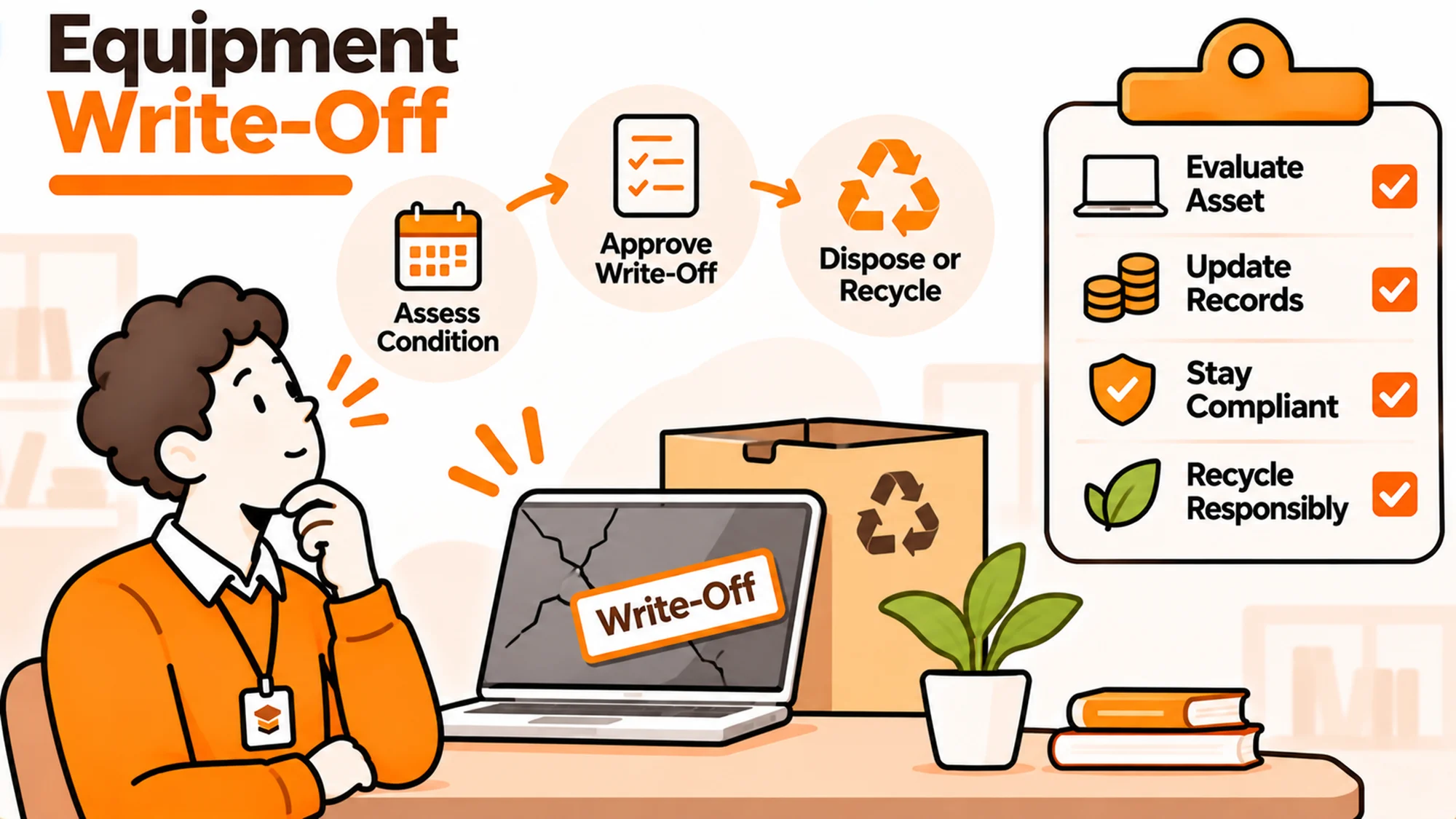
An equipment write off is the decision to stop treating a device as recoverable and close its record. It matters because without one, unrecovered laptops stay open on the register indefinitely, and a long list of open rows is how genuinely missing devices hide among the merely old ones.
- A write off closes a record. It does not mean nobody looked for the device.
- Set a time limit after which recovery efforts stop and a decision is made.
- Name an approver by value band. Everything cannot go to the same person.
- Record the reason. Lost, unreturned and destroyed are different outcomes.
- You still cannot attest a device was wiped if you never had it back.
The moment this becomes real
Say an audit samples your asset register and asks about twelve devices. Nine are accounted for immediately. Three are leaver machines from between fourteen and thirty months ago that never came back.
Each one has a history of chasing emails that stopped at some point. None has a decision attached. They are not recorded as lost, because nobody wanted to say that, and they are not recorded as recovered, because they were not. They are simply still open.
Best tools for Device Management
The auditor’s concern is not the three laptops, which represent a small amount of money. It is that the register contains entries nobody can explain and no process produced that state. The real issue is not the missing devices. It is that there was never a point at which somebody was required to decide.
When this is lighter than you think
Four stages where this needs no formality.
- Everything comes back. Some teams genuinely recover every device. If your open list is empty, there is nothing to write off.
- Very small estates. Under about fifty devices you know each one personally, and a note in the spreadsheet is sufficient.
- Fully depreciated hardware. If the accounting value is already zero, the finance half is simple and only the record matters.
- Leased devices. The write off question sits with the provider under the agreement, though your data obligations do not.
It matters once you have a standing list of unrecovered devices, which most distributed teams acquire within two years.
The five questions teams actually ask
When should we stop chasing? Pick a period and write it down. Ninety days after the leaving date is common and any consistent number is better than deciding case by case. The point is not that chasing becomes pointless on a specific day. It is that somebody has to decide rather than letting the record drift.
Who approves it? Set bands by value. A three year old laptop should not need the same sign off as a recent high specification machine. Without bands, either everything escalates and nothing gets closed, or nobody approves anything and the list grows.
Does a write off mean we gave up? No, and this distinction matters for how people treat it. It means recovery efforts are complete and the record is being closed honestly. If the device later turns up, you reinstate it, which is a much easier conversation than explaining a two year old open row.
What about the data? This is the part that survives the write off. Closing the asset record does not let you say the device was wiped, because you never had it. Record it as unaccounted rather than disposed, because those mean very different things to an auditor or a customer.
Does finance need to be involved? If the device still carries book value, yes. Disposal and write off have accounting consequences and the treatment depends on your reporting framework. Agree the threshold at which finance is notified rather than surprising them annually.
Three ways teams handle it, and where each breaks
Never write anything off. The most common state. Nobody has to make an uncomfortable decision. It breaks because the register becomes a mixture of real devices and historical gaps, and the people who could explain the old entries have left.
Bulk clean up annually. Once a year somebody closes everything older than a certain date. Better than nothing and it does clear the list. It breaks on scrutiny, since a batch of write offs approved in one afternoon with no individual reasoning looks exactly like what it is.
Write off at a fixed point in the process. Each unrecovered device hits a decision date, gets an approver by value band, and is closed with a recorded reason. This works. It breaks only if the approver is not reachable, which is why bands matter more than a single named person.
Five questions to find your own backlog
Working out whether you need an equipment write off process takes five minutes.
How many devices are open from leavers over six months ago? That number is your backlog and most teams have never counted it.
What is the oldest open entry? If it is measured in years, the register is carrying history rather than assets.
Who could approve a write off today? If nobody knows, that is why nothing gets closed.
Does your register distinguish lost from disposed? They are very different and many systems only have one status.
When did finance last hear about this? An annual surprise is worse than a quarterly note.
What is actually available
Five honest options, including ours.
A status field and a quarterly review. Best first move for everyone. Nearly free and it forces the decision to exist. Struggles if the review has no owner.
Value banded approval. Best structural improvement. Low value devices close quickly, higher value ones get real scrutiny. Struggles only in that somebody has to set the bands once.
Annual clean up with documented reasoning. Best for clearing an existing backlog rather than as an ongoing process. Struggles as a steady state, because it batches decisions that should be individual.
Insurance claim where applicable. Best for genuine loss rather than non return. Recovers some value. Struggles on excess levels and on whether home based devices are covered at all.
RemoAsset. Best at the upstream end, since most write offs exist because a device was never collected in the first place. Retrieval from remote staff and wiping with a disposal record mean devices that do come back close properly rather than sitting in an ambiguous state. Where it struggles: no service recovers a laptop somebody has decided not to return, and the approval process is entirely internal. Its published pricing starts with a pay as you go plan and a yearly subscription above it.
Where to start, by situation
| Situation | Scale | Setup | Primary pain | Recommended starting point |
|---|---|---|---|---|
| Everything is recovered | Any | Good return rate | None | No process needed, keep doing what works |
| Small estate, few open rows | Under 50 | Spreadsheet | Minor | A note and a status field is enough |
| Growing list of open entries | 100 plus | No decision point | Register filling with history | Set a decision date and a status field |
| Mixed device values | Any | One approver | Nothing gets closed | Introduce value banded approval |
| Large historical backlog | Any | Years of entries | Nobody can explain old rows | One documented clean up, then a steady process |
What the gap actually costs
The hardware is already gone, so a write off recovers nothing. That is why it feels like administrative work with no return and why it keeps being deferred.
What it buys is a register you can stand behind. A list with forty open entries of unknown status cannot support an insurance valuation, an audit response, a security questionnaire or a diligence request, because every number derived from it carries the same uncertainty. One unexplained row undermines the rows around it.
The third cost is that real losses become invisible. A device stolen last month looks identical to a laptop nobody chased in 2024, because both are simply open. So the question is not whether writing off recovers value. It is whether you could currently tell the difference between a device that is missing and one that was merely forgotten.
When write offs are a symptom
A growing write off list is usually not a write off problem. It is a collection problem producing a paperwork problem. Teams that recover most devices have very little to write off, and they did not get there through better approval workflows.
So the useful order is to fix the front end first. Book collection at the start of notice rather than the end, send packaging, and make returning easy. That shrinks the input to this process far more than any improvement to the process itself.
What a laptop lifecycle management service changes is the share of devices that come back at all, particularly in markets where you have no way to collect. Then write off becomes what it should be: an occasional decision about genuine exceptions, rather than the main way records get closed.
See how devices are collected before they become write offs
Read our guide to unreturned equipment
Related reading
- What to do about unreturned equipment
- Writing an asset disposal policy
- Running an equipment amnesty
- Equipment insurance valuation
- Accounting treatment depends on your framework. The IFRS Foundation publishes international standards and the FASB publishes US ones. Take advice on disposal treatment.
Frequently Asked Questions
What is an equipment write off?
The decision to stop treating a device as recoverable and close its record, with a reason attached. It is an administrative act rather than an admission of failure, and its purpose is to stop unrecovered devices sitting open on the register indefinitely with no explanation.
How long should we chase before writing something off?
Pick a period and apply it consistently. Ninety days after the leaving date is common. The specific number matters less than having one, because the alternative is that each case is decided individually by whoever is asked, which in practice means never decided at all.
Who should approve a write off?
Set approval bands by device value. A three year old laptop and a recent high specification machine should not need the same sign off. Without bands, either everything escalates to someone too senior to action it or nothing is approved at all.
Does writing a device off mean we stop looking for it?
In practice yes, but it is not an admission that nobody tried. It records that recovery efforts are complete. If the device later reappears you reinstate it, which is a far easier conversation than explaining a two year old open entry during an audit.
What should the record say about the data?
That the device is unaccounted for, not that it was disposed of. You cannot attest that a machine was wiped if you never had it back, and those two statuses mean completely different things to an auditor or to a customer asking a security question.
Does finance need to be involved?
If the device still carries book value, yes, because disposal and write off have accounting consequences that depend on your reporting framework. Agree a threshold at which finance is notified rather than presenting them with a year of decisions at once.
How do we reduce the number of write offs?
Improve collection rather than the write off process. Book retrieval at the start of a notice period, send packaging, and make returning easy. Teams with good recovery rates have very few write offs, and they did not achieve that through better approval workflows.