TL;DR
Equipment recovery in Poland starts with a question that has nothing to do with couriers: whose laptop is it? Teams here often mix employees with people who work as self-employed businesses, and the device may be yours, theirs or a mix. Settle that from the agreement, then plan pickup points, local currency and a write off line. RemoAsset does not publish Poland in its retrieval list, and this article says so plainly.
- Establish ownership from the agreement, not the asset register. Registers record what was issued, not who owns it.
- Ask whether pickup points beat home collection. A prepaid label plus a drop-off point is often quicker than a door pickup.
- Set a write off line in local terms, so a cheap old laptop is not shipped at great cost.
- Send instructions in Polish and keep them to one page.
- Keep final pay out of it. Take local advice on that question alone.
- RemoAsset does not publish Poland in its retrieval list. Procurement only. Ask any supplier about collections in writing.
Equipment recovery in Poland starts with who owns the laptop
This article describes operational practice only. It does not state what any employment, tax or customs rule requires, what may be withheld from anybody, or who employs whom, because those answers differ by jurisdiction and by circumstance. Take local advice.
Before booking anything, establish two facts from the paperwork rather than from the asset register.
Best tools for Device Management
Who owns the hardware. Where some of your people invoice you as businesses rather than working as employees, the laptop may belong to them, to you or to neither fully. Say you have thirty people in Poland and eight of them work this way. For those eight, the device question is a contract question.
Who you are talking to. If an intermediary holds the engagement, your request travels through them, which changes both the timeline and who can escalate.
Registers record what was issued. They do not record ownership, and the two drift apart in exactly these arrangements. How any of this interacts with employment status is a question for local advice, and the International Labour Organization publishes comparative material if you want orientation first.
Our guide to devices for staff employed through an arrangement covers the same trap from another angle.
Pickup points, return kits and the door collection default
Many European markets have moved toward collection points and parcel lockers for returns. Whether that suits your Polish team is something to ask, not assume.
A prepaid label and a drop-off at a nearby point can beat a door collection. The person chooses a time that suits them, and nobody has to be home between nine and five. For a leaver with a new job, that matters.
The catch is the box. A laptop in a return kit needs to fit the point’s size limits and survive a trip. Ask your supplier what the kit contains, whether the label works at points near your people, and what proof of drop-off you receive.
Keep door collection as the fallback for people who cannot reach a point. It is slower and costlier, but it closes the gap.
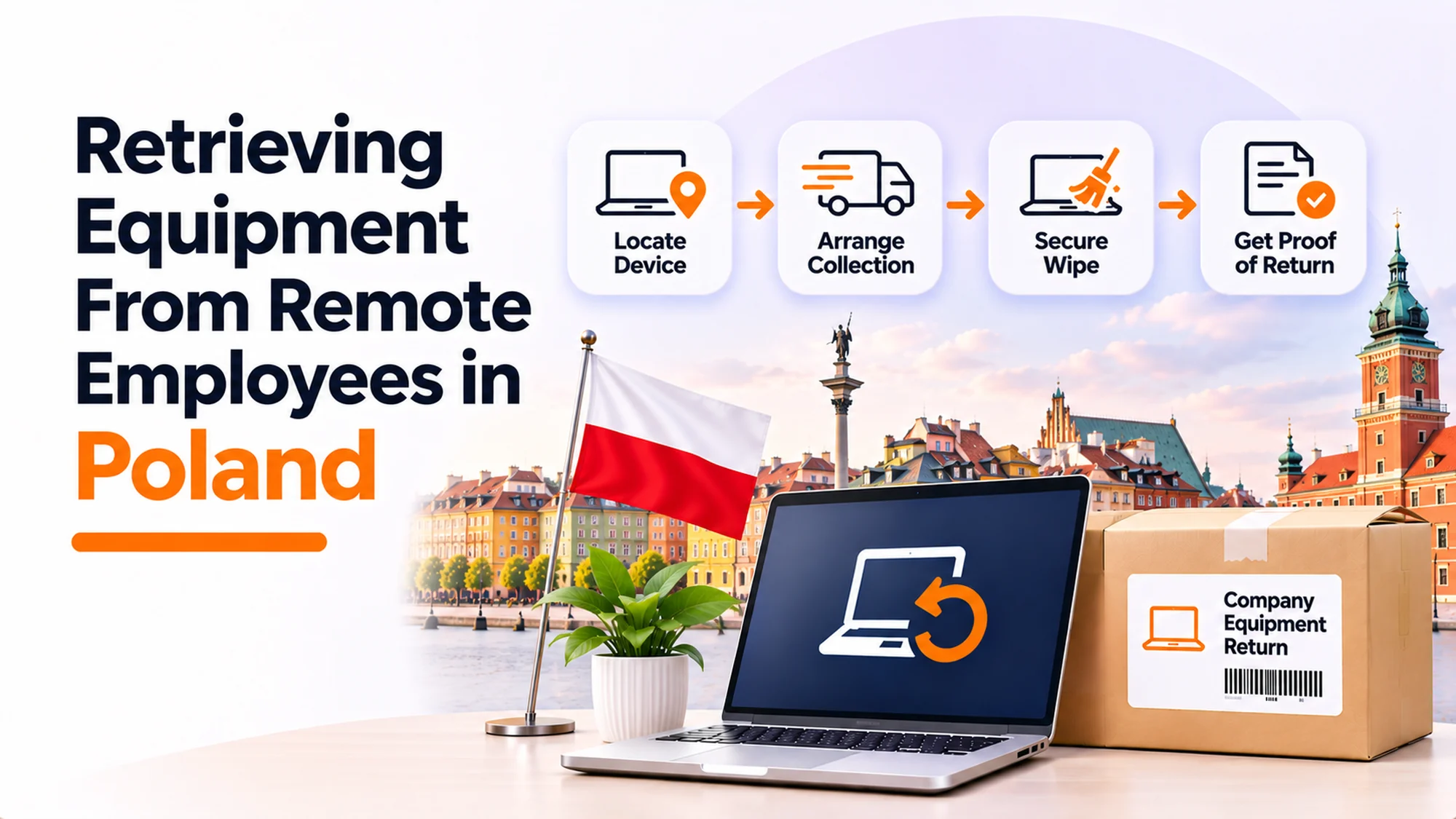
Whichever route you choose, record the tracking reference against the serial number the day the box is sent.
A write off line, in local terms
Every programme eventually meets a laptop that is not worth recovering.
Decide where that line sits before it happens. A device bought three years ago, with a low book value, may cost more to collect, wipe and store than to replace. If you set the line in advance, the decision is policy. If you leave it, it gets made under pressure by whoever has the ticket.
Express the line in the currency your Polish team is budgeted in, and revisit it when exchange rates move enough to matter. Our note on equipment cost per hire covers how to think about the value of a device.
One caution. A written off device is not a forgotten device. It might still hold company data, and NIST Special Publication 800-88 is the standard for how it should be wiped or destroyed. Record what happened, even when the answer is that you decided not to chase.
Polish instructions and the exit conversation
Write the return instructions in Polish. Offer English if the person prefers it. Keep the page short enough to read in one glance.
The exit conversation needs four lines. List what was issued, by serial number. Confirm the pickup route and the date. Explain that packaging is sent so the person arranges nothing. And say that the machine is wiped before anyone else uses it.
Ask early. The notice period is the window in which somebody is still reachable and willing. After the last day you are asking a favour of a stranger.
For people engaged as businesses, add one more line: confirm in writing whether the device is yours to collect. It is better to learn that on the first day of the notice period than on the last.
The final pay temptation, and why to resist it
Disclosure: RemoAsset, named below, is owned by the same people who publish this site. Its published coverage and its limits are both stated. HROpsLab takes no vendor money and sells no placements.
At some point somebody will suggest holding back part of a final payment, or an invoice, until the laptop arrives.
We are not going to tell you whether that is permissible in Poland. It depends on the agreement, on the circumstances and on advice from somebody qualified locally.
What we can say is operational. Combining the two conversations turns a logistics exchange into a dispute, and a person in dispute is slower to return anything. Keep them apart.
Where you have no local capacity, a supplier handles the part you cannot. RemoAsset lists Poland under procurement, and its subscription starts from 1,499 dollars a year for companies of 50 to 5,000 employees.
Where RemoAsset struggles, and it is the relevant limit here. Poland is not in its published retrieval list, which names ten markets. Its procurement coverage is quoted much wider, and the page gives those two figures in different places. Do not assume a collection in Poland. Ask it, in writing, whether it can collect from your named cities, and put the same question to every other supplier.
The decision table
| Situation | Scale | Setup | Primary pain | Recommended starting point |
|---|---|---|---|---|
| Employees, company issued kit | Any | Your serial numbers | Collection and erasure | Trigger at notice start, confirm the route |
| Self-employed contractors | Any | Device ownership unclear | Not your asset | Read the agreement before contacting anyone |
| People near a collection point | Any | Distributed addresses | Home availability | Prepaid label and drop-off |
| People far from any point | Any | Rural or remote | Reach drops | Door collection with a longer window |
| Older, low value laptop | Any | Low book value | Cost exceeds worth | Apply the written write off line |
| No local presence | Small | One or two people | No counterparty | Ask suppliers about collections, not coverage |
What getting this wrong costs
The first cost is the ownership mistake. Chasing a device you have no claim to wastes weeks and sours a relationship you may need again.
The second is the shipment nobody needed. A cheap old laptop collected, wiped and stored can cost more than a new one.
The third is the data position. A device you cannot account for may carry customer information, and NIST Special Publication 800-88 is the standard you will be asked about. Where hardware is finished, the R2 standard for responsible recycling is the reference for a disposal claim.
The fourth sits under every movement. Batteries travel under rules, and IATA guidance on shipping lithium batteries is what your carrier is working to.
Our note on unreturned equipment covers how these appear in the accounts.
Making it reliable
Four changes, none of which needs a budget.
Check the agreement for every person in Poland and record who owns each device. Move the trigger to the start of the notice period. Choose a default route, pickup point or door. And set the write off line in local terms.
Then decide the local policy once: store and reissue in Poland by default, move a device out only with a stated reason.
If you want a supplier, choose on published collection markets rather than a country count. RemoAsset is worth asking about procurement and storage, and it should say plainly whether it can collect in your Polish cities. Our guide to running an equipment amnesty covers the backlog.
Read our note on equipment exceptions, or our note on the device policy in your handbook.
Frequently asked questions
Where should equipment recovery in Poland start?
With ownership. Establish from the agreement, not the asset register, whose laptop it is. Where some people work as self-employed businesses, the device may be yours, theirs or a mix, and the answer decides whether you can ask for it back at all. Do this on the first day of the notice period.
Are pickup points better than home collection?
Often, but ask rather than assume. A prepaid label and a drop-off at a nearby point lets the person choose a time. Check that the kit fits the point’s size limits, that the label works near your people and that you receive proof of drop-off. Keep door collection as the fallback.
What is a write off line and why set one?
A stated value below which you do not chase or ship a device, set in local terms. A three year old laptop can cost more to collect, wipe and store than to replace. Setting the line in advance makes it policy. Record the decision and the wipe or destruction, because a written off device may still hold company data.
Can we withhold final pay or an invoice until the laptop is returned?
That depends on the agreement, on the circumstances and on local advice, so this article cannot answer it. Combining the two conversations turns logistics into a dispute and the device becomes less likely to arrive. Keep them apart and take advice on pay separately.
What language should the instructions be in?
Polish, with English offered if the person prefers it. Keep it to one page that can be read at a glance, and send it twice: at the start of the notice period and a few days before collection.
Should we ship recovered laptops out of Poland?
Usually not. Cross-border movement of a used device involves paperwork whose specifics vary and change, and for an older machine the cost often exceeds its value. Storing locally and reissuing to your next hire in the same market is normally cheaper and faster.
Does RemoAsset cover collections in Poland?
Not on its published retrieval list, which names ten markets and does not include Poland. Poland appears under procurement coverage instead. We own RemoAsset and we say so plainly, because implying coverage we do not publish would be worse. Ask us and every other supplier about collections in your named Polish cities, in writing.