TL;DR
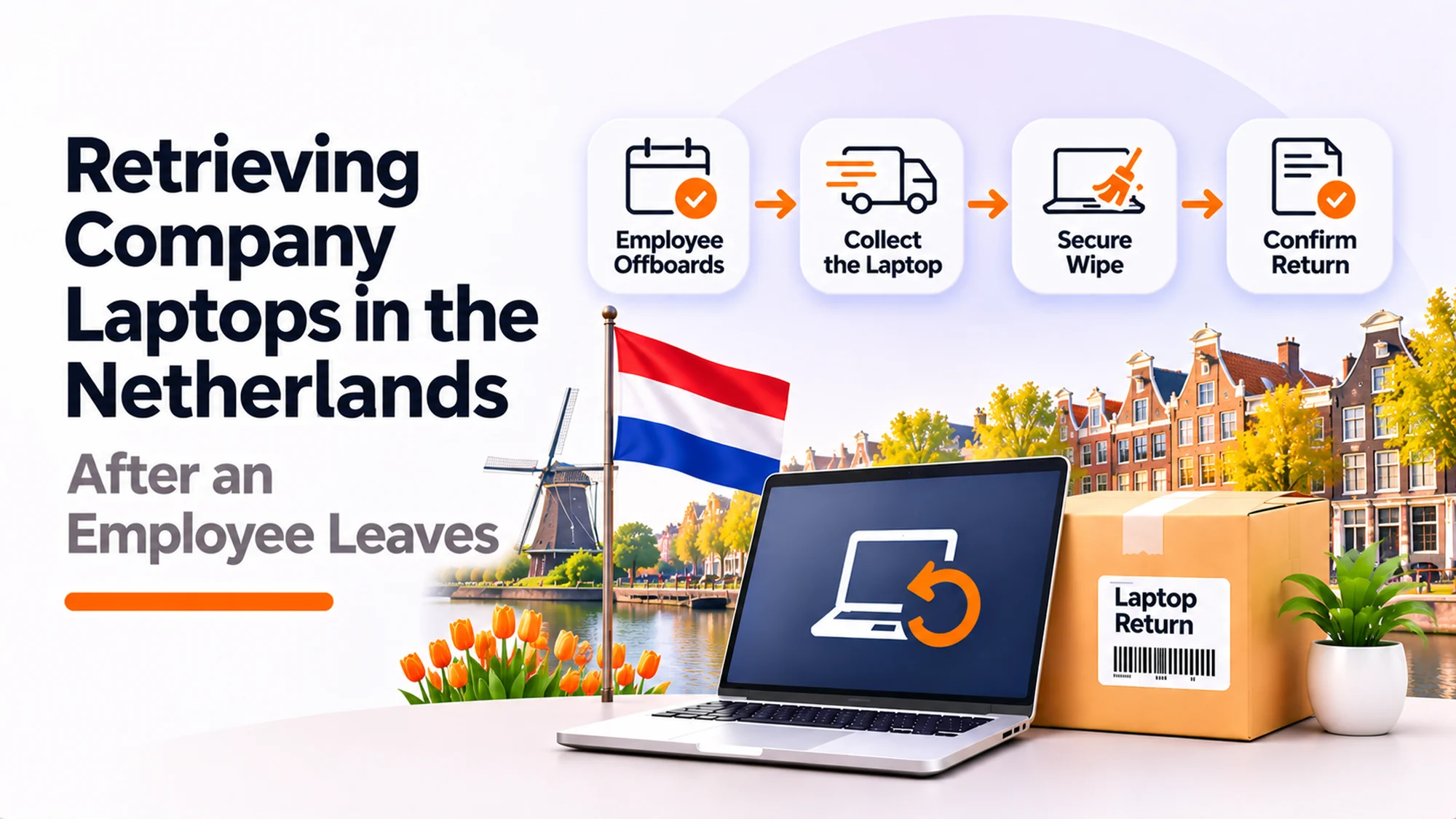
Equipment recovery in the Netherlands has an unusual problem: it is too easy. Distances are short, couriers are everywhere and nobody feels urgency. So the collection happens eventually, and the laptop then sits in a box for a month while a new hire waits for one. The failure is rarely the pickup. It is the gap between a returned device and a reissued one. RemoAsset, which we own, lists the Netherlands among its ten published retrieval markets, and its limits are stated below.
- The pickup is rarely the hard part. The weak point is the time between a returned laptop and a reissued one.
- Short distances remove urgency. That feels like a benefit and it is how a four day task becomes a month.
- Wipe and verify before it moves. Reissue only after the erase is recorded, against the serial number.
- Reuse beats shipping out. Reissuing in-country is almost always faster than moving a device anywhere else.
- Shared spaces and flats complicate delivery. Confirm who receives a parcel and who signs for it.
- RemoAsset lists the Netherlands among ten published retrieval markets. Ask about reissue as well as collection.
Equipment recovery in the Netherlands hides a reuse gap
This article describes operational practice only. It does not state what any employment, tax or customs rule requires, what may be withheld from anybody, or who employs whom, because those answers differ by jurisdiction and by circumstance. Take local advice.
Start with what actually goes wrong.
Best tools for Device Management
A leaver returns a laptop within a week, because the country is small and the courier is quick. That is a success on the dashboard. Then the machine goes into a cupboard, somebody has to wipe it, somebody has to re-image it, and nobody owns the sequence. Three weeks later a new hire starts and an order for a fresh laptop goes out.
You paid to collect a machine and then bought another. The collection did its job and the process around it failed.
The fix is to treat collection and reissue as one flow with one owner. A returned device should have an explicit next step the day it arrives, such as reissue to a named incoming hire, hold for a refresh, or dispose.
Our equipment reconciliation guide shows how to keep that flow visible at the register.
Short distances, and why they hide delay
Everything is close. A courier can reach a former employee in a day or two almost anywhere, which is excellent, and which also means nobody feels any pressure.
In a larger or sparser country a six day window feels tight and people act. Here it feels generous, so the request sits at the bottom of a list. By the time somebody chases, the person has started a new job and a new routine.
Counter that with a stated deadline. Put a date in the exit message, not an open invitation, and have the collection booked before the last working day. A fixed date does what distance no longer does.
Then measure it. Days from last working day to device received is a number you can track, and most companies have never looked at theirs. If you cannot produce it today, you are managing by impression.
Wipe and verify before anything moves
The order matters more than the speed.
A returned laptop should be erased and the erase recorded before it goes to the next person. Reissuing first and wiping later is how personal files and company data end up in front of somebody who should not see them.
NIST Special Publication 800-88 is the reference most auditors will mention. The practical point is simpler: the record should say who erased the machine, when, by what method, and against which serial number. A line in a spreadsheet saying done is not a record.
Where a device is genuinely at the end of its life, the R2 standard for responsible recycling is what a disposal claim gets measured against, and the EPA list of certified electronics recyclers is a starting point if you operate in the United States and are checking a recycler. Ask any supplier whose certificate you would receive.
Skip this step to save two days and you may spend two months explaining it.
Flats, shared spaces and who signs
A parcel needs somebody to hand it to.
Many people in dense urban areas live in apartments or shared houses, and many work from shared spaces. Delivery to the front door is not the same as delivery to the person. A packaging kit can sit in a hallway, get taken by a housemate or go back to a depot.
Ask in the exit conversation where the kit should go and who will be there. Then confirm who signs for the outbound parcel, and what the courier does if nobody answers.
For devices that leave a shared space, such as a coworking desk, name the person who hands the laptop over. An unnamed desk is where devices vanish.
Our note on equipment during the notice period covers the order of these steps. And, as always, how any of it interacts with employment terms is a question for local advice.
Reuse in-country, do not ship out
If you hire here continuously, the cheapest laptop is the one you already own.
Moving a used device across a border involves paperwork that varies by route and changes over time, and the World Customs Organization is the reference body if you want to understand the general picture. For an older machine the shipping and handling often cost more than the device is worth.
Storing it locally and reissuing to the next hire is usually faster and cheaper. It also means the new person has a working machine on day one, not a parcel in transit.
Set the rule by device age and value in advance. Under a certain age and above a certain condition, a returned machine goes to local stock. Beyond that, it is disposed locally with a record.
A rule agreed in advance beats a decision made by whoever picks up the ticket.
Who collects it, and where RemoAsset fits
Disclosure: RemoAsset, named below, is owned by the same people who publish this site. It is described with its limits stated, on the same terms as every other supplier here. HROpsLab takes no vendor money and sells no placements.
Where you have no local presence, a supplier handles the part you cannot.
RemoAsset lists the Netherlands among the ten markets on its published retrieval list. Retrieval is described as courier pickup, chain of custody and a NIST wipe, started from the exit record. Its subscription starts at 1,499 dollars a year for 50 to 5,000 employees.
That makes it a reasonable first call for an HR team that wants a printed price and a supplier that does not require a change of payroll provider.
Where RemoAsset struggles. It prints no per device rate. Its retrieval list names ten markets under a 25 plus claim, and its pricing page also says 80 plus, the procurement figure. Its Netherlands page does not describe reissue as a step, so ask about storage and reuse as well as pickup. It is not a certified disposal vendor. And it is our product.
Ask any supplier to confirm collection, storage and reissue in writing.
The decision table
| Situation | Scale | Setup | Primary pain | Recommended starting point |
|---|---|---|---|---|
| Returns fast, then sits idle | Any | No named owner after receipt | Idle time, then a new purchase | One owner for collect, wipe and reissue |
| Staff in flats and shared houses | Any | Parcel to a shared door | Kit goes missing or back to depot | Confirm who receives and who signs |
| Devices at coworking desks | Any | Unnamed hand-over | Nobody accountable | Name the person who hands it over |
| Hiring continuously in the Netherlands | 20 plus locally | Steady churn | Buying new while old sits | Local storage and reissue to the next hire |
| No wipe record | Any | Spreadsheet says done | Cannot prove erasure | Record who, when, how and the serial number |
| No local presence at all | 50 to 5,000 | One or two leavers a month | No counterparty | A supplier with the Netherlands on its published retrieval list |
What getting this wrong costs
The first cost is the duplicate purchase. Collect a laptop, leave it in a cupboard, and buy a new one for the next starter. The returned machine becomes dead stock that ages on a shelf.
The second is the quiet deadline. Because distances are short, nobody sets a date, and a one week task takes a month. The person changes jobs, the address changes, and the chase starts again.
The third is the data position. A device reissued before the erase is recorded is a risk with a name on it, and NIST Special Publication 800-88 is what you will be asked about afterwards.
The fourth is shipping. Whenever a device does move, IATA guidance on shipping lithium batteries is what the carrier follows for batteries.
Our note on unreturned equipment shows how these costs appear in the accounts.
If you had to say today how many returned laptops are sitting idle in a cupboard, what would the answer be?
Making it reliable
Four changes, none of which needs a budget.
Give every returned device a next step on the day it arrives. Put a date, not an invitation, in the exit message. Record the erase against the serial number before reissue. And name one owner for the whole flow, because the handover between teams is where it stalls.
Then decide local policy once: reissue in-country by default, move a device out only with a stated reason, and dispose locally where the hardware is finished.
Where you need capability you do not have, pick a supplier on its published collection markets and ask about reissue. To see how RemoAsset handles the Netherlands, book a demo at remoasset.com and bring your last year of leavers.
Our guide to running an equipment amnesty covers what to do with the backlog.
Read our guide to equipment recovery in the UK, or our note on the device policy in your handbook.
Frequently asked questions
Why is equipment recovery in the Netherlands often slow if distances are short?
Because short distances remove urgency. A courier can reach almost anybody quickly, so nobody sets a date and the request sits at the bottom of a list. A task that could take four days takes a month. A stated deadline in the exit message does what distance no longer does.
What happens between collection and reissue?
That is usually the weak point. A returned laptop sits in a cupboard until somebody wipes it, somebody re-images it and a new hire needs one. Without one owner for the flow, a new machine is ordered while the returned one ages. Give every returned device a next step on the day it arrives.
What should the erase record contain?
Who erased the machine, when, by which method and against which serial number. A line saying done is not a record. NIST SP 800-88 is the reference most auditors mention, and the record should let you answer in minutes, not weeks.
Can we withhold pay until the laptop is returned?
That depends on jurisdiction, on what the contract says and on the circumstances, so it is a question for local advice and not one this article can answer. Operationally, combining the two conversations turns a logistics exchange into a dispute. Keep the topics separate.
How do shared flats and coworking spaces affect collection?
A parcel needs somebody to hand it to. A kit left in a hallway can be taken by a housemate or returned to a depot, and a device at a coworking desk with no named owner can vanish. Confirm who receives the kit and who signs for the outbound parcel.
Does RemoAsset collect laptops in the Netherlands?
The Netherlands is on its published retrieval list of ten markets, alongside the United States, Canada, Mexico, Brazil, the United Kingdom, Germany, France, Ireland and Sweden. Its page does not describe reissue as a step, so ask about storage and reuse too. We own RemoAsset and say so.
Should recovered laptops be shipped out of the Netherlands?
Usually not. Cross-border movement of a used device involves paperwork that varies by route and changes over time, and for an older machine the cost often exceeds the value. Storing locally and reissuing to your next hire is normally faster and cheaper.