TL;DR
Equipment induction is the short briefing that tells a new starter what to do when their laptop breaks, how to report a problem without fear of being charged, and what they are responsible for. Most companies hand over a device with a signature and no conversation, then wonder why problems are reported late.
- Tell people how to report a problem before telling them their obligations.
- Damage reported early is cheaper than damage reported when it fails.
- Say plainly whether personal use is allowed. Ambiguity helps nobody.
- Cover travel and insurance once, not after the first incident.
- Five minutes in week one, not a twenty page document nobody opens.
The moment this becomes real
Say somebody drops their laptop in month three. The corner is dented and the screen has a hairline crack at the edge. It still works perfectly.
They do not report it. Not out of dishonesty, but because nobody ever told them what happens if they do, and the equipment agreement they signed on day one mentioned liability for damage. The rational move is to say nothing and hope.
Best tools for HR Operations
Four months later the display fails properly, which is a bigger repair than it would have been, and the warranty conversation is now complicated by visible impact damage. The real issue is not the drop, which was an accident. It is that the only thing the company ever communicated about equipment was a liability clause.
When this is lighter than you think
Four stages where this needs almost nothing.
- Very small teams. Under twenty people this happens naturally in conversation and does not need formalising.
- Experienced technical hires. Somebody who has managed company hardware for a decade needs the reporting route and nothing else.
- Office based with walk up IT support. If there is a desk to visit, the reporting question answers itself.
- Devices with no local data. The data handling half gets much shorter when nothing is stored on the machine.
It matters for remote starters who have never met anyone in IT, for first jobs, and anywhere people are issued equipment they have not used before.
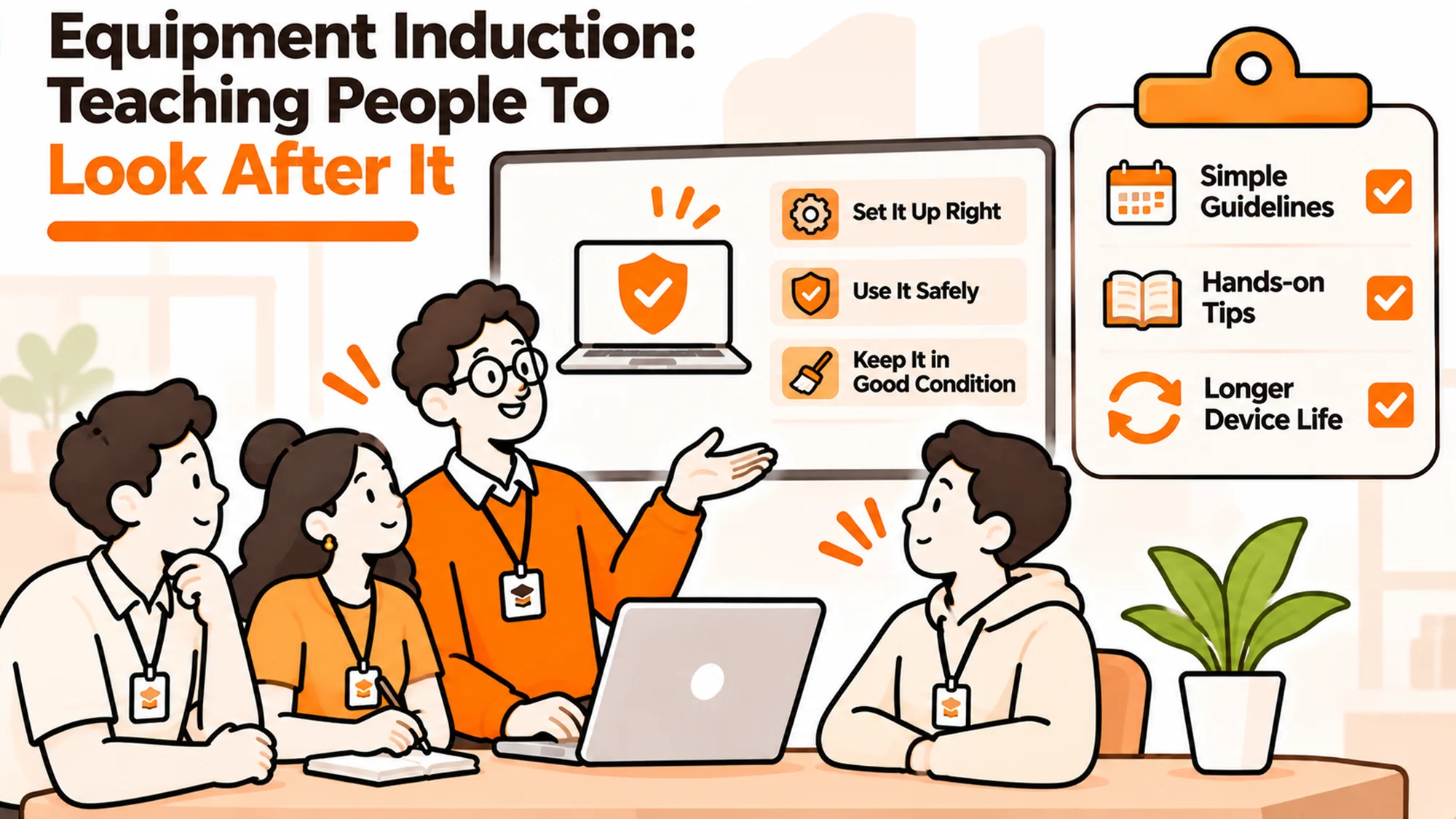
The five things worth covering
How to report a problem, and what happens next. Put this first, before anything about responsibility. People who know that reporting a cracked screen leads to a repair rather than an invoice report it the same day. People who do not, hide it. This single ordering choice changes behaviour more than any policy wording.
What they are actually responsible for. Say it plainly and proportionately. Reasonable care, report damage promptly, do not leave it in a car. Avoid implying that ordinary accidents will be charged, unless they will be, in which case say so clearly rather than leaving it ambiguous.
Whether personal use is allowed. Most people assume some is fine. If your position differs, this is the moment to say so. If it is allowed within limits, defining them removes a surprising amount of low grade anxiety and is worth two sentences.
Travel and basic physical care. Not a lecture. Carry it in a bag rather than loose, do not check it into hold luggage, do not leave it visible in a car. Three lines that prevent a meaningful share of all damage.
What happens at the end. Mentioning the return process on day one makes it unremarkable later. A person who knew from the start that devices come back is far easier to collect from than one for whom it is a surprise.
Three ways teams do it, and where each breaks
Signature only. Hand over the device with an agreement to sign. Fast and it covers the legal base. It breaks because a liability document is the only equipment communication the person ever receives, which makes reporting problems feel risky.
A written guide. A page or two in the onboarding pack covering the same ground in plainer language. Much better and genuinely useful as a reference. It breaks on attention, since week one contains a great deal of reading and this is rarely the most urgent of it.
A short conversation plus a short written reference. Five minutes with a person, backed by something they can find later. This works, because the conversation establishes that reporting is safe and the document answers the details. It breaks on scheduling, which is the only real cost.
Five questions about your own handover
Working out whether you have an equipment induction at all takes five questions.
What is the first thing a new starter learns about their laptop? If it is a liability clause, that is the finding.
Does anyone tell them how to report damage? Ask a recent joiner. They will remember clearly.
Is personal use addressed anywhere? If not, everyone is guessing.
How long between a problem starting and being reported? IT will have a sense, and it is usually weeks.
Does anybody mention the return process? Mentioning it early makes offboarding easier.
What is actually available
Five honest options, including ours.
Nothing beyond the agreement. Best for experienced hires in small teams. Costs nothing. Struggles because it sets reporting behaviour badly from day one.
A one page guide in the onboarding pack. Best general answer. Cheap, reusable and it exists when needed. Struggles on week one attention.
A short live handover. Best for remote starters. Establishes a person to contact, which is most of the value. Struggles on scheduling across time zones.
A video walkthrough. Best at scale. Made once, watched whenever. Struggles on feeling impersonal, and people rarely rewatch it when a problem actually happens.
RemoAsset. Relevant to one specific line of the induction, which is what somebody does when the machine breaks. Where maintenance and repairs run through a provider with coverage in the person’s market, the answer is a real process rather than work it out locally, and device security and data handling covers the end of life half. Where it struggles: the induction itself is a people job that takes five minutes and no vendor can do it for you. Its published pricing starts with a pay as you go plan and a yearly subscription above it.
Where to start, by situation
| Situation | Scale | Setup | Primary pain | Recommended starting point |
|---|---|---|---|---|
| Small office team | Under 20 | Walk up support | Very little | A conversation at handover is enough |
| Experienced technical hires | Any | Any | Minimal | Give them the reporting route and stop |
| Remote starters | Any | No face to face | No contact established | A short live handover plus a written reference |
| First job or apprentice cohort | Any | Young workforce | Damage goes unreported | Lead with reporting, not with liability |
| Large distributed onboarding | 100 plus a year | No consistency | Nobody covers this | A one page guide plus a recorded walkthrough |
What the gap actually costs
Five minutes per joiner, which is why nobody does it. There is no budget line for a conversation and no project that would contain it.
What it costs to skip is late reporting. A screen with a hairline crack is a cheap repair; the same screen failing four months later is a larger one, and there is often a warranty conversation complicated by impact damage that was never declared. Across a year of joiners this is real money, and it never gets attributed to onboarding.
The second cost is the relationship. The first thing many people learn about their employer’s attitude to equipment is a liability clause, and they calibrate accordingly for the rest of their time there. So the question is not whether an induction is worth five minutes. It is what people currently conclude from the only communication they received.
When the answer depends on where they are
Most of an equipment induction is the same everywhere and can be written once. Reporting route, responsibilities, personal use, basic care, return process. That part is a page and it does not change.
The part that varies is what actually happens after somebody reports a problem, and it varies by geography. In a market where you have IT presence the answer is simple. In one where you have never shipped anything, telling a new starter to report a fault is a promise you may not be able to keep quickly.
That is worth knowing before you write the induction, because an induction that promises support you cannot deliver is worse than one that is honest about timescales. Where repair and replacement run through a provider with coverage in those markets, as with a laptop lifecycle management service, the induction can say something specific. Otherwise say what is true, including that it may take time.
See how repairs are handled where your people actually are
Read our guide to the employee equipment agreement
Related reading
- What belongs in an employee equipment agreement
- Device damage liability
- Writing an employee equipment policy
- Day one equipment readiness
- Basic device care overlaps with security guidance. See the NCSC device security guidance and the ICO on handling personal data.
Frequently Asked Questions
What should an equipment induction cover?
How to report a problem and what happens next, what the person is responsible for, whether personal use is allowed, basic travel and physical care, and the fact that devices come back at the end. Five topics, five minutes, and a written reference they can find later.
Why does the order of topics matter?
Because leading with liability teaches people that reporting damage is risky. Someone who knows a cracked screen results in a repair reports it the same day. Someone whose only equipment communication was a liability clause has every reason to say nothing and hope.
Should we tell people whether personal use is allowed?
Yes, explicitly. Most people assume a degree of personal use is acceptable, so if your position is different they need to know. If it is allowed within limits, defining them takes two sentences and removes a surprising amount of low grade uncertainty.
Is a written guide enough on its own?
It is useful as a reference and it struggles to land in week one, when people are reading a great deal at once. A short conversation establishes that reporting is safe and gives them a person to contact, which is the part a document cannot do.
Should we mention the return process on day one?
Yes. Mentioning it at handover makes it unremarkable later, and people who knew from the start that devices come back are considerably easier to collect from than those for whom it arrives as a surprise during their notice period.
How do we reduce unreported damage?
Make clear what happens when somebody reports it, and make sure the answer is not an invoice for ordinary accidents. Late reporting is almost always a rational response to uncertainty about consequences rather than an attempt to hide something.
What if we cannot support a quick repair in their country?
Say so honestly in the induction rather than promising support you cannot deliver. An accurate expectation of a two week turnaround is far better received than a vague promise of help that turns into silence when somebody actually needs it.