
TL;DR
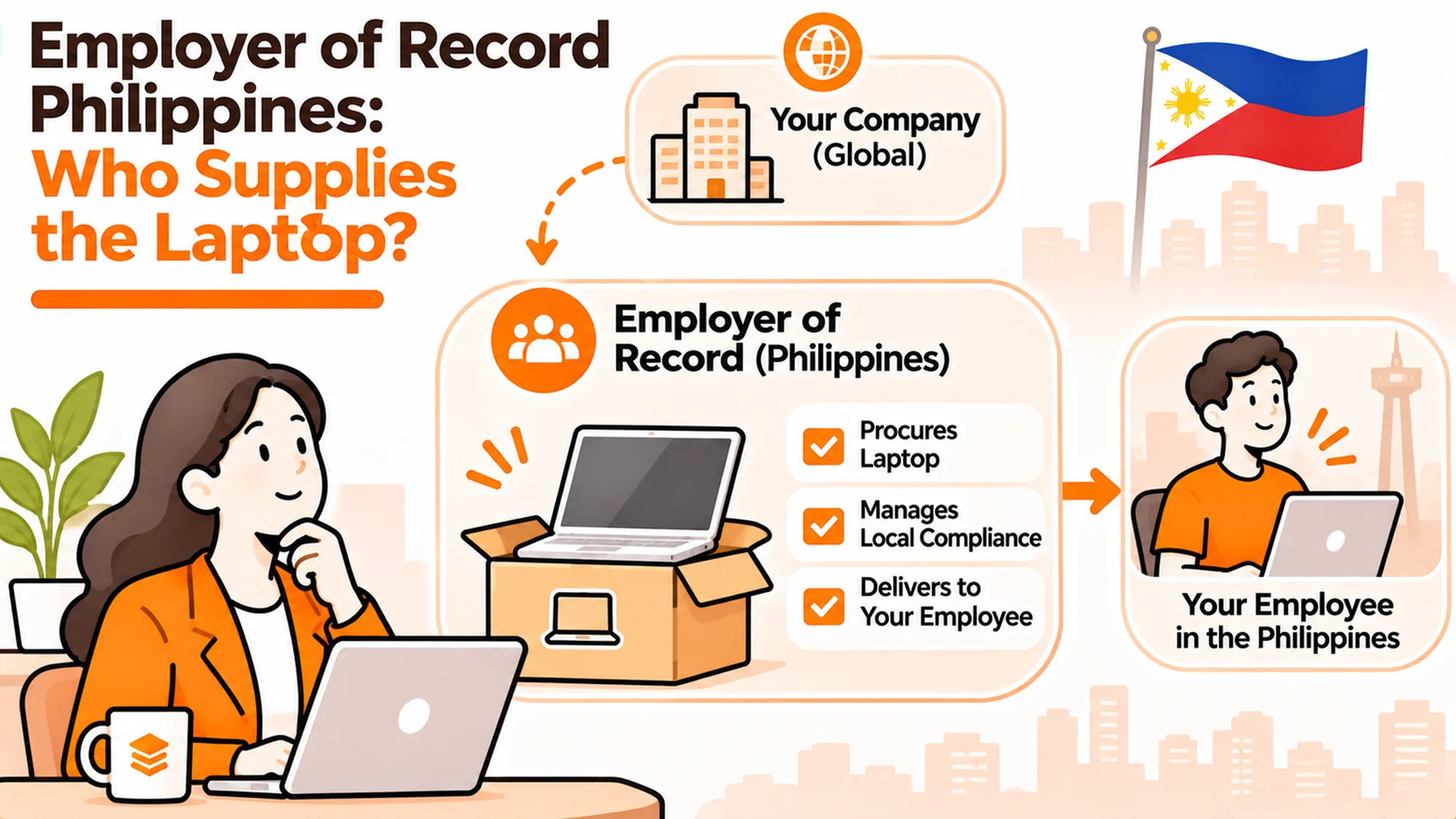
- Employment and equipment are usually two different services. Assuming the second comes with the first is the most common planning error in this arrangement.
- Several providers do offer equipment, as a separately priced product. Deel IT, for instance, is a distinct product line from Deel’s employment service.
- The question that matters more than who ships it is who owns it, because ownership decides who can get it back.
- Confirm scope in writing before the start date, not in the onboarding week. Lead times into the Philippines do not forgive a late start.
- If equipment is out of scope, buying locally in Manila is usually the cleanest answer, because a domestic purchase has no import event.
- Nothing here is advice on employment or tax status. Those answers differ by jurisdiction and by circumstance, so take local advice.
A company decides to hire its first two people in Manila. Rather than set up a local entity, it engages a provider to employ them, which is a well established way of getting started quickly. Contracts are signed in week one. Start dates are set for the first of the month. Everybody is pleased with how fast it moved.
Nine days before the start date somebody asks who is sending the laptops. The answer turns out to be nobody. The hiring provider was never asked and does not include it. The internal IT team assumed it was covered because the provider is handling everything else. Two people start work on their own machines while a purchase order moves through approval, and the security policy quietly does not apply to either of them for three weeks.
This is not an unusual outcome. It is close to the default one, and it happens because an employer of record arrangement is genuinely comprehensive about employment, which makes it reasonable to assume it is comprehensive about everything. The equipment question sits in a gap between two teams who each think the other has it.
Best tools for Device Management
A boundary before anything else. This article is about the practical equipment question only. It does not say who employs anybody, who holds any obligation, what any arrangement transfers, or what is required of you. Those answers depend on facts this page cannot know and they differ by jurisdiction and by circumstance. Take local advice on them.
What the arrangement actually does, in operational terms
Worth setting out plainly, because a lot of the people searching for this are meeting the term for the first time and the available explanations tend to be written by people selling it.
In operational terms, a company that wants somebody working in a country where it has no local entity engages a provider that already has one. The provider handles the local employment administration, the payroll runs locally, and the person does their day to day work for the company that hired them. It removes the need to establish an entity before the first hire, which for most companies is the point of it.
What that means for anybody’s legal status, who holds which obligations, and what any of it transfers are questions this page does not answer and should not. They differ by jurisdiction, by the structure of the arrangement, and by facts specific to each company. Those are questions for local counsel and for the provider, and anybody answering them in a blog post is guessing on your behalf.
What is safe to say operationally is where the boundaries usually sit
The provider’s scope is typically the employment administration. Your scope is typically the work itself: what the person does, which systems they use, what equipment they use to do it, and what happens to your data. Equipment falls on your side of that line far more often than people expect, which is the entire subject of this article.
The useful mental model is that an employer of record philippines arrangement solves the question of how somebody gets paid in Manila. It does not, by default, solve the question of what they are typing on.
Why the Philippines makes this gap more expensive than most
The equipment gap exists everywhere. Three things about this market make the consequences larger.
Hiring here is fast, so the mismatch is wider
The Philippines is one of the quickest markets to start in, which is a large part of why companies choose it. The faster the employment side moves, the more visible it is that the hardware side has not. A market where hiring takes three months hides the problem. A market where it takes two weeks exposes it immediately.
The talent is frequently senior and remote-first
Many Philippine hires are experienced people working from home rather than from a client office, which means there is no local desk with a spare machine on it and no colleague who can hand something over. Whatever arrives at the person’s address is the entire provision.
Recovery is genuinely harder here
People commonly relocate from Metro Manila back to their home province when a job ends, so the address captured at hiring is often stale by the time anybody needs it. Courier coverage outside the main cities thins, and degrades further during the rainy season. A device that would be recovered routinely in a single-city market can simply stop being recoverable.
Taken together, the Philippines rewards deciding the equipment question early and punishes leaving it. That is a market characteristic rather than a problem with the market, and the fix is scheduling rather than anything clever.
Contractors are a different shape, and the difference matters
Plenty of Philippine engagements are not employment arrangements at all. People are engaged as independent contractors, sometimes directly and sometimes through a contractor-of-record service. The equipment question changes shape.
Where somebody is engaged as a contractor, the common expectation is that they supply their own tools, and plenty of contracts say so, or say nothing at all, which amounts to the same thing until somebody tests it. That has one clear consequence worth planning around: you have no device, no control over its build, and no agreed basis for recovering anything or for requiring that data be removed from it.
Companies respond in one of three ways. They accept it and restrict what contractors can access, which is coherent and requires actually implementing the restriction. They supply equipment anyway, which needs the arrangement written down because supplying hardware to somebody engaged as a contractor is exactly the kind of detail that deserves local advice rather than an assumption. Or they do neither, which means contractor-held company data on unknown machines, and that is the situation most companies are in without having chosen it.
The operational point, which is the only one this page will make, is that the equipment position should be an explicit term rather than a silence. Whether a given arrangement is appropriate, and what it implies, is a question for local counsel in the Philippines, because the answer depends on specifics and because getting it wrong is not a hardware problem.
The assumption worth checking in week one
The assumption is that equipment comes with the employment service. Sometimes it does. Frequently it does not. And the gap between those two states is not visible in any of the documents that get read closely during a hiring decision.
The reason is structural rather than evasive. Employing somebody and supplying them with a laptop are different businesses. One is about payroll, contracts and local administration. The other is procurement, logistics, customs, device management and reverse logistics. Providers that do both generally do them as two products, with two scopes and two prices, because they are two different operations.
So a provider saying yes to the employment question has not said anything at all about the hardware question. Nobody has misled anybody. The hardware question simply was not asked, and it tends not to be asked because it does not come up in the conversations where an employer of record philippines decision actually gets made, which are about speed, cost per head and how quickly somebody can start.
The check is one sentence long. Ask, in writing: does your service include procuring, shipping, supporting and recovering a laptop for this person, and if so what does it cost and what are the lead times. The answer will be clear. It is only ambiguous when nobody asks.
What “they will handle it” can actually mean
When a provider indicates that equipment is covered, it generally means one of three different things, with quite different consequences.
A full equipment service as a separate product
The provider sources, images, ships, supports and recovers the device, and invoices for it separately from the employment fee. Deel IT is the clearest example of this shape, sitting alongside rather than inside the employment service. This is the most complete answer and the one with the clearest commercial terms.
A procurement and reimbursement arrangement
The provider buys locally on your behalf, or the worker buys and is reimbursed through payroll. Fast and inexpensive. The catch is that the specification is whatever was available, the device arrives unmanaged, and in the reimbursement version the question of who owns the machine is genuinely unclear unless somebody wrote it down.
A referral
The provider introduces you to a partner who does equipment. Perfectly reasonable, and it means the scope, the price, the lead time and the recovery process are all with a third party you have not yet assessed. Treat this as not covered, because operationally it is.
These are easy to tell apart with one question: who invoices us for the laptop, and what does that invoice say. A separate line item from the provider is the first case. A payroll entry is the second. A different company’s invoice is the third.
Who owns the asset, which matters more than who ships it
Delivery is a one-time problem with an obvious owner. Ownership is a permanent question that decides what happens at every later point, and it is the one most often left unwritten.
Ownership determines who can ask for the device back and on what basis. It determines whose asset register the machine belongs on. It determines who carries it on their books and depreciates it. It determines who is responsible for the data on it. And it determines what happens if the relationship between you and the provider ends while devices are still in circulation.
Three arrangements are common. You own it, the provider or a third party simply handles the logistics, and the machine sits on your register. The provider owns it and supplies it as part of a service, which is cleaner administratively and means the device leaves with the provider if you switch. The worker owns it, usually after a reimbursement or a stipend, in which case you do not have an asset and should stop treating it as one.
All three are workable. The unworkable one is not knowing, which is the state most arrangements are in until somebody leaves. The symptom is an email thread where three parties each explain why the machine is one of the other two’s responsibility, while the device sits in a flat in Quezon City.
Settle it at contract stage in one line. It costs nothing then and it is the most expensive thing on this page to settle later.
The timing problem nobody plans for
Employment arrangements can move quickly. A provider can often have somebody employed and ready to start inside two weeks, which is most of the appeal.
Equipment does not match that pace, and the mismatch is where the gap opens. A local purchase in Manila is quick, a few days, once somebody has approved it and somebody has placed the order, and those two steps are frequently slower than the purchasing itself. An import is slower again, one to three weeks depending on the route and the customs handling, and it cannot start until you know the person’s address, which you usually do not have until the employment paperwork is complete.
So the critical path runs backwards from the start date through address confirmation, which depends on contract completion. Compressing the hiring timeline compresses the equipment timeline by the same amount, and only one of the two can absorb it.
Two things fix this cheaply. Trigger the equipment process at offer acceptance rather than at contract completion, using whatever address information you have and confirming it later. And hold the start date to a realistic equipment lead time rather than the employment one, or accept explicitly and in writing that the first week will be on a personal machine with whatever that implies for your access controls.
The failure mode worth avoiding is the unspoken version, where nobody decides and the person simply starts on their own laptop because the alternative was to not start. That decision gets made by default, by the most junior person in the chain, on the day.
What to confirm before the start date
Six questions, all answerable in writing, none of which takes a provider more than a short email.
Is equipment in scope, and is it a separate invoice?
This settles which of the three shapes above you are in.
Who owns the device?
Us, you, or the worker. One word.
Will it arrive enrolled in our device management, or unmanaged?
An unmanaged arrival means a remote setup session on day one with somebody in a different time zone, and it means the machine is outside policy until that session happens.
What is the lead time from today, not from an unspecified start?
Lead times quoted from the point of order are not useful when the order cannot be placed until the contract completes.
What happens when it breaks?
Specifically whether there is a warranty valid in the Philippines and whether there is any spare machine available, because an unanswered version of this question becomes a person not working for three weeks.
What happens on their last day?
Who collects it, who pays for the collection, who wipes it, what evidence you receive, and where it goes afterwards. This is the question that most often has no answer at all, and it is the one that costs the most.
If equipment is out of scope, what to do instead
Being out of scope is a perfectly good outcome once it is known. It is only expensive when discovered late.
Buy locally in the Philippines
Usually the cleanest answer for one to five machines. A domestic purchase has no import event, so no customs declaration, no import tax at a border, no delay and a warranty the local service network will honour. Manila has real supply for mainstream business machines, and Philippine retail sells US keyboard layout as standard, which is what most international teams want.
Ship from a hub you already hold stock in
Sensible if your build is standardised and the exact configuration is not stocked locally. Specify Delivered Duty Paid so your new starter is not asked to pay a courier at the door, and remember that import tax is assessed on a base that includes your freight, so express shipping raises the tax bill as well as the carriage.
Use a specialist equipment supplier alongside the employment provider
Keeps the two arrangements separate, which has a real advantage: changing one does not disturb the other. Suppliers operating in this market include Workwize, GroWrk, allwhere, Esevel, Firstbase and RemoAsset.
Disclosure: RemoAsset is owned by the same people who publish HROpsLab. It is named here with its limitations stated and its competitors described on the same terms. This site takes no vendor money and sells no placements.
RemoAsset publishes a subscription starting at 1,499 dollars a year and states coverage of 80 or more countries including the Philippines. Its clearest limitation for this use case is that it publishes no per-device rate, so a company hiring two people in Manila cannot model the cost from the website and has to ask. For two machines, a local purchase and a spreadsheet is very likely the better answer, and a subscription entry point suits a committed estate rather than a first hire.
What not to do
is run a stipend without deciding what it means. A stipend is a legitimate model, but it means you do not own the device, cannot enforce the build and have no mechanism to recover anything. Choosing that deliberately is fine. Arriving at it because nobody decided is how companies end up with production data on machines they have never seen.
If you are already in this position
Most of this page is prevention, which is not much use to somebody who already has eleven people in Manila on an assortment of machines nobody has a list of. That situation is extremely common and it is recoverable without a project.
Start by counting, not by fixing
Ask every person three questions: what machine are you working on, did the company pay for it, and is it enrolled in our management tool. Three questions, one message, and the answers will sort themselves into company devices you knew about, company devices you did not, and personal machines. The third group is the one that matters and it is usually larger than expected.
Then close the personal machine group rather than the whole problem
For each person on a personal device, decide one of two things: provide a company machine on a stated date, or restrict what that person can access until you do. Both are acceptable. Doing neither, which is the current state, is the only option that is not.
Settle ownership retrospectively while people are still employed
For every company-funded device, write down who owns it and confirm it with the provider where one is involved. This is dramatically easier now than at the point somebody leaves, and it is the single highest value hour in the whole exercise.
Only then look at tooling
The instinct is to buy a platform first, and it is the wrong order, because a platform populated with a list you do not trust produces a confident and inaccurate register. Get the list right by hand, then decide whether anything needs automating. At eleven people, probably not yet.
The whole exercise is a few hours of asking and a decision per person. What makes it feel large is that it has been avoided for a while, not that it is difficult.
The decision table
| Situation | Scale | Setup | Primary Pain | Recommended Starting Point |
|---|---|---|---|---|
| First hires through a provider | 1 to 3 | Employment arranged, equipment unasked | Discovered nine days out | Ask the scope question in writing today. Buy locally. |
| Provider offers equipment as an add-on | Any | Separate invoice available | Price and lead time unclear | Take it for convenience, confirm ownership and recovery terms |
| Standardised global build | 10 plus | Imaged stock in a hub | Local spec does not match | Ship DDP, keep equipment separate from employment |
| Reimbursement or stipend in place | Any | Worker buys own machine | No asset, no control, no recovery | Decide if that is deliberate. Write it into the contract either way. |
| Growing Manila team | 10 to 40 | Mixed sources, no register | Nobody knows what is owned | Local reseller plus a six-field register and a named owner |
| Thinking about switching provider | Any | Devices supplied by the provider | Hardware tied to employment | Establish who owns each device before you start the switch |
What assuming costs, in the order it usually lands
The first cost is the start that does not happen. Somebody is being paid from the first of the month and is not able to do the job they were hired for. That is the number everybody calculates, and it is the smallest one.
The second is the unmanaged period. Work done on a personal machine means company data on a device with no encryption guarantee, no managed updates, no remote wipe and no record that it ever happened. It is rarely documented at the time and almost never remediated afterwards, which makes it awkward to describe accurately in a customer security questionnaire two years later. The honest answer to “have you ever had company data on unmanaged devices” is one most companies have not thought about.
The third is the device that cannot be recovered. Where ownership was never settled, a recovery attempt becomes a negotiation between you, the provider and the former worker, with no agreed basis. These are not usually dramatic. They are simply unresolvable, and they end with somebody writing the machine off and the asset register carrying a permanent inaccuracy.
The fourth only appears later, during diligence or an audit, when somebody asks for a reconciled list of company devices and the honest answer involves a spreadsheet, three email threads and some guessing.
None of these is expensive to prevent. All of them are prevented by the same thing, which is asking a question in week one instead of week nine.
The shape of that list matters, because the costs get larger as they get less visible. The late start announces itself and is small. The unmanaged period is invisible and moderately serious. The unrecoverable device is invisible until somebody leaves. The unreconciled estate is invisible until an outsider asks. Organisations tend to budget against the first one, which is the only one that announces itself, and carry the other three without pricing them at all.
What changes when the Manila team reaches thirty
Everything above is written for the first few hires, where the answer is usually to buy locally and keep a spreadsheet. Three things change as the team grows, and they change at different points.
At around ten, the spreadsheet stops being accurate on its own
Not because ten is a large number, but because by ten you have had your first leaver, your first hardware failure and your first person who moved house, and each of those is an update somebody has to remember to make. The fix is not software. It is a named owner and a quarterly reconciliation against twenty random rows.
At around twenty, buying one at a time stops making sense
You are now placing orders often enough that a standing arrangement with a local reseller beats ad hoc purchasing, and you can hold a small buffer. Two spare machines in Manila converts a three week hardware failure into a one day one, and at twenty people you will have several a year.
At around thirty, the provider relationship becomes a dependency worth examining
Thirty people employed through one arrangement with devices supplied under the same arrangement is a concentration. Changing provider now means re-equipping a team as well as re-papering employment, and that is the point at which companies discover they never established who owns the hardware. The time to separate the two is before you need to.
None of these thresholds is exact and the numbers are a rough guide rather than a rule. The signals are more reliable than the counts: the first recovery you cannot complete, the first week somebody loses to a dead machine, and the first time somebody asks a question about the estate that nobody can answer from a document.
The security questions you will eventually be asked
Companies with Philippine teams frequently serve customers elsewhere, and those customers send questionnaires. The equipment decisions made in week one determine whether those are easy to answer.
The questions that recur are narrow and specific. Are all devices accessing company data managed by you. Is full disk encryption enforced and can you evidence it. Can you remotely wipe a device. What is your process when somebody leaves, and how long does it take. Can you produce a list of every device, who holds it, and where it is. And, the hardest one, have you had company data on unmanaged devices, and what did you do about it.
Every one of those is straightforward where the equipment was enrolled and registered from the start. Every one of them is awkward where people started on their own machines because the laptop had not arrived, and nobody wrote that down. The awkwardness is not that the answer is bad. It is that there is no answer at all, because the period was never recorded.
There is a specific trap in arrangements where a provider supplies the devices. If asked whether you can produce evidence that a leaver’s device was wiped, the answer “our provider handles that” is not an answer, and the follow-up question is always whether you can show the certificate. Agree at contract stage that you receive per-device evidence by serial number, because retrofitting it means asking a supplier for records of something that happened a year ago.
The cheapest moment to settle all of this is the same moment as everything else on this page, which is before the first person starts rather than before the first audit.
A short checklist for contract stage
Six lines to add to the conversation before anything is signed. They are not legal terms and this is not a template. They are the operational facts somebody will need, and the point is simply that they exist in writing somewhere findable.
One, whether equipment is in scope, and if so under which product and at what price. Two, who owns each device. Three, whether devices arrive enrolled in your management tooling. Four, the realistic lead time measured from offer acceptance. Five, what happens on a hardware failure, including whether any spare is available in the Philippines. Six, the exit process: who collects, who pays, who wipes, what evidence you receive, and where the device goes next.
Put the answers wherever your team will actually look, which is usually the onboarding runbook rather than the contract folder. A term that is agreed and unfindable gets rediscovered the hard way.
One more thing belongs in that conversation and rarely gets raised, which is what happens if the person changes address during the engagement. People move, and in this market they move often. A process that captures an address once at hiring and never again will be working from stale information by the time it matters most, which is the exit. Asking once a year costs nothing.
Then run one test. Walk a single real case end to end on paper, from offer accepted to device recovered, and see where it stops. It stops somewhere on the first attempt for almost everybody, and the place it stops is the thing worth fixing before you scale the hiring. Usually it stops at a handover between two teams who each believed the other owned the next step, which is why running it on paper beats discussing it in the abstract.
HROpsLab publishes independent comparison work across HR and IT tooling. We sell nothing, we take no vendor money, and we publish no paid placements. Where a vendor publishes no price, we say so rather than estimating, and where a product is our own we state that too.
Frequently asked questions
Does an employer of record philippines arrangement include a laptop?
Usually not as part of the employment service itself, because employing somebody and supplying equipment are different operations with different costs, so providers that do both generally sell them as two products. Several do offer equipment as a separately priced add-on, Deel IT being a clear example of a product line sitting alongside rather than inside the employment service. The reliable way to find out is to ask in writing whether procuring, shipping, supporting and recovering a device is in scope, and what it costs.
Who owns a laptop supplied through an employer of record?
It depends entirely on what was agreed, which is why it needs to be written down rather than assumed. Three arrangements are common: you own it and the provider only handles logistics, the provider owns it and supplies it as part of a service, or the worker owns it following a reimbursement or stipend. All three work in practice. The one that causes trouble is nobody having decided, which typically surfaces at the moment somebody leaves and three parties each think the device is one of the other two’s responsibility.
Should we buy the laptop locally in Manila or ship one in?
Buy locally for small numbers, because a domestic purchase has no import event at all, which removes the customs declaration, the import tax, the delay and the warranty question in a single decision, and Manila has real supply for mainstream business machines. Shipping makes sense when your build is standardised and the exact configuration is not stocked locally, or when you already hold imaged stock in a hub. Keyboard layout is not a reason to ship here, since Philippine retail sells US layout as standard.
How early should we start the equipment process?
At offer acceptance rather than at contract completion, because the critical path runs backwards from the start date through address confirmation, and the address usually is not known until the employment paperwork is done. Employment can be arranged in about two weeks while an import takes one to three, so compressing the hiring timeline compresses the equipment timeline by the same amount and only one of them can absorb it. Starting earlier with provisional details and confirming later costs nothing.
What happens if the laptop arrives after the start date?
In practice the person starts on a personal machine, which is a decision worth making deliberately rather than by default, because it means company data sits on a device with no encryption guarantee, no managed updates, no remote wipe and no record that it happened. If it is unavoidable, limit what can be accessed during that window, write down the dates, and treat it as a temporary exception with an end rather than something that quietly continues until somebody notices months later.
Can we keep the laptops if we change employment provider?
That turns entirely on who owns them, which is the reason the ownership question matters more than the shipping question. Where you own the devices and the provider only handled logistics, a change of provider does not disturb the hardware. Where the provider owns them and supplies them as a service, the devices may leave when the arrangement does, which can mean re-equipping an entire team during a transition. Establish the position device by device before you start a switch rather than during it.
What should we ask about getting devices back?
Ask who triggers the collection and on what day, who confirms the person’s current address, who sends packaging, who books and pays for the courier, who performs the wipe, what evidence you receive per device, and where the machine goes afterwards. The address question matters more in the Philippines than most markets, because people frequently relocate from Metro Manila to their home province when a job ends, so an address captured at hiring is often stale by the time anybody tries to use it.
Is a stipend a reasonable alternative?
It is a legitimate model with a specific cost attached, which is that you do not own the asset, cannot enforce the build, cannot guarantee encryption and have no mechanism to recover anything or to evidence that data was removed. Some companies accept that trade knowingly and it works for them. The failure is arriving at it by accident because nobody decided, then discovering at the first customer security review that the company has no idea what its people are working on and no way to find out.