
TL;DR
Computer leasing companies are easy to compare on the monthly rate and almost impossible to compare on everything else. The rate is set by the term, the residual value assumption and what happens at the end. Get those three in writing and the quotes become comparable. Skip them and you are choosing on a number that means different things at each supplier.
- The monthly rate is the least comparable number on a leasing quote. Term, residual and end of term options set it.
- Ask for the total cost over the full term, including every fee, before you compare anything.
- Section 179 generally does not apply to leased property, so the tax case is different from buying.
- A lease over 12 months lands on your balance sheet under ASC 842, so it is not an off books trick.
- The expensive surprises are nearly all at end of term: condition charges, late return, missing devices.
- If your team is stable and your refresh cycle is known, buying usually wins.
What these companies are actually selling
Three different businesses use the same label, and the quotes look alike until you read the terms.
Finance houses
They are lending you money against hardware. The machine is a formality. You choose the kit, they pay for it, you repay over a term. Support, delivery and disposal are yours. Rates are usually the lowest because the service content is near zero.
Best tools for Device Management
Resellers with a finance arm
You buy from their catalogue and they arrange the paper. You get a real supplier relationship, local stock and somebody to call. The lease terms are often less flexible because the finance is a bolt on rather than the product.
Lifecycle providers
The hardware comes with delivery, imaging, support, retrieval and erasure. The rate is higher and it is not really a lease rate, it is a service fee with hardware inside it. For a distributed team this is frequently the cheapest option once you cost the alternative honestly.
So the first question is not what does it cost. It is which of those three am I buying, because the answer changes what else I still have to do.
Six things that make quotes comparable
Ask for these in writing and the spread between suppliers usually collapses to something you can judge.
- Term length and whether it can be shortened. Early termination clauses vary enormously and are rarely volunteered.
- Total cost over the full term. Not monthly. The sum, including every fee named in the agreement.
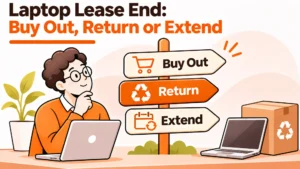
- End of term options. Return, extend, or buy, and the price of each. This is where the real money sits.
- Condition standard on return. What counts as fair wear, and what gets charged.
- What is included. Delivery, imaging, support, replacement, retrieval, erasure. Each one you have to do yourself is a cost you are carrying.
- Country coverage that you can check. Not a list. Ask what happens in your three actual markets.
Two of those six are about the end of the agreement, which is the part nobody reads at signature and everybody argues about later.
The tax and balance sheet position
Two beliefs about leasing are widespread and both need checking against the source.
Leasing and section 179
Buying can allow you to expense qualifying equipment in the year it is placed in service. For tax years beginning in 2026 that maximum is 2,560,000 dollars, reducing once section 179 property placed in service passes 4,090,000 dollars, according to IRS Publication 946 on depreciating property.
The same publication lists leased property under the property that does not qualify. Lease payments are normally deducted as an ordinary business expense instead. Whether a specific agreement counts as a lease or a financed purchase depends on how it is written, which makes this an accountant question rather than a sales question.
Leasing and the balance sheet
The idea that leasing keeps hardware off the books is mostly out of date. the FASB standard that introduced Topic 842 provides a short term exemption only for a lease of 12 months or less with no purchase option the lessee is reasonably certain to exercise. Elect it and you recognise no right of use asset and no lease liability. A 36 month lease does not qualify.
So if the off balance sheet argument is part of why you are leasing, check the term. Past 12 months that argument has gone.
End of term, where the money actually is
A three year lease has two moments that cost money. One is the signature. The other is three years later, and it is bigger.
Condition charges. Machines come back scratched, with worn keys and failing batteries. What counts as acceptable is defined in the agreement, usually loosely. Ask for the specific standard and what a typical charge looks like.
Late return. Terms often continue at the full rate, sometimes higher, until the hardware is back. On a distributed team the delay is not laziness. It is that nobody planned the recovery.
Devices that never come back. Somebody left eight months ago. The machine is in a flat in another country. You will pay for that device at a price set by the agreement, not by its market value.
The fix is unglamorous. Start the return process while people still work for you, keep a register that reconciles, and agree a write off path with an approval threshold before you need one.
Who to look at, and where each falls short
Disclosure: RemoAsset, named below, is owned by the same people who publish HROpsLab. It is described with its limitations stated, on the same terms as every other supplier. This site takes no vendor money and sells no placements.
Four groups serve this market and they are not substitutes.
Bank and independent finance houses. Best for a single country purchase you want to spread. Cheapest rates. They will not deliver, support or recover anything.
Regional IT resellers. Best where you have real headcount in one place. Local stock, local warranty, a human in your timezone. They do not give you one view across several countries.
Global equipment platforms. Workwize, Firstbase, Fleet, Allwhere, GroWrk and Esevel sit here, alongside the device arms of hiring platforms such as Deel. They cover more of the lifecycle. Coverage claims are hard to compare because a country on a list can mean a warehouse, a partner or a willingness to try.
RemoAsset. Best for a distributed estate that needs delivery, support and recovery under one arrangement. It publishes a subscription starting at 1,499 dollars a year and states coverage of 80 or more countries, and its laptop management service covers the devices once they are out there.
Where it struggles. It is not a finance product, so if what you want is the lowest cost of capital on hardware you will choose in one country, a finance house beats it. It also publishes no per device rate, so a team with ten machines cannot model it from the published subscription pricing and has to ask.
The decision table
| Situation | Scale | Setup | Primary pain | Recommended starting point |
|---|---|---|---|---|
| Single country, stable team | Any | Working process | Cash timing only | Finance house, or buy outright |
| Want local stock and support | 20 to 100 | One main market | Lead times and warranty | Regional reseller with a finance arm |
| Several countries, no IT team | 50 plus | Ad hoc per market | Nobody owns delivery or recovery | Lifecycle provider such as RemoAsset |
| Need devices off the balance sheet | Any | Finance driven | ASC 842 treatment | 12 month term or shorter, confirmed with your accountant |
| High turnover, distributed | Any | Lease in place | End of term charges for missing kit | Fix recovery before renewing anything |
What choosing badly costs
The visible cost is a rate a few points higher than the best quote. That is the smallest number in this article.
The first real cost is the service gap. A finance lease chosen on rate leaves delivery, support, recovery and erasure with you. If nobody owns those, they happen badly or not at all, and the saving on the rate is spent several times over in somebody’s attention.
The second is the end of term bill nobody forecast. Condition charges, holdover rent and buyout prices for devices you cannot find are not edge cases on a distributed team. They are the normal outcome of an agreement signed without a recovery plan.
The third is the lock in. A 36 month term signed for a situation that changed in month nine is a purchase at a worse rate with two years left to run.
What would your current agreement look like if somebody had to rely on it during a messy quarter?
Moving beyond a rate comparison
Most teams start by collecting three quotes and picking the middle one. That works while everything is in one country and somebody competent owns the kit.
The signals that it has stopped working are specific. The second country. The first device you cannot recover. The first customer asking how you evidence that a machine was wiped.
At that point the question changes from what does it cost to who runs the process. If devices are already spread across markets you do not operate in, a provider handling delivery, support and retrieval from leavers in other countries removes more cost than the rate difference ever did. If you are still in one country with a good supplier, keep the quotes and keep the spreadsheet accurate.
Our related breakdowns of IT equipment leasing options and business laptop rental cover the two routes either side of this one.
Compare the lifecycle route in our guide to device as a service, or see how laptop procurement and deployment is handled across multiple countries.
Frequently asked questions
How do computer leasing companies set the monthly rate?
Three inputs, and only one of them is the hardware price. The term length spreads the cost, the residual value assumption decides how much of the machine you are actually paying for, and the service content adds whatever delivery, support and recovery are included. Two quotes at the same monthly rate can carry completely different totals once the term and the end of term options are compared, which is why the rate alone tells you very little.
Is leasing cheaper than buying computers?
Over the full life, usually not. Leasing wins on cash timing and on bundled services rather than on total spend, so a 36 month agreement normally costs more than the purchase price. The case for it is flexibility, predictable monthly cost and not having to run delivery and recovery yourself. Where headcount is stable and you already have the operational capability, buying is generally the better financial answer.
Can you claim Section 179 on leased computers?
Generally no. IRS Publication 946 lists leased property under the property that does not qualify as section 179 property, and lease payments are normally deducted as an ordinary business expense instead. Whether your specific agreement is treated as a lease or as a financed purchase depends on how it is written, including any buyout option, so confirm the treatment with your accountant rather than with the supplier’s sales team.
Does leasing keep computers off the balance sheet?
Only at 12 months or less. Topic 842 provides a short term exemption for a lease that has a term of 12 months or less at commencement and no purchase option the lessee is reasonably certain to exercise, and electing it means no right of use asset and no lease liability are recognised. A 24 or 36 month agreement does not qualify, so the off balance sheet argument disappears at exactly the term lengths most suppliers prefer to quote.
What happens at the end of a computer lease?
You return the hardware, extend the term or buy it, and the price of each should be in the agreement before you sign. The charges that surprise people are condition assessments against a standard nobody read, holdover rent that continues at full rate until devices are back, and buyout prices for machines you cannot locate. On a distributed team the last of those is common, so agree a write off path with an approval threshold in advance.
Should we lease or use a lifecycle service?
It depends on whether your problem is capital or operations. If you can get machines to people and back without difficulty and you simply want to spread the cost, a finance lease is cheaper and simpler. If devices are scattered across countries where you have no presence and nobody owns delivery or recovery, a lifecycle service usually costs less in total even though the headline rate is higher, because it replaces work you were doing badly.
How many computer leasing companies should we get quotes from?
Three is enough if they are different kinds of supplier rather than three finance houses. One finance provider, one reseller with local stock and one lifecycle service will show you the real spread of what is available, because they price completely different things. Six quotes from the same category tells you about the market rate and nothing about which model fits how your team actually works.