TL;DR
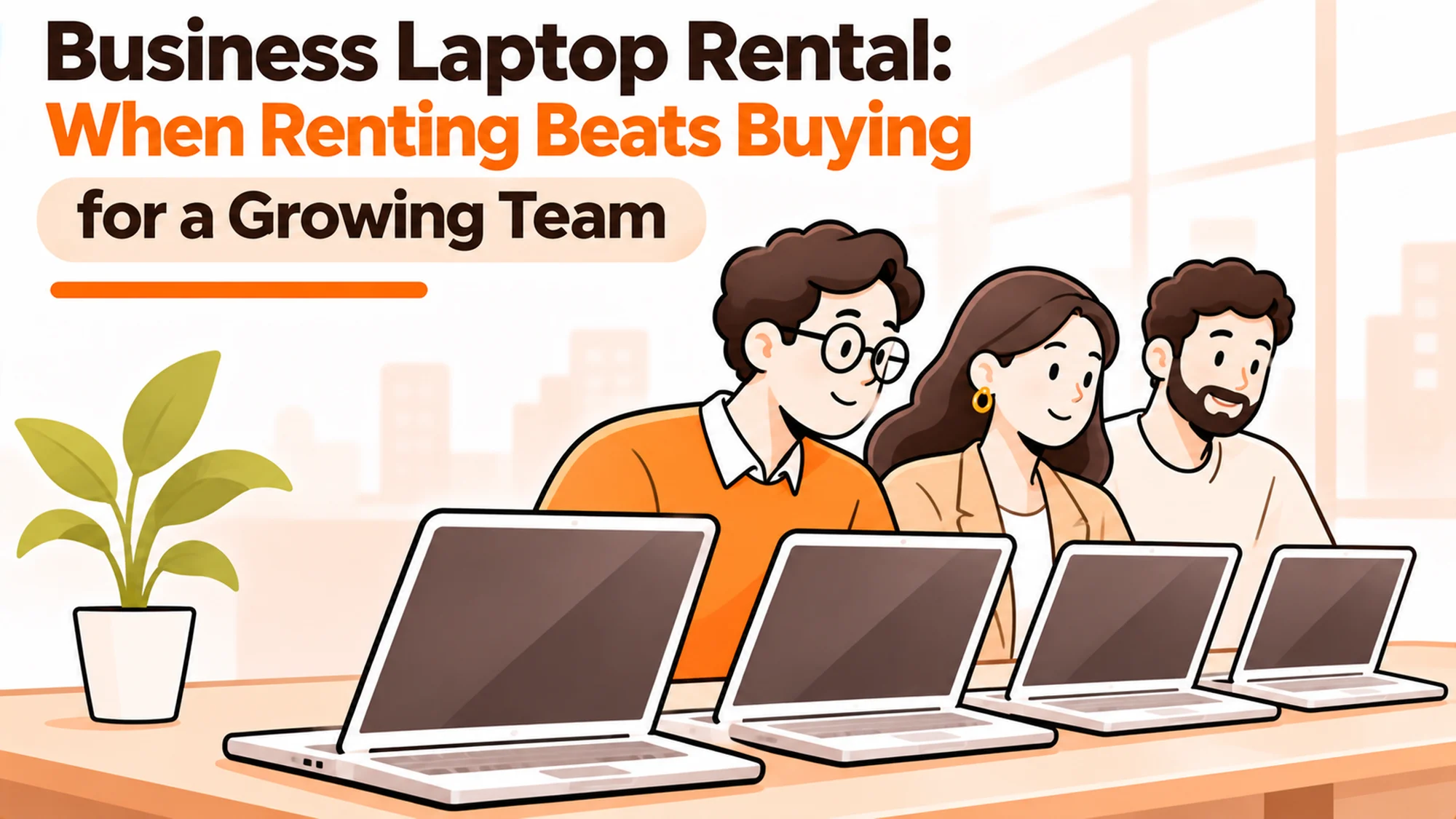
Business laptop rental is worth paying for when the uncertainty is real: a six month project, a team you are not sure will still exist next year, a contractor who needs a machine on Monday. It almost never wins on total cost over three years. You are buying flexibility and bundled support, not a cheaper laptop.
- Rental beats buying on cash timing and optionality, not on total spend. Over 36 months you will usually pay more than the purchase price.
- It stops making sense somewhere around 24 months. Past that you are financing a purchase at a worse rate.
- Section 179 generally does not apply. IRS Publication 946 lists leased property under what does not qualify.
- Renting only keeps devices off your balance sheet at 12 months or less, under the ASC 842 short term exemption.
- The real value is usually the services: delivery, replacement, retrieval and erasure. Price those separately before you compare.
- Settle what happens to the data at end of term before you sign, because the machine goes to somebody else.
When renting actually wins
Four situations, and they share one feature. In every one of them, the thing you do not know is more expensive than the premium you pay.
The project with an end date
A six month implementation. A seasonal peak. An audit team that exists for one quarter. Buying twelve machines for twelve people who will not be there in July means you own twelve machines in July. Renting prices that risk and hands it to somebody else.
Best tools for Device Management
Headcount you cannot forecast
Early stage teams change shape fast. A plan for thirty hires can become fifteen or fifty inside two quarters, and neither version is a failure. Committing capital to hardware against a number nobody believes is how you end up with a cupboard of unopened boxes or a three week wait.
Contractors and short engagements
Somebody is with you for eight weeks. You still need the work on a managed machine rather than their own. A short term rental solves that without adding an asset you then have to recover, wipe and redeploy for a fractional return.
Entering a market you might leave
The first two hires in a new country are a test. If the test fails you want to unwind cleanly, and unwinding is much easier when the hardware was never yours. This is the case people most often get wrong, because the first two hires feel small enough to just buy.
Notice what is common. Rental is insurance against a decision you have not made yet. Where there is no real uncertainty, you are paying a premium for nothing.
When buying is the better call
This section matters more than the one above, because most teams reading about business laptop rental do not need it.
You have stable headcount and a known refresh cycle. If you replace machines every three years and your team size moves by a few people a year, buy. The premium buys flexibility you will not use.
The work is heavy and long lived. Development and design machines get specified generously and kept. You want the better specification and you want it for years, which is the worst possible case for a rental rate.
You already have the operational capability. A good deal of what rental bundles is logistics and support. If you have somebody who does that well and a supplier who ships quickly, you are paying twice.
Cash is not the constraint. Rental smooths cash. If cash is comfortable and the tax position favours capital spend, that advantage disappears.
The honest summary: renting is for uncertainty, buying is for everything else. Teams that rent out of habit rather than out of a specific unknown are usually overpaying by a visible margin.
The tax and balance sheet math
Two details decide more of this than the monthly rate does, and both are frequently assumed rather than checked.
Section 179 generally does not cover rented equipment
Buying can let you expense qualifying equipment in the year it is placed in service rather than depreciating it. The IRS guidance in Publication 946 sets the maximum section 179 expense deduction at 2,560,000 dollars for tax years beginning in 2026, with the benefit reducing once section 179 property placed in service passes 4,090,000 dollars.
The detail that matters here: that same publication lists leased property under the property that does not qualify. Rental payments are normally deducted as an ordinary business expense instead, which spreads the benefit rather than front loading it. Whether a specific agreement counts as a lease or a financed purchase depends on how it is written, so this is a question for your accountant rather than for a quote.
Renting only stays off the balance sheet under 12 months
The common belief is that renting keeps hardware off the books. That stopped being generally true under ASC 842.
The standard provides a short term exemption for a lease that, at commencement, has a term of 12 months or less and carries no purchase option the lessee is reasonably certain to exercise. Companies electing it recognise no right of use asset and no lease liability, and expense the payments on a straight line basis. The FASB standard that introduced Topic 842 sets out that definition.
So a 12 month rental can stay off the balance sheet. A 24 or 36 month agreement generally cannot, and at that point one of the headline reasons to rent has quietly gone. If the balance sheet treatment is part of your case, the term length is the whole decision.
Three ways to get laptops without buying them
Strip away the branding and there are three shapes. None is correct in general.
Do it yourself with a local supplier
You rent or lease from a regional reseller and handle the rest. Cheapest in cash, most expensive in attention. It works in one or two countries where somebody competent owns it. It fails at the fourth country, where the knowledge stops being general and starts being local.
Use your HR or employment platform’s device add on
Convenient if you already use one, and genuinely quick to start. The cost is that equipment becomes entangled with your employment arrangement, so changing one disturbs the other. It is also usually a separate product with separate commercial terms rather than part of the service you already buy.
Use a dedicated laptop lifecycle service
One relationship across many markets, with delivery, support, retrieval and erasure included. Fails on depth in any single market compared with a good local reseller, and fails commercially for very small estates, because the pricing generally assumes a committed volume.
Who actually offers this
Disclosure: RemoAsset, named below, is owned by the same people who publish HROpsLab. It is described with its limitations stated, on the same terms as every other supplier. This site takes no vendor money and sells no placements.
The market splits into three groups, and they are not substitutes.
Local IT resellers and rental houses. Best for a single country and a short, specific need. They hold stock, they will quote in a day, and the machine is covered by a warranty their own engineers honour. The limit is that they solve procurement and nothing else.
Global equipment platforms. Firstbase, Workwize, Fleet, Allwhere, GroWrk and Esevel operate here, alongside the device arms of broader hiring platforms such as Deel. They cover more of the lifecycle and charge accordingly. Coverage claims are hard to compare, because a country on a list can mean a warehouse, a partner or a willingness to arrange something.
RemoAsset. Best for a distributed estate that needs delivery, support and retrieval under one arrangement rather than a short rental. It publishes a subscription that starts at 1,499 dollars a year and states coverage of 80 or more countries, and its laptop procurement and deployment service covers sourcing through to delivery.
Where it struggles, stated plainly. It is a lifecycle subscription rather than a true rental product, so if what you want is twelve machines for six months and nothing else, this is not the shape of that. It also publishes no per device rate, so a team with eight laptops cannot model the cost from the published subscription pricing and has to ask. For a short, small, single country need, a local rental house will be quicker and cheaper.
The decision table
| Situation | Scale | Setup | Primary pain | Recommended starting point |
|---|---|---|---|---|
| Project with a fixed end date | 5 to 20 | One country | Owning hardware after the project ends | Local rental house, term matched to the project |
| Headcount plan nobody believes | 10 to 40 | One or two countries | Capital committed against a moving number | 12 month rental, which also stays off the balance sheet |
| Contractors and short engagements | Any | Mixed | Assets you must recover for a small return | Short term rental, erasure terms agreed up front |
| Testing a new market | 1 to 5 | No local presence | Unwinding cleanly if the test fails | Rent locally, or buy locally if the market supports it |
| Stable team, known refresh cycle | Any | Working process | Paying for flexibility you will not use | Buy, and keep a small spare pool |
| Distributed estate, several markets | 50 plus | No single view of devices | Delivery and retrieval across borders | Lifecycle service such as RemoAsset, chosen on your actual markets |
What getting this wrong costs
The visible cost is the premium, and it is the smallest part.
The first hidden cost is the term that outlived the reason for it. A 36 month agreement signed for a situation that resolved in month eight is a purchase at a worse rate, paid monthly, for over two more years. Nobody revisits it because it is a small line item.
The second is the end of term surprise. Machines have to go back in a defined condition, by a date, with the data dealt with. Where none of that was agreed in detail, the final invoice carries charges for damage, for late return and for devices that were never recovered from people who left.
The third is the evidence gap. A rented machine goes back to somebody else, so the erasure happens outside your control. If a customer asks you to show that a specific device holding their data was wiped, the answer “our supplier handles it” is not an answer, and the follow up is always whether you can produce the certificate.
What would your current agreement look like written down and handed to somebody who had to rely on it?
Moving beyond a spreadsheet and a credit card
Most teams start by buying a few machines on a card and tracking them in a sheet. That is the right answer for a while, and the signals that it has stopped being right are specific.
The first is the second country. The second is the first device you cannot get back from somebody who has left. The third is a customer asking how you evidence that a device was wiped.
At that point the question stops being rent or buy and becomes who runs the process. If the devices are already spread across markets you do not operate in, a service that handles delivery, support and retrieval from leavers in other countries removes more cost than the rate comparison suggests. If you are still in one country with a competent person owning it, keep buying and keep the spreadsheet accurate.
See how device storage and redeployment works or read our breakdown of IT equipment leasing options and costs.
Frequently asked questions
Is business laptop rental cheaper than buying?
Almost never over the full life of the machine. Rental wins on cash timing and on flexibility, not on total cost. Over a 36 month horizon you will usually pay more in rental fees than the purchase price. The question is whether the flexibility and the bundled services are worth that premium for your situation, which for short projects and uncertain headcount they often are.
Can you claim Section 179 on a rented laptop?
Generally no. IRS Publication 946 lists leased property under what does not qualify as section 179 property. Rental payments are usually treated as a deductible business expense instead, which spreads the benefit across the term rather than front loading it. The treatment depends on how the agreement is structured, so confirm it with your accountant before you assume either route.
Does renting keep laptops off the balance sheet?
Only if the term is 12 months or less. Under ASC 842 a lease of 12 months or less with no purchase option the lessee is reasonably certain to exercise qualifies for the short term exemption, and companies electing it recognise no right of use asset or lease liability. A 24 or 36 month agreement does not qualify, so it lands on the balance sheet much like a purchase.
What happens to the data on a rented laptop at the end of the term?
That is the question to settle before signing, because the machine goes back to somebody else. Ask who performs the erasure, what standard is used, and what evidence you receive per device by serial number. A certificate covering a batch processed on a date tells an auditor nothing about the one machine they are asking about, and that is always the machine with something sensitive on it.
How long should a business laptop rental term be?
Match it to the thing that is actually uncertain. A six month project takes a six month term. A role you are unsure about takes 12 months, which also keeps you inside the ASC 842 short term exemption. Beyond 24 months the flexibility you are paying for has mostly evaporated and you are financing a purchase at a worse rate, so buying or leasing usually wins.
What is the difference between renting and leasing a laptop?
In practice rental means shorter terms, a higher monthly rate, services bundled in and no intention to own. Leasing means longer terms, a lower rate, and often an option to buy at the end. The labels are used loosely by suppliers, so read the term length, the end of term options and whether support and replacement are included rather than trusting the word on the quote.
Who handles a broken machine on a rental agreement?
Usually the supplier, and that is a real part of what you are paying for. Confirm three things in writing: the replacement time for a failed device, whether a spare is held in the country where your people actually are, and what the person uses in the meantime. An unanswered version of that third question becomes somebody not working for three weeks.