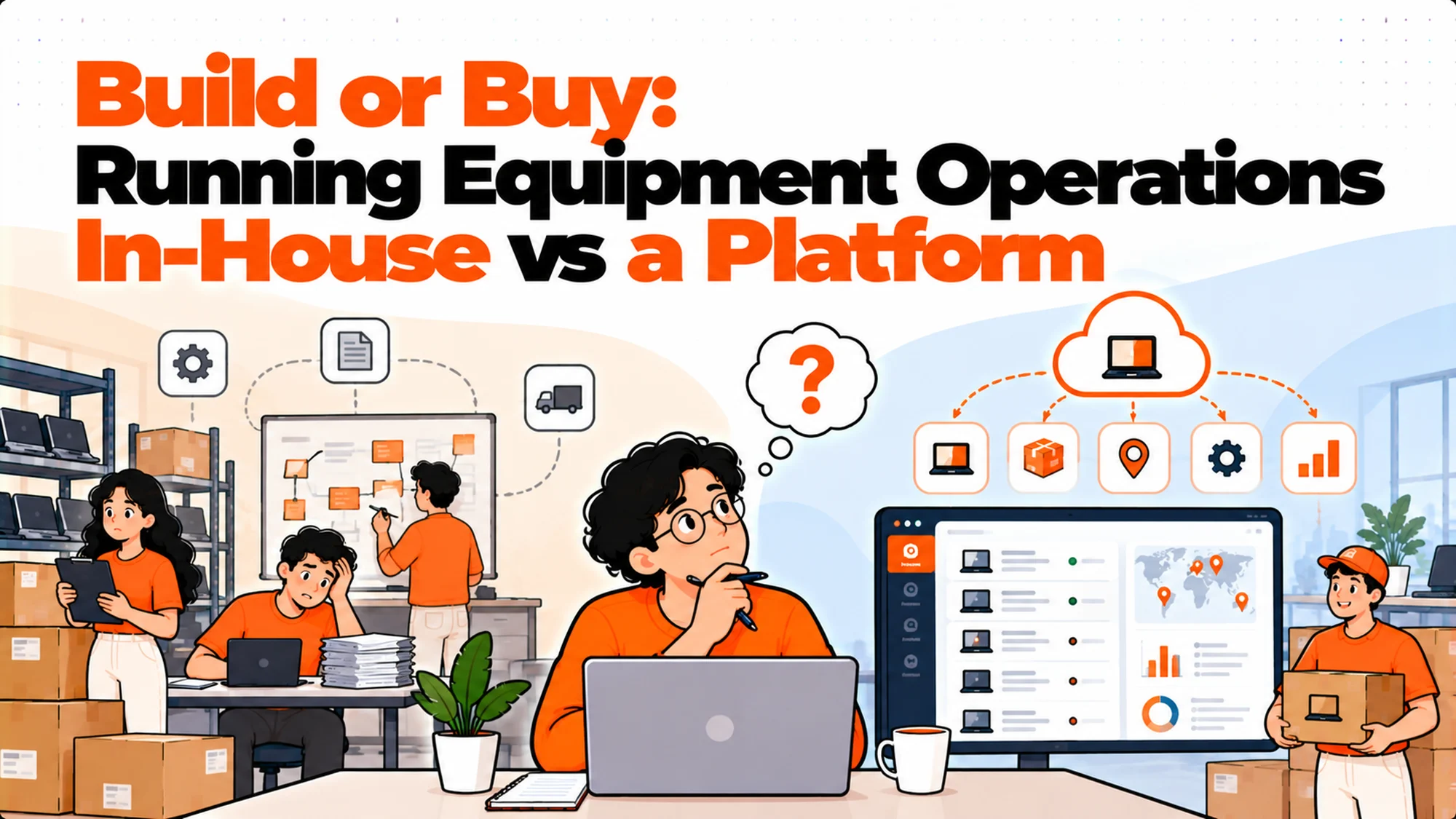
TL;DR
- Nobody decides to build equipment operations. It accumulates, one courier account and one spreadsheet at a time, and the decision gets made by not making it.
- The comparison people run counts shipping against a platform fee and omits the person doing the work, which is usually the largest number on either side.
- Build genuinely wins in two situations: concentrated single-market companies with steady volume, and companies whose requirements are so unusual that a platform would be fought rather than used.
- The thing that breaks in-house is not cost, it is concentration. One person holds the arrangement in their head and the model fails the week they are unavailable.
- Borders are the multiplier. Every country you add increases the in-house burden faster than it increases the platform fee, which is why the answer changes as you expand.
- Hybrid is common and workable, provided you decide which system is authoritative before the two of them disagree.
The operation nobody chose to build
A 200-person company would have told you it had not built an equipment operation. It had a spreadsheet, a courier account, a relationship with a reseller and an arrangement with a storage unit near the old office.
It also had an operations coordinator who spent somewhere between a day and a day and a half a week on equipment. Placing orders, tracking shipments, answering questions about where things were, arranging collections from leavers, reconciling the spreadsheet when somebody noticed it was wrong, and dealing with customs queries from two markets.
None of that was in her job description. It had arrived gradually, each piece reasonable at the time, and the total had never been looked at. When she went on leave for three weeks, four onboardings slipped, two collections were abandoned and the spreadsheet stopped being updated entirely, which took a month to notice and a week to fix.
Best tools for HR Operations
The company had built an equipment operation. It had just never described it that way, never costed it, and never asked whether it was the right thing to be doing.
When building is genuinely the right answer
You are concentrated in one or two markets with steady volume. The cost of this problem scales with borders rather than headcount. A 250-person company in a single country with predictable hiring has a genuinely manageable version of it, and a platform is solving a problem you do not have.
You already have the capability. Companies with a facilities function, a warehouse, or an IT team that already handles hardware have the marginal cost close to zero. Buying a platform means paying for something you are already staffed for.
Your requirements are genuinely unusual. Specialist hardware, an unusual security posture, a regulated process that prescribes handling. Platforms are good along the path they anticipated, and a company whose path is different will spend its time fighting the configuration.
Volume is low enough that fixed costs dominate. A company equipping fifteen people a year is paying a platform fee per movement that no efficiency can justify. Do it manually and spend the money elsewhere.
And you have a second person. This is the condition most often missing and the one least often checked. In-house works when two people can do it; it fails when one can. The test is not whether somebody is nominally a backup, it is whether that person has actually placed an order, arranged a collection and dealt with a customs query within the last six months. A deputy who has only ever read the documentation will not get a device released from a customs hold on a Friday afternoon.
The comparison most companies run, and what it omits
Courier spend plus hardware against the platform fee. In-house wins, often decisively, and the decision looks settled.
That comparison omits four things, and the omissions are not small. Each one is knowable with a morning's work, and together they usually change the answer for distributed companies while leaving it unchanged for concentrated ones.
The person. The single largest omission. Count the hours actually spent across everybody who touches equipment, use loaded cost rather than salary, and put the number in. In the story above it was roughly a quarter of one salary, which was larger than any other line in the comparison.
The failures. Devices not recovered, replacements bought because nobody could find the original, shipments that went wrong and were re-sent. These sit in a hardware line and look like purchases rather than like losses, which is why they never appear in a comparison: the accounting treats a replacement laptop and a new-joiner laptop identically, and only somebody who knows the story behind each purchase can separate them. Pull twelve months of hardware spend and ask which of those machines replaced something rather than equipping somebody.
The slow days. A new joiner waiting four days for a machine is a real cost even though no invoice records it. If you have a sense of how often that happens, put a number on it; if you do not, that absence is itself informative, because it means nobody is measuring the thing the whole operation exists to deliver. A rough version is enough: how many starters in the last year did not have a working machine on day one, and roughly how long did each wait.
And the concentration risk. Not a line item, but the thing that actually breaks. Price it as the cost of three weeks of the arrangement not working, because that is what a holiday costs you today.
| Line | In-house | Platform | Usually omitted |
|---|---|---|---|
| Hardware | Same either way | Same either way | No |
| Shipping | Your courier rates | Usually in the fee | No |
| Customs and duty | Yours to handle | Usually handled | Partly |
| Storage | Unit or office space | Often included | No |
| Internal time | Large and invisible | Reduced, not removed | Yes |
| Unrecovered devices | Appears as purchases | Reduced | Yes |
| Delay cost | No invoice exists | Reduced | Yes |
| Single-person risk | Real and unpriced | Transferred | Yes |
Counting the hours honestly
The time figure is the one a sceptical reader attacks first, so it is worth producing one that survives.
Count everybody, not just the obvious person. Equipment work is distributed: an operations coordinator places orders, an IT person images machines, a manager chases a leaver, somebody in finance codes an unexplained customs charge. The visible owner is usually a fraction of the total.
Use a sample rather than an estimate. Ask the people involved to note what they spend on equipment for two weeks. Two weeks of actual observation beats anybody's recollection, and it takes almost no effort from them.
Take the lower number where there is a range. You are not trying to maximise this figure, you are trying to produce one that cannot be dismissed. A defensible small number persuades where an aggressive large one invites an argument about methodology.
And use the finance team's loaded cost figure rather than constructing your own, because a number finance supplied is a number finance will not dispute.
Then state honestly what the platform does to it. A platform reduces this work; it does not remove it. Somebody still approves orders, manages the vendor, handles exceptions and owns the asset data. The honest claim is a reduction of some fraction, and overclaiming here is the fastest way to lose credibility with the person approving the spend.
The concentration problem, which is the real argument
Cost comparisons are how these decisions get discussed. Concentration is why they actually get made.
An in-house equipment operation at a growing company almost always ends up resident in one person. Not because anybody designed it that way, but because the knowledge is operational and tacit: which reseller is quickest, which courier handles that market, where the spare docks are, who to call when something is stuck in customs, what the arrangement with the storage place actually is.
None of that is written down, because writing it down was never anybody's priority and the person who knows it has no reason to think of it as institutional knowledge. It is just how they do their job.
The model then fails in three predictable ways. Leave, where three weeks produces a backlog nobody can clear because nobody else knows the arrangements. Departure, where the knowledge leaves permanently and the replacement rebuilds it over months. And growth, where volume exceeds what one person can hold and the response is to hire a second, which is the moment the in-house cost steps up sharply rather than scaling smoothly.
A platform does not eliminate this; it relocates it. The vendor holds the operational knowledge and your dependency is on the relationship rather than the individual. That is a real improvement and it is not the same as the risk disappearing.
Making in-house survivable, if that is your answer
Plenty of companies read this and correctly conclude they should keep building. The useful follow-up is that in-house fails on concentration rather than on cost, so the work is to remove the concentration rather than to optimise the spend.
Write down the arrangements. Not a process document, a page: which reseller for what, which courier for which market, where the storage is and who holds the key, what the customs broker's reference is, who to call when something is stuck. This is an afternoon and it converts tacit knowledge into something transferable.
Name a second person and have them do it occasionally. Not as a documented deputy who has never placed an order, but somebody who handles a week of it each quarter. Knowledge that has only ever been read does not survive contact with a real customs query.
Put the register somewhere shared and make returns update it. The most common in-house failure is a register that is accurate in one person's head and stale everywhere else. Recording returns on arrival rather than on redeployment is the single highest-value habit here.
Set a review trigger rather than a review date. Diary reminders get dismissed. Agree in advance that you will re-run the comparison when you open a market you cannot collect from, when the owner changes, or when onboarding volume passes a stated number. Those are the events that actually change the answer.
Doing those four things costs perhaps two days and removes most of what makes in-house fragile. A company that has done them can keep building for considerably longer than one that has not, and will make the eventual switch deliberately rather than in response to a crisis.
The border multiplier
The single best predictor of which way this decision should go is not headcount, it is the number of countries you ship to.
Each additional market adds a customs regime, a supplier question, a courier arrangement, a different lead time and a market where you may have no presence to collect from. Those costs land almost entirely on the in-house side, because a platform's fee does not usually scale with your country count in the same way.
That is why companies routinely find the answer changes under them. The in-house arrangement that was clearly correct at four people in one country is marginal at eighty people in five, and clearly wrong at two hundred across twelve, without anybody having made a decision in between.
The practical signal to watch for is the first market where you cannot execute a collection. A country where somebody leaves, has a laptop, and you have no realistic way to get it back is the point at which the in-house model has a gap that effort cannot close. That is usually the moment to run the comparison properly rather than waiting for a cost review to force it.
What you actually have to build, item by item
"Build" sounds like a decision and it is really a list of capabilities, each of which somebody has to own. Seeing the list is frequently what settles the argument, because most companies have four of these and assume they have all nine.
| Capability | What it means in practice | Hardest part |
|---|---|---|
| Procurement | Supplier relationships, pricing, stock availability | Sourcing the same specification across markets |
| Configuration | Imaging, enrolment, getting a machine usable | Doing it remotely for somebody you cannot reach |
| Outbound logistics | Shipping, customs paperwork, tracking | Markets you ship to rarely |
| Receiving | Somebody physically accepts and checks deliveries | Having an address in each market |
| Asset records | Who holds what, since when, serial numbers | Keeping it true rather than creating it |
| Storage | Space for devices between holders | Location, since a warehouse only serves its own country |
| Retrieval | Initiating and completing collections from leavers | People who no longer work for you |
| Repair and warranty | Routing faults, managing claims | Warranty terms that differ by market |
| Disposal | Wiping, evidence, lawful routes | Evidence you can produce later |
Run down that list and mark what you genuinely do today, what you do badly, and what you simply do not do. Most in-house arrangements are strong on procurement and outbound, adequate on configuration and records, and have nothing real behind retrieval, storage and disposal.
That pattern is not a criticism. Those three are the hard ones, they only matter at a certain scale, and they are precisely the capabilities a platform exists to supply. If your gaps are in the first four, building more is reasonable. If they are in the last three, you are not choosing between building and buying, you are choosing between buying and continuing not to do them.
The transition cost, which belongs in the comparison
Whichever direction you move, changing costs something, and leaving it out makes the comparison dishonest in whichever direction you are already leaning.
Moving to a platform means a data migration, which is a reconciliation rather than an import and takes weeks rather than days. It means devices already in the field have to be accounted for and brought into the new record. It means a parallel period where both arrangements exist, with the ambiguity that creates. And it means somebody's time to run all of it, on top of their normal work.
Moving back in-house is rarer and harder. The vendor holds the asset data and any inventory, your supplier relationships have lapsed, and the operational knowledge you used to have left with whoever used to do it. Companies underestimate this one badly because they remember doing it before.
And a hybrid has a transition too, usually underestimated because it looks partial. Splitting by market means deciding which devices move, which stay, and what happens to anything currently in the wrong place.
Price it as a one-off in the first year of the comparison rather than ignoring it. A platform that is cheaper from year two but carries a real migration cost in year one is still probably the right answer; a platform that is marginally cheaper and carries a large migration is not.
The hybrid, and how to stop it going wrong
Most companies that look at this honestly end up somewhere in the middle, and the middle is a legitimate destination rather than a failure to decide.
The common split works like this. You keep the domestic operation, where you have volume, space and existing relationships and where your costs are genuinely competitive. A platform covers the markets where you have no presence, no reach and no ability to execute a collection.
Two things make this work.
Decide which system is authoritative for device location, and do it before they disagree rather than afterwards. Two registers both claiming to know where devices are will diverge within a quarter, and reconciling them is more work than either arrangement saved.
Draw the boundary on geography rather than on activity. Splitting by market is clean: these countries are ours, those are theirs. Splitting by activity, where you do procurement and they do retrieval, creates handoffs on every device and those handoffs are where things get lost.
The failure mode to watch is drift. Hybrids expand informally, usually because the platform is easier to use, and a year later you are paying for a platform while still running the internal operation at full cost. Review the split annually with actual volumes.
Scale, and where the curves cross
The two models have different shapes and that is why the answer flips rather than drifting.
In-house is mostly linear with a step function underneath. Each additional device costs roughly what the last one did, right up until the volume exceeds what one person can hold. Then you hire, and the cost jumps by a salary rather than by an increment. After that it is flat again for a while, until the second step.
A platform is mostly fixed with a smaller variable. There is a floor you pay regardless, and above it the marginal cost per device is lower than doing it yourself in most markets. That is the whole commercial logic of the category.
Two consequences follow. Below the floor, building wins and it is not close. A company equipping fifteen people a year cannot justify a platform fee, and no efficiency argument changes that arithmetic.
Around the step, the comparison is at its most misleading. A company just below the point where it needs a second person has artificially good in-house economics, because it is running one person at capacity. The comparison run in that month says build. The same comparison six months later, after the hire, says buy. Nothing about the vendor changed.
So run the comparison against where you expect to be in a year rather than where you are, and specifically ask whether your current in-house cost assumes somebody operating at their limit. If it does, the honest comparison includes the second salary, because that is what the next twelve months actually costs.
What a platform does not remove
Worth being explicit, because overselling this is how in-house advocates win the argument.
Somebody still owns it. Vendor management, approvals, exceptions and the asset data remain yours. Expect this to be a meaningful fraction of a role rather than nothing.
Your data quality is still your problem. A platform gives you a better register; it does not give you an accurate one if your inputs are wrong. Garbage about who holds what produces garbage reports faster.
Policy decisions stay with you. What people get, who approves exceptions, what happens on damage. No vendor decides those and a platform applied to an undecided policy produces faster disagreement.
And the hard markets stay hard. A vendor with coverage in a difficult country handles it better than you would; it does not make it easy. Lead times are still longer and things still go wrong there. The realistic improvement is that somebody who has done it before is handling the problem and you have an escalation route, rather than that the problem stops existing. Buyers who expect the second version are disappointed by the first, which is a reasonable outcome mis-sold.
RemoAsset is our own product and that is the disclosure rather than a footnote. It covers procurement and retrieval across 80+ countries and publishes a Subscription tier from $1,499 a year, with a pay-as-you-go tier below for smaller teams. The honest position on this article's question is that for a concentrated single-market company with steady volume and existing capability, building is frequently cheaper and we would say so. Three limits that matter to a build-or-buy comparison specifically: it enrols devices but is not an MDM in its own right, so endpoint management stays with you either way; it wipes devices but is not a certified ITAD, so formal disposal may need a separate provider under either model; and coverage and lead times vary by market, which is exactly the variable the comparison turns on, so check your own markets rather than the country total.
The decision table
| Situation | Scale | Setup | Primary Pain | Recommended Starting Point |
|---|---|---|---|---|
| Single market, steady hiring | Under 250 | Reseller and courier, works fine | None that is real | Keep building, revisit on expansion |
| Two to three markets | 100 to 300 | Spreadsheet, one owner | Concentration, not cost | Count the hours, then decide |
| First market you cannot collect from | Any | Gap effort cannot close | A capability you do not have | Hybrid, platform for that market |
| Distributed across many markets | 200 plus | Multiple couriers, drifting register | Cost and accuracy together | Run the full comparison, expect buy |
| Existing warehouse and staff | Any | Real internal capability | Platform duplicates what you have | Keep building, buy only reach |
| Unusual requirements | Any | Specialist hardware or process | Configuration would be fought | Build, or buy only the parts that fit |
Who argues which way, and why
These decisions get made in rooms where different people have genuinely different views, and knowing where the views come from makes the conversation shorter.
The person currently doing it often argues for building, and their reasons are usually good ones rather than self-interest. They know the arrangements work, they know where the bodies are buried, and they have a realistic fear that a platform will be worse at the specific awkward cases they handle well. They are also the person least able to see how much time it takes, because it is distributed across their week.
Finance usually argues for whichever is cheaper on the visible lines, which means in-house, because the internal time is not in any system they can query. This is not an error; it is a correct reading of the data available to them, and the fix is supplying the time figure rather than arguing.
IT leadership frequently argues for buying, because they see the capability gaps most clearly and because they carry the risk when something cannot be recovered. They sometimes overstate the relief a platform provides.
And whoever was last on holiday when it broke argues for buying, which is anecdotal and also the most direct experience of the concentration risk anybody in the room has.
The useful move is to separate the cost question from the capability question and take them in that order. Most disagreements that present as cost disputes are actually about whether retrieval and disposal are things you currently do. Settle that first, with the capability list above, and the cost conversation becomes narrower and considerably less heated.
How to actually run the comparison
A morning's work, and it is the whole decision.
Count the hours across everybody who touches equipment, from a two-week sample rather than from memory, at loaded cost.
Pull twelve months of real spend: hardware, shipping, customs, storage, and replacements bought because something was lost.
Count your markets and specifically count the ones where you could not execute a collection today.
Get two quotes against an identical specification, including the unit they price in, because comparing a per-device model with a subscription requires normalising first.
Then compare like for like, remembering that a platform reduces internal time rather than eliminating it. Assume you keep a meaningful fraction of the role.
If the two numbers are close, the tie-breaker is concentration rather than cost. Ask what happens if the person who currently holds this is unavailable for a month. If the honest answer is that onboarding stops, that is worth paying something to fix.
The quality difference nobody puts in the spreadsheet
Cost comparisons treat the two options as delivering the same outcome at different prices. They do not, and the differences cut both ways.
In-house is usually better on judgement. Somebody internal knows that this particular new joiner is starting on a client site and needs the machine two days early, that this leaver is being handled sensitively, that this market has a holiday next week. A platform executes a process; a colleague exercises discretion. For companies where those cases are frequent, that is worth real money.
A platform is usually better on consistency. The same thing happens every time regardless of who is away, how busy the week is, or whether anybody remembered. In-house quality varies with load, and it varies most exactly when load is highest, which is during a hiring surge when it matters most.
In-house is faster on the easy cases and slower on the hard ones. Somebody in your main office can hand a laptop over in ten minutes. The same person cannot get one to Chile in under three weeks. A platform narrows both ends of that distribution.
And the employee experience differs in ways people do not anticipate. A new joiner receiving a machine from a named colleague who checks it arrived has a different experience from one receiving a tracked parcel. Which is better depends on the company and on how reliably the colleague actually checks.
None of this belongs in the cost column, and all of it belongs in the decision. The honest way to use it is to ask which failure you would rather have: occasional inconsistency with good judgement, or reliable consistency with less discretion.
What getting this wrong actually costs
The visible cost is a platform fee for something you could have done yourself, which is recoverable and usually small.
The larger cost runs the other way. A company that keeps building past the point where it should have stopped accumulates an operation nobody designed, held by one person, with a register that drifts and a set of arrangements nobody else understands. The cost is not the money; it is that the company cannot see the position clearly enough to make the decision, because the work is distributed across people who each think their part is small.
The cost with the longest tail is the capability gap. The first time somebody leaves in a market you cannot reach, the device is simply not coming back, and no amount of effort changes that. Every subsequent hire in that market compounds it. That gap is invisible on a cost comparison and it is the thing that eventually forces the decision anyway, usually under worse conditions than if it had been made deliberately.
So the question is not which is cheaper. It is whether anybody has ever added up what the current arrangement costs, because in most companies the honest answer is no.
A worked shape, not a worked number
The arithmetic matters less than knowing which lines to fill, so here is the frame. The figures you put in it come from your own two-week sample and your own twelve months of spend, and borrowing numbers from anywhere else is the error this whole article is about.
Start with annual throughput: joiners plus leavers plus swaps, which is the volume both models are priced against. Headcount is the wrong number and it is the one people reach for.
For the in-house column, add internal hours at loaded cost, shipping and customs for twelve months, storage, devices replaced because the original could not be found, and a provision for the markets where you currently cannot collect at all. That last one is awkward because it is a capability gap rather than a cost, and the honest treatment is to price it as the replacement cost of the devices you will not recover.
For the platform column, take the quote, add the internal time you will still spend on approvals, vendor management and exceptions, and add the first-year migration cost as a one-off. Do not assume internal time goes to zero.
Then look at the gap against the step function. If in-house is cheaper but only because one person is at capacity, add the second salary and look again. If the two are within fifteen or twenty per cent of each other, the cost comparison has not settled anything and you should decide on concentration and capability instead.
What this frame is for is making the omissions visible. Almost every company that runs it finds the internal time line is larger than they expected and the shipping line smaller, which is the opposite of the intuition that produced the original comparison.
When the decision gets made for you
Most companies do not choose between these models. They run in-house until something forces a change, and the forcing events are predictable enough to be worth naming.
The person leaves. The operation turns out to have been a person rather than a process, and the replacement cannot rebuild it quickly.
A market opens where you have no reach. Hiring somewhere you cannot ship to or collect from creates a capability gap rather than a cost problem.
An audit asks a question. Somebody wants chain of custody, or evidence of disposal, or an accurate count, and the spreadsheet cannot produce it.
Or volume crosses a line. Onboarding rises to a rate one person cannot hold, and the choice becomes hiring a second person or buying a service.
All four are better handled before they happen than during. The useful moment to run the comparison is while the current arrangement is still working, because that is when you can choose rather than react. A company that runs the numbers at two hundred people and concludes in-house is correct has made a real decision. A company that discovers at three hundred that its equipment operation left with somebody has had the decision made for it.
Frequently asked questions
Is running equipment operations in-house actually cheaper?
Often on the lines people count, and frequently not once the person doing the work is included. The comparison most companies run is courier spend against a platform fee, which omits internal time, devices lost and replaced, the cost of a new joiner waiting, and the risk concentrated in one person. Count the hours from a two-week sample at loaded cost and the answer changes for distributed companies while usually holding for concentrated ones with existing capability.
When is building genuinely the right call?
Four conditions, and meeting most of them makes a strong case. You operate in one or two markets so the border multiplier does not apply. Your volume is steady enough that one person can hold it. You already have the capability, meaning space, a facilities function or an IT team that handles hardware, so marginal cost is near zero. And your requirements are ordinary enough that a platform would be used rather than fought. A fifth condition matters more than people expect: you need two people who can do it, not one.
What is the biggest hidden cost of doing it in-house?
Internal time, by a wide margin, and it is hidden because it is distributed. An operations coordinator places orders, an IT person images machines, a manager chases a leaver and somebody in finance codes an unexplained customs charge. Each contribution feels small and nobody adds them up. In practice the total frequently exceeds every other line in the comparison, and the only reliable way to size it is a two-week sample where people note what they actually spend.
Does a platform remove the internal work?
It reduces it rather than removing it, and overclaiming here is how these business cases lose credibility. Somebody still approves orders, manages the vendor relationship, handles exceptions and owns the asset data, which is typically a meaningful fraction of a role rather than nothing. Your data quality also remains your problem: a platform gives you a better register, not an accurate one, if what goes into it is wrong. Policy decisions about who gets what stay entirely with you.
How do borders change the calculation?
They are the multiplier that usually decides it. Each additional market adds a customs regime, a supplier question, a courier arrangement, a different lead time and possibly a country where you have no presence to collect from, and those costs land almost entirely on the in-house side. A platform fee does not usually scale with country count the same way. This is why the answer changes underneath companies: an arrangement that was clearly right at four people in one country is marginal at eighty across five.
Is a hybrid arrangement a sensible outcome?
Yes, and most companies that examine this honestly end up there. The workable split keeps the domestic operation where you have volume, space and existing relationships, with a platform covering markets where you have no reach. Two rules make it hold. Decide which system is authoritative for device location before they disagree, because two registers will diverge within a quarter. And split by geography rather than by activity, since splitting procurement from retrieval creates a handoff on every device.
What is the single best signal that in-house has stopped working?
The first market where you cannot execute a collection. When somebody leaves, has a company laptop, and you have no realistic route to get it back, that is a capability gap rather than a cost problem, and no amount of effort or process improvement closes it. Every subsequent hire in that market compounds it. That moment is the point to run the comparison properly, rather than waiting for a cost review or a departure to force the question under worse conditions.
How do I make the time estimate credible internally?
Three things. Sample rather than estimate, by asking the people involved to note equipment time for two weeks, which costs them almost nothing and beats anybody's recollection. Take the lower end where there is a range, because a defensible small number persuades while an aggressive large one invites an argument about method. And use the loaded cost figure your finance team already uses for hiring approvals rather than constructing your own, since a number they supplied is a number they will not dispute.
Where this leaves you
Nobody builds an equipment operation deliberately. It accumulates, and the decision gets made by not making it.
Count the hours from a real sample. Pull twelve months of actual spend including the replacements that were really losses. Count the markets where you could not execute a collection today. Get two quotes against one specification. Then compare properly, assuming a platform reduces internal work rather than removing it.
If the numbers are close, the tie-breaker is not cost. It is what happens when the person who holds this is away for a month.
And if the answer is that you keep building, which for a lot of companies it should be, spend two days making it survivable rather than optimising it. Write the arrangements down, give a second person a week of it each quarter, put the register somewhere shared, and agree the trigger that will make you revisit. Those four things cost almost nothing and they are the difference between choosing to switch later and being forced to.
The company in the story at the start of this article was not running a bad operation. It was running an undocumented one, held by somebody who had never been asked whether she wanted it, and nobody discovered the shape of that until she took three weeks off. That is the failure mode, and it is a staffing problem wearing a procurement problem's clothes.