
TL;DR
- The core decision: which of the four parts is actually broken, because the phrase covers four separate problems and you're probably failing at one of them.
- When doing nothing is right: when the schedule gets published on time, the hours reaching payroll are right first time, and absence doesn't surprise anybody.
- What has to be true: you can say where each of the four lives today, even if the answer for three of them is a spreadsheet.
- How the options split: by which question they answer, not by which product category they sit in.
- Decision rule: diagnose from the symptom you can observe this week, then fix that part. Buying the suite doesn't fix the part that's broken.
- Outcome to expect: a narrower problem than the one you were handed, and a much shorter list of things you need.
Four Problems Wearing One Name
Somebody gets told to sort out workforce management. It arrives as a single instruction, usually after a specific irritation: payroll had to be corrected twice, or a manager escalated a rota nobody could cover, or finance asked why labour cost moved and nobody could explain it.
So they start reading, and within an hour the phrase has come apart. One source means scheduling. Another means clocking in. A third is mostly about absence and leave. A fourth is talking about forecasting demand weeks ahead. All four use the same term, several are sold as the same product, and the person reading has no way to tell which one their own problem belongs to.
What follows is predictable. Something gets bought, usually the thing with the best demonstration, and it addresses one of the four competently. The original irritation persists, because it lived in a different part. Six months later the conclusion is that the system didn't deliver, when what actually happened is that the diagnosis was never made.
Best tools for Workforce Management
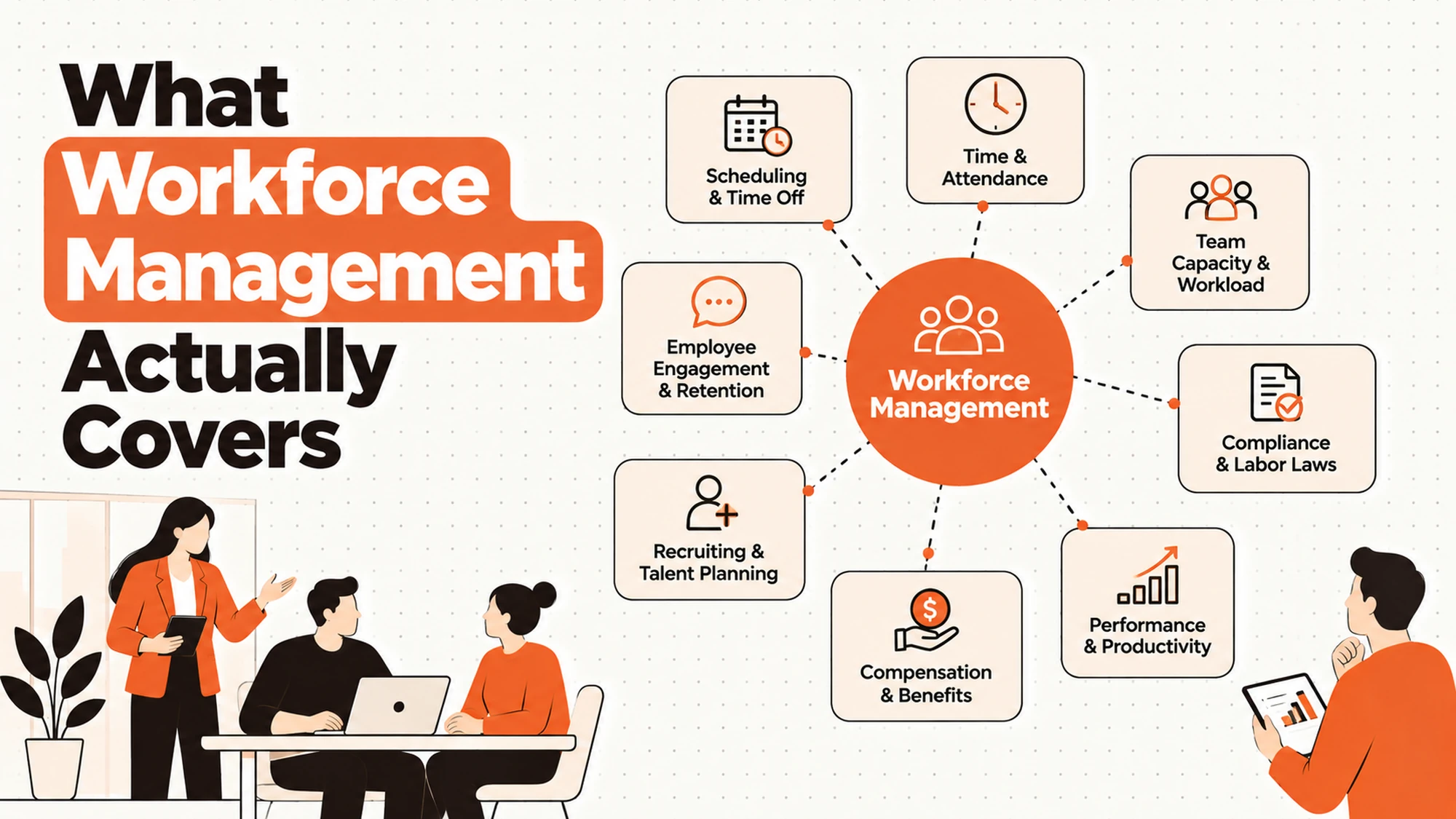
The real problem isn't that workforce management is a vague term. It's that it's an umbrella over four genuinely separate questions that happen to share tooling: who is meant to be working, who actually worked, who is absent and why, and how much labour next week even needs. Most organisations are failing at exactly one of those, and knowing which one is nearly the whole job.
When You Genuinely Do Not Need to Act Yet
Your current setup is genuinely fine. The schedule goes out on time, the hours arriving at payroll are right first time, absence gets handled without anybody being surprised, and managers aren't rebuilding the rota midweek. If that's you, whatever combination of spreadsheets and habits you have is working, and replacing it with a system is a project with no benefit attached.
Friction is starting to show. Payroll is being corrected after the fact, or a manager has said they spend a day a week on the rota, or somebody asked a simple question about hours worked and it took a morning to answer. Any of those means one part is under strain. The cheapest check is to trace a single week end to end and see where the time went.
It has become a real cost. Corrections are routine rather than occasional, or you can't answer a question about hours without a manual reconstruction, or a manager's week is substantially consumed by scheduling admin. At this point the cost is measurable in somebody's time even if it's invisible in any budget, and it's worth fixing the specific part rather than the general situation.
The edge case that forces it. You've grown across sites, or added a second shift pattern, or acquired a team with different arrangements. Systems that worked at one location with one pattern tend to fail quietly at two, because the coordination that used to happen by people talking to each other no longer does. The same applies when somebody asks for records you can't produce, which is usually the moment the record keeping part gets noticed for the first time.
Five Questions This Reader Asks at 11pm
Is this the same thing as HR software? Overlapping and not identical. HR systems are built around the person: who they are, what they're paid, what their contract says. Workforce management is built around time: what's needed, what's scheduled, what happened. Small organisations often get enough of the second from the first. Once your work is genuinely shift-based, the time side needs more than a personnel record can give it.
Do we need all four parts? Almost never at once. Salaried, predictable teams may only need absence handling. A shift-based operation with steady demand needs scheduling and time but may not need forecasting at all. The parts you need are determined by how variable your demand is and how much of your workforce is paid by the hour.
Should scheduling and time tracking be the same system? Ideally yes, and not because of the sales argument about integration. It's that the useful information lives in the difference between them: scheduled against actual is what tells you whether your plan was any good. Held separately, that comparison requires somebody to do it manually, which means nobody does it.
Who should own this? Whoever owns the consequence, which is usually operations rather than HR. HR owns the policy questions underneath, particularly around absence and record keeping. The common failure is giving it to HR as an administrative matter when the pain is operational, which produces a system that satisfies the reporting requirement and doesn't help the person building the rota.
Where do we start? With the symptom you can observe this week rather than with a category of software. Trace one payroll cycle backwards from the correction, or one week's rota forwards from the moment it was published. Whichever part the pain lives in is the one to fix, and it's usually narrower than the brief you were given.
Three Honest Categories the Approaches Split Into
Point solutions, one part at a time. You solve scheduling, or time capture, or absence, with something built for that job. It's right when one part is clearly broken and the others are working, which is the most common situation and the one least often diagnosed. It's also cheaper and faster to implement, and it avoids the risk of replacing three working things to fix one broken one. It fails on the seams: the value that sits between parts, particularly scheduled against actual, is exactly what you don't get, and every additional point solution adds a reconciliation somebody has to perform.
A single suite covering all four. One system holds the schedule, the clock, the absence record and the forecast. It's right at genuine scale, across multiple sites and shift patterns, where the coordination cost between separate systems is higher than the cost of a larger implementation. The comparisons it enables are the actual benefit, not the tidiness. It fails when it's bought to solve a problem in one part, because you've then implemented four things to fix one, and three of them are competing with processes that were working. It also tends to be configured for the hardest case, which makes it heavy for the ordinary one.
Whatever you already have, used properly. Spreadsheets, the scheduling feature in your existing HR system, and a convention everybody follows. It's right far more often than the market suggests, particularly under about a hundred people on one site with a stable pattern. The reason to take it seriously is that most of the failures described in this article are process failures rather than tooling failures, and they survive a system change intact. It fails on scale and on continuity: a spreadsheet that works is usually one person's spreadsheet, and it stops working the week they leave.
Five Diagnostic Questions You Can Self-Assess Against
Trace one payroll cycle backwards. Take the last one that needed correcting and find where the wrong number entered the process. It's almost always one of three places: the schedule was changed and the record wasn't, somebody's absence wasn't recorded before the cut-off, or the hours were captured in a form that needed manual interpretation. Whichever it is, that's your broken part.
Ask whoever builds the rota how long it takes. Then ask how much of that is building it and how much is rebuilding it after publication. A large ratio of rebuild to build points at scheduling; a large total with little rebuild points at the tools rather than the process. This is the single most informative question you can ask and it takes five minutes.
Can you answer how many hours were worked last week, by team, without reconstructing it? If the answer needs a morning and a spreadsheet, your time data exists but isn't usable, which is a different problem from not having it. If the answer needs a phone call, it doesn't exist in any central form.
Where does absence get recorded first? Follow one instance. If the first record is a message to a manager that may or may not be transferred somewhere, you have an absence problem regardless of what your policy says, and the downstream effects on payroll and coverage are consequences of that.
Does anybody ever compare what was scheduled to what happened? Ask directly. In most organisations the answer is no, which means nobody knows whether the plan is any good, and the rota gets copied forward each week carrying whatever error it started with.
The Four Parts of Workforce Management, Reviewed
Scheduling: who is meant to be where
The part that decides in advance who works which hours, in which role, at which location. It earns its place as the foundation, because everything else measures against it: without a schedule, attendance has nothing to compare to and forecasting has nothing to produce. It's also the part with the most direct effect on the people doing the work, since the rota determines whether somebody can plan their life.
Where it falls short is in how it's usually done. Most schedules are built by copying the last one forward, which carries every assumption in it indefinitely, including ones that stopped being true a year ago. The other common failure is treating publication as completion: a rota that can't absorb a single absence without a rebuild wasn't a plan, and the midweek scramble is where the real cost sits.
It's the part to fix first if managers are spending significant time on it, and the part most likely to be blamed when the actual problem is forecasting.
One thing worth separating out, because it gets conflated: building a schedule and deciding the pattern are different jobs on different timescales. The pattern is a structural decision about how the week is shaped, revisited rarely. Building this week's rota is execution within it. A team struggling weekly usually has a pattern that doesn't fit the demand, and no amount of better weekly building will fix a pattern that was wrong when it was set.
Time and attendance: what actually happened
The record of hours genuinely worked, against which people are paid. It earns its place because payroll depends on it and because it's the only source of truth about what the operation actually cost. It's also the part with the clearest failure signal: if payroll needs correcting, something here isn't working.
It falls short when it's treated as a technology question. The method of capture matters much less than the policy underneath it: what counts as time worked, who may amend a record, and what happens when the clock disagrees with the schedule. Organisations that buy a system without answering those get the same disputes through a better interface. It also carries obligations that differ considerably by jurisdiction, particularly around record retention and anything biometric, so establish what applies where you operate before you collect anything and take local advice.
Fix this part when corrections are routine, and expect the fix to be mostly about decisions rather than equipment.
The question that catches organisations out is amendments. Every time record gets changed sometimes, because people forget to clock, equipment fails and shifts genuinely change on the day. What matters is whether those changes are logged with who made them and why, or whether they're simply overwritten. A record that can be silently altered isn't a record, and the moment that becomes apparent is usually a dispute, which is the worst time to discover it.
Absence management: the gap between the two
Recording who isn't there, why, for how long, and what follows. It earns its place because absence is the main reason a schedule stops matching reality, and because it's the part where the consequences of getting it wrong are least recoverable. It also sits closest to the individual, which is why it's the part most likely to be experienced as intrusive.
It falls short when it's built entirely for measurement. A system that produces an absence rate and no mechanism for the conversation around it gives managers a number and no help. It also fails when one policy is applied to genuinely different situations, since a single unpredictable day, a long-term health matter and a pattern that's really a signal about the job need completely different responses. Rules on sick leave, evidence and protected absence differ sharply by jurisdiction and some absence carries specific protections, so this is the part to have reviewed locally before you standardise anything.
It's also the part where the recording point matters more than the reporting. If the first record of an absence is a message to a manager's phone, everything downstream depends on that manager transferring it somewhere, which they will do reliably until a busy morning. A single defined place for absence to land, used by everybody, fixes more coverage problems than any amount of analysis performed on the data afterwards.
Demand forecasting: how much labour is needed at all
Predicting the volume of work so the schedule can be built against something rather than against last week. It earns its place because it's upstream of everything: a perfectly executed schedule built on a wrong forecast is still wrong, and it's the only part that addresses over-staffing, which never generates a complaint and costs money continuously.
It falls short by being the most demanding and the least necessary. It requires demand data you may not have, it's only worth doing where demand genuinely varies, and in a steady operation a sensible template beats a forecast. It also fails when the forecast is produced centrally and the schedule is built locally by somebody who doesn't believe it, which is common and produces the appearance of forecasting without any of the effect.
Skip this entirely unless demand varies enough that getting it wrong is visible in your costs.
Where it is worth doing, start cruder than you'd like. A simple pattern drawn from the same week last year, adjusted for anything you know has changed, is usually close enough to beat copying last week forward, and it can be built by hand before anybody buys anything. The sophisticated version earns its place only once somebody is actually checking the forecast against what happened, and a team not yet doing that with a crude one won't do it with a better one.
Compliance record keeping: the part nobody owns
The records of hours, breaks, rest periods and absence that you'd need to produce if somebody asked. It earns its place because it's the only part with a hard external consequence, and because the moment it's needed is the moment it's too late to start.
It falls short because it's nobody's job until it is. It's usually assumed to be a byproduct of the other three, which it is only if those three were designed with it in mind, and they generally weren't. What must be kept, for how long, and in what form differs considerably between jurisdictions and has been changing in several, so this is worth establishing deliberately with local advice rather than assuming your system handles it.
Treat it as a requirement on the other three rather than as a fifth project. The practical version of that is asking, for each of the other three, what it would need to retain and for how long, and building that into the design rather than bolting it on. Retrofitting record keeping onto a system already in use is considerably harder than specifying it at the start, and the organisations that discover this tend to discover it under time pressure from somebody external.
The Decision Table
| Situation | Scale | Setup | Primary Pain | Recommended Starting Point |
|---|---|---|---|---|
| Rota on time, payroll right, no surprises | Any | Any | None | Leave it alone |
| Payroll corrected most cycles | Any | Any | Hours arrive wrong or late | Time and attendance, starting with the policy |
| Manager rebuilds the rota midweek | Any | Shift-based | The schedule cannot absorb one absence | Scheduling, and slack design |
| Cannot answer hours worked without a reconstruction | Any | Any | Data exists but is not usable | Time capture, then one report |
| Absence recorded in messages to managers | Any | Any | No central record, coverage surprises | Absence, single point of entry |
| Over-staffed in quiet periods, nobody notices | Over one hundred | Variable demand | No forecast, schedule copied forward | Demand forecasting |
| One site, one pattern, stable team | Under one hundred | Single site | None of the above is acute | Use what you have, properly |
| Multiple sites or patterns, separate systems | Over two hundred | Multi-site | Reconciliation between parts | A suite, for the seams rather than the tidiness |
| Asked for records you could not produce | Any | Any | Record keeping was nobody's job | Establish local requirements, take advice |
The second and third rows account for most of the pain in most organisations, and they point at different parts. Payroll corrections are a time and attendance symptom; the midweek rebuild is a scheduling one. Buying a suite addresses both and three other things you didn't need, which is why the diagnosis is worth the afternoon it takes.
Which of the Four Is Actually Broken
The symptom is usually visible without any analysis. What's missing is the step from symptom to part, which is where most purchasing decisions go wrong.
| Symptom you can observe | Which part it points to | What people wrongly buy instead |
|---|---|---|
| Payroll corrected after most cycles | Time and attendance, and the policy under it | A scheduling system, because the rota gets blamed |
| Rota rebuilt by message every midweek | Scheduling, specifically slack and swaps | A forecasting module, to predict the unpredictable |
| Coverage gaps discovered on the day | Absence recording, not scheduling | A stricter attendance policy |
| Over-staffed in quiet hours, nobody complains | Demand forecasting | Nothing, because nobody raises it |
| Hours question takes a morning to answer | Time data exists but is not usable | A full suite, to replace the thing that works |
| Managers each do it differently | Process and ownership, not tooling | A system, which will be used differently too |
| Cannot produce records on request | Record keeping, as a requirement on the rest | A storage solution, rather than a design change |
| Same absence conversation, different outcomes | Absence policy and manager guidance | Absence tracking software |
The fourth row is the one nobody acts on, and it's the only entry that costs money every single week without generating a complaint. Understaffing produces immediate noise from customers and staff. Overstaffing produces a quiet, continuous cost that shows up only in a labour line nobody traces back to the rota.
The sixth row is worth reading twice. Where the real problem is that every manager does this differently, a system doesn't fix it, because a system can be used differently by every manager too. That's an ownership and standards question, and the software will simply record the inconsistency more precisely.
Why the Parts Have to Talk to Each Other
Each part is useful alone. What you lose by keeping them separate isn't tidiness, it's a specific set of comparisons that only exist in the gaps between them, and those comparisons are where most of the improvement lives.
Scheduled against actual is the first and the most valuable. It answers whether your plan was any good, which is a question almost nobody asks, because answering it requires putting two systems side by side. A team that consistently works longer than scheduled has a scheduling problem dressed as a cost problem. A team that consistently works less has a forecasting problem dressed as nothing at all, since it generates no complaints.
Absence against schedule is the second. Knowing somebody is off is useful; knowing which shift is now uncovered, immediately, is the thing that prevents the scramble. Where absence is recorded in one place and the rota lives in another, the gap between the two is filled by a manager noticing, which works until they don't.
Forecast against actual demand is the third, and it's the one that decays fastest when unexamined. A forecast nobody checks afterwards is a guess with a spreadsheet attached, and it'll drift steadily without anybody noticing, because the schedule built from it looks equally plausible either way.
None of this requires one system. It requires that somebody, on a defined cadence, puts two of these next to each other and looks. A single system makes that easy enough that it might actually happen, which is the honest argument for one, and it's a better argument than the integration pitch.
What to Put in Writing
Most of what goes wrong here is undocumented convention that differs by manager and vanishes when somebody leaves.
| Artefact | Who owns it | When it is written | What it prevents |
|---|---|---|---|
| Which of the four parts lives where today | Operations | Before evaluating anything | Buying a system for a part that was working |
| What counts as time worked | Operations, with HR | Before any time system is chosen | The same disputes through a better interface |
| Who may amend a time record, and how it is logged | Operations | At implementation | Changes nobody can account for later |
| Where absence is recorded first | HR, with operations | Now | Coverage gaps discovered on the day |
| What records must be kept, for how long | HR, with local advice | Before a request arrives | Discovering the obligation at the worst moment |
| Who owns the rota, and what they may change | Operations | When the pattern is set | Every manager running a different system |
The second row is the one that decides whether a system purchase succeeds. Almost every time and attendance dispute traces back to a question of definition rather than of measurement, and definitions don't come in the box.
Questions to Ask Before You Commit
On the diagnosis. Which of the four parts is actually failing, and what's the symptom? A bad answer names a product category.
On ownership. Who owns the consequence when this goes wrong? A bad answer is that it's shared between HR and operations.
On the definition. What counts as time worked here, and who decided? A bad answer is that the system will handle it.
On the seam. Does anybody compare scheduled to actual? A bad answer is that the reports are available.
On the forecast. Does your demand vary enough to justify predicting it? A bad answer assumes yes without checking the quiet periods.
On the records. What are you required to keep where you operate, and who confirmed it? A bad answer is that the vendor says it's compliant.
What Getting This Wrong Costs
The first cost is buying the wrong part, and it's the most common outcome of a vague brief. A system arrives, it works as advertised for the thing it does, and the original irritation is untouched because it lived somewhere else. The direct waste is the licence and the implementation. The larger waste is the organisation's appetite: after one failed system, the next proposal is harder to get approved, including the one that would have worked.
The second cost is the manager time nobody accounts for. Scheduling admin, chasing absence, reconstructing hours and correcting payroll are all real work performed by people with other jobs, and none of it appears in any budget line as the cost of a process that doesn't work. It shows up instead as managers who seem stretched, which gets diagnosed as a capacity problem and answered with a headcount request.
The third is the quiet one: over-staffing. Understaffing is loud and self-correcting, because customers and staff both complain immediately. Over-staffing generates no signal at all. Without anybody comparing the forecast to what actually happened, an operation can carry more labour than it needs in its quiet periods indefinitely, and the cost accumulates in a line that nobody traces back to the rota.
So before you evaluate anything: is this a scheduling problem, a data problem, or a definition problem? Scheduling means the plan can't survive contact with a normal week. Data means the information exists somewhere and can't be used. Definition means nobody has agreed what counts, and no system will decide that for you. Three different problems, and only the first two are things you can buy an answer to.
When You Are Ready to Go Further
None of this needs a budget to begin. It needs one payroll cycle traced backwards to where the wrong number entered, one honest answer from whoever builds the rota, and a written statement of what counts as time worked.
The step after that is comparison, and it's the one thing that separates an operation that improves from one that runs. Put scheduled next to actual on a defined cadence and have somebody look at it. Whatever system you eventually buy, that habit is what produces the value, and it can start before you buy anything.
HROpsLab publishes independent comparison work across HR tooling, applicant tracking and payroll. We sell nothing, we take no vendor money, and we publish no paid placements. If the next step is working out which part of this your current tooling actually covers, our comparison work is one place to start.
Frequently Asked Questions
What does workforce management mean?
It's an umbrella term covering four separate activities that happen to share tooling: scheduling, which decides who's meant to be working; time and attendance, which records what actually happened; absence management, which handles the gap between those two; and demand forecasting, which decides how much labour is needed in the first place. A fifth concern, keeping the records you'd need to produce on request, runs through all of them. The reason the definition matters is practical rather than academic: most organisations are struggling with exactly one of the four, and buying something aimed at a different one is the most common expensive mistake in this area.
What does workforce management software actually do?
It depends entirely on which of the four parts the product is built around, which is why demonstrations tend to look similar and land differently once implemented. A scheduling-led product will be strong at building and publishing rotas and weaker at what happens to the hours afterwards. A time-led product will capture attendance precisely and may assume the schedule exists elsewhere. Suites cover all four, and their genuine advantage isn't tidiness, it's that the comparisons between parts become possible: scheduled against actual, absence against coverage, forecast against what really happened. Those comparisons are where most of the improvement lives.
How is workforce management different from HR software?
HR systems are organised around the person, holding who somebody is, what they're paid, what their contract says and where they sit in the structure. Workforce management is organised around time: what's needed, what's scheduled and what happened. The two overlap at absence and at anything feeding payroll, which is why smaller organisations often get enough workforce management from the HR system they already have. The point at which that stops working is usually when a meaningful part of the workforce is paid by the hour and works variable shifts, because the time side then needs more precision than a personnel record is designed to carry.
Does a small business need workforce management software?
Frequently not, and the honest test is whether anything is currently failing rather than whether you've outgrown a spreadsheet by some general standard. Under about a hundred people on one site with a stable shift pattern, a well-maintained spreadsheet plus a convention everybody follows will often outperform a system, because most of the failures in this area are process failures that survive a software change untouched. The two things that genuinely change the calculation are multiple sites or patterns, where coordination stops happening by people talking to each other, and key-person risk, since a spreadsheet that works is usually one person's spreadsheet.
Who should own workforce management?
Operations, in most organisations, because they own the consequence when coverage fails and they're closest to the demand that drives it. HR should own the policy questions underneath, which are substantial: what counts as time worked, how absence is handled, what records are kept and what the local obligations are. The common failure is assigning the whole thing to HR as an administrative matter when the pain is operational, which produces a system that satisfies reporting requirements while the person actually building the rota is no better off. Whoever owns it needs authority over both the process and the tooling, or they'll be accountable for something they can't change.
What is the difference between workforce management and workforce planning?
They operate on completely different timescales and answer different questions. Workforce planning is a strategic activity about the shape of the workforce over quarters and years: what roles you'll need, what capabilities are missing, what the headcount should be. Workforce management is operational and mostly concerns the coming weeks: who's working Tuesday, who clocked in, who's off sick, how many people the Saturday peak needs. The similarity of the names causes real confusion in meetings, and it's worth naming the timescale explicitly when the two come up together, since the people who own them are usually different.
Should scheduling and time tracking be in the same system?
Where practical, yes, though the reason usually given is the weaker one. The strong argument isn't integration for its own sake, it's that the most valuable information in this whole area lives in the difference between scheduled and actual hours, and that comparison only happens if both sit somewhere it can be made easily. A team consistently working longer than scheduled has a planning problem being recorded as a cost problem. Kept in separate systems, the comparison requires somebody to perform it manually each period, which in practice means nobody does, and the question goes unanswered for years.
Where should you start with workforce management?
With the symptom rather than the category. Trace one payroll cycle backwards from the last correction and find where the wrong number entered, and separately ask whoever builds the rota how much of their time goes on building it versus rebuilding it after publication. Those two exercises take an afternoon between them and they'll almost always point at a single part, which is a much narrower problem than the brief you were handed. Resist starting with a product comparison, since the demonstrations are organised around what each product does well rather than around which of your four parts is broken.
Workforce management isn't one problem. It's four, and you're probably only failing at one of them.