
TL;DR
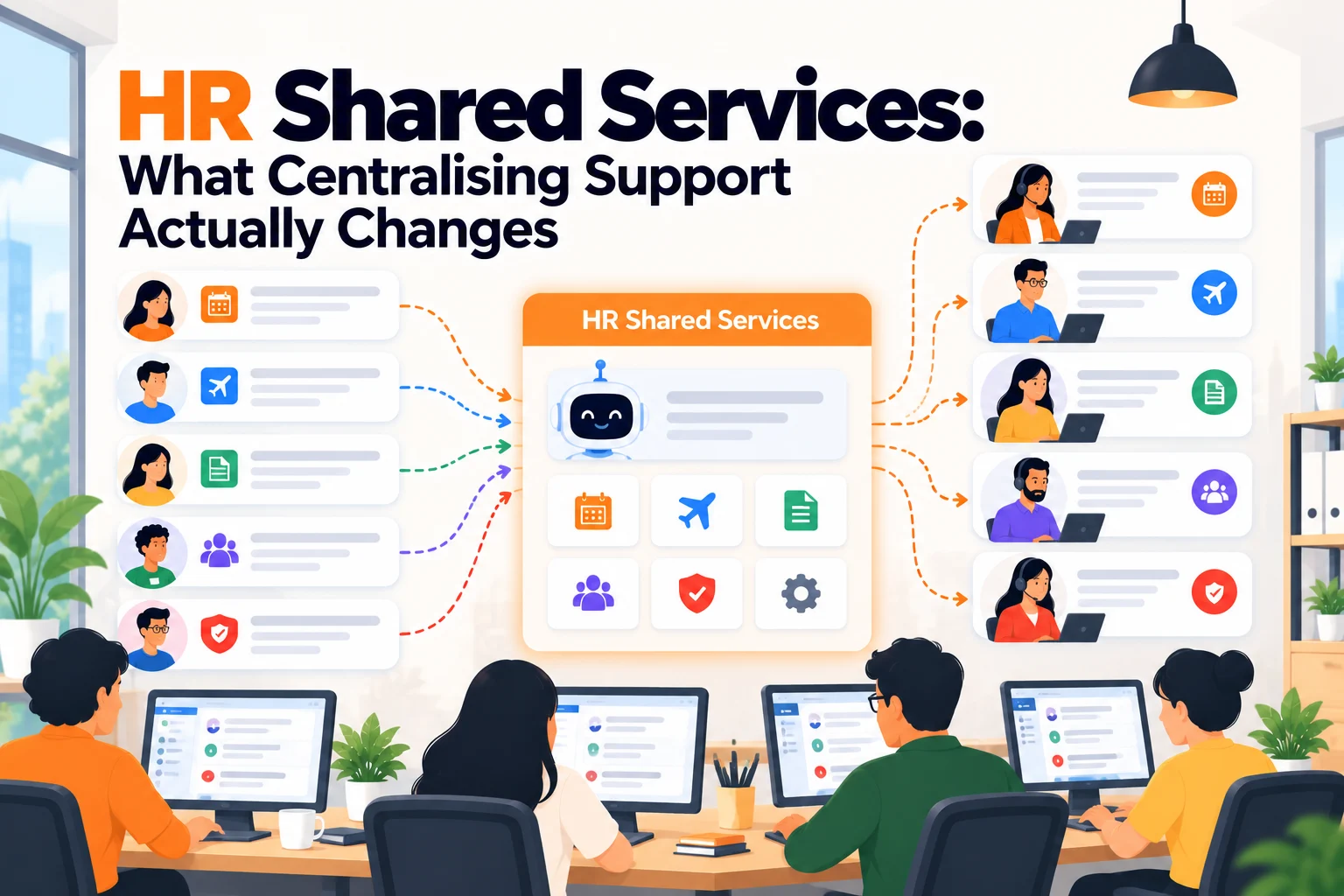
- HR shared services means consolidating repeatable HR support into one team and one entry point, so that questions and requests are handled by a defined tier rather than by whoever the employee happens to know.
- If you have one country, one entity, under about 200 people and one way of doing things, you do not need this. You need a current handbook and somebody who answers consistently.
- The model has four tiers in practice: self-service, a generalist front line, specialists, and the centres of expertise that own policy. Most implementations fail because they build the front line and skip the tier below it.
- The real decision is not which software to buy. It is what you are willing to standardise, because you cannot centralise a process that is still allowed to differ by manager, country or entity.
- Measure the share of requests resolved at first contact, not the volume handled. Volume rewards the wrong behaviour and hides the problem you built this to fix.
- Done properly, an employee asks once and gets a consistent answer regardless of who is on shift, and the specialists stop being interrupted for things a generalist could resolve.
The Service Centre That Made Everything Slower
A 900-person company across four countries set up an HR service centre. One inbox, one phone number, three generalists, a service catalogue, a two-day response target. Six weeks after go-live, the complaints were not about response time. They were that people now had to explain their situation twice: once to the generalist, who could not resolve it, and again to the country HR lead they used to go to directly.
The generalists were good. The catalogue was sensible. What nobody had resolved was that parental leave worked differently in each of the four countries, bereavement leave was discretionary in two of them, and the probation process depended on which entity the contract sat under. A generalist cannot resolve a request whose correct answer depends on circumstances nobody has written down. So every one of those became a handoff, and a handoff with a two-day target attached to it is slower than the direct line it replaced.
The real issue was not the staffing or the tooling. It is that shared services is usually sold as a consolidation of effort when it is actually a consolidation of judgement, and judgement cannot be consolidated until somebody has decided what the answers are. Centralising a question whose answer varies does not make it faster. It adds a stop.
Best tools for HR Operations
This is what HR shared services is supposed to solve, and the order of operations is what determines whether it does.
When You Don't Actually Need Shared Services
When there is one way of doing things
One country, one entity, one set of policies and under roughly 200 people. At that size the consistency that shared services buys you already exists, because the same two or three people answer everything. Adding a tiered model here adds handoffs to a process that currently has none, and the measurable result is usually slower resolution with better reporting.
When friction starts showing
The signal is inconsistency rather than volume. Two employees get different answers to the same question in the same month, and both answers were defensible given what each person knew. That is the point at which the issue stops being capacity and becomes standardisation, and it typically arrives with the second country or the third entity rather than at a particular headcount.
When it becomes a liability
Once somebody outside HR needs to show that a policy was applied consistently, informal handling becomes a problem you cannot evidence. A works council asking why two similar cases went differently, an acquirer reviewing employment practice, an internal audit sampling leave decisions. The cost of not having a defined tier structure is not slowness, it is that nobody can demonstrate consistency, and demonstrating it is the entire point.
The edge case that forces it
Acquiring a company, or a country entry. Both import a second set of policies overnight, and both make the standardisation question unavoidable rather than deferrable. A company that absorbs 200 people with their own parental leave arrangement now has two arrangements and no stated position, and the first employee to notice will ask HR which one applies to them.
Five Questions People Ask Before Building This
"Will this actually be faster for employees?" Only if the front line can resolve things rather than route them. First-contact resolution is the whole mechanism, and a tiered model without it is a queue with extra steps.
"What happens to the HR person people already trust?" They move up a tier, and that has to be said out loud. The failure mode is the direct line continuing informally alongside the new channel, which produces two systems, neither complete.
"Do we have to standardise everything first?" No, and attempting to will stall the project. You need to standardise the things the front line will own, and explicitly list what remains local. The list of exceptions is a deliverable, not an admission.
"How do we handle a sensitive matter in a shared model?" With a defined route that bypasses the general queue entirely. If a grievance can reach a generalist's inbox, the model is wrong regardless of how good the generalist is.
"What does this cost to run, not to buy?" Software is the small number. The real cost is the content behind tier 0, the training behind tier 1, and the ongoing ownership of both, and the projects that fail are almost always the ones that budgeted only for the licence.
The Four Tiers, and the One Most Teams Skip
The tier model is the substance of shared services. It is also routinely described in a way that makes all four sound equally present when in practice one is usually missing.
Tier 0: self-service. The employee finds the answer without contacting anybody. A current handbook, a policy set that can be searched, and increasingly something that answers from those documents directly, which is what the best HR chatbot tools are ranked on. This tier handles the largest share of inbound in any mature model, and it is the cheapest tier by a wide margin because its marginal cost per answer is close to nothing.
Tier 1: the generalist front line. One entry point, staffed by people who can resolve the routine majority on first contact. They need two things to work: documented answers, and the authority to apply them without checking. Remove either and tier 1 becomes a routing desk.
Tier 2: specialists. Payroll, benefits, mobility, employee relations. They take what tier 1 cannot resolve, and their value depends entirely on tier 1 filtering properly. A specialist spending half their week on questions a generalist could have answered is the most expensive failure in this model and the most common.
Tier 3: centres of expertise. They own policy, design and the exceptions. They should be nearly untouched by inbound. If they are answering employee questions, the tiers below are not working and no amount of tooling will change that.
The tier that gets skipped is tier 2, and the reason is organisational rather than financial. Tier 1 is visible and easy to staff, tier 3 already exists under another name, and tier 2 requires somebody to decide which specialists now belong to a shared function rather than to a country or a business unit. That decision is political, so it gets deferred, and the result is a front line handing straight to the people who own policy.
| Tier | Resolves | Needs to work | What it looks like when broken |
|---|---|---|---|
| 0, self-service | The majority of questions | Current, searchable documents | Staff ask a person anyway |
| 1, generalists | Routine requests, first contact | Documented answers plus authority | Becomes a routing desk |
| 2, specialists | Genuine complexity | Tier 1 filtering properly | Answering routine questions |
| 3, centres of expertise | Policy and exceptions | Tiers 0 to 2 absorbing volume | Handling individual employee queries |
Closing the Informal Channel
The tier model has a competitor, and it is the arrangement it replaced. People who have always messaged a particular HR person will keep doing it, because it works and because asking somebody you know is easier than using a channel. Left alone, that informal route runs alongside the new one indefinitely, and you end up operating two systems where only one is measured.
This is not solved by telling people to stop. It is solved by making the new route better and by removing the old one's capacity.
Give the people who used to be the direct line a new job, publicly. If a country HR lead is now tier 2, say so to their population rather than leaving it implied. The ambiguity is what sustains the old channel, because nobody has been told it closed.
Redirect rather than refuse. A request arriving by direct message should be answered once, with a note about where it goes next time. Refusing to answer it damages trust in the model before it has earned any, and answering it silently teaches people the direct line still works.
Watch the ratio, not the volume. Track the share of requests arriving through the official route against those arriving elsewhere. If that share is not climbing after the first month, your front line is not yet better than the alternative, and that is a content or authority problem rather than a compliance one.
So treat the informal channel as a signal rather than a nuisance. People use it when it is faster, and when it stops being faster they stop using it without being asked.
The Standardisation Decision Nobody Wants to Own
This is the part that determines the outcome, and it is not a software decision.
For every process the front line will handle, somebody has to say whether the answer is the same everywhere. Not whether it currently is, but whether it should be. There are only three honest options per process, and the work is choosing one explicitly rather than leaving it undecided.
Standardised. One answer, everywhere, documented. Tier 1 owns it completely. Most administrative requests belong here, and more policy belongs here than companies initially accept.
Standardised with stated local variations. One process, with a documented difference per country or entity. Tier 1 can still own it provided the variation is written down and reachable, which is exactly what makes the difference between a resolution and a handoff.
Deliberately local. The decision stays with local HR, and the front line's job is to route it cleanly and quickly. This is a legitimate choice and it needs to be an explicit one, because an undeclared local process looks identical to a broken standard from the employee's side.
Go through your service catalogue and mark every line with one of those three. The exercise usually takes a couple of days and it surfaces the thing the project actually depends on: how many processes are currently undecided. Those are the ones that will produce the double-explanation problem, because a generalist cannot resolve an undecided process and will hand it on every time.
What to do:
- List every request type the front line is expected to handle.
- Mark each as standardised, standardised with stated variations, or deliberately local.
- For anything marked standardised, confirm the answer exists in writing and that tier 1 can reach it.
- For anything marked with variations, write the variations down before go-live rather than after.
- Count the undecided remainder. That number is your real readiness measure, and if it is large, delay the launch rather than the decision.
Designing the Bypass Route
Every tiered model needs a way for a sensitive matter to reach the right person without passing through the general queue, and it has to be designed before launch because the first person who needs it will not wait for you to build it.
The route has three parts, and all three are decisions rather than configuration.
A separate intake that does not look like an exception. If the only way to raise something sensitive is to avoid the normal channel, people either use the normal channel anyway or say nothing. Publish the route alongside the service catalogue as an ordinary option, named plainly, so that using it is not itself a signal.
A named recipient, not a queue. Sensitive intake should arrive with a specific person and a named deputy for when they are away. A rota of generalists is the wrong answer here even if every generalist is trustworthy, because the employee is deciding whether to speak based on who will read it.
A stated boundary on what happens next. Say what you will do with it and what you cannot promise, before anybody uses it. Teams that leave this vague create an expectation of confidentiality they may not be able to honour, and that is worse than a clear limit stated up front.
So test the route the way an employee would encounter it. Ask somebody outside HR to find it from your intranet, cold, without being told where to look. If they cannot, it does not exist in any practical sense regardless of what has been configured.
How to Choose: Five Questions Before You Talk to Any Vendor
What share of requests could be resolved by a generalist today? Take a month of real requests and have one experienced generalist mark each as resolvable with current documentation or not. That percentage is your realistic first-contact resolution ceiling at launch, and it is almost always lower than the business case assumed.
Where does your inbound actually arrive? Look at last month rather than at your intended design. If most requests came through direct messages to specific people, a portal will not change that by existing. The tools that get used meet people where they already ask, and the ones that do not become a reporting layer over an unchanged habit.
Can one entry point hold both routine and sensitive? Decide the bypass route for grievances and anything naming a third party before you shortlist, because it is a hard requirement rather than a configuration detail. Any tool that cannot restrict a single matter from colleagues holding the same role is unsuitable regardless of its other strengths.
What does tier 0 contain right now? Open your handbook and check when it was last revised. Tier 0 is the cheapest tier and the one that makes every other tier affordable, and it is entirely dependent on content quality. A tool that answers from out-of-date documents does not reduce contact, it produces confident wrong answers at scale.
Who owns the content in a year? Name the person. Shared services decays through content drift more than through anything technical, and an unowned knowledge base degrades to the point where staff stop trusting tier 0 and go back to messaging a human. That reversion is quiet and it undoes the economics of the whole model.
Who Actually Owns Tier 0 Content
Tier 0 carries the economics of the whole model and it is the only tier with no obvious owner, which is why it decays. The reason is structural rather than careless. Policy is owned at tier 3. The answers served at tier 0 are derived from that policy. So the people who can change the content are not the people who notice it is wrong, and the people who notice are a front line with no authority to edit policy language.
That gap is where six months of drift comes from. Here is the arrangement that holds.
Tier 3 owns the policy. Tier 1 owns the answer. Separate the two explicitly. The centre of expertise owns what the rule is; the front line owns how it is phrased for an employee asking at 11pm. Those are different artefacts and conflating them means every wording fix needs a policy owner's approval, which is why wording fixes stop happening.
One named person, with it written into their objectives. Not a committee and not a rotating responsibility. The single reliable predictor of whether tier 0 still works in a year is whether somebody's performance review mentions it. If it is nobody's stated job, it is everybody's optional one.
A standing feedback loop from tier 1, with a low threshold. The front line sees every question that self-service failed to answer. That is the highest-quality content signal available and most companies never capture it. Make logging a failed self-service attempt a single click rather than a form, and review the list weekly. Any question that reaches a generalist twice is a tier 0 gap, not a tier 1 workload.
A revision trigger attached to policy change, not to the calendar. Quarterly content reviews get skipped under pressure, reliably. Instead, add one line to the policy change process: when a policy is revised, the owner names which self-service answers reference it. That puts the review at the moment the change happens, which is the only moment anybody has the context to do it properly.
And then measure the thing that tells you whether this is working, which is not usage. It is the rate at which self-service answers are followed by a contact about the same subject within 48 hours. A high rate means the answer is present but not trusted or not clear, which is a content problem you can fix. Usage alone cannot distinguish between an answer that worked and an answer that sent somebody to a person anyway.
Checklist:
- Name the tier 0 content owner and write it into their objectives.
- Separate policy wording, owned at tier 3, from employee-facing phrasing, owned at tier 1.
- Give the front line a one-click way to flag a failed self-service answer.
- Review flagged gaps weekly and treat a twice-asked question as a content defect.
- Add a "which answers reference this" step to the policy revision process.
- Track answer-then-contact within 48 hours, not usage.
But the point worth holding onto is simpler than the mechanics. Tier 0 is not a tool you install, it is a body of writing somebody maintains, and the companies whose self-service still works two years in are the ones that treated it as a job rather than a project.
Seven Options Worth Knowing
Prices were read from each vendor's own page with the date noted. Where a vendor publishes nothing, the entry says so. Four of the seven publish nothing at all, which is characteristic of this part of the market and worth allowing time for.
ServiceNow HR Service Delivery
Best for: large organisations running a tiered model across several countries, particularly where ServiceNow already exists for IT.
Why companies choose it: it models the tier structure properly, including routing rules, service catalogues and the reporting a shared services leader has to present. If the platform is already in the building, adding HR is an internal conversation rather than a procurement cycle.
Where it struggles: it publishes no price. Checked in a browser on 6 October 2026, the HR Service Delivery product page carries no currency figures and every call to action is a demo request. Implementation is a project with its own budget and timeline, and below roughly 1,000 people the capability is real and the overhead rarely justified.
Workday
Best for: multi-entity organisations where the employee record, the org structure and the service model need to sit together.
Why companies choose it: it will represent complicated organisational structures accurately, which matters when the correct answer to a request depends on which entity somebody sits in. The reporting is built for defending numbers upward.
Where it struggles: pricing is on request. Configuration is powerful and expensive to change, which cuts against a shared services model in its first two years when the tier definitions are still moving. It is a poor fit for a company still deciding what it wants to standardise.
SAP SuccessFactors
Best for: organisations already standardised on SAP, with genuine multi-country complexity.
Why companies choose it: broad coverage and strong handling of country-specific variation, which is precisely the problem that defeats simpler tools in a four-country rollout.
Where it struggles: pricing is on request, and the implementation effort is substantial. The breadth means a long configuration phase, and companies frequently go live with tier 1 while tier 2 is still being argued about internally.
Freshservice
Best for: mid-size companies building a first front line without an enterprise implementation.
Why companies choose it: it publishes its prices, at $19, $49 and $99 per agent per month on annual billing, with the Freddy AI add-on a further $29 per agent per month. For a team standing up tier 1 and wanting real reporting from day one, the cost is knowable and the setup is weeks rather than quarters.
Where it struggles: it is a service desk at heart, so the tier model is something you configure rather than something it assumes. Multi-country policy variation has to be handled in your content rather than in the tool's structure. Per-case confidentiality needs deliberate setup and testing before any sensitive matter touches it.
Zendesk
Best for: companies already running Zendesk elsewhere who want HR requests out of shared mailboxes.
Why companies choose it: mature routing and reporting, and a familiar interface for anybody who has worked a support queue. At $55 per agent per month on Suite Team billed yearly, with Copilot AI a further $50 per agent per month, the arithmetic is at least visible.
Where it struggles: per-agent pricing gets expensive as the front line grows, and the AI layer is charged separately on top of it. It carries no HR-specific tier structure or service catalogue, and it sits further from HR work in practice than the HR-oriented alternatives.
Leena AI
Best for: enterprises wanting one assistant across HR, IT and finance, covering tier 0 and parts of tier 1.
Why companies choose it: the cross-department scope means one content operation rather than three, which at several thousand employees is a genuine saving in people rather than licences. It also actions requests rather than only answering them, which pushes it further into tier 1 than the pure answering tools reach.
Where it struggles: pricing is not published. The breadth that justifies it at 5,000 people is overhead at 400, and maintaining accurate content across three departments is harder than the demo suggests. It is not a case management tool and should not be the route for sensitive matters.
Matram
Disclosure: Matram is owned by the same people who publish HROpsLab. It appears here because it occupies one specific tier in this model, and being precise about which one is more useful than a general recommendation.
Best for: tier 0, and only tier 0. Answering employee questions directly from documents you already maintain.
Why companies choose it: flat pricing at $29, $69 or $199 a month with unlimited seats, which matters more in a shared services context than anywhere else, because tier 0 is supposed to serve every employee and per-seat pricing penalises exactly that. It answers in the surface staff already use rather than requiring a portal visit, and there is a 30-day trial with no card required.
Where it struggles: it does not do tier 1, 2 or 3. It answers and cannot action, so it will not file a request, update a record, route a case or hold a service catalogue, and it has no case-level access control because it holds no cases. Sensitive matters must not route through it. There is no free tier. And it inherits your document quality completely, so a shared services team with an out-of-date handbook will get fluent, confident, wrong answers until that is fixed.
What Each One Published
| Option | Published price | Unit | Tier it serves |
|---|---|---|---|
| Matram | $29, $69 or $199 | per month, unlimited seats | Tier 0 only |
| Freshservice | $19, $49 or $99 | per agent, per month, annual | Tier 1, AI extra at $29 |
| Zendesk | $55, plus $50 for Copilot | per agent, per month | Tier 1 |
| ServiceNow HRSD | Not published | n/a | Tiers 0 to 3 |
| Workday | Not published | n/a | Tiers 1 to 3 |
| SAP SuccessFactors | Not published | n/a | Tiers 1 to 3 |
| Leena AI | Not published | n/a | Tier 0 and part of tier 1 |
Service desk and chatbot figures read 5 October 2026, ServiceNow read in a browser 6 October 2026, and the Workday and SAP SuccessFactors positions come from the HROpsLab tool database, which records both as pricing on request.
The Decision Table
| Situation | Scale | Setup | Primary Pain | Recommended Starting Point |
|---|---|---|---|---|
| One country, one entity, consistent answers | Under 200 | Single entity | Nothing is actually broken | A current handbook, not a tier model |
| Same question answered differently twice | 200 to 800 | Any | Inconsistency, not capacity | Standardise first, then tier 0 |
| Handbook is current, contact volume high | 200 plus | Any | Volume of answerable questions | Tier 0 tooling such as Matram |
| Building a front line from nothing | 300 to 900 | Any | No entry point, no reporting | Freshservice for tier 1 |
| Specialists interrupted all day | 500 plus | Any | Tier 2 doing tier 1 work | Fix tier 1 authority before buying |
| Four countries, policy varies by each | 500 plus | Multi-country | Undecided standardisation | The standardisation exercise, not software |
| ServiceNow already running in IT | 1,000 plus | Existing platform | Paying twice for overlapping capability | ServiceNow HRSD on an internal quote |
| Multi-entity, board-level reporting needed | 1,000 plus | Multi-entity | Defensibility across regions | Workday or SAP SuccessFactors, on a quote |
Two of these rows recommend doing no purchasing at all, which is deliberate. The most common mistake in this category is buying tooling to resolve a question that is actually a decision.
What Getting This Wrong Costs
The expensive failure is launching tier 1 on top of undecided processes. The generalists are competent, the tooling works, and every request that touches an unresolved policy becomes a handoff. Employees experience this as having to explain themselves twice, which is worse than the direct line it replaced, and within a couple of months they revert to messaging the person they always messaged. Now you are paying for a service centre and running an informal channel alongside it, and your reporting covers only the formal one, so the numbers look fine while satisfaction falls.
The second cost is measuring the wrong thing. Volume handled is the metric most often reported and the one that rewards the behaviour you want to eliminate. A front line that takes 2,000 requests and resolves 400 of them is not performing better than one that takes 900 and resolves 700, but on a volume chart it appears to be. First-contact resolution is the number that tells you whether the model works, and it is uncomfortable precisely because it exposes the standardisation gap rather than the team's effort.
The third is tier 0 decay. It is the cheapest tier and the one that quietly carries the economics, and it depends entirely on content nobody is credited for maintaining. Six months of unowned drift and staff stop trusting self-service, contact volume rises back to where it started, and the obvious conclusion is that the tooling failed. The tooling did not fail. The content did, and the content had no owner.
So ask the diagnostic question plainly. Is your problem capacity, consistency, or a decision nobody has made? Capacity wants staffing and tier 0. Consistency wants documentation. An undecided process wants somebody with authority to choose, and until that happens, every pound spent on tooling buys a faster route to the same handoff.
When You're Ready to Build This
The readiness signals are specific. Your service catalogue is marked up and the undecided count is small. An experienced generalist has sampled a month of requests and can resolve most of them from existing documentation. The bypass route for sensitive matters is designed. Somebody is named as the owner of tier 0 content, with that ownership written into their actual objectives rather than assumed. And there is agreement, in writing, about which specialists belong to the shared function.
If those are true, the tooling decision is comparatively easy and the implementation tends to go quietly. If any of them is false, fix that first, because no product on this page will substitute for it.
Where tier 0 is the piece you are missing, it is also the cheapest to test and the fastest to prove or disprove, and HR help desk software covers that side in detail. Matram occupies exactly that slot, prices flat so that serving everybody does not change the bill, and does not pretend to be your front line. If your handbook is current, it is worth a closer look alongside the alternatives here. If your handbook is not current, start there, because every tool in this category will repeat whatever it finds.
Frequently Asked Questions
What is HR shared services?
HR shared services is an operating model in which repeatable HR support is consolidated into one team with a single entry point, rather than being handled by whichever HR person an employee happens to know. In practice it is organised in tiers: self-service, a generalist front line resolving routine requests at first contact, specialists handling genuine complexity, and centres of expertise owning policy and exceptions. The purpose is consistency as much as efficiency, because a defined tier structure produces the same answer regardless of who is on shift. It is an organisational design decision supported by software, not a software purchase, and treating it the other way round is the most common reason implementations disappoint.
At what size does HR shared services make sense?
Less a matter of headcount than of variation. A single-country, single-entity company of 400 people with one set of policies often does not need it, because the consistency it delivers already exists. A 250-person company across three countries with three different parental leave arrangements may need it badly. The trigger is usually the second country or the third entity rather than a particular employee count, and the clearest signal is two employees receiving different defensible answers to the same question in the same month.
What is the difference between HR shared services and an HR help desk?
A help desk is the tooling and the queue; shared services is the operating model that decides who resolves what, at which tier, under which standard. You can buy a help desk and have no shared services model at all, which is extremely common and produces a well-reported routing desk. The reverse is also possible, since a shared services model can run initially on a shared inbox and a documented catalogue. The help desk answers where requests land, and shared services answers who owns the judgement, which is the harder and more valuable question.
Do we have to standardise all our policies first?
No, and trying to will stall the project indefinitely. What you must do is make an explicit decision for every process the front line will handle: standardised everywhere, standardised with documented local variations, or deliberately left local with the front line only routing it. All three are legitimate. The problem is the fourth category, the undecided process, because a generalist cannot resolve one and will hand it on every time, which produces the double-explanation experience that makes employees abandon the new channel. Count your undecided processes before launch and treat a high number as a reason to delay go-live.
How much does HR shared services software cost?
The tooling range is wide and the enterprise end largely does not publish. Of the options compared here, Freshservice publishes $19, $49 and $99 per agent per month on annual billing with its AI add-on a further $29 per agent, Zendesk publishes $55 per agent per month on Suite Team billed yearly with Copilot a further $50 per agent, and Matram publishes $29, $69 or $199 per month with unlimited seats. ServiceNow HR Service Delivery, Workday, SAP SuccessFactors and Leena AI publish nothing. Be aware that software is normally the smaller cost: the content behind self-service and the training behind the front line are the larger and more frequently unbudgeted ones.
What should we measure?
First-contact resolution, as a share of requests, broken down by request type. It is the only number that tells you whether the model is working rather than merely operating, and the breakdown by type points straight at which processes are still undecided. Volume handled is the metric most teams report and it actively misleads, because a front line that routes everything can show impressive throughput while delivering a worse experience than the arrangement it replaced. Track self-service usage alongside it, since a fall there is the earliest warning that tier 0 content has started to drift.
How do sensitive matters work in a shared services model?
They need a defined route that bypasses the general queue completely, designed before launch rather than added afterwards. A grievance, an investigation or anything naming a third party should not be reachable by a generalist, and the tool has to be able to restrict an individual matter from colleagues who hold the same role. This is a requirement rather than a preference, and it eliminates some otherwise capable products. Test it during a trial on realistic data rather than accepting a description of the permission model, and specifically check what somebody without access sees when they search for a name.
Why do HR shared services implementations fail?
Most often because tier 1 goes live on top of processes nobody has decided, so the front line routes rather than resolves and employees end up explaining themselves twice. The second common reason is skipping tier 2, which happens because deciding which specialists join the shared function is a political question that gets deferred, leaving the front line handing straight to the people who own policy. The third is tier 0 content with no named owner, which decays within months until staff stop trusting self-service and contact volume returns to where it began. None of these is a tooling problem, which is why none of them is solved by changing tools.
HROpsLab takes no vendor money and publishes no paid placements, which is why the prices on this page carry the date they were read.