TL;DR
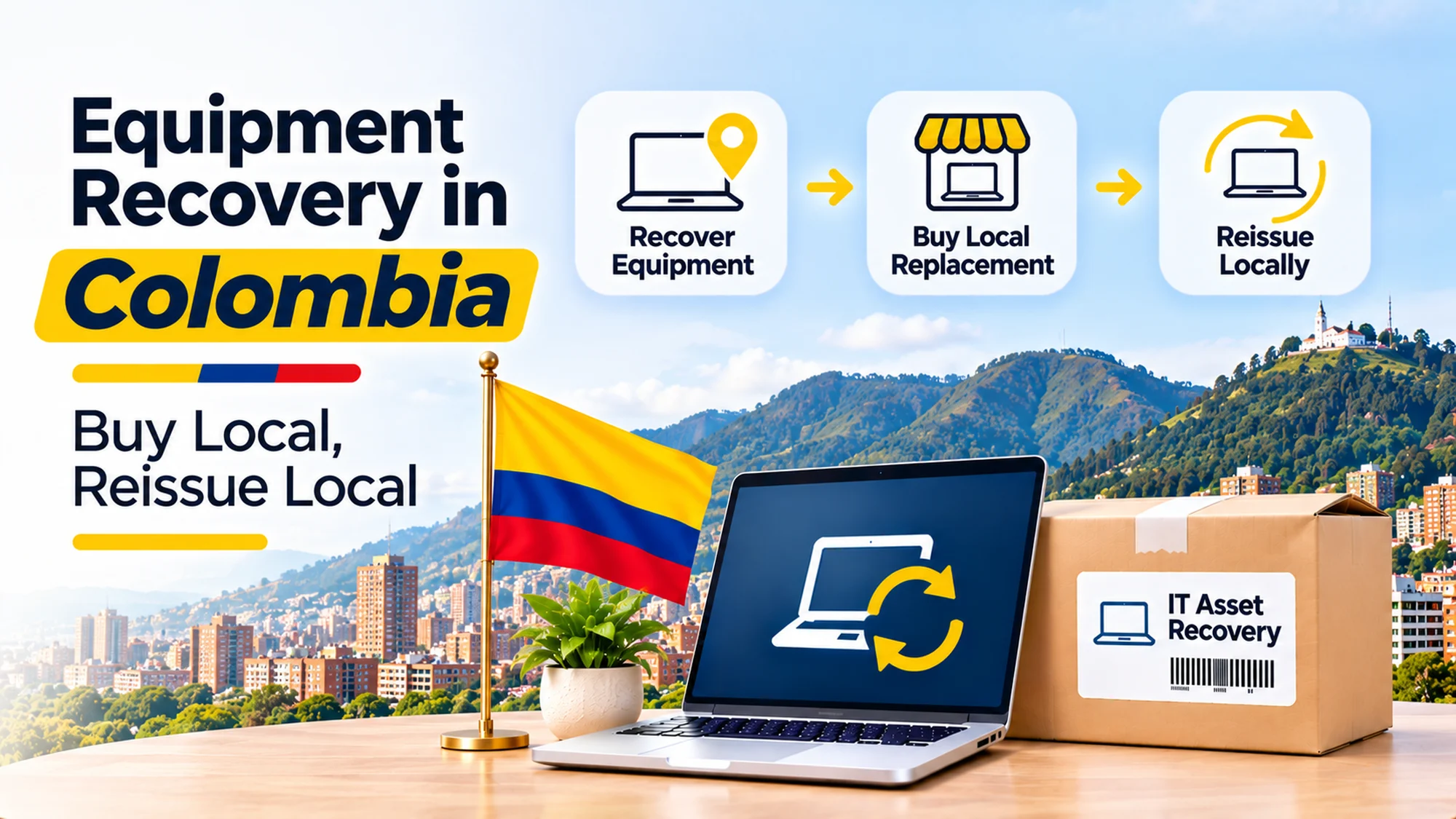
Equipment recovery in Colombia is easiest when the laptop never has to leave. Buy the device in the country, store it there and reissue it to the next hire, and the recovery question shrinks to one local handover. That fits the one thing RemoAsset publishes here: it lists Colombia under procurement, not retrieval. So this article is about designing the process around a local loop, and asking any supplier about collections directly.
- Build a local loop. Source in Colombia, store in Colombia, reissue in Colombia. The device never crosses a border.
- Cities and the rest are different problems. Ask for reach to a named place.
- Check hours if you work across time zones. Schedule collections inside the person’s day, not yours.
- Ask who engages the person if an intermediary does, and who owns the device.
- Keep pay out of the collection conversation. Take local advice separately.
- RemoAsset lists Colombia under procurement only. It is not in the retrieval list. Ask any supplier about collections in writing.
Equipment recovery in Colombia works best as a local loop
This article describes operational practice only. It does not state what any employment, tax or customs rule requires, what may be withheld from anybody, or who employs whom, because those answers differ by jurisdiction and by circumstance. Take local advice.
The cheapest recovery is the one that never leaves the country.
Best tools for Device Management
Source the laptop in Colombia. Store it there between users. Reissue it to your next hire in the same market. Done well, a departing person hands a device to someone local, it is wiped and sits on a shelf, and the next person receives it without any border involved.
That loop changes what recovery means. You are not designing an international return. You are designing a handover, a wipe and a storage step, all in one place.
It also removes the costliest decisions. Whether to ship a used laptop across a border, how to price it and how long it will take all disappear, because the device stays.
The loop needs one thing from you: a named local holder for stored devices, and a record of where each one sits. Without that, the stored laptop becomes the next one nobody can find.
Our note on day one equipment readiness covers the reissue end of the loop.
Cities and the rest: reach differs
Colombia has large, well served cities and a lot of ground between them. Terrain makes some journeys slower than the map suggests.
Courier density is good in the major metropolitan areas and changes outside them. Remote work has put people in smaller places, so you cannot assume that your Bogota experience applies to everyone.
Ask a supplier a specific question. Can you collect from this named town? Who performs the pickup? How long does it take, and what happens when an address falls outside normal service?
Pull your Colombian employees’ real addresses from the HR system before any conversation. Count how many are outside the main cities. That list is the specification.
For people outside the cities, the honest options are a longer window, a handover at a depot the person can reach, or a decision to write the device off below a stated value.
Hours, time zones and who the collection suits
Many teams that hire in Colombia work with colleagues in other time zones, and some work hours aligned to another country. That shapes the exit process more than people expect.
If your HR team sits in a different zone, a call to arrange a collection may land outside the person’s day. A courier window that works for you may not work for them. So schedule by the person’s calendar, not yours.
Agree the collection window in the exit conversation, in the person’s local time, and confirm it in writing the day before. Ask who will be home or reachable, and whether a second contact can hand the device over.
Then keep the instruction short and in Spanish, with English offered if the person prefers it. Include the line that matters most: the machine is wiped to a recognised standard, ideally naming NIST Special Publication 800-88, before anyone else uses it.
Who engages the person, and who owns the device
Before booking anything, establish two facts from the paperwork rather than from the asset register.
Who owns the hardware. Where people are engaged through an intermediary, such as a local provider or a staffing arrangement, the laptop may have been supplied by that organisation. Collecting it may not be your decision.
Who holds the engagement. If an intermediary does, your request travels through them, which changes the timeline and who can escalate.
Registers record what was issued. They do not record who owns it, and the two drift apart in exactly these arrangements. How any of this interacts with employment status is a question for local advice.
Our guide to devices for staff employed through an arrangement covers the trap in more detail.
The final pay temptation, and why to resist it
Disclosure: RemoAsset, named below, is owned by the same people who publish this site. Its published coverage and its limits are both stated. HROpsLab takes no vendor money and sells no placements.
At some point somebody will suggest holding back part of a final payment until the laptop arrives.
We are not going to tell you whether that is permissible in Colombia. It depends on the contract, on the circumstances and on advice from somebody qualified locally.
The operational point holds everywhere. Joining the two conversations turns a logistics exchange into a dispute, and a person in dispute is slower to hand anything over. Keep them apart.
Where you have no local capacity, a supplier handles the part you cannot. RemoAsset lists Colombia under procurement, which suits the local loop above, and its retrieval country list is separate and shorter.
Where RemoAsset struggles, and it is the relevant limit here. Colombia is not in its published retrieval list, which names ten markets. Its procurement coverage is quoted much wider, and its own page states those two figures in different places. So do not assume a collection in Colombia. Ask it, in writing, whether it can collect from your named cities, and ask every other supplier the same.
The decision table
| Situation | Scale | Setup | Primary pain | Recommended starting point |
|---|---|---|---|---|
| Hiring continuously in Colombia | 20 plus | Steady churn | Shipping in and out | Local loop: buy, store, reissue |
| Staff in a major city | Any | Good courier reach | Scheduling across zones | Collect in the person’s local hours |
| Staff in a smaller place | Any | Reach varies | Longer timeline | Ask for a named place timeline |
| Engaged through an intermediary | Any | Provider supplied kit | Not your asset | Read the contract before contacting anyone |
| Old, low value laptop | Any | Low book value | Cost exceeds worth | Apply the written write off line |
| No local presence | Small | One or two people | No counterparty | Ask suppliers about collections, not coverage |
What getting this wrong costs
The first cost is the border you did not need to cross. Sending a used laptop abroad can cost more than the machine is worth, and the decision is often made in a hurry.
The second is the stored device nobody can find. A local loop only works if somebody knows where each laptop sits.
The third is the data position. A device you cannot account for may carry customer information, and NIST Special Publication 800-88 is the standard you will be asked about. Where hardware is finished, the R2 standard for responsible recycling is the reference for a disposal claim.
The fourth sits under every movement. Batteries travel under rules, and IATA guidance on shipping lithium batteries is what your carrier works to.
Our note on unreturned equipment covers how these costs appear in the accounts.
Making it reliable
Four changes, none of which needs a budget.
Name a local holder for stored devices and record where each one sits. Schedule collections in the person’s local hours. Confirm who engages each person and who owns each device. And name the person who closes the asset record.
Then set the policy once: source, store and reissue in Colombia by default, move a device out only with a stated reason.
If you want a supplier, choose on published markets rather than a country count. RemoAsset fits the sourcing end of the local loop because it lists Colombia for procurement, and it should tell you plainly whether it can collect in your cities. Our guide to running an equipment amnesty covers the backlog.
Read our note on writing an employee equipment policy, or our guide to unreturned equipment.
Frequently asked questions
What is a local loop for equipment recovery in Colombia?
Source the laptop in Colombia, store it there between users and reissue it to your next hire in the same market. A departing person hands the device to someone local, it is wiped and stored, and the next person receives it. No border is involved, which removes the costliest decisions.
Does reach differ between cities and smaller places?
Considerably. Courier density is good in major cities and changes outside them, and terrain makes some journeys slower than a map suggests. Ask any supplier whether it can collect from a named town, who performs the pickup and what happens when an address falls outside normal service.
How should we schedule collections across time zones?
By the person’s calendar, not yours. Agree a window in their local time during the exit conversation, confirm it in writing the day before, and ask for a second contact who can hand the device over. A window that suits HR may fall outside the person’s working day.
Can we withhold final pay until the laptop is returned?
That depends on the contract, on the circumstances and on local advice, so this article cannot answer it. Combining the two conversations turns logistics into a dispute and makes the device less likely to arrive. Keep them apart and take advice on pay separately.
Who owns the laptop if staff come through an intermediary?
Establish that from the contract rather than from your asset register, because registers record what was issued rather than who owns it. Where an intermediary supplied the hardware, your request travels through them. Attempting a collection you have no authority to make wastes weeks.
Should we ship recovered laptops out of Colombia?
Usually not. Cross-border movement of a used device involves paperwork whose specifics vary and change, and for an older machine the cost often exceeds its value. A local loop of storing and reissuing avoids the question entirely.
Does RemoAsset cover collections in Colombia?
Not on its published retrieval list, which names ten markets and does not include Colombia. Colombia appears under procurement coverage instead. We own RemoAsset and we say so plainly, because implying coverage we do not publish would be worse. Ask us and every other supplier about collections from your named cities, in writing.