
TL;DR
- The core decision: whether you're increasing the volume of feedback or fixing the four things that stop it landing. More of it doesn't fix any of them.
- When doing nothing is right: when people already tell each other things close to the event and something visibly changes afterwards.
- What has to be true: you can name one thing that's different because somebody was told something in the last quarter.
- How the options split: by when it arrives, who it comes from, and whether anything follows.
- Decision rule: feedback fails for reasons of timing, source, specificity or agency. Work out which before adding a mechanism.
- Outcome to expect: less feedback, arriving sooner, from people whose view carries weight.
More Feedback, Same Behaviour
An organisation decides it needs a feedback culture. The reasoning is sound: people say they don't know how they're doing, managers say they don't have enough information, and the annual review is too infrequent to be useful.
So mechanisms get added. A tool where anyone can give feedback to anyone. A prompt in the one-to-one template. Training for managers on how to phrase things. Requests for feedback after projects. The volume goes up substantially, which everybody takes as evidence that it's working.
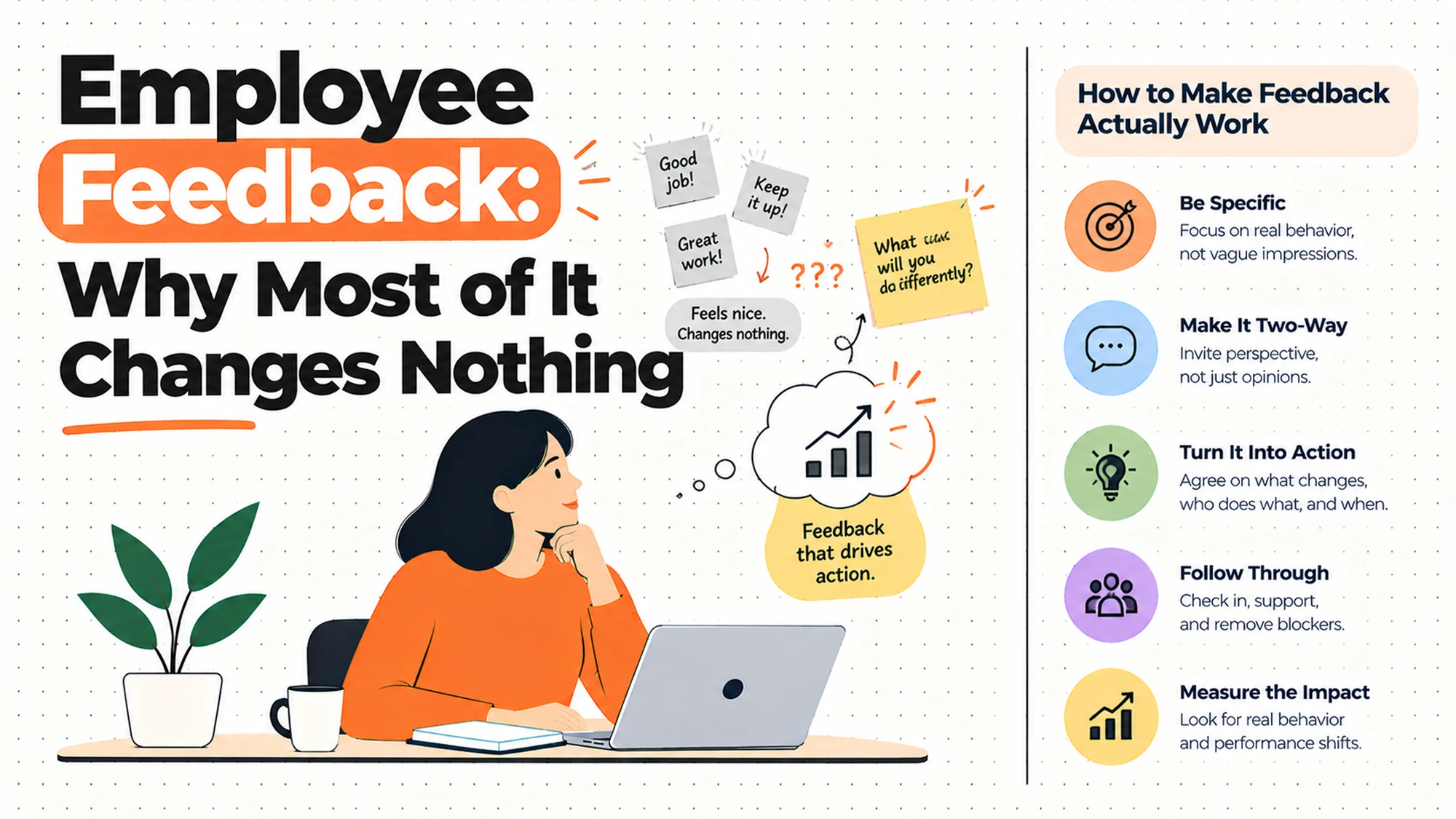
A year later, ask what's different. Not what's been said, but what somebody now does that they didn't before. In most organisations the honest answer is very little, and it's not because the feedback was badly phrased. It's because feedback changes behaviour only under specific conditions, and none of the mechanisms addressed any of them.
Best tools for Performance Management
The real problem is that feedback fails for four reasons that have nothing to do with wording. It arrives too late to connect to anything. It describes a pattern with no instance attached. It comes from somebody whose view the person doesn't weight. Or it names something the person has no ability to change. More feedback doesn't fix any of those, and a culture built on volume produces a lot of talk and the same behaviour.
When You Genuinely Do Not Need to Act Yet
Your current setup is genuinely fine. People tell each other things close to when they happen, managers raise problems while they're still small, and you can point to things that changed because somebody was told. That's what a working feedback culture looks like, and it usually doesn't have a system behind it.
Friction is starting to show. Somebody has said they didn't know something was a problem, or a manager has saved several observations for a review, or you've noticed that feedback flows downward and never upward. Each of those is specific. The cheapest check is to ask what changed as a result of feedback in the last quarter, and to notice how long the answer takes.
It has become a real cost. A problem that several people knew about reached you late, or somebody resigned over something nobody had told them about, or your last engagement survey said people don't feel informed about their performance. At this point the channels aren't carrying anything, and adding another one won't help.
The edge case that forces it. Feedback is being recorded in a way that may support a decision about somebody's employment, or it's being collected anonymously in groups small enough that contributors are identifiable. What can be recorded, how it may be used, and what confidentiality can be promised differ sharply by jurisdiction. Establish what applies where you operate and take local advice.
Five Questions This Reader Asks at 11pm
How often should feedback be given? As close to the event as possible, which makes frequency the wrong frame. Feedback isn't a quota to hit, it's a response to something specific, and the useful rule is that anything worth saying is worth saying this week. Scheduling it guarantees delay, and delay is the most common reason it fails.
Should feedback be positive or negative? Both, and the split matters less than the specificity. Vague praise and vague criticism are equally useless: neither tells somebody what to repeat or stop. The one asymmetry worth knowing is that positive feedback is more often vague, because nobody interrogates a compliment, so it's the half most likely to be wasted.
Who should give feedback? Whoever saw the thing. Routing observations through a manager adds delay, strips detail, and frequently loses the specific instance entirely. The manager's role is the pattern, not the incident: if several people noticed the same thing, that's a manager's conversation, and the individual instances belong with whoever witnessed them.
Does anonymous feedback work? For surfacing things nobody will say openly, sometimes. For changing behaviour, rarely, because an anonymous comment can't be explored and the recipient can't ask what happened. It also fails in small teams, where anonymity is nominal. Use it to find out what you don't know, not to get somebody to change. Those two purposes also imply different designs: discovery works with open questions and a wide group, while anything intended to change a specific person's behaviour needs the specificity that anonymity removes.
How do I get people to act on feedback? Check whether they can. A surprising proportion of feedback names something the person has no authority to change, no capacity to change, or doesn't understand how to change. All three look like resistance from the outside, and none of them is.
Three Honest Categories the Approaches Split Into
Increase the volume. Tools, prompts, training, requests after every project. It's right where the genuine problem is that nothing is being said at all, which happens in organisations where feedback is culturally uncomfortable, and getting anything moving is an improvement. It fails as a general answer because it treats quantity as the constraint when the constraint is usually one of the four failure conditions. Adding volume to a system where feedback arrives late and vague produces more late vague feedback, plus a tool that people eventually stop opening.
Improve the delivery. Training managers to phrase things well, giving them structures, teaching them to be specific. It's right where managers are genuinely avoiding conversations because they don't know how to have them, which is common and fixable. It fails when phrasing wasn't the problem: feedback delivered beautifully six months after the event still can't be acted on, and a well-structured comment about something outside somebody's control is still about something outside their control.
Fix the conditions. Work out which of the four failures is happening and address that specifically. It's right almost always, because it's diagnostic rather than generic, and the fixes tend to be cheap: raise things sooner, attach an instance, route observations from whoever saw them, check that the person can act. It fails on visibility, which is a political rather than a practical problem. Nobody announces a diagnosis, so this approach produces no launch, no tool and nothing to point at, which makes it a hard sell against a platform.
Five Diagnostic Questions You Can Self-Assess Against
Name one thing that changed because somebody was told something. Last quarter, specifically. If nothing comes to mind quickly, your feedback is producing conversation rather than change, and adding more of it will produce more conversation.
How long between the event and the feedback? Trace two recent examples. The gap is the single strongest predictor of whether anything happens, and most organisations are astonished by their own numbers. Anything measured in months is too late for the specifics to be available to either party.
Does the feedback name an instance? Look at what's actually said. A pattern with no example attached is a claim about somebody's character, which is both harder to accept and impossible to act on. A person told they're not detail-oriented has nothing to do on Monday.
Who does feedback come from? Map it. In most organisations it comes almost exclusively from managers, downward, which means the largest source of observations, colleagues, is unused, and the most important recipient, the manager, receives nothing.
When somebody doesn't act on feedback, do you know why? Ask before concluding anything. The three reasons are that they can't, they don't know how, or they disagree, and those need completely different responses. Treating all three as resistance is the most common mistake in this area. It is also self-reinforcing, because somebody who has been treated as resistant when they were actually blocked will stop explaining the block, which makes them look more resistant the next time.
Five Feedback Mechanisms, Reviewed
In the moment, from whoever saw it
Somebody says something shortly after it happens, directly to the person. It earns its place as the format that works best, because it satisfies three of the four conditions automatically: the timing is right, the instance is obvious, and it comes from a witness. It's also free and needs no design.
Where it falls short is on courage and on norms. Saying something to a colleague in the moment requires a small amount of social risk, and in organisations where that isn't normal, people don't. It also handles patterns badly, since a single observer sees one instance and can't know whether it's characteristic, so in-the-moment feedback can be disproportionate to something that happened once.
The way to get more of it isn't to mandate it, which produces awkward performances. It's for senior people to do it visibly and to receive it without punishing anybody, which establishes that it's survivable.
There's a smaller intervention worth trying first, which is lowering the stakes on the format. People hesitate because saying something feels like a formal act, so giving it a lighter frame helps: noticing something out loud, in passing, without the preamble that signals a difficult conversation is starting. The preamble is what makes it heavy, and most of what needs saying doesn't require one.
Scheduled, in a regular one-to-one
Feedback given in an existing recurring meeting. It earns its place through reliability: the slot exists, it recurs, and it provides a low-stakes container for things that would otherwise never be raised. For managers who find these conversations difficult, having a regular place for them lowers the barrier considerably.
It falls short because the schedule creates a reason to wait. Something that happens on Tuesday gets saved for the Thursday meeting, which is usually fine, and something that happens the day after the meeting waits a fortnight, which usually isn't. The bigger risk is that the slot becomes the only channel, and then everything waits.
Use it as a backstop for things that didn't get said, not as the primary route. If your one-to-one is where feedback happens, it's already too slow.
It does have one genuine advantage over in-the-moment feedback, which is that it's private by default. Some things shouldn't be said where others can hear, and a manager who notices something in a meeting is right to hold it until the two of them are alone. The distinction worth drawing is between waiting for privacy, which is a couple of days at most, and waiting for the slot, which can be a fortnight.
Collected by the manager on somebody else's behalf
The manager gathers observations from colleagues and relays them. It earns its place for patterns, which is genuinely a manager's job: several people noticing the same thing is a different signal from one person noticing it once, and somebody has to aggregate that.
It falls short on fidelity. Relayed feedback loses the specific instance, arrives later, and can't be interrogated, since the manager wasn't there and the recipient can't ask the original observer. It also puts the manager in an awkward position, defending an account they didn't witness. And it creates a route for people to avoid saying things directly, which over time makes direct feedback less normal rather than more.
Relay patterns. Push instances back to the person who saw them.
That push-back is harder than it sounds, because somebody bringing a manager a complaint about a colleague is usually hoping to hand the problem over. Declining to take it, and instead helping them have the conversation themselves, feels unhelpful in the moment and is the thing that changes how a team operates. A manager who accepts every relayed complaint becomes the channel for all of them, permanently.
Written feedback requested through a tool
A system where feedback is requested, written and stored. It earns its place for reach and for record: people can give feedback to colleagues they'd never otherwise be asked about, and the output persists, which helps at review time.
It falls short on friction and on what written feedback becomes. Writing takes longer than speaking, so people do it less and more blandly, and anything they'd hesitate to say aloud they'll certainly not type into a system that stores it. There's also a drift that's hard to avoid: a tool that stores feedback becomes, in people's minds, a file, and once it feels like a file the content becomes careful.
These work best as prompts that lead to conversations rather than as containers for the feedback itself.
There's one use where a tool genuinely outperforms conversation, and it's worth knowing: capturing something at the moment it happens so it isn't lost by the time the two people next speak. A note to yourself, or a short message flagging that you'd like to discuss something specific, solves the memory problem without moving the actual feedback into writing. The record is the trigger, not the content.
Only at the review
Feedback saved and delivered once or twice a year. It earns its place in exactly one circumstance, which is when the alternative is nothing at all.
It falls short on every one of the four conditions simultaneously. The timing is months late, the instances have blurred for both parties, it's relayed rather than witnessed, and it arrives as a collection, which changes its character entirely: three saved observations delivered together stop being corrections and become a case. That's why review feedback so reliably produces defensiveness, and why people describe the meeting as an ambush even when every individual point is fair.
If this is your only channel, the problem isn't the review. It's that nothing is happening in the months around it.
The mechanism that makes saved feedback worse is worth understanding rather than just avoiding. Three observations delivered separately, over three months, are three corrections, each small enough to absorb. The same three delivered together are evidence of a pattern, and a pattern is a claim about somebody rather than about something they did. Identical facts, opposite effect, and the only variable is when they were said.
The Decision Table
| Situation | Scale | Setup | Primary Pain | Recommended Starting Point |
|---|---|---|---|---|
| Things get said quickly and things change | Any | Any | None | Leave it alone. Do not add a tool |
| Nothing is said at all | Any | Conflict-avoidant culture | Volume genuinely is the constraint | Senior people modelling it visibly |
| Feedback arrives months after the event | Any | Any | Timing, the most common failure | Raise it this week, whatever it is |
| Feedback describes character, not events | Any | Any | Specificity, and nothing to act on | Require an instance, or do not say it |
| All feedback flows downward | Any | Any | The largest source is unused | Peer routes, and upward with protection |
| Manager relays everything | Any | Any | Fidelity lost, instances gone | Relay patterns, push instances back |
| Person is not acting on feedback | Any | Any | Could be capability, clarity or agency | Ask which, before concluding resistance |
| Tool adopted, volume up, nothing changed | Any | Any | Wrong constraint was addressed | Diagnose the four conditions instead |
| Feedback may support an employment decision | Any | Any | Local requirements apply | Establish them, take advice |
The third row is the highest-return fix available and it costs nothing. Most organisations could improve their feedback substantially by changing one thing, which is how long people wait before saying something, and that requires no system, budget or training.
Why Feedback Fails to Land
Four failures account for nearly everything. Each has a distinct symptom and a distinct fix, and treating them as one problem is why generic feedback initiatives underperform.
| The failure | What the receiver experiences | What would have to change |
|---|---|---|
| It arrives too late | Being told about something they cannot picture | Say it within days, while both remember |
| It has no instance attached | A claim about who they are, not what they did | Attach a specific event, or hold the comment |
| The source carries no weight | Being assessed by somebody who did not see it | Feedback from the witness, not a relay |
| They cannot act on it | Being asked to change something outside their control | Change the constraint, or drop the request |
| It arrives as a collection | An ambush, and a case being made | Deliver things singly, when they happen |
| Nothing followed last time | No reason to treat this as different | Close the loop visibly on something old |
The fourth row is the one most often misread. Where somebody repeatedly doesn't act on feedback, the assumption is resistance, and the reality is frequently that the thing they're being asked to change depends on a decision above them, a resource they don't have, or a constraint nobody has acknowledged. Asking what would have to be true for them to do this differently surfaces that in one conversation.
The last row is the quiet killer of feedback cultures. People who have raised something, seen nothing happen, and been asked again will contribute less the second time and less again the third. That's not disengagement, it's an accurate response to evidence, and the only remedy is to close a loop visibly, including where the answer was no.
Feedback Upward, Which Almost Nobody Gets Right
Feedback travels downward easily and upward almost not at all, and the imbalance costs more than it appears to, because the person whose behaviour affects the most people receives the least information about it.
The reason is straightforward and not about courage. Telling your manager something critical carries a real asymmetry: they influence your pay, your work and your prospects, and you have no equivalent influence over them. In that situation, staying quiet is a reasonable calculation rather than a failure of nerve, and no amount of encouragement changes the arithmetic.
What does change it is evidence. A manager who receives something uncomfortable and responds well, visibly, in front of others, has demonstrated something no invitation can. One instance of that is worth more than any number of statements about having an open door, and the reverse is equally true: one defensive reaction is remembered for years and generalises to everybody who witnessed it. The asymmetry there is worth sitting with. Handling it well once builds a little credit; handling it badly once spends a great deal, and the people who saw it will not test you again.
Structure helps at the margin. Asking a specific question rather than a general one produces answers, because what could I do differently in meetings is answerable in a way that how am I doing as a manager isn't. The narrower the question, the better it works. Asking about one recurring meeting, or one decision you made recently, gives somebody a bounded thing to comment on and a legitimate reason to stop there, which is much easier than being invited to assess you in general and having to decide for themselves how far to go. Asking somebody else to gather it works where the relationship is strained. Anonymous upward mechanisms have a place, provided the group is large enough that anonymity is real, and provided something visible happens afterwards.
The thing that reliably fails is asking for it and then explaining. It fails even when the explanation is entirely correct, which is what makes it such a difficult habit to drop: the manager is usually right about the context and is still teaching the person that raising something costs them a debate they did not want. A manager who responds to upward feedback by providing context, however reasonable that context is, has taught the person that offering it costs them a conversation. The answer that works is much shorter: thank you, let me think about it, and then something different happens.
And a note for anybody considering giving it. The safest form is specific, small and about a behaviour rather than a pattern, offered as an observation rather than a verdict. One instance, described neutrally, with what it caused. That's considerably easier for somebody to receive than an assessment of how they manage, and it's the version most likely to change anything.
Timing helps too. Raising something immediately after it happened, when the manager is still thinking about the same meeting, is easier for both people than scheduling a conversation about it, which turns a small observation into an event. And if the response is poor, that's information worth having early, delivered at a cost of one uncomfortable minute rather than a formal discussion.
What to Put in Writing
Feedback is mostly spoken, and the small amount worth recording is not the content.
| Artefact | Who owns it | When it is written | What it prevents |
|---|---|---|---|
| What was raised, and when | The manager | At the time | A review containing information the person has never heard |
| What was agreed would change | The manager, with the person | At the time | A conversation that produces general resolve |
| What came of something raised upward | Whoever received it | When it resolves | People concluding that speaking up goes nowhere |
| Which feedback the person cannot act on | The manager | When it becomes clear | Repeating a request that was never actionable |
| Local requirements on records and anonymity | HR, with local advice | Before any system is adopted | Promising confidentiality you cannot deliver |
The third row is the one that determines whether upward feedback continues to exist in your organisation. Closing the loop visibly, including on the occasions where the answer was no, is the only mechanism that keeps people contributing, and it costs a sentence.
Questions to Ask Before You Commit
On outcomes. What changed last quarter because somebody was told something? A bad answer describes how much feedback was given.
On timing. How long between the event and the conversation? A bad answer is that it depends.
On specificity. Does the feedback name an instance? A bad answer is that the pattern is clear.
On direction. When did you last receive something critical from a report? A bad answer is that your team knows they can.
On agency. Can this person actually change the thing you're asking about? A bad answer assumes yes.
On history. What happened to the last thing somebody raised? A bad answer is that it was noted.
What Getting This Wrong Costs
The first cost is the effort, and it's larger than it looks because it's distributed. Feedback training, tooling, prompts, and the hours people spend writing considered responses all consume real capacity, and where the underlying conditions haven't changed, none of it produces behaviour change. The tooling cost is the visible part and the smallest; the time people spend composing thoughtful written feedback that nobody acts on is considerably larger and appears in no budget. Organisations in this position usually conclude that their culture resists feedback, which is both demoralising and the wrong diagnosis.
The second cost is what happens to people's willingness to contribute. Anybody who has given honest feedback and watched nothing follow has learned something, and they'll invest less next time. That decay is quiet and cumulative, and it's why second and third rounds of any feedback exercise produce thinner material than the first. Nobody announces that they have stopped bothering, so the decline registers as improving results rather than as falling participation, which is the most misleading possible reading of it. Recovering it requires visible follow-through, which is harder than establishing it in the first place.
The third cost falls on the person who never hears the thing. Somebody whose colleagues have all noticed a problem, none of whom has said anything directly, is being quietly excluded from work, opportunities and consideration on the basis of information they don't have. When it eventually surfaces, usually at a review or a promotion decision, their reaction is about the months of not being told rather than about the substance, and they're right. The colleagues who said nothing are usually not being unkind either. Each of them made an individually reasonable decision to avoid an awkward conversation, and the aggregate of those reasonable decisions is somebody being disadvantaged without knowing why.
So before you add anything, work out which of the four conditions is failing. A timing problem means things are being saved, and the fix is to raise them sooner. A specificity problem means feedback describes people rather than events, and the fix is to require an instance. A source problem means it's relayed rather than witnessed, and the fix is routing. An agency problem means people are being asked to change things they can't, and the fix isn't about feedback at all. It is usually about a constraint somebody above them has the authority to remove, which makes it a conversation to have upward rather than another one to have with the person who cannot act.
When You Are Ready to Go Further
None of this needs a tool. It needs one honest answer about how long people wait before saying something, a requirement that feedback names an instance, and a single loop closed visibly on something somebody raised months ago.
The step beyond your own practice is the direction problem, which is the largest structural gap in most organisations. Managers receive almost no information about the thing that most affects their teams, and closing that gap is worth more than any improvement to downward feedback. It starts with one senior person receiving something uncomfortable in public and handling it well, which is not a programme and is the only thing that works.
HROpsLab publishes independent comparison work across HR tooling, applicant tracking and payroll. We sell nothing, we take no vendor money, and we publish no paid placements. If the next step is looking at what feedback tooling actually changes, our comparison work is one place to start.
Frequently Asked Questions
What is employee feedback?
It's information given to somebody about their work with the intention of reinforcing or changing something. That definition sounds obvious and it contains the test most feedback fails: if nothing could change as a result, what was given was a comment rather than feedback. The useful way to think about it is as a system with four requirements rather than as an act of communication. It has to arrive soon enough to connect to something the person remembers, name a specific instance, come from somebody whose observation carries weight, and concern something the person is actually able to change.
How often should feedback be given?
Frequency is the wrong frame, because feedback isn't a quota to fill, it's a response to something specific. The useful rule is that anything worth saying is worth saying within days, while both people can still picture the event. Organisations that set a frequency target find people manufacturing feedback to meet it, which produces exactly the vague, generic comments that fail. If you want a target, make it about delay rather than volume: nothing worth raising should wait more than a week, and nothing at all should be saved for a scheduled review.
Should feedback be positive or negative?
Both, and the split matters far less than the specificity of either. Vague praise and vague criticism fail identically, since neither tells somebody what to repeat or stop doing. The asymmetry worth knowing is that positive feedback is much more often vague, because nobody interrogates a compliment: you can tell somebody they did a great job and they'll accept it without asking which part. That makes positive feedback the half most commonly wasted, and naming specifically what somebody did well is usually more useful than another round of general encouragement.
Who should give feedback to an employee?
Whoever witnessed the thing. Routing observations through a manager adds delay, loses the specific instance, and puts the manager in the position of defending an account they didn't see. The manager's proper role is the pattern rather than the incident: if several people have noticed the same thing, aggregating that into a conversation is a manager's job, and the individual instances belong with the people who saw them. Organisations where all feedback flows through managers have effectively disabled their largest source of observations, which is everybody else.
Does anonymous feedback work?
For finding out things nobody will say openly, it has a genuine use, particularly where power differences make named feedback unrealistic. For changing behaviour, it works poorly, because the recipient can't ask what happened, can't establish context, and predictably fixates on whatever stings most. It also fails in small teams, where the author of a distinctive comment is usually identifiable regardless of what the system promises. Treat anonymity as a tool for discovery rather than for improvement, and be honest with contributors about what can actually be kept confidential in a group of your size.
How do you get people to act on feedback?
Start by establishing why they haven't, since there are three quite different reasons and they need opposite responses. They may not be able to, because the thing depends on a decision, a resource or a constraint above them. They may not know how, in which case the feedback identified a gap without providing a route across it. Or they may disagree, which is legitimate and worth hearing out. Treating all three as resistance is the most common error here, and asking what would have to be true for you to do this differently usually surfaces the real answer in one conversation.
How do you ask for feedback as a manager?
Ask a specific question rather than a general one, because how am I doing is unanswerable and what could I do differently in our planning meetings is not. Then handle the answer in a very particular way: thank them, say you'll think about it, and stop. The instinct to explain your reasoning, however reasonable, teaches the person that offering feedback costs them a conversation, and they'll do it less. What actually establishes that upward feedback is safe isn't an invitation, it's one visible occasion where somebody said something uncomfortable and something changed as a result.
What do you do when feedback is contradictory?
Treat it as information rather than as a data problem. Somebody experienced differently by different groups is telling you something specific: they may be effective with peers and difficult with reports, or excellent within their team and unhelpful across departments. Averaging that away destroys the finding. The useful question is which group saw what, and what's different about how the person operates in each context. Contradictory feedback is also common simply because different people have different standards, so before concluding anything, check whether the disagreement is about the person or about what good looks like.
Feedback doesn't fail because it was phrased badly. It fails because it arrived late, named nothing specific, came from the wrong person, or asked for something nobody could do.